
Thursday, January 6, 2011
Not Just "Inflation Versus Deflation" ... We've Got "MixedFlation" and "ExportFlation"
Many people have made persuasive arguments for inflation.
See, for example, my roundup from 2009, and Gonzolo Lira's recent essay arguing that there is no political will to raise interest rates, and so commodities have become the safe haven investment (replacing bonds).
Many others have made persuasive arguments for deflation.
See, for example, my post from 2009, and Charles Hugh Smith's recent essay arguing that mild deflation is good for the powers-that-be, and so they will make it happen (part II).
But perhaps debates about inflation and deflation paint with too broad a brush, or too narrow a focus ...
Too broad a brush because the economy is not a monolith ... different asset classes can move in different directions at the same time.
Too narrow a focus because you can't analyze what's happening in the U.S. in a vacuum in a highly global economy.
MixedFlation
As I noted in 2008:
I wrote in July 2009:Some people think that some prices will go up at the same time that others go down.
For example, Dominic Frisby writes:Are we going to see rising prices or falling prices? Of course, it depends on the asset class – and in what currency you are measuring.Adam Hamilton of Zeal LLC agrees:***
Falling prices in assets associated with debt - houses and financial stocks – and rising prices in things which you buy with cash – food, energy and some imported goods.So we may very well experience both inflation and deflation.Anything typically financed by debt is likely to see its prices plunge dramatically, like houses and cars, as the ongoing Great Bear bust continues to destroy the gross excesses of debt via higher long rates. Conversely, anything not typically ‘paid for’ with debt, including groceries and general living expenses, is almost certain to rise in the coming years. We are staring down a brutal environment of widespread inflation marked by various sectors witnessing falling prices as debt leverage implodes.
You know from experience that when you're in a national park, movie theater or some other contained place, prices are higher than elsewhere.
Basically, the stores in such places know you can't go somewhere else, so they can charge you what I call "got you" prices. In other words, you're a captive buyer, and they've "got you".
I've noticed the same thing with health care costs. My family's health care premiums increased 6% last year - on top of the 6% increase the year before.
This is "got you" prices. The health care industry knows that Americans are desperate for health care, and that if they raise prices, people will pay.
I've previously pointed out that inflation versus deflation is not necessarily an all-or-nothing proposition: we can have inflation in some asset classes and deflation in others.
So my current theory is that we will have deflation for some time in most asset classes, but inflation in the "got you" classes of basic necessities that everyone needs - food, energy, and health care.
In a tough economy, companies that can squeeze broke consumers for more money will do so
I reported in September 2009:
Well-known financial analyst Dian L. Chu wrote in June 2010:Jeffrey Saut - Chief Investment Strategist and Managing Director of Equity Research at Raymond James - is now confirming that theory:
Saut thinks inflation will eventually win out:Inflation, or deflation, the argument rages; yet on CNBC last Thursday I opined that we are currently experiencing both... It appears to me that the country’s top quintile of wage-earners (the folks with the most assets) are experiencing deflation as their home prices have collapsed, their 401K’s are substantially below where they were in October 2007, their bonuses have been “whacked,” and the list goes on.
Meanwhile, the lower-income households are experiencing inflation with their heath care costs rising, food prices escalating, insurance premiums climbing, etc.Our “bet” is that the inflationary forces will eventually win out because that’s the way it has always played since the Great Depression.But that is not controversial. Indeed, even the greatest advocates of the deflation theory say we may eventually get inflation. For example, David Rosenberg says that deflationary periods can last years before inflation kicks in.
Despite the seemingly tame headline inflation numbers, consumers never seem to see price declines in certain categories like education and health. For instance, prescription drug inflation escalated to 5% from less than 3% in 2007 and 2008.I have seen many reports of rising food, commodity, energy and healthcare costs. But housing is double-dipping, and wages are declining. And see this.
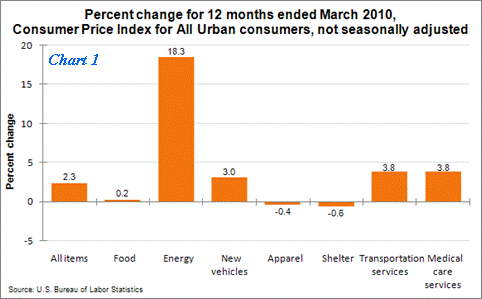
So, it is pretty obvious what we have here--biflation--instead of deflation. Biflation is a state of the economy where inflation and deflation occur simultaneously. (Chart 1)The price increase of commodities is caused by the increased money flow (via loose monetary policy) chasing them. On the other hand, the growth of economy is tempered with high unemployment and decreasing purchasing power. This has resulted in a greater amount of money directed toward essential items (inflation) and away from non-essential items and things required credit to buy such as house and cars (deflation).
***
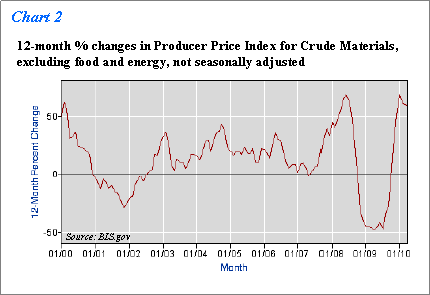
Producer Price Index (PPI) for finished goods was up 5.5% year-over-year. Further up the supply chain, signs of inflation are even more worrisome.
The PPI for intermediate goods increased 8.6% year-over-year in April, while core PPI for crude materials, excluding food and energy, shot up 60% year-over-year in April (Chart 2).
Meanwhile, the Purchasing Manager Index (PMI) report shows manufacturing sector expanded in May for the 10th consecutive month, and the overall economy grew for the 13th consecutive month. Backlogs are also increasing which further points to the inflationary pressure in the pipeline.
***
While all of that money Federal Reserve pumped into the system could in theory cause inflation ... weak banks and slack in the economy would weigh against that. Indeed, it is likely that crude material price increases could begin to move down the supply chain; however, end markets are still too weak to allow a full price increase.
So, in the near term, biflation could be around through possibly 2012 with pockets of inflation seen in certain sectors such as energy and feedstock chemicals, and deflation/low inflation in other sectors, netted to a moderate headline inflation number.
So despite what die-hard inflationists or deflationists might say (and I respect both camps), things are actually mixed.
Moreover, as I pointed out last year:
Given that speculators drove up the price of oil last year, it is possible that - especially in a stagnant economy - speculators could drive up the prices of some asset classes and drive others down.And see this.
ExportFlation
The Fed's easy money policies (including, but not limited to quantitative easing), asset purchases and other policies are sending a lot of hot money flows abroad.
In fact, America has been massively exporting inflation.
As Bloomberg noted last October:
China renewed an attack on quantitative easing, citing the risk of increased prices in emerging economies, a day after the Group of 20 nations said the markets can adopt regulatory steps to cope.
China “doesn’t support” the monetary easing that causes “imported” inflation in developing countries, Commerce Minister Chen Deming told a forum today in Macau, a Chinese special autonomous region. The capital inflows increase the risk of “asset bubbles,” Jin Zhongxia, deputy director general of the international department at the People’s Bank of China, said at the same forum.
***
Major reserve-currency issuing countries excessively print money to get out of their own economic difficulties, posing a policy dilemma for emerging economies,” Jin said in Macau today, without naming any countries. “That will impose greater pressure on capital inflows, bigger bubbles in asset markets and inflationary pressure.” Capital flows into emerging markets are running at $575 billion a year, 20 percent higher than before the world financial crisis, Goldman Sachs Group Inc. said in September.
***
Countries from Brazil and Indonesia to South Korea imposed restrictions on investment inflows aimed at defusing the danger of hot money, or capital seeking short-term gains. The G-20 called on international regulators to compile a report on best practices on financial-security policies, including capital-flow tools.
So not only some asset classes rising and some declining in America, but a portion of the effects from American monetary policies are felt abroad, instead of within the U.S.
The BRIC governments, apparently, are not very happy about America's exported inflation. As Phoenix Capital Research wrote in December:
Over the last few months I’ve noted repeatedly that THE key issue for the financial markets is the ongoing tension building between the Fed’s pro-inflation policy and China’s anti-inflation policy.
***
China’s not the only one. Both Russia and Brazil have recently entered into the “anti-inflation fray” as the below stories attest ....
***
In plain terms, our esteemed Fed Chairman Ben Bernanke is about to find his policies running face first into a BRIC wall. He’s been exporting inflation abroad to the emerging markets all the while claiming it doesn’t exist. With growing civil unrest due to soaring food and energy prices the emerging markets are now fighting back [by raising interest rates].
Andy Xie agrees, arguing that 2011 will be a show-down between China's efforts to curb it's inflation and America's efforts to export it's inflation.
Indeed, a prominent Chinese pro-democracy activist says that inflation will cause the collapse of the current Chinese regime unless it is put in check.


Wednesday, January 5, 2011
To Bee Or Not To Be?

Bees - upon which the entire human food chain rests - are suffering a sharp decline.
As the Guardian pointed out Monday:
The abundance of four common species of bumblebee in the US has dropped by 96% in just the past few decades, according to the most comprehensive national census of the insects [a three-year study published in the Proceedings of the National Academy of Sciences].
***Sydney Cameron, an entomologist at the University of Illinois, led a team on a three-year study of the changing distribution, genetic diversity and pathogens in eight species of bumblebees in the US.
By comparing her results with those in museum records of bee populations, she showed that the relative abundance of four of the sampled species (Bombus occidentalis, B. pensylvanicus, B. affinis and B. terricola) had declined by up to 96% and that their geographic ranges had contracted by 23% to 87%, some within just the past two decades.
Cameron's findings reflect similar studies across the world. According to the Centre for Ecology and Hydrology in the UK, three of the 25 British species of bumblebee are already extinct and half of the remainder have shown serious declines, often up to 70%, since around the 1970s. Last year, scientists inaugurated a £10m programme, called the Insect Pollinators Initiative, to look at the reasons behind the devastation in the insect population.
As the Guardian notes, bees are essential for human food production:
Bumblebees are important pollinators of wild plants and agricultural crops around the world including tomatoes and berries thanks to their large body size, long tongues, and high-frequency buzzing, which helps release pollen from flowers.
Bees in general pollinate some 90% of the world's commercial plants, including most fruits, vegetables and nuts. Coffee, soya beans and cotton are all dependent on pollination by bees to increase yields. It is the start of a food chain that also sustains wild birds and animals.
***
Insects such as bees, moths and hoverflies pollinate around a third of the crops grown worldwide. If all of the UK's insect pollinators were wiped out, the drop in crop production would cost the UK economy up to £440m a year, equivalent to around 13% of the UK's income from farming.
The collapse in the global bee population is a major threat to crops. It is estimated that a third of everything we eat depends upon pollination by bees, which means they contribute some £26bn to the global economy.
***
"Pollinator decline has become a worldwide issue, raising increasing concerns over impacts on global food production, stability of pollination services, and disruption of plant-pollinator networks," wrote Cameron. "
The Guardian notes that bees are not the only pollinators which are declining:
But the insects, along with other crucial pollinators such as moths and hoverflies, have been in serious decline around the world since the last few decades of the 20th century. It is unclear why, but scientists think it is from a combination of new diseases, changing habitats around cities, and increasing use of pesticides.
The Guardian points to some of the potential causes of bee decline:
Parasites such as the bloodsucking varroa mite and viral and bacterial infections, pesticides and poor nutrition stemming from intensive farming methods.
As Fast Company pointed out last month:
A leaked EPA document reveals that the agency allowed the widespread use of a bee-toxic pesticide, despite warnings from EPA scientists.
The document, which was leaked to a Colorado beekeeper, shows that the EPA has ignored warnings about the use of clothianidin, a pesticide produced by Bayer that mainly is used to pre-treat corn seeds. The pesticide scooped up $262 million in sales in 2009 by farmers, who also use the substance on canola, soy, sugar beets, sunflowers, and wheat, according to Grist.
The leaked document (PDF) was put out in response to Bayer's request to approve use of the pesticide on cotton and mustard. The document invalidates a prior Bayer study that justified the registration of clothianidin on the basis of its safety to honeybees:
Clothianidin’s major risk concern is to nontarget insects (that is, honey bees). Clothianidin is a neonicotinoid insecticide that is both persistent and systemic. Acute toxicity studies to honey bees show that clothianidin is highly toxic on both a contact and an oral basis. Although EFED does not conduct RQ based risk assessments on non-target insects, information from standard tests and field studies, as well as incident reports involving other neonicotinoids insecticides (e.g., imidacloprid) suggest the potential for long-term toxic risk to honey bees and other beneficial insects.
The EPA is still allowing the use of Clothianidin to this day. And see this and this.
And as I've previously pointed out:
There is also evidence that genetically modified crops might be killing bees ... or at least weakening them so that they are more susceptible to disease. See this, this, this, this, this, this, this, this and this.
- While being trucked around, bees are fed a diet of high-fructose corn syrup (and soy protein), not real pollen (see also this).
To recap: bees are fed junk food totally different from what bees naturally eat with very little nutritional content, taken out of their normal natural environment and shoved into trucks, and then driven all over the nation.
The bottom line is that raising and using bees to pollinate crops in a way that won't kill so many bees will be more expensive ... thus driving up food prices.
The poor nutrition, exposure to numerous pesticides (and genetically modified foods), and stressful condition of being constantly trucked all over the country are hurting the bees. Why do beekeepers do it? Because high-fructose corn syrup and soy protein are cheap junk, and because the widespread use of pesticides coupled with trucking bees around the country is the low-cost industrial farming business model.
And as Agence France-Presse notes, inbreeding may be weakening the bees.
(On a side note, no one has yet asked whether silver iodide or other compounds used in weather modification affect bees. They may not, but someone should test the bees for such compounds and their metabolites so that we can rule out them out as a cause of colony collapse.)
Albert Einstein reportedly said:
If the bee disappears from the surface of the earth, man would have no more than four years to live. No more bees, no more pollination … no more men!That might have been a slight exaggeration, but Einstein was right: If we kill off the bees, we will be in big trouble.
There are also reports of birds and fish mysteriously dying world-wide. While these may or may not be connected with the collapse of bee populations, it is a sign that all is not right with the world.
As I wrote two years ago:
First the frogs started disappearing.
Then the bees started disappearing.
Now, its birds. According to CBC, tens of millions of birds are disappearing across North America.
According to the Seattle Times:
Pelicans suffering from a mysterious malady are crashing into cars and boats, wandering along roadways and turning up dead by the hundreds across the West Coast, from southern Oregon to Baja California, Mexico, bird-rescue workers say.Frogs and bees are so different from people that they are easier to ignore. But birds are larger, more complicated, warm-blooded animals, and thus closer to us biologically.
People will be in real trouble unless we figure out why the amphibians, bees and birds are dying.
Tuesday, January 4, 2011
Humans Have Intentionally Modified Weather for Military Purposes and Climate Control for Decades
Weather modification is a well-known endeavor. For example, governments have been seeding clouds for decades to create more rain.
And during warfare to create mud to slow the enemy's ability to use roads.
As the Guardian reported in 2001:
During the Vietnam war, the Americans launched Project Popeye, a secret mission to seed the tops of monsoon clouds and trigger phenomenal downpours that would wash away the Ho Chi Minh Trail used for ferrying supplies.Interestingly, U.S. weather modification efforts during the Vietnam war were revealed as part of the Pentagon Papers.For five years Vietnam, Cambodia and Laos were sprayed during the monsoons, and military intelligence claimed that rainfall was increased by a third in some places. It only came to an end in March 1971 when [Washington Post] journalist Jack Anderson exposed the project and caused such a public furor that the UN general assembly approved a universal treaty banning environmental warfare.
But the US air force planners recently came up with new proposals to launch new weather weapons. Instead of silver-iodide, the idea is to shower fine particles of heat-absorbing carbon over clouds to trigger localised flooding and bog down troops and their equipment. Lasers on aircraft would also trigger lightning onto enemy aircraft, whilst other lasers could be fired at fog to clear a path over enemy targets on the ground.
Whether or not they work, past experiences tell us to be wary of tampering with the weather. In 1947, meteorologists tried to kill off a dying hurricane out at sea by seeding the clouds. The following day, the hurricane suddenly gathered strength, swung round and hit Savannah, Georgia causing extensive damage. The weather boffins were so rattled by the disaster it was not until August 1969 that they dared try again.
When Hurricane Debbie was 700 miles out at sea, they flew three seeding missions around its eye, where tropical storms are at their most intense, but the results were mixed - with each seeding the hurricane's winds were reduced and each time they picked up again.
As the Washington Post reported on July 2, 1972:
Indochina - by the evidence of a long-ignored passage in the Pentagon Papers - has been a test battleground, the site of purposeful rain-making along the Ho Chi Minh trails.The Post makes clear that cloud-seeding wasn't limited to the Vietnam war theater:
***
Sen. Claiborne Pell (D-R.I.) is prominent among members of Congress who believe it has become a reality. "There is very little doubt in my mind," he says. Rep. Gilbert Gude (R-Md.) states: "There's no doubt in my mind that it's going on in Vietnam."
"I think there's no doubt rain-making was used in Laos on the trail," says a Senate committee aide wee versed in defense affairs.
***
It is a "successful" pre-1967 use which is documented in the "senator Gravel" version of the Pentagon papers. In late February, 1967, this document discloses the Joint Chiefs of Staff prepared a list of "alternative strategies" for President Johnson.
One, titled "Laos Operations", read:
"Continue at present plus Operation Pop Eye to reduce trafficability along infiltration routes ... authorization required to implement phase of weather modification process previously successfully tested and evaluated in same area. (Italics added)
In 1967 -- according to columnist Jack Anderson, who published the first allegation of Indochina rain-making -- U.S. forces started secret Project Intermediary Compatriot "to hamper enemy logistics" ... (with) claimed success in creating man-made cloudbursts ... and flooding conditions" along the Ho Chi Minh trails, "making them impassable."
The Defense Department freely reports that it has "field capacities" for making rain. It used them in the Philippines in 1969, in a six-month "precipitation augmentation project" at the Philippines request; in India in 1967, at a similar invitation; over Okinawa and Midway Islands, and in June, July and August, 1971, over drought-stricken Texas, at the urgent request of Gov. Preston Smith.In 2008, the Denver Post noted the enormous scope of weather modification projects:
***
Navy rain-makers are currently involved in two long-range California programs -- one over the Pacific off Santa Barbara, an attempt to increase rainfall over a national forest; the other over the Central Sierras to try to increase the snow-pack for electric utilities that depend on water power.
Scientists are monitoring more than 150 weather-modification projects in 40 countries, including at least 60 in the Western United States. The projects include wringing additional snow out of clouds for California hydropower and easing droughts in sub-Saharan Africa.In 2005, the Boston Globe provided an account of the early discovery of silver iodide as a tool for modifying weather:
Most of the current research on this inexact science is being conducted abroad ....
In 1946, over Mount Greylock in western Massachusetts, a General Electric research chemist named Vincent Schaefer scattered three pounds of crushed dry ice out of an airplane into a cloud and set off a snow flurry. It was the world's first successful cloud seeding-later that year, the meteorologist Bernard Vonnegut (brother to the novelist) discovered that silver iodide smoke had a similar effect-and weather modification emerged from the realm of con men and eccentrics. Most meteorologists remained skeptical, but by 1951, 10 percent of the United States was under commercial cloud seeding.(And see this discussion by an MIT scientist regarding the use of weather modification to mitigate hurricane damage.)
"Intervention in atmospheric and climatic matters on any desired scale" was only decades away, predicted John von Neumann, the mathematician who helped invent and began programming the first electronic computers to model the weather. Over the next 30 years, the federal government spent hundreds of millions of dollars on projects all over the country to increase precipitation, to mitigate hailstorms (an age-old enemy of farmers), and, most successfully, to clear the fog from around airports. Perhaps the era's most ambitious endeavor was Project Stormfury, which sent up airplanes to seed the eye walls of hurricanes with silver iodide to weaken the winds before landfall.
Moreover, the Post points out that - even in 1972 - weather modification has been tested for other applications as well:
And - as the Post notes - even in 1972, the government was studying the affect of weather modification on climate:Among patterns that can be predictably" be modified [Robert M. White, the current chief of the National Oceanic and Atmospheric Administration ] said, are: cold fog (which can be cleared from airfields) ; cumulus clouds (most common in the tropics -- "In Florida,", White said, "we have been able almost at will to make them grow explosively"); orographic clouds (moist air moving up over mountains -- "At the right temperature you can begin thinking of milking them for water") and hailstorms (which can often be suppressed, according to recent claims by the Russians, who fire silver iodide into them from rockets and artillery).
ARPA Director Stephen J. Lukasik told the Senate Appropriations Committee in March: "Since it now appears highly probable that major world powers have the ability to create modifications of climate that might be seriously detrimental to the security of this country, Nile Blue [a computer simulation] was established in FY 70 to achieve a US capability to (1) evaluate all consequences of of a variety of possible actions ... (2) detect trends in in the global circulation which foretell changes ... and (3) determine if possible , means to counter potentially deleterious climatic changes ..."The Post also quoted high-level scientists warning that enemies could modify weather as a direct form of warfare, for example, by flooding coastal areas where one's enemy resided.
"What this means," Lukasik explains, "is learning how much you have to tickle the atmosphere to perturb the earth's climate. I guess we'd call it a threat assessment."
Now, weather modification is so mainstream that the Chinese government and the State of Texas openly discuss their cloud-seeding programs.
And U.S. Senator Kay Bailey Hutchison of Texas introduced the Weather Modification Research And Technology Transfer Authorization Act in 2004, saying:
Weather modification is the general term that refers to any human attempt to alter the weather.... These efforts have been used in the U.S. for more than 50 years to reduce crop and property damage, optimize useable precipitation during growing seasons and lessen the impact of periodic, often severe droughts.(The bill apparently didn't pass)
The weather modification projects in Texas and other States in the U.S. are much more than well considered responses to drought. They are trying to use the latest technological developments in the science to chemically squeeze more precipitation out of clouds. Moisture that is needed to replenish fresh-water supplies in aquifers and reservoirs.
There's even a Journal of Weather Modification (here's a peek inside).
The Technology Has Advanced Far Beyond Seeding Clouds With Silver Iodide
The technology has advanced a long way since the early 1970s.
For example, the Telegraph reported yesterday that Abu Dhabi 'creates man-made rainstorms' by "using giant ionisers, shaped like giant lampshades, to generate fields of negatively charged particles, which create cloud formation." "There are many applications," Professor Hartmut Grassl, a former institute director, is quoted by the Daily Mail as saying. "One is getting water into a dry area. Maybe this is a most important point for mankind."
And former secretary of defense William Cohen told a conference on terrorism on April 28, 1997 that people can:
Alter the climate ... remotely through the use of electromagnetic waves.The Use of Sulfur Dioxide to Affect Climate?
Tom Wigley - senior scientist at the National Center for Atmospheric Research and former director of the Climatic Research Unit at the University of East Anglia and current - has proposed releasing sulfur dioxide in the upper atmosphere to reflect sunlight and reduce warming. And see this.
Wigley talks about this proposal in a Discovery channel special on weather modification.
Other scientists have suggested the same thing. See - by way of example only - this, this, this, this, this, this, this, this, this and this.
More History ... and Complicated Issues to Consider for the Future
The above-described Boston Globe article pointed to the complexity of the issues involved in weather modification:
In 2003 the National Academy of Sciences recommended "a coordinated national program" to "conduct a sustained research effort" into weather modification.Here is a copy of the Air Force study "Weather as a Force Multiplier: Owning the Weather in 2025".
Politicians in Western and Southwestern states are funding attempts to tickle more moisture out of the clouds ....
Last fall, a meteorologist named Ross Hoffman suggested in Scientific American that a network of microwave-beaming satellites could literally take the wind out of hurricanes.
In some of the driest parts of Mexico, a Bedford-based company called Ionogenics is testing a rainmaking apparatus that uses an array of steel poles to ionize the air.
China, a country with widespread cloud seeding, has announced plans to engineer clear weather in Beijing for the 2008 Olympics.
Meanwhile, deepening concern over the possibly cataclysmic effects of climate change has spurred a number of recent proposals, some sketched out in considerable detail, to engineer a measure of counteractive cooling. John Latham, an atmospheric physicist at the National Center for Atmospheric Research in Boulder, Colo., has proposed increasing the reflectivity of the cloud cover by stirring up water vapor from the ocean with a fleet of giant egg-beater-like turbines.
A few years ago, a team led by the late Edward Teller suggested creating a similar effect by launching a million tons of tiny aluminum balloons into the atmosphere.
***
As our ability to comprehend the weather improves and as the threat of climate change looms larger, some scientists are ready to brave the uncertainty and tangled ethics of tinkering with the skies. . . .
The US military, unsurprisingly, was intrigued by the possibility of a godlike meteorological arsenal. According to Spencer Weart, a physicist and historian of science at the American Institute of Physics, the thinking in the Defense Department was "maybe we'll give the Russians a real Cold War, or maybe they'll give us one, so we should be ready." Pentagon money funded much of the era's climate research, helping to create the weather models we now use in forecasting. War gamers dreamed up climatological warfare scenarios like laying down a blanket of fog over an airfield or visiting drought upon an enemy's breadbasket.
***
But the grandest climate engineering schemes came from the Soviet Union. The most Promethean among them was a late 1950s proposal to dam the Bering Strait and, by pumping water from the Arctic Ocean into the Pacific, draw warm water northward from the Atlantic to melt the polar ice pack, making the Arctic Ocean navigable and warming Siberia. The leading Soviet climatologist, Mikhail I. Budyko, cautioned against it, arguing that the ultimate effects were too difficult to predict (though he himself had played with the idea of warming the Arctic by covering it in soot to decrease its reflectivity). John F. Kennedy, as a presidential candidate, suggested the United States look into collaborating on the project. While the two countries continued desultory discussions of the Bering Strait plan into the 1970s, the American government was by then losing interest in the whole field of weather modification.
***
In 1972, a government cloud-seeding run in South Dakota was followed by a violent deluge, and more than 200 people were killed in the ensuing flood. Meteorologists disagreed over whether seeding was to blame, but the incident became an ominous symbol for those who saw weather modifiers as latter-day Pandoras. . . . Boyle's caution may be merited, but scientists are better equipped today to understand and manipulate the weather than they were 30 years ago.
***
Some scientists and engineers, such as Daniel Schrag, director of Harvard's Laboratory for Geochemical Oceanography, point out that, in light of the planet's growing thirst and rising temperature, even Soviet-scale climate modification is attracting real consideration. Boyle, who spoke at a joint MIT-Cambridge University conference on the topic last year, readily concedes, "There are very prominent, serious scientists who are considering these things."
***
A 1996 Air Force report entitled "Weather as a Force Multiplier: Owning the Weather in 2025," argued that "the tremendous military capabilities that could result from this field are ignored at our own peril."
***
Even purely peaceful aims would lead to a cascade of seemingly zero-sum conflicts. In the US, cloud seeding has set off several lawsuits in which, for example, downwind farmers have accused a cloud-seeding neighbor of "stealing" their rain. Such issues only grow in complexity along with the scale.
***
According to Joe Kaplinsky, a technology analyst in London, "To raise these things before the technology has really gotten off the ground is to deprive us of the potential benefits of any technology, because any technology can be misused." "Of course some people will benefit and some people will lose," Kaplinsky says, "but there are social mechanisms for solving disagreements, either through compensation or through democratic debate."
The American Institute of Physics - the organization mentioned in the Boston Globe article - provides an interesting overview of the history of weather modification:
What About Contrails?From 1945 into the 1970s, much effort went into studies of weather modification. American entrepreneurs tried cloud-seeding to enhance local rainfall, Russian scientists offered fabulous schemes of planetary engineering, and military agencies secretly explored "climatological warfare."
***
In the mid 1970s ... Research turned instead to controversial "geoengineering" schemes for interventions that might restrain global warming if it started to become unbearable.
***At the close of the Second World War, a few American scientists brought up a troublesome idea. If it were true, as some claimed, that humans were inadvertently changing their local weather by cutting down forests and emitting pollution, why not try to modify the weather on purpose? For generations there had been proposals for rainmaking, based on folklore like the story that cannonades from big battles brought rain.
Now top experts began to take the question seriously.... At the end of 1945 a brilliant mathematician, John von Neumann, called other leading scientists to a meeting in Princeton, where they agreed that modifying weather deliberately might be possible. They expected that could make a great difference in the next war. Soviet harvests, for example, might be ruined by creating a drought. Some scientists suspected that alongside the race with the Soviet Union for ever more terrible nuclear weapons, they were entering an equally fateful race to control the weather. As the Cold War got underway, U.S. military agencies devoted significant funds to research on what came to be called "climatological warfare."
***
In 1953 a President's Advisory Committee on Weather Control was established to pursue the idea. In 1958, the U.S. Congress acted directly to fund expanded rainmaking research. Large-scale experimentation was also underway, less openly, in the Soviet Union.Military agencies in the U.S. (and presumably in the Soviet Union) supported research not only on cloud seeding but on other ways that injecting materials into the atmosphere might alter weather. Although much of this was buried in secrecy, the public learned that climatological warfare might become possible. In a 1955 Fortune magazine article, von Neumann himself explained that "Microscopic layers of colored matter spread on an icy surface, or in the atmosphere above one, could inhibit the reflection-radiation process, melt the ice, and change the local climate." The effects could be far-reaching, even world-wide. "What power over our environment, over all nature, is implied!" he exclaimed. Von Neumann foresaw "forms of climatic warfare as yet unimagined," perhaps more dangerous than nuclear war itself. He hoped it would force humanity to take a new, global approach to its political problems.
***
Around 1956, Soviet engineers began to speculate that they might be able to throw a dam across the Bering Strait and pump water from the Arctic Ocean into the Pacific. This would draw warm water up from the Atlantic. Their aim was to eliminate the ice pack, make the Arctic Ocean navigable, and warm up Siberia. The idea attracted some notice in the United States — presidential candidate John F. Kennedy remarked that the idea was worth exploring as a joint project with the Soviets, and the discussion continued into the 1970s.
***
Beginning around 1961, Budyko and other scientists speculated about how humanity might alter the global climate by strewing dark dust or soot across the Arctic snow and ice. The soot would lower the albedo (reflection of sunlight), and the air would get warmer. Spreading so much dust year after year would be prohibitively expensive. But according to a well-known theory, warmer air should melt some snow and sea-ice and thus expose the dark underlying soil and ocean water, which would absorb sunlight and bring on more warming. So once dust destroyed the reflective cover, it might not re-form.
***
A 1972 U.S. government rain-making operation in South Dakota was followed by a disastrous flood, and came under attack in a class-action lawsuit.
***
Already back in 1965, a Presidential advisory panel had suggested that if greenhouse effect warming by carbon dioxide gas ever became a problem, the government might take countervailing steps. The panel did not consider curbing the use of fossil fuels. They had in mind geoengineering schemes — spreading something across the ocean waters to reflect more sunlight, perhaps, or sowing particles high in the atmosphere to encourage the formation of reflective clouds. Some back-of-the-envelope arithmetic suggested such steps were feasible, and indeed could cost less than many government programs. In 1974, Budyko calculated that if global warming ever became a serious threat, we could counter it with just a few airplane flights a day in the stratosphere, burning sulfur to make aerosols that would reflect sunlight away.
For a few years in the early 1970s, new evidence and arguments led many scientists to suspect that the greatest climate risk was not warming, but cooling. A new ice age seemed to be approaching as part of the natural glacial cycle, perhaps hastened by human pollution that blocked sunlight. Technological optimists suggested ways to counter this threat too. We might spread soot from cargo aircraft to darken the Arctic snows, or even shatter the Arctic ice pack with "clean" thermonuclear explosions. [For background, see this and this.]
***
The bitter fighting among communities over cloud-seeding would be as nothing compared with conflicts over attempts to engineer global climate. Moreover, as Budyko and Western scientists alike warned, scientists could not predict the consequences of such engineering efforts. We might forestall global warming only to find we had triggered a new ice age.
Such worries revived the U.S. military's interest in artificial climate change on a global scale. A group at the RAND corporation, a defense think tank near Los Angeles, had been working with a computer climate model that originated at the University of California, Los Angeles.
***
The RAND group had to scramble to find support elsewhere. They turned to the Advanced Research Projects Agency of the Department of Defense.
***
When a National Academy of Sciences panel convened in 1991 to catalog the options, the members got into a long and serious debate over whether to include the grand "geoengineering" ideas. Might hopes of a future fix just encourage people to avoid the work of restricting greenhouse gas emissions? The panel reluctantly voted to include every idea, so that preparations could start in case the climate deteriorated so badly that radical steps would be the lesser evil. Their fundamental problem was the one that had bedeviled climate science from the start — if you pushed on this intricate system, nobody could say for sure what the final consequences might be.
The Environmental Protection Agency notes in a report entitled "Aircraft Contrails Factsheet":
Persistent contrails can last for hours while growing to several kilometers in width and 200 to 400 meters in height.As Nova notes:
***
Figure 2. Photograph of two contrail types. The contrail extending across the image is an evolving persistent contrail. Shown just above it is a short-lived contrail. Short-lived contrails evaporate soon after being formed due to low atmospheric humidity conditions. The persistent contrail shown here was formed at a lower altitude where higher humidity was present .... (Photos: J. Holecek, NOAA Aeronomy Laboratory, Boulder, CO.)
***
Figure 3. Persistent contrails and contrails evolving and spreading into cirrus clouds. Here, the humidity of the atmosphere is high, and the contrail ice particles continue to grow by taking up water from the surrounding atmosphere. These contrails extend for large distances and may last for hours. On other days when atmospheric humidity is lower, the same aircraft passages might have left few or even no contrails. (Photo: L. Chang, Office of Atmospheric Programs, U.S. EPA.)
***
Figure 5. Satellite photograph showing an example of contrails covering central Europe on May 4, 1995. The average cover in a photograph is estimated by using a computer to recognize and measure individual contrails over geographical regions of known size. Photograph from the National Oceanic and Atmospheric Administration (NOAA)-12 AVHRR satellite and processed by DLR (adapted from Mannstein et al., 1999). (Reproduced with permission of DLR.)
***
Persistent contrails are of interest to scientists because they increase the cloudiness of the atmosphere. The increase happens in two ways. First, persistent contrails are line-shaped clouds that would not have formed in the atmosphere without the passage of an aircraft. Secondly, persistent contrails often evolve and spread into extensive cirrus cloud cover that is indistinguishable from naturally occurring cloudiness (See Figure 3). At present, it is unknown how much of this more extensive cloudiness would have occurred without the passage of an aircraft. Not enough is known about how natural clouds form in the atmosphere to answer this question. Changes in cloudiness are important because clouds help control the temperature of the Earth’s atmosphere. Changes in cloudiness resulting from human activities are important because they might contribute to long-term changes in the Earth’s climate. Many other human activities also have the potential of contributing to climate change. Our climate involves important parameters such as air temperature, weather patterns, and rainfall. Changes in climate may have important impacts on natural resources and human health. Contrails’ possible climate effects are one component of aviation’s expected overall climate effect.
***
Persistent line-shaped contrails are estimated to cover, on average, about 0.1 percent of the Earth’s surface ....


The sheer number of contrails generated on a typical day in busy air corridors can come as a shock. A NASA satellite took this enhanced infrared image of the southeastern U.S. on January 29, 2004.
It is clear that persistent jet contrails can affect weather and climate. I have no idea whether persistent jet contrails are an unintentional affect of airplanes interacting with the environment, or an intentional attempt to affect the weather.The thin wisps of condensation that trail jet airliners have a significant influence on the climate, according to scientists who studied U.S. skies during a rare interruption in national air traffic after the September 11 terrorist attacks.
During the three-day commercial flight hiatus, when the artificial clouds known as contrails all but disappeared, the variations in high and low temperatures increased by 1.1 degrees Celsius (2 degrees Fahrenheit) each day, said meteorological researchers.
***
"I think what we've shown are that contrails are capable of affecting temperatures," said lead scientist David Travis of the University of Wisconsin, Whitewater. "Which direction, in terms of net heating or cooling, is still up in the air."
In many ways, contrails behave in the same manner as cirrus clouds, thin high-altitude floaters that block out solar energy from above and trap in heat below.
***
With air traffic growing and contrails becoming more prevalent, the natural variation will further decline and could disrupt regional ecosystems, some scientists speculate.
***
In some ways, contrails differ from their natural brethren. Cirrus clouds let less heat out than in overall, producing a net increase in the Earth's temperatures, according to climate scientists. With contrail clouds, they said they are not so sure.
"Contrails are denser and block sunlight much more than natural cirrus clouds," said Travis, who with colleagues reported the findings this week in the journal Nature.
"And contrails are much more prevalent when the sun is out," he said. "When this is factored in, there is a possibility that they offset global warming, and this is what we are trying to determine now."
The articles quoted in the first part of this essay provide support for the possibility that at least some of the affects might be intentional. And as a 2008 international workshop on weather modification noted:
It has been well established that successful implementation of Cloud Seeding resulting in precipitation enhancement has significant positive beneficial impact in managing the issue of global warming and climate change....German television network RTL purportedly alleges that the German government has admitted testing persistent jet contrails for military purposes - as a high-tech form of "chaff" to disrupt enemy radar.
The EPA attributes formation of persistent jet contrails to altitude and humidity, as well as trace impurities such as sulfur contained in jet fuel. On the other hand, some claim that very high concentrations of chemicals like barium and sulfur have been found in groundwater after the incidence of persistent jet contrails increased.
But whether or not persistent jet contrails are intentionally being created to affect climate or for military purposes or are an unintentional byproduct of flying a modern airplane is beyond the scope of this essay.
Monday, January 3, 2011
Biggest Terrorism Scaremongers Are THEMSELVES Promoting Terrorism
The biggest scaremongers regarding the threat from terrorism are themselves promoting terrorism.
Don't believe me?
Well, Pulitzer-prize winning investigative reporter Seymour Hersh says that the Bush administration (and especially Dick Cheney) helped to fund groups which the U.S. claims are terrorists (see confirming articles here and here).
And as the New York Times, Washington Post and others are reporting, former New York City Mayor Rudy Giuliani, former Homeland Security Secretary Tom Ridge, former national security adviser Fran Townsend and former Attorney General Michael Mukasey - who all said that the terrorists were going to get us if we didn't jettison the liberties granted under the Bill of Rights - are now supporting terrorists in Iran.
If you've forgotten how shrill these folks were, here's some background on Giulani (and see this), Ridge, Townsend and Mukasey (and see this and this).
As Raw Story reports today:
Former New York City Mayor Rudy Giuliani, former Homeland Security Secretary Tom Ridge, former national security adviser Fran Townsend and former Attorney General Michael Mukasey all attended a forum organized by supporters of Mujaheddin-e Khalq (MEK).
The MEK is a communist group that helped Saddam Hussein carry out attacks against Iraq's Shiite population in the 1990s. The group attacked Americans in Iran in the 1980s and helped with the 1979 takeover of the US embassy in Tehran.
The US designated the MEK a foreign terrorist organization in January 2009.
Giuliani and the former Bush officials, however, sided with the group due to their opposition to the current Iranian regime.
"Appeasement of dictators leads to war, destruction and the loss of human lives," Giuliani told the forum. "For your organization to be described as a terrorist organization is just really a disgrace."
"The United States should not just be on your side," he said. "It should be enthusiastically on your side. You want the same things we want."
"If the United States truly wants to put pressure on the Iranian regime, it takes more than talk and it takes more than sanctions," Townsend declared.
Georgetown University law professor and attorney David Cole believes that under US law, the group of conservatives may have gone too far.
"The problem is that the United States government has labeled the Mujahedeen Khalq a 'foreign terrorist organization,' making it a crime to provide it, directly or indirectly, with any material support," he wrote in Monday's edition of the New York Times. "It is therefore a felony, the government has argued, to file an amicus brief on behalf of a 'terrorist' group, to engage in public advocacy to challenge a group’s 'terrorist' designation or even to encourage peaceful avenues for redress of grievances."
The Supreme Court has ruled that any "advocacy performed in coordination with, or at the direction of, a foreign terrorist organization" is a crime.
And see this.
Does American exceptionalism mean that terrorism is okay when we promote it? Some in government have been acting as if they believe so.
Only 35% of Americans Support the Afghanistan War
Despite the government's best efforts at scaring people with overblown hype

And at labeling people opposed to war as terrorists or traitors

And the government and media's attempt to sell the war as being necessary, good and patriotic


Only 35% of all Americans support the Afghanistan war, according to a new CNN poll.
Americans are finally starting to wake up ...
All paintings by Anthony Freda: www.AnthonyFreda.com.
Sunday, January 2, 2011
Michael Hudson: Average Stock Held for 22 Seconds and Average Foreign Currency Position Held for 30 Seconds
Michael Hudson is a highly-regarded economist. He is a Distinguished Research Professor at the University of Missouri, Kansas City, who has advised the U.S., Canadian, Mexican and Latvian governments as well as the United Nations Institute for Training and Research. He is a former Wall Street economist at Chase Manhattan Bank who also helped establish the world’s first sovereign debt fund.
Yesterday, Hudson said:
Take any stock in the United States. The average time in which you hold a stock is--it's gone up from 20 seconds to 22 seconds in the last year. Most trades are computerized. Most trades are short-term. The average foreign currency investment lasts--it's up now to 30 seconds, up from 28 seconds last month.
War Causes Inflation ... And Inflation Allows The Government to Start Unnecessary Wars
War almost always causes inflation.
As liberal economist James Galbraith wrote in 2004:
War causes inflation.
Every major war in the past century brought inflation to some degree. And so did two upheavals in the Middle East, the Yom Kippur War of 1973 and the Iranian Revolution of 1979, which did not directly involve the United States, except through their effect on the price of oil. Why is this so? The big reason is that wars must be paid for, somehow. They require resources that civilians would otherwise use. Those resources must be diverted to the war effort. Usually, inflation is the easiest way. World War I was largely financed by inflation, and so were the Revolutionary and Civil Wars before that. So, though on a smaller scale, was Vietnam.
Inflation applies the law of the jungle to war finance. Prices and profits rise, wages and their purchasing power fall. Thugs, profiteers and the well connected get rich. Working people and the poor make out as they can. Savings erode, through the unseen mechanism of the "inflation tax" -- meaning that the government runs a big deficit in nominal terms, but a smaller one when inflation is factored in.
***
There is profiteering. Firms with monopoly power usually keep some in reserve. In wartime, if the climate is permissive, they bring it out and use it. Gas prices can go up when refining capacity becomes short -- due partly to too many mergers. More generally, when sales to consumers are slow, businesses ought to cut prices -- but many of them don't. Instead, they raise prices to meet their income targets and hope that the market won't collapse.
***
Is there another way? The answer is yes, but it isn't easy.
In wars past -- notably in World War II and Korea -- the job was done by steeply progressive taxes including taxes on excess profits, by "forced saving" (which was an essentially compulsory private holding of public debt), and by price control. Interest rates were frozen at 2 percent on government bonds -- and essentially at 0 on bank deposits. The principle was: No one profits from the war.
This combination kept inflation down -- prices were stable from 1942 through 1945. Not many grew rich off that war. Instead, my generation grew up with series EE bonds to our names. They were the promise that those working to win the war would see some of the material fruits of their labor later, when peacetime production returned.
Libertarian Congressman Ron Paul agreed in 2007:
Congress and the Federal Reserve Bank have a cozy, unspoken arrangement that makes war easier to finance. Congress has an insatiable appetite for new spending, but raising taxes is politically unpopular. The Federal Reserve, however, is happy to accommodate deficit spending by creating new money through the Treasury Department. In exchange, Congress leaves the Fed alone to operate free of pesky oversight and free of political scrutiny. Monetary policy is utterly ignored in Washington, even though the Federal Reserve system is a creation of Congress.
The result of this arrangement is inflation. And inflation finances war.
Economist Lawrence Parks has explained how the creation of the Federal Reserve Bank in 1913 made possible our involvement in World War I. Without the ability to create new money, the federal government never could have afforded the enormous mobilization of men and material. Prior to that, American wars were financed through taxes and borrowing, both of which have limits. But government printing presses, at least in theory, have no limits. That's why the money supply has nearly tripled just since 1990.
For perspective, consider our ongoing military commitment in Korea. In Korea alone, U.S. taxpayers have spent $1 trillion in today's dollars over 55 years. What do we have to show for it? North Korea is a belligerent adversary armed with nuclear weapons, while South Korea is at best ambivalent about our role as their protector. The stalemate stretches on with no end in sight, as the grandchildren and great-grandchildren of the men who fought in Korea give little thought to what was gained or lost. The Korean conflict should serve as a cautionary tale against the open-ended military occupation of any region.
The [hundreds of billions] we've officially spent in Iraq is an enormous sum, but the real total is much higher, hidden within the Defense Department and foreign aid budgets. As we build permanent military bases and a $1 billion embassy in Iraq, we need to keep asking whether it's really worth it. Congress should at least fund the war in an honest way so the American people can judge for themselves.
Blanchard Economic Research pointed out in 2001:
War has a profound effect on the economy, our government and its fiscal and monetary policies. These effects have consistently led to high inflation.
***
David Hackett Fischer is a Professor of History and Economic History at Brandeis. [H]is book, The Great Wave, Price Revolutions and the Rhythm of History ... finds that ... periods of high inflation are caused by, and cause, a breakdown in order and a loss of faith in political institutions. He also finds that war is a triggering influence on inflation, political disorder, social conflict and economic disruption.
The type of inflation that is associated with wars usually arises from increases in aggregate demand. In time of war, government spending for military purposes stimulates demand throughout an economy, at the same time that a shift of workers from productive labor into war production causes a decline in aggregate supply.
War also causes the type of inflation that results from a rapid expansion of money and credit. "In World War I, the American people were characteristically unwilling to finance the total war effort out of increased taxes. This had been true in the Civil War and would also be so in World War II and the Vietnam War. Much of the expenditures in World War I, were financed out of the inflationary increases in the money supply." (See "American Economic History," Scheiber, Vatter and Faulkner)
War usually leads to the type of inflation which is caused by inflationary expectations. Professor Fischer explains:
"It occurs when people begin to raise prices not because of actual changes in supply or demand or cost or the size of the money supply, but out of fear that some such changes might happen."***
Professor Fischer also provides an interesting perspective on war-related inflations in the 20th century:
"Inflation surged after America joined World War I in 1917, then declined after 1919, but to pre-war levels. After World War II, Korea and Vietnam, war-inflations were not followed by a decline at all. Prices continued to climb."
Professor Fischer had some interesting things to say about the Korean War:
"In its economic impact the Korean War was similar to the world wars that had preceded it. Once again, inflationary pressures surged throughout the world. In 1950, wholesale prices jumped 12% in the United States, 18% in Germany, 21% in Britain, 28% in France, and 32% in Sweden."
Professor Fischer discusses the inflation that took place as part of the Vietnam War and as part of the 1973 Yom Kippur War. He says that the Vietnam War was not the pivotal event in the acceleration of inflation during the 1960s, although he admits that the Johnson administration's decision to expand public spending for social welfare at the same time that it fought a major war in Southeast Asia, without a large increase in taxes, was a major miscalculation.
Other economists agree with Professor Fischer's link between inflation and war.
James Grant, the respected editor of Grant's Interest Rate Observer, supplies us with the most timely perspective on the effect of war on inflation in the September 14 issue of his newsletter:
"War is inflationary. It is always wasteful no matter how just the cause. It is cost without income, destruction financed (more often than not) by credit creation. It is the essence of inflation."
***
Roger Bootle, in his book, The Death of Inflation, also traced the historic link between inflation and war in America's 225-year history:
"This country's first two experiences with high inflation were during the American War of Independence (1775-83) and during the Civil War. There was also high inflation associated with the First World War; the unifying theme running through inflation episodes are the occurrence of bad times, often as a result of war or its aftermath.""After the Second World War, inflation became the norm everywhere in the industrial world. There was another surge of inflation during the Korean War, which took inflation in the U.S. above 9% in 1951 (and wholesale price inflation into double digits)."
"The inflation that accompanied the Vietnam War and the Yom Kippur War, and oil price shocks in the 1970s, led people to increase their inflationary expectations, which aggravated inflation itself."
Similarly, in her book, Money Meltdown, Judy Shelton also traces the relationship between war and inflation from the Civil War through Vietnam:
"'We tried to finance the Vietnam War and the Great Society programs without a tax increase,' admits Charles L. Schultze, Johnson's budget director at the time, 'and clearly that started our course of inflation.'"
"Political leaders always have tended to take the view that in time of war the nation must do whatever is necessary to succeed, and the financial repercussions can be dealt with later. Johnson was only following the pattern that had been adhered to by his predecessors ...."
Libertarian economics writer Lew Rockwell noted in 2008:
You can line up 100 professional war historians and political scientists to talk about the 20th century, and not one is likely to mention the role of the Fed in funding US militarism. And yet it is true: the Fed is the institution that has created the money to fund the wars. In this role, it has solved a major problem that the state has confronted for all of human history. A state without money or a state that must tax its citizens to raise money for its wars is necessarily limited in its imperial ambitions. Keep in mind that this is only a problem for the state. It is not a problem for the people. The inability of the state to fund its unlimited ambitions is worth more for the people than every kind of legal check and balance. It is more valuable than all the constitutions every devised.
***
The connection between war and inflation, then, dates long before the creation of the Federal Reserve.
***
Before the creation of the Federal Reserve, the idea of American entry into the conflict that became World War I would have been inconceivable. In fact, it was a highly unpopular idea, and Woodrow Wilson himself campaigned on a platform that promised to keep us out of war. But with a money monopoly, all things seem possible. It was a mere four years after the Fed was invented under the guise of scientific policy planning that the real agenda became obvious. The Fed would fund the US entry into World War I.
It was not only entry alone that was made possible. World War I was the first total war. It involved nearly the whole of the civilized world, and not only their governments but also the civilian populations, both as combatants and as targets. It has been described as the war that ended civilization in the 19th-century sense in which we understand that term. That is to say, it was the war that ended liberty as we knew it. What made it possible was the Federal Reserve. And not only the US central bank; it was also its European counterparts. This was a war funded under the guise of scientific monetary policy.
***
Reflecting on the calamity of this war, Ludwig von Mises wrote in 1919
One can say without exaggeration that inflation is an indispensable means of militarism. Without it, the repercussions of war on welfare become obvious much more quickly and penetratingly; war weariness would set in much earlier.
***
The story of central banking is one step removed from the story of atom bombs and death camps. There is a reason the state has been unrestrained in the last 100 years, and that reason is the precise one that many people think of as a purely technical issue that is too complicated for mere mortals.
Fast-forward to the Iraq War, which has all the features of a conflict born of the power to print money. There was a time when the decision to go to war involved real debate in the House of Commons or the US House of Representatives. And what was this debate about? It was about resources and the power to tax. But once the executive state was unhinged from the need to rely on tax dollars and did not have to worry about finding willing buyers for its unbacked debt instruments, the political debate about war was silenced.
In the entire run-up to war, George Bush just assumed as a matter of policy that it was his decision alone whether to invade Iraq. The objections by Ron Paul and some other members of Congress and vast numbers of the American population were reduced to little more than white noise in the background. Imagine if he had to raise the money for the war through taxes. It never would have happened. But he didn't have to. He knew the money would be there. So despite a $200 billion deficit, a $9 trillion debt, $5 trillion in outstanding debt instruments held by the public, a federal budget of $3 trillion, and falling tax receipts in 2001, Bush contemplated a war that has cost $525 billion dollars — or $4,681 per household. Imagine if he had gone to the American people to request that. What would have happened? I think we know the answer to that question. And those are government figures; the actual cost of this war will be far higher — perhaps $20,000 per household.
***
If the state has the power and is asked to choose between doing good and waging war, what will it choose? Certainly in the American context, the choice has always been for war.
And progressive economics writer Chris Martenson explains as part of his "Crash Course" on economics:
Along came a war, the Revolutionary War, and the country found itself unable to pay for the war with the gold and silver to be found in the Treasury.
So a paper currency called “continentals” was printed, and at first it was fully backed by a specified amount of real gold and/or silver in the Treasury. But then the war proved to be more expensive than thought, and more and more was printed. Then the British, aware of the corrosive effects of inflation on a society, started counterfeiting and distributing vast amounts of bogus continentals, and soon the currency began to collapse.
Before long, massive inflation took hold, and Abigail Adams complained bitterly about this experience, noting that goods were hard to come by, making life difficult.
Seen on the inflation chart, the Revolutionary War took the general price level from a reading of “5” to a reading of “8”. After the war, the paper continentals were utterly rejected by the populace, who strongly preferred gold and silver. Most interestingly, price levels promptly returned back to their prewar levels.
The next serious bout of inflation was also associated with a war, again due to overprinting of paper currency, and again, upon conclusion of the war, we saw a relatively prompt return of prices to their pre-war levels, where they stayed for an additional 30 years. By now we are nearly 200 years into this chart, and we find that the cost of living is roughly that same as it was in 1665. That’s a truly fascinating concept to entertain.
But then a war came along – the Civil War – and it was a doozy. To finance the war, the North had to resort to printing a type of currency that still lends its name to our own currency today. Of course, back then it really did have a “green back.” Again we see a rapid rise of inflation as a direct consequence of war that again returned to baseline after the crisis was over. We are now 250 years into this story and the cost of living is still roughly the same as it was at the start. Can you imagine?
But then another war came along, this one even bigger than any before, and again it was a highly inflationary event.
And then another war, even bigger than any before it, which again proved inflationary. But this time, something odd happened. Inflation did not retreat before the next war began. Why? Two reasons. First, the country was no longer on a gold standard, but instead a fiat paper standard administered by the Federal Reserve, and the populace did not have another form of money to which it could turn. And second, because this was the first time that the war apparatus was not dismantled upon conclusion of hostilities.
Instead, full mobilization was maintained and a protracted cold war was fought; certainly as inflationary a conflict as any shooting war ever was.
And now if we look at the entire sweep of history, we can make an utterly obvious claim: All wars are inflationary. Period. No exceptions.
Why? Simple, really. Any time the government engages in deficit spending, it creates the conditions for inflation. However when the deficit spending is on legitimate infrastructure, such as roads or bridges, that investment will slowly “pay for itself” by boosting productivity and paving the way for the creation of additional goods and services that will ‘soak up’ the extra cash over time.
Wars, however, are special. Vast quantities of money are spent on things that are meant to be blown up. The money stays at home, while the goods get sent off to be blown up. When a bomb blows up, there is no residual benefit to the domestic economy later on. This means war spending is the most inflationary of all spending. It’s a double whammy – the money stays behind, working its evil magic, while the goods disappear. Heck, even if the goods aren’t blown up, there’s practically zero residual economic benefit to such specialized hardware, as amazing as that technology may be.
For some reason, the most recent pair of wars have been presented by the US mainstream press as being relatively “pain-free” for the average citizen, despite overwhelming historical odds to the contrary.
In fact, on this 15-year-long chart of commodity prices, we observe that prices bounced in a channel, marked by the green lines, for more than 10 years. However, and now hopefully unsurprisingly, shortly after the start of the Iraq War commodity prices began marching higher and have inflated nearly 140% in the five years since. Your gasoline and food bills will confirm this.
So if anybody tries to tell you that you haven’t sacrificed for the war, let them know you sacrificed a large portion of your savings and your paycheck to the effort, thank you very much.
And see this:

(Click here for larger version.)
The bottom line is that war always causes inflation, at least when it is funded through money-printing instead of a pay-as-you-go system of taxes and/or bonds. It might be great for a handful of defense contractors, but war is bad for Main Street, stealing wealth from people by making their dollars worth less.
And contrary to what many pundits say, war will not lead to an economic recovery.
And as discussed above, liberals such as James Galbraith and conservatives such as Ron Paul agree that we wouldn't get into as many wars - and the wars which we did wage would be ended more quickly - it if the people were required to pay for them directly instead of war being paid out of the "hidden tax" of inflation.
The father of modern economics - Adam Smith - agreed:
Were the expence of war to be defrayed always by a revenue raised within the year [instead of financing it with long-term public debt], the taxes from which that extraordinary revenue was drawn would last no longer than the war. The ability of private people to accumulate, though less during the war, would have been greater during the peace than under the system of funding. War would not necessarily have occasioned the destruction of any old capitals, and peace would have occasioned the accumulation of many more new. Wars would in general be more speedily concluded, and less wantonly undertaken. The people feeling, during the continuance of the war, the complete burden of it, would soon grow weary of it, and government, in order to humour them, would not be under the necessity of carrying it on longer than it was necessary to do so. The foresight of the heavy and unavoidable burdens of war would hinder the people from wantonly calling for it when there was no real or solid interest to fight for. The seasons during which the ability of private people to accumulate was somewhat impaired, would occur more rarely, and be of shorter continuance. Those on the contrary, during which that ability was in the highest vigour, would be of much longer duration than they can well be under the system of funding.


 Posts
Posts



