
Thursday, February 12, 2009
Wells Fargo Is Effectively Insolvent
Two smart and meticulous financial analysts - Reggie Middleton and Mish - argue that Wells Fargo is insolvent.
In yesterday's update to his June 11, 2008 analysis, Reggie shows that the lion's share of Wells Fargo's assets are in mortgages in the California, Florida and Arizona markets, which are all tanking. He concludes:
Wells Fargo has an impaired balance sheet. Marking mortgage assets ANYWHERE near what they are worth results in insolvency.
Mish, who has also been covering Wells for a long time, wrote on February 2nd that Wells is drowning in loan defaults, and has hidden staggering amounts of toxic losses off of its balance sheets, just like Citigroup:
[Despite its claim that it is saving mortgages by reworking their terms,] 30% of Wells Fargo's reworked mortgage loans are 90 days past due or longer, one year after loan modification. ***
Wells Fargo claims it is "well capitalized". Is it? By what measure? What is hidden off its balance sheet that we do not know enough about? Can anyone believe what any financial institution says when it is perfectly clear all these games are being played?
It's not just Citigroup and Bank of America that are in trouble . . . other big banks like Wells Fargo are also on the ropes.
JP Morgan is by far the largest holder of derivatives, and thus has tremendous exposure.


Friday, April 10, 2009
Wells Fargo's Turnaround: A Mirage?
Wells Fargo is projecting a $3 billion dollar first quarter profit.
But since the Fed is ordering banks to keep the results of the "stress tests" secret, and given the suspension of mark-to-market accounting, can we be sure that Wells has really turned a corner?
Well, Wells was effectively insolvent a short time ago, drowning in toxic derivatives debt. And Geithner's toxic asset plan is a charade, merely shuffling bad debt between the biggest derivatives holders. So its hard to see how Wells could have turned around so quickly.
And as HousingWire writes:
“We believe that credit quality materially deteriorated in the first quarter, and that Wells Fargo is under-reserving for expected future losses,” FBR’s Miller wrote in a Wednesday research brief. “We reiterate our Underperform rating.”More questions from Miller: “[W]e remain cautious based on what we don’t know. Most importantly, what happened to nonperforming loans and what would have been net charge-offs excluding purchase accounting adjustments? What are the trends in WFC’s Option ARM portfolio? Did the company write up the MSR and what was the new capitalized cost of servicing? Was there any benefit from an increase in level 3 assets given recent accounting guidance?”...
This chart ... should speak volumes about the value of skepticism here:
This shows the ratio of loan loss reserves/total loans at the four major U.S. banks still standing. Wells Fargo is in white. Notice anything? You know, like which bank is comparatively weakest on reserving activity against its loan book?
This chart doesn’t include updated Q1 numbers for Wells, as the bank did not provide an updated loan total on Wednesday — meaning it doesn’t include Wachovia. Historically, Wells has justified its lower reserves by maintaining a comparatively higher-quality loan book; can the same argument really be made now? With Wachovia’s option ARMs lurking? Because there’s an ugly truth about credit costs: they come home to roost eventually, irrespective of any games played with loss reserves in the interim.

I wish that Wells' turnaround was for real. But given that the Fed and Treasury are suppressing the results of the phony stress tests (if you don't know that they are phony, see this and this), given that mark-to-market has been suspended, given that Wells was one of the banks previously judged insolvent because of its huge derivatives holdings, and given that Wells appears to have very little reserves, I'd be a little skeptical of its amazing turn around.
Thursday, October 14, 2010
Same Person Forged Billions of Dollars Worth of Mortgage Documents for Bank of America, Wells Fargo, U.S. Bank and Dozens of Other Lenders and Shells
The Washington Post notes:
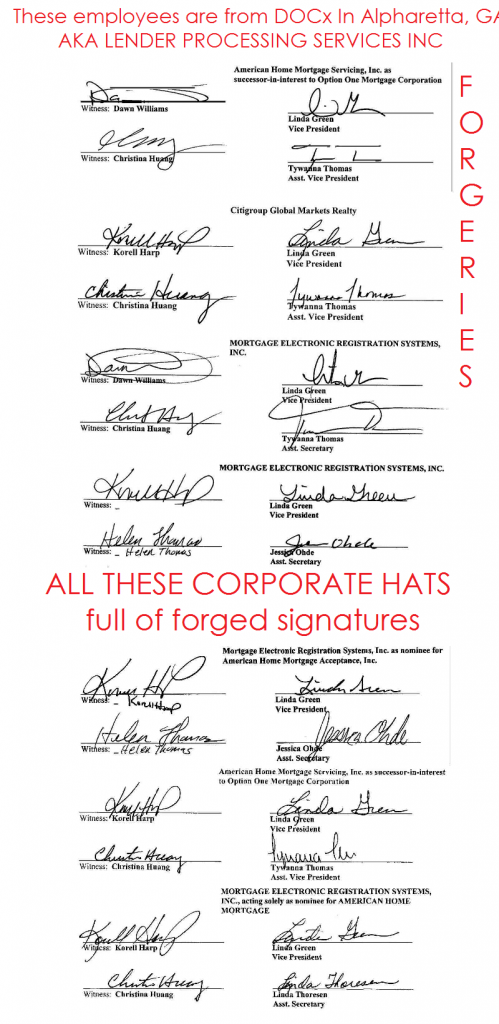
In Georgia, an employee of a document processing company, Linda Green, for years claimed to be executives of Bank of America , Wells Fargo, U.S. Bank and dozens of other lenders while signing off on tens of thousands of foreclosure affidavits. In many cases, her signature appeared to be forged by different employees.
Green worked for a foreclosure document company owned by Lender Processing Services. The company is being investigated by a U.S. attorney in Florida for allegedly using improper documentation to speed foreclosures.
Lenders have already started to withdraw foreclosures that had Green's name on them.
Green also submitted to courts documents that listed "Bogus Assignee" as the owner of a mortgage instead of the real name. In another case, she signed as the vice president of "Bad Bene," a made-up company.
***"There are procedures to be followed in order to get a foreclosure, and you either get it right or not. Either you're pregnant or not. There's no in-between," [Arthur M. Schack, a Kings County Supreme Court judge in Brooklyn,] said
Foreclosure attorney Lynn Szymoniak located numerous signatures of "Linda Green" from pleadings filed in various courts.
StopForeclosureFraud.com has rounded up some examples of "Linda Green's" signatures in one image:
In February 2010, 4ClosureFraud.org posted one of Green's signatures on an assignment of title to "Bogus Assignee":
(And here are numerous other assignments to "Bogus Assignee" signed by Green, start with the fourth document down.)
Szymoniak pointed out in July:
There are examples of the many different Linda Green signatures/forgeries. Green’s “signature” appears on HUNDREDS OF THOUSANDS of mortgage assignments – as an officer of at least 20 different banks and mortgage companies.Doing the Math
The total mortgage loan amount on 500 “Linda Green” Mortgage Assignments is $126,956,912, or approximately $125 million for each 500 Assignments. The average output of Assignments from the Docx office in Alpharetta [Green's actual employer], Georgia in 2009 was 2,000 Assignments per day.
This would be equivalent to (4 x $125 million) or $500 million each day. Assuming that Docx operated 5 days a week for 51 weeks (allowing for holidays), the office was open, producing Assignments, 255 days. It is likely that the Linda Green/Docx crew prepared and filed Mortgage Assignments showing One Hundred Twenty-Seven Billion, Five Hundred Million ($127,500,000,000) in mortgages were Assigned in 2009.
Remember also that Mortgage Electronic Registration Systems - which Green repeatedly signed for - is itself a shell company which holds 60% of all American residential mortgages.
DocX is also the company which published price lists for forging documents, including such gems as:
"Create Missing Intervening Assignment" $35
"Cure Defective Assignment" $12.95
"Recreate Entire Collateral File" $95
Given the above, it is clear why the Florida Attorney General has issued a subpoena to Linda Green's real employer - DocX - requesting the following documents:
2. Copies of any and all underlying documentation that allows for your employee or ex-employee, Linda Green to sign documents in the following capacities:
a. Vice President of Loan Documentation, Wells Fargo Bank, N.A. successor by merger to Wells Fargo Home Mortgage, Inc.;
b. Vice President, Mortgage Electronic Registration Systems, Inc. as nominee for American Home Mortgage Acceptance, Inc.;
c. Vice President, American Home Mortgage Servicing as successor-in-interest to Option One Mortgage Corporation;
d. Vice President, Mortgage Electronic Registration Systems, Inc. as nominee for American Brokers Conduit;
e. Vice President & Asst. Secretary, American Home Mortgage Servicing, Inc., as servicer for Ameriquest Mortgage Corporation;
f. Vice President, Option One Mortgage Corporation;
g. Vice President, Mortgage Electronic Registration Systems, Inc. as nominee for HLB Mortgage;
h. Vice President, American Home Mortgage Servicing, Inc.;
1. Vice President, Mortgage Electronic Registration Systems, Inc. as nominee for Family Lending Services, Inc.;
J. Vice President, American Home Mortgage Servicing, Inc. as Successor -ininterest to Option One Mortgage Corporation;
k. Vice President, Argent Mortgage Company, LLC by Citi Residential Lending, Inc., attorney-in-fact;
1. . Vice President, Sand Canyon Corporation f/kJal Option One Mortgage Corporation;
m. Vice President, Amtrust Funsing (sic) Services, Inc., by American Home Mortgage Servicing, Inc., as Attorney-in -fact;
n. Vice President, Seattle Mortgage Company.
3. Copies of every document signed in any capacity by Linda Green.
Of course, its not just Linda Green.
As Szymoniak points out:
The offices of Lender Processing Services in Mendota Heights, Minnesota, seems likely to also have produced 2,000 Assignments each working day.Jeffrey Stephan from the GMAC offices in Montgomery County, Pennsylvania also is likely to have produced 2,000 Assignments each day.
Bryan Bly of Nationwide Title Clearing also is likely to have produced 2,000 Mortgage Assignments each day.
Scott Anderson of Ocwen Loan Servicing in West Palm Beach, Florida, almost certainly produced an average of 2,000 Assignments a day.
Herman John Kennerty of America’s Servicing Company in Ft. Mill, South Carolina, also is likely to have produced 2,000 Assignments each day.
Erica Johnson-Seck was almost certainly producing Assignments at this same level for IndyMac.
Christina Trowbridge, Whitney Cook, and Stacy Spohn of Chase Home Finance in Franklin, Ohio likely had the same output.
Keri Selman and Renee Hertzler of BAC Home Loan Servicing (formerly Countrywide) in Texas almost certainly produced an average of 2,000 Assignments a day.
If these nine offices each produced 2,000 Assignments a day, the value of the Mortgage Assignments filed by all nine offices in 2009 was One Trillion, One Hundred Forty Seven Billion, Five Hundred Million ($1,147,500,000,000).
Saturday, November 21, 2009
Wells Fargo Says It Doesn't Have to Reserve Against Its Off-Balance Sheet Residential Exposure Because the FHA (Meaning the Taxpayers) Will Pay For It
Chris Whalen has a must-read essay at Zero Hedge:
In the case of WFC [Wells Fargo], the bank has taken the position that NONE of its conforming residential exposures should be brought on balance sheet despite the FASB rule change. As we discussed in The Institutional Risk Analyst this week, "Why? Because the loans inside these securitization vehicles are insured by FHA, so goes the thinking of WFC and its auditor, thus the bank has no liability to these entities or the securities they have issued to investors. Pretty neat trick, eh?"A "conforming loan" is one that meets lending guidelines, including loan amounts as set by the government sponsored enterprises, such as Fannie as or Freddie.
Thus WFC is basically saying that none of the bank's $1.1 trillion in conforming OBS [off balance sheet] exposures need to be represented or reserved against.
As part of the 2008 stimulus bill, Congress temporarily increased the conforming amounts available through the FHA.
Bottom line: Wells Fargo is saying that since the FHA - that is, the government, that is, the taxpayers - will bail out Wells for loans that go bad, the giant bank doesn't have to reserve against these possible losses.
Yes, Wells is as bad as the other too big to fails. See this, this, this and this.
Wednesday, December 1, 2010
Fed Data Shows Foreign Banks Huge Beneficiaries of Emergency Lending Programs, Hedge Funds, McDonald’s, Harley-Davidson and Others Also Bailed Out
Under orders from Congress pursuant to the Dodd-Frank financial legislation, the Fed has finally released details of its emergency lending starting in 2007.
As Bloomberg notes:
Bank of America Corp. and Wells Fargo & Co. were among the top borrowers from the Term Auction Facility [TAF]...
Bank of America had three loans for $15 billion each outstanding from the facility as of Jan. 15, 2009, while Wells Fargo had three loans for $15 billion each on Feb. 26 ...
Citigroup Inc. and JPMorgan Chase & Co. also availed themselves of the TAF. Citigroup’s Citibank NA subsidiary had three loans under the facility totaling $20 billion on Jan. 15, 2009. JPMorgan’s JPMorgan Chase Bank NA had two loans totaling $25 billion on Feb. 26, 2009.
Bloomberg notes that foreign banks borrowed heavily from TAF as well:
Banks with headquarters outside the U.S. were among the first to begin using the facility in December 2007 and were also among its heaviest borrowers. These included the U.S. affiliates of banks such as Manama, Bahrain-based Arab Banking Corp., Madrid-based Banco Santander SA, and Paris-based Societe Generale SA. Beginning on June 18, 2009, Barclays Bank Plc had two loans totaling $23.45 billion outstanding.In a second article, Bloomberg points out that despite Goldman's statements that it would have survived even without help from the Fed, Goldman was a big borrower as well:
Goldman Sachs Goup Inc., which rebounded from the financial crisis to post record profit last year, was a regular borrower from two emergency Federal Reserve programs in 2008 and early 2009, new data show.
The firm borrowed from the Fed’s Term Securities Lending Facility most weeks from March 2008 through April 2009, data released by the Fed today show. Two units of the New York-based firm borrowed as much as $24.2 billion from the Fed’s Primary Dealer Credit Facility in the weeks after Lehman Brothers Holdings Inc.’s bankruptcy in September 2008, the data show.
Chief Executive Officer Lloyd Blankfein, 56, was quoted by Vanity Fair last year as saying the company might have survived the credit crisis without government help. The firm’s president,Gary Cohn, was more definitive, according to the magazine: “I think we would not have failed,” he was quoted as saying. “We had cash.”
Business Insider quotes the Fed to show that many banks tried to avoid the stigma attached to discount window borrowing by using the TAF program:
Many banks were reluctant to borrow at the discount window out of fear that their borrowing would become known and would be erroneously taken as a sign of financial weakness.Business Insider also notes that, "Morgan Stanley, Citi, and Merrill were the biggest users of the PDCF [the Primary Dealer Credit Facility]."
***
The PDCF functioned as an overnight loan facility for primary dealers, similar to the way the Federal Reserve's discount window provides a backup source of funding to depository institutions. By providing a source of liquidity to primary dealers when funding was not available elsewhere in the market,
CNBC points out that foreign banks used the PDCF as well:
In addition to Barclays, BNP Paribas Securities , Daiwa Securities America, Deutsche Bank Securities, Mizuho Securities USA, Dresdner Kleinwort Securities and UBS Securities all received support from the PDCF.In a third article, Bloomberg reports that foreign banks were also among the biggest users of the Fed's emergency commercial paper facility:
The U.S. subsidiaries of European financial institutions, led by Zurich-based UBS AG and Brussels- based Dexia SA were among the largest users of a government program to provide emergency short-term funding to U.S. companies and banks during the credit crisis.
Six European banks were among the top 11 companies that sold the most debt overall to the the Commercial Paper Funding Facility. They sold a combined $274.1 billion, according to data made public today by the U.S. central bank. UBS sold $74.5 billion, the most among all borrowers. The largest U.S.-based user was insurer American International Group, selling $60.2 billion.
UBS’s figure of $74.5 billion represents the company’s total sales over the life of the program. The bank’s CPFF borrowings peaked at $37.2 billion, an amount the firm rolled over, or re-sold at maturity, once. Other companies rolled over debt in the program as well.
Zero Hedge writes:
One may be forgiven to believe that ... the Fed only bailed out foreign Central Banks, which in turn took the money and funded their own banks. It turns out that is only half the story: we now know the Fed also acted in a secondary bail out capacity, providing over $350 billion in short term funding exclusively to 35 foreign banks, of which the biggest beneficiaries were UBS, Dexia and BNP. Since the funding provided was in the form of ultra-short maturity commercial paper it was essentially equivalent to cash funding. In other words, between October 27, 2008 and August 6, 2009, the Fed spent $350 billion in taxpayer funds to save 35 foreign banks....

Zero Hedge also reports that California pension giant Calpers was the largest user of the TALF program, and provides details on the big foreign central bank users of the Fed's emergency swap lines:
- Looking at the TALF data, we see that the biggest borrower by subscription is Calpers, with a total of about $5.4 billion
- More curiously, now disgraced and embroiled in an insider trading scandal hedge fund FrontPoint seems to have been a very active borrower on the TALF facility, having received $4.136 billion on subscription, the bulk of it going to a FrontPoint Michigan Strategic Partnership Investment entity, which has borrowed $2.6 billion
- Foreign central bank borrowings
- ECB [European Central Bank] - 271 borrowings for gross rolling total of just over $8 trillion.
- SNB [Swiss National Bank] - 114 borrowings, for a gross rolling total of $465 billion
- BOE [Bank of England] - 81 borrowings for a gross rolling total of $918 billion


Huffington Post is providing an excellent live-blogging round up as new discoveries are made from the Fed's data release. Here are some of the more interesting insights:
Huffington Post also reports that many of these banks borrowed at ridiculously low interest rates.Mutual funds, hedge funds and bond funds borrowed more than $71 billion from the Fed's Term Asset-Backed Securities Loan Facility, the WSJ reported. This includes $7.1 billion borrowed by the massive bond fund PIMCO, run by veteran investor Bill Gross. Gross's involvement in the details of the bailout, which included a campaign for public-private partnerships to unwind toxic assets, raised more than few eyebrows from critics.
***
Two European Megabanks Got A Windfall From The Fed ... Two European megabanks -- Deutsche Bank and Credit Suisse -- were the largest beneficiaries of the Fed's purchase of mortgage-backed securities. The Fed's dollars also flowed to major American companies that are not financial players, including McDonald's and Harley-Davidson, through unsecured short-term loans.
***
Wall Street firms teetering on the verge of collapse pledged more than $1.3 trillion in junk-rated securities to the Federal Reserve for cheap overnight loans....
The fact that Wall Street was able to pledge junk to the Fed in exchange for cheap financing is likely to enrage lawmakers who view the Bush and Obama-era crisis programs as largely benefiting Wall Street while "Main Street" has been left behind.
Adding insult to the perceived slight, banks have ramped up their requirements for new loans to borrowers, making it ever more difficult for cash-strapped households and businesses to take out new commitments.
Karl Denninger argues that the fact that the Fed took stock in two of AIG's largest foreign insurance subsidiaries violates Section 14 of the Federal Reserve Act, which prohibits the Fed from taking an equity interest in a company irrespective of the means or terms.
While Bank of America and Wells Fargo were the biggest TAF recipients, AP reports that - when total government loans and aid are added up - other American banks borrowed much more:
New documents show that the most loan and other aid for U.S. institutions over time went to Citigroup ($2.2 trillion), followed by Merrill Lynch ($2.1 trillion), Morgan Stanley ($2 trillion), Bear Stearns ($960 billion), Bank of America ($887 billion), Goldman Sachs ($615 billion), JPMorgan Chase ($178 billion) and Wells Fargo ($154 billion).However, it may be too early to call the horse race in terms of totals and rankings for emergency loans and aid to the banks. Because of the way that the Fed presented the data, there is a possibility of double-counting across different program categories, or failing to take into account that loans were repaid and then new loans taken out. So it may take a couple of days for a definitive analysis.
Saturday, September 3, 2011
Full-Blown Civil War Erupts On Wall Street: As Reality Finally Hits The Financial Elite, They Start Turning On Each Other
By David DeGraw, AmpedStatus.com Finally, after trillions in fraudulent activity, trillions in bailouts, trillions in printed money, billions in political bribing and billions in bonuses, the criminal cartel members on Wall Street are beginning to get what they deserve. As the Eurozone is coming apart at the seams and as the US economy grinds to a halt, the financial elite are starting to turn on each other. The lawsuits are piling up fast. Here's an extensive roundup:
As I reported last week:
Collapse Roundup #5: Goliath On The Ropes, Big Banks Getting Hit Hard, It's A "Bloodbath" As Wall Street's Crimes Blow Up In Their FaceWell, well... here's your Shock & Awe:
Time to put your Big Bank shorts on! Get ready for a run... The chickens are coming home to roost... The Global Banking Cartel's crimes are being exposed left & right... Prepare for Shock & Awe...
First up, this shockingly huge $196 billion lawsuit just filed against 17 major banks on behalf of Fannie Mae and Freddie Mac. Bank of America is severely exposed on this lawsuit. As the parent company of Countrywide and Merrill Lynch they are on the hook for $57.4 billion. JP Morgan is next in the line of fire with $33 billion. And many death spiraling European banks are facing billions in losses as well.
FHA Files a $196 Billion Lawsuit Against 17 Banks
The Federal Housing Finance Agency (FHFA), as conservator for Fannie Mae and Freddie Mac (the Enterprises), today filed lawsuits against 17 financial institutions, certain of their officers and various unaffiliated lead underwriters. The suits allege violations of federal securities laws and common law in the sale of residential private-label mortgage-backed securities (PLS) to the Enterprises.You can read the suits filed against each individual bank here. For some more information read Bloomberg: BofA, JPMorgan Among 17 Banks Sued by U.S. for $196 Billion. Noticeably absent from the list of companies being sued is Wells Fargo.
Complaints have been filed against the following lead defendants, in alphabetical order:
1. Ally Financial Inc. f/k/a GMAC, LLC - $6 billion
2. Bank of America Corporation - $6 billion
3. Barclays Bank PLC - $4.9 billion
4. Citigroup, Inc. - $3.5 billion
5. Countrywide Financial Corporation -$26.6 billion
6. Credit Suisse Holdings (USA), Inc. - $14.1 billion
7. Deutsche Bank AG - $14.2 billion
8. First Horizon National Corporation - $883 million
9. General Electric Company - $549 million
10. Goldman Sachs & Co. - $11.1 billion
11. HSBC North America Holdings, Inc. - $6.2 billion
12. JPMorgan Chase & Co. - $33 billion
13. Merrill Lynch & Co. / First Franklin Financial Corp. - $24.8 billion
14. Morgan Stanley - $10.6 billion
15. Nomura Holding America Inc. - $2 billion
16. The Royal Bank of Scotland Group PLC - $30.4 billion
17. Société Générale - $1.3 billion
These complaints were filed in federal or state court in New York or the federal court in Connecticut. The complaints seek damages and civil penalties under the Securities Act of 1933, similar in content to the complaint FHFA filed against UBS Americas, Inc. on July 27, 2011. In addition, each complaint seeks compensatory damages for negligent misrepresentation. Certain complaints also allege state securities law violations or common law fraud. [read full FHFA release]
And the suits just keep coming...
BofA sued over $1.75 billion Countrywide mortgage pool
Bank of America Corp (BAC.N) was sued by the trustee of a $1.75 billion mortgage pool, which seeks to force the bank to buy back the underlying loans because of alleged misrepresentations in how they were made. The lawsuit by the banking unit of US Bancorp (USB.N) is the latest of a number of suits seeking to recover investor losses tied to risky mortgage loans issued by Countrywide Financial Corp, which Bank of America bought in 2008. In a complaint filed in a New York state court in Manhattan, U.S. Bank said Countrywide, which issued the 4,484 loans in the HarborView Mortgage Loan Trust 2005-10, materially breached its obligations by systemically misrepresenting the quality of its underwriting and loan documentation. [read more]Bank of America kept AIG legal threat under wraps
Top Bank of America Corp lawyers knew as early as January that American International Group Inc was prepared to sue the bank for more than $10 billion, seven months before the lawsuit was filed, according to sources familiar with the matter. Bank of America shares fell more than 20 percent on August 8, the day the lawsuit was filed, adding to worries about the stability of the largest U.S. bank.... The bank made no mention of the lawsuit threat in a quarterly regulatory filing with the U.S. Securities and Exchange Commission just four days earlier. Nor did management discuss it on conference calls about quarterly results and other pending legal claims. [read more]Nevada Lawsuit Shows Bank of America’s Criminal Incompetence
As we’ve stated before, litigation by attorney general is significant not merely due to the damages and remedies sought, but because it paves the way for private lawsuits. And make no mistake about it, this filing is a doozy. It shows the Federal/state attorney general mortgage settlement effort to be a complete travesty. The claim describes, in considerable detail, how various Bank of America units engaged in misconduct in virtually every aspect of its residential mortgage business. [read more]Nevada Wallops Bank of America With Sweeping Suit; Nationwide Foreclosure Settlement in Peril
The sweeping new suit could have repercussions far beyond Nevada's borders. It further jeopardizes a possible nationwide settlement with the five largest U.S. banks over their foreclosure practices, especially given concerns voiced by other attorneys general, New York's foremost among them.... In a statement, Bank of America spokeswoman Jumana Bauwens said reaching a settlement would bring a better outcome for homeowners than litigation. "We believe that the best way to get the housing market going again in every state is a global settlement that addresses these issues fairly, comprehensively and with finality. [read more]FDIC Objects to Bank of America’s $8.5 Billion Mortgage-Bond Accord
The Federal Deposit Insurance Corp. is objecting to Bank of America Corp. (BAC)’s proposed $8.5 billion mortgage-bond settlement with investors, joining investors and states that are challenging the agreement. The FDIC owns securities covered by the settlement and said it doesn’t have enough information to evaluate the accord, according to a filing today in federal court in Manhattan. Bank of America has agreed to pay $8.5 billion to resolve claims from investors in Countrywide Financial mortgage bonds. The settlement was negotiated with a group of institutional investors and would apply to investors outside that group. [read more]Fed asks Bank of America to list contingency plan: report
The Federal Reserve has asked Bank of America Corp to show what measures it could take if business conditions worsen, the Wall Street Journal said, citing people familiar with the situation. BofA executives recently responded to the unusual request from the Federal Reserve with a list of options that includes the issuance of a separate class of shares tied to the performance of its Merrill Lynch securities unit, the people told the paper. Bank of America and the Fed declined to comment to the Journal. Both could not immediately be reached for comment by Reuters outside regular U.S. business hours. [read more]Bombshell Admission of Failed Securitization Process in American Home Mortgage Servicing/LPS Lawsuit
Wow, Jones Day just created a huge mess for its client and banks generally if anyone is alert enough to act on it. The lawsuit in question is American Home Mortgage Servicing Inc. v Lender Processing Services. It hasn’t gotten all that much attention (unless you are on the LPS deathwatch beat) because to most, it looks like yet another beauty contest between Cinderella’s two ugly sisters. AHMSI is a servicer (the successor to Option One, and it may also still have some Ameriquest servicing).Fraudclosure: MERS Case Filed With Supreme Court
AHMSI is mad at LPS because LPS was supposed to prepare certain types of documentation AHMSI used in foreclosures. AHMSI authorized the use of certain designated staffers signing with the authority of AHSI (what we call robosinging, since the people signing these documents didn’t have personal knowledge, which is required if any of the documents were affidavits). But it did not authorize the use of surrogate signers, which were (I kid you not) people hired to forge the signatures of robosigners. The lawsuit rather matter of factly makes a stunning admission... [read more]
Before readers get worried by virtue of the headline that the Supreme Court will use its magic legal wand to make the dubious MERS mortgage registry system viable, consider the following:Iowa Says State AG Accord Won’t Release Banks From Liability
1. The Supreme Court hears only a very small portion of the cases filed with it, and is less likely to take one with these demographics (filed by a private party, and an appeal out of a state court system, as opposed to Federal court). This case, Gomes v. Countywide, was decided against the plaintiff in lower and appellate court and the California state supreme court declined to hear it
2. If MERS or the various servicers who have had foreclosures overturned based on challenges to MERS thought they’d get a sympathetic hearing at the Supreme Court, they probably would have filed some time ago. MERS have apparently been settling cases rather than pursue ones where it though the judge would issue an unfavorable precedent
3. The case in question, from what the experts I consulted with and I can tell, is not the sort the Supreme Court would intervene in based on the issue raised, which is due process (14th Amendment). But none of us have seen the underlying lower and appellate court cases, and the summaries we’ve seen are unusually unclear as to what the legal argument is. [read more]
The 50-state attorney general group investigating mortgage foreclosure practices won’t release banks from all civil, or any criminal, liability in a settlement, Iowa Attorney General Tom Miller said. [read more]Fed Launches New Formal Enforcement Action Against Goldman Sachs To Review Foreclosure Practices
The Federal Reserve Board has just launched a formal enforcement action against Goldman Sachs related to Litton Loan Services. Litton Loan is the nightmare-ridden mortgage servicing unit, a subsidiary of Goldman, that Goldman has been trying to sell for months. They penned a deal to recently, but the Fed stepped in and required Goldman to end robo-signing taking place at the unit before the sale could be completed. Sounds like this enforcement action is an extension of that requirement. [read more]Goldman Sachs, Firms Agree With Regulator To End 'Robo-Signing' Foreclosure Practices
Goldman Sachs and two other firms have agreed with the New York banking regulator to end the practice known as robo-signing, in which bank employees signed foreclosure documents without reviewing case files as required by law, the Wall Street Journal said. In an agreement with New York's financial-services superintendent, Goldman, its Litton Loan Servicing unit and Ocwen Financial Corp also agreed to scrutinize loan files for evidence they mishandled borrowers' paperwork and to cut mortgage payments for some New York homeowners, the Journal said. [read more]Banks still robo-signing, filing doubtful foreclosure documents
Reuters has found that some of the biggest U.S. banks and other "loan servicers" continue to file questionable foreclosure documents with courts and county clerks. They are using tactics that late last year triggered an outcry, multiple investigations and temporary moratoriums on foreclosures. In recent months, servicers have filed thousands of documents that appear to have been fabricated or improperly altered, or have sworn to false facts. Reuters also identified at least six "robo-signers," individuals who in recent months have each signed thousands of mortgage assignments -- legal documents which pinpoint ownership of a property. These same individuals have been identified -- in depositions, court testimony or court rulings -- as previously having signed vast numbers of foreclosure documents that they never read or checked. [read more]JPMorgan fined for contravening Iran, Cuba sanctions
JPMorgan Chase Bank has been fined $88.3 million for contravening US sanctions against regimes in Iran, Cuba and Sudan, and the former Liberian government, the US Treasury Department announced Thursday. The Treasury said that the bank had engaged in a number of "egregious" financial transfers, loans and other facilities involving those countries but, in announcing a settlement with the bank, said they were "apparent" violations of various sanctions regulations. [read more]This Is Considered Punishment? The Federal Reserve Wells Fargo Farce
What made the news surprising, of course, was that the Federal Reserve has rarely, if ever, taken action against a bank for making predatory loans. Alan Greenspan, the former Fed chairman, didn’t believe in regulation and turned a blind eye to subprime abuses. His successor, Ben Bernanke, is not the ideologue that Greenspan is, but, as an institution, the Fed prefers to coddle banks rather than punish them.Exclusive: Regulators seek high-frequency trading secrets
That the Fed would crack down on Wells Fargo would seem to suggest a long-overdue awakening. Yet, for anyone still hoping for justice in the wake of the financial crisis, the news was hardly encouraging. First, the Fed did not force Wells Fargo to admit guilt — and even let the company issue a press release blaming its wrongdoing on a “relatively small group.”
The $85 million fine was a joke; in just the last quarter, Wells Fargo’s revenues exceeded $20 billion. And compensating borrowers isn’t going to hurt much either. By my calculation, it won’t top $20 million. [read more]
U.S. securities regulators have taken the unprecedented step of asking high-frequency trading firms to hand over the details of their trading strategies, and in some cases, their secret computer codes. The requests for proprietary code and algorithm parameters by the Financial Industry Regulatory Authority (FINRA), a Wall Street brokerage regulator, are part of investigations into suspicious market activity, said Tom Gira, executive vice president of FINRA's market regulation unit. [read more]And here's part of the Collapse Roundup I wrote on August 25th, referenced in the beginning of this report - as you will see, I would probably make a lot more money as an investment adviser:
Collapse Roundup #5: Goliath On The Ropes, Big Banks Getting Hit Hard, It's A "Bloodbath" As Wall Street's Crimes Blow Up In Their Face
 Time to put your Big Bank shorts on! Get ready for a run...
The chickens are coming home to roost. Reality is catching up with the market riggers (Fed, ECB, PPT, CIA) and the "too big to fail" banks are getting whacked. Trillions of dollars in bailouts and legalized (FASB) accounting fraud cannot save these insolvent zombie banks any longer. The Grim Reaper is on the horizon and his sickle will do what paid off politicians won't, cut 'em down to size. So get your silver stake ready, time to plunge it into their vampire squid hearts....
What about Warren Buffet? He saved Goldman Sachs with a bailout in 2008. Can he save Bank of America?...
Warren’s bailout will help BofA over the short run, but $5 billion is just a drop in the bucket when it comes to their problems. The only thing his $5 billion will accomplish is a temporary run up in stock value so everyone who has been killed on the plummeting stock price can then jump out without complete loss....
Trouble a-comin'...
Goldman Sachs TANKS After CEO Lloyd Blankfein Hires Famous Defense Lawyer
Speaking of hiring lawyers...Is the Goldman Sachs CEO facing a new lawsuit?
The market seems to think so. Goldman Sachs just tanked in minutes before the close after news that Lloyd Blankfein hired a lawyer famous for defending vilified execs. It's back up a bit since dropping over 5%, but the news is still concerning.
It's unclear whether the lawyer is for him, Goldman Sachs, or both, but Goldman Sachs's CEO Lloyd Blankfein hired Reid Weingarten, a high profile defense attorney who says "I'm used to these monstrously difficult cases where everybody hates my clients," according to Reuters.
Reuters says the hire might have something to do with accusations of Blankfein's committing perjury. Or something else:
One former federal prosecutor, who was not authorized to speak publicly, said Blankfein may have hired outside counsel after receiving a request from investigators for documents or other information. [read full report]
The Global Banking Cartel's Crimes Are Being Exposed Left & Right...
Blowing Up In Their Face... Prepare for Shock & Awe...
BOOM! Moody's exposed:
MOODY'S ANALYST BREAKS SILENCE: Says Ratings Agency Rotten To Core With Conflicts
A former senior analyst at Moody's has gone public with his story of how one of the country's most important rating agencies is corrupted to the core.BOOM! The SEC Caught Covering Up Wall Street Crimes:
The analyst, William J. Harrington, worked for Moody's for 11 years, from 1999 until his resignation last year.
From 2006 to 2010, Harrington was a Senior Vice President in the derivative products group, which was responsible for producing many of the disastrous ratings Moody's issued during the housing bubble.
Harrington has made his story public in the form of a 78-page "comment" to the SEC's proposed rules about rating agency reform....
Here are some key points:
* Moody's ratings often do not reflect its analysts' private conclusions. Instead, rating committees privately conclude that certain securities deserve certain ratings--but then vote with management to give the securities the higher ratings that issuer clients want.
* Moody's management and "compliance" officers do everything possible to make issuer clients happy--and they view analysts who do not do the same as "troublesome." Management employs a variety of tactics to transform these troublesome analysts into "pliant corporate citizens" who have Moody's best interests at heart.
* Moody's product managers participate in--and vote on--ratings decisions. These product managers are the same people who are directly responsible for keeping clients happy and growing Moody's business.
* At least one senior executive lied under oath at the hearings into rating agency conduct. Another executive, who Harrington says exemplified management's emphasis on giving issuers what they wanted, skipped the hearings altogether. [read full report]
Matt Taibbi Exposes How SEC Shredded Thousands of Investigations
An explosive new report in Rolling Stone magazine exposes how the U.S. Securities and Exchange Commission destroyed records of thousands of investigations, whitewashing the files of some of the nation’s largest banks and hedge funds, including AIG, Wells Fargo, Lehman Brothers, Goldman Sachs, Bank of America and top Wall Street broker Bernard Madoff. Last week, Republican Sen. Chuck Grassley of Iowa said an agency whistleblower had sent him a letter detailing the unlawful destruction of records detailing more than 9,000 information investigations. We speak with Matt Taibbi, the political reporter for Rolling Stone magazine who broke this story in his latest article....
KA-BOOM! The Fed And All Their Crony-Capitalist Cartel Members Exposed, Yet Again:
Wall Street Pentagon Papers Part III – Are The Federal Reserve’s Crimes Still Too Big To Comprehend?
Speaking of the $16 trillion GAO audit...Another day, another trillion plus in secret Federal Reserve “bailouts” revealed. Bloomberg News exposes this latest Fed “deal” after winning a long Freedom of Information Act (FOIA) legal battle to get the details on what was done with the American people’s money. Their report runs with an AmpedStatus style headline: “Wall Street Aristocracy Got $1.2 Trillion From Fed.”
The aristocracy is alive and well… thanks to the Fed, of course.
Keep in mind, this $1.2 trillion is in addition to the $16 trillion the Government Accountability Office (GAO) audit revealed and the over $2 trillion in Quantitative Easing the Fed dished out, not to mention the now continued promise of the Zero Interest Rate Policy (ZIRP). This is also separate from the $700 billion TARP program that Congress approved. This is yet another unknown secret program, throwing another mere $1.2 trillion in public money at the Wall Street elite (global banking cartel), just being revealed now.
Those of us paying attention over the past three years have had Fed crony-capitalism on steroids fatigue for awhile now. Nonetheless, this is deja vu all over again as another mindbogglingly huge story that must be covered comes to light.
Here are the details of this latest revelation:
[read full report]
BOOM! GAO audit exposed, missing some vital details:
More on how the GAO's Fed audit failed to disclose some dirty secrets about BlackRock and JP Morgan
In its review of the Fed's outsourcing practices, it failed to mention the most damaging and suspicious sole-source (no bid) contract awarded to BlackRock, which was for handling the New York Fed's toxic Bear Stearns portfolio, otherwise known as Maiden Lane. This contract would generate $108,000,000 in fees and was one of the largest awarded during the bailout period, but it might also have saved JP Morgan $1.1 billion in losses from its Bear Stearns acquisition....BOOM! Bear Stearns exposed:
Also, BlackRock was also one of the managers of the NY Fed's separate $1.25 trillion MBS purchase program as part of QE1. Contrary to the lie on the NY Fed's webpage (that the MBS auctions were conducted via competitive bidding), the NY Fed's own purchasing manager, Brian Sack, admitted in a paper that, "the MBS purchases were arranged with primary dealer counterparties directly, [and] there was no auction mechanism to provide a measure of market supply."
Putting it all together, it looks like Jamie Dimon signed off on hiring BlackRock for no justifiable reason to trade the very Maiden Lane portfolio that could have caused his bank, JP Morgan, to lose up to $1.1 billion. And, it was entirely possible that BlackRock saved the portfolio by trading the MBS portion of ML with the New York Fed directly as QE1 was underway. [read full report]
Report Says Bear Stearns Executives Sold Illegal RMBS and Covered It Up
Former back office employees from Bear Stearns are coming out of the woodwork to explain how Tom Marano’s mortgage group cheated their own clients out of billions. This week I reported at The Distressed Debt Report, EMC insiders say they were told to make up the classification for whole loans, packaged into mortgage securities, to get them switched out of the trust. By classifying the loans as ‘prepaid’ or having ‘subsequent recoveries’ Bear employees were able to fool the trustee into giving them back loans they were not able to legally service. A move New York Attorney General Eric Schneiderman is actively investigating now.The big banks are getting lit up!
In my latest DealFlow story we hear from EMC staffers who describe how subprime loans, that would have been sold by Bear Stearns trader Jeff Verschleiser’s team, never had a proper servicing license in West Virginia when they were packaged into the residential mortgage backed security. In 2003 Bear/EMC put $100 million of subprime loans from West Virginia into a few RMBS transactions. EMC, the banks wholly owned mortgage servicing shop, would service all of Bear’s RMBS after they were sold.
A year latter, when senior executies realized the mishap instead of Bear going out and informing their regulator and applying for a license, they orchestrated a cover up and even threaten EMC employees not to talk about it. [read full report]
You shall reap what you sow.
Karma is a ... bit@h. [read full report]
Let's end with this video. We need to keep in mind that the Federal Reserve has known about all of this criminal activity from the start. Yet, they have done everything they could, and are still trying, to keep this criminal operation up and running. As all these criminal banks begin to blow up, let's not forget who their central bank is and what they have done to the American people.
Cenk, take it away and drive the point home:
- David DeGraw is the founder and editor of AmpedStatus.com. His long-awaited book, The Road Through 2012: Revolution or World War III, will finally be released on September 28th. He can be emailed at David[@]AmpedStatus.com. You can follow David's reporting daily on his new personal website: DavidDeGraw.org
Monday, May 4, 2009
Wells Fargo Fails the Stress Test
Wells Fargo has failed the stress test.
Given that Wells is insolvent, that's not surprising.
Tuesday, March 10, 2009
Citi, B of A, HSBC, Wells and JP Morgan’s Current Net Loss Risks from Derivatives $587 Billion as of Dec. 31 (Up 49% in 90 Days)
Everywhere you look, there's evidence that derivatives are what is killing the economy.
McClatchy reports that derivatives, mainly credit default swaps, are destroying Citibank, B of A, HSBC, Wells and JP Morgan:
America's five largest banks, which already have received $145 billion in taxpayer bailout dollars, still face potentially catastrophic losses from exotic investments if economic conditions substantially worsen, their latest financial reports show.
Citibank, Bank of America, HSBC Bank USA, Wells Fargo Bank and J.P. Morgan Chase reported that their "current" net loss risks from derivatives — insurance-like bets tied to a loan or other underlying asset — surged to $587 billion as of Dec. 31. Buried in end-of-the-year regulatory reports that McClatchy has reviewed, the figures reflect a jump of 49 percent in just 90 days....
Federal regulators portray the potential loss figures as worst-case. However, the risks of these off-balance sheet investments, once thought minimal, have risen sharply as the U.S. has fallen into the steepest economic downturn since World War II ....
The biggest concerns are the banks' holdings of contracts known as credit-default swaps, which can provide insurance against defaults on loans such as subprime mortgages or guarantee actual payments for borrowers who walk away from their debts.
The banks' credit-default swap holdings, with face values in the trillions of dollars, are "a ticking time bomb, and how bad it gets is going to depend on how bad the economy gets," said Christopher Whalen, a managing director of Institutional Risk Analytics, a company that grades banks on their degree of loss risk from complex investments....
Trading in credit-default contracts has sparked investor fears because they are bought and sold in a murky, private market that is largely out of the reach of federal regulators. No one, except those holding the instruments, knows who owes what to whom. Not even banks and insurers can accurately calculate their risks.
"I don't trust any numbers on them," said David Wyss, the chief economist for the New York credit-rating agency Standard & Poor's....
Kopff, the bank shareholders' expert, said that several of the big banks' risks are so large that they are "dead men walking."
The banks' credit-default portfolios have gotten little scrutiny because they're off-the-books entries that are largely unregulated.
Monday, July 27, 2009
96% of Credit Derivative Risk Held by 5 Banks
Fitch's has found that JP Morgan Chase, Bank of America, Goldman Sachs, Citigroup, and Morgan Stanley together hold 80% of the country's derivatives risk, and 96% of the exposure to credit derivatives:
About 80% of the derivative assets and liabilities carried on the balance sheets of 100 companies reviewed by Fitch were held by five banks: JP Morgan Chase, Bank of America, Goldman Sachs, Citigroup, and Morgan Stanley.
Those five banks also account for more than 96% of the companies' exposure to credit derivatives.
As Newsweek wrote in April:
Major Wall Street players are digging in against fundamental changes...At issue is whether trading in credit default swaps and other derivatives—and the giant, too-big-to-fail firms that traded them—will be allowed to dominate the financial landscape again once the crisis passes. As things look now, that is likely to happen...
Geithner's new rules would allow the over-the-counter market to boom again, orchestrated by global giants that will continue to be "too big to fail" (they may have to be rescued again someday, in other words). And most of it will still occur largely out of sight of regulated exchanges...The old culture is reasserting itself with a vengeance. All of which runs up against the advice now being dispensed by many of the experts who were most prescient about the crash and its causes—the outsiders, in other words, as opposed to the insiders who are still running the show.
Newsweek was right. The same giants - JP Morgan, B of A, and Citigroup - are dominating the CDS market.
When I last looked at this issue, JP Morgan, B of A, and Citigroup were still the top 3 holders of derivatives in general, as well as credit derivatives.
But Goldman and Morgan weren't even on the list (granted, Wachovia has since gone bust and been purchased by a bigger bank, Wells Fargo. But Wells isn't in the top 5).
Given that Goldman bought $20 billion of credit default swaps from AIG in 2005 alone, and that Goldman received $13 billion and Morgan $1 billion from the AIG bailout, why weren't Goldman and Morgan on the earlier list?
It might simply be that Fitch's new list is not limited to any certain type of company, but includes all derivatives holders. Or it might be because Goldman and Morgan became "bank holding companies" since the list was published, and their new status made them subject to inclusion in Fitch's new list. Or it may be because Goldman and Morgan hid the data.
Thursday, July 9, 2009
Will California Lay Down and Die . . . Or Will It Regain Control Of Its Money System and Thrive?
Wells Fargo started in California on March 18, 1852.
Bank of America started in California on October 17, 1904 (it was originally called "Bank of Italy").
These two banks owe their prosperity to the state of California.
But now, Wells and B of A are refusing to honor California's IOUs (as are JPMorgan and Citigroup).
Is California going to take this lying down?
Is Schwarzenegger - the former world champion bodybuilder who played the Terminator and Conan the Barbarian - going to just give up?
Or will California take back control over its money system by forming its own bank?
Read this to learn how and why it should be done.
Friday, April 30, 2010
If We Broke Up Standard Oil, We Can Break Up the Giant Banks
If we broke up standard oil, we can break up the giant banks.
Says who?
Senator Ted Kaufman (interviewed recently by The American Prospect's Tim Fernholz):
You and Senator Sherrod Brown have proposed an amendment that would cap the size of the largest banks and, in effect, break them up. How do you sell this to people who are leery of what seems like a radical move?
First off, we've broken up things before. We broke up Standard Oil, we broke up AT&T, we broke up the accountants, too. A lot of the changes we're talking about, the mergers, are just new. When you look at the reasons these banks are so big -- and you know how big they are -- remember the reason JP Morgan Chase is so big is because they bought Washington Mutual when it was in trouble, and Wells Fargo bought Wachovia, and Bank of America bought Merrill Lynch [during the crisis]. It is pretty straightforward, now that these are back on their feet, that it makes sense to break them up.
U.S. regulators should consider breaking up large financial institutions considered “too big to fail,” former Federal Reserve Chairman Alan Greenspan said.
Those banks have an implicit subsidy allowing them to borrow at lower cost because lenders believe the government will always step in to guarantee their obligations. That squeezes out competition and creates a danger to the financial system, Greenspan told the Council on Foreign Relations in New York.
“If they’re too big to fail, they’re too big,” Greenspan said today. “In 1911 we broke up Standard Oil -- so what happened? The individual parts became more valuable than the whole. Maybe that’s what we need to do.”
At one point, no bank was considered too big to fail, Greenspan said. That changed after the Treasury Department under then-Secretary Hank Paulson effectively nationalized Fannie Mae and Freddie Mac, and the Treasury and Fed bailed out Bear Stearns Cos. and American International Group Inc.
“It’s going to be very difficult to repair their credibility on that because when push came to shove, they didn’t stand up,” Greenspan said.
Fed officials have suggested imposing a tax or requiring higher capital ratios on larger banks to ensure the firms’ safety and reduce some of the competitive advantage from the implied subsidy. Greenspan said that won’t work.
“I don’t think merely raising the fees or capital on large institutions or taxing them is enough,” Greenspan said. “I think they’ll absorb that, they’ll work with that, and it’s totally inefficient and they’ll still be using the savings”...
“If you don’t neutralize that, you’re going to get a moribund group of obsolescent institutions which will be a big drain on the savings of the society,” he said.
“Failure is an integral part, a necessary part of a market system,” he said. “If you start focusing on those who should be shrinking, it undermines growing standards of living and can even bring them down.”
Former chief IMF economist Simon Johnson:
Former Secretary of Labor Robert Reich:Writing in the New York Times today, Joe Nocera sums up, “If Mr. Obama hopes to create a regulatory environment that stands for another six decades, he is going to have to do what Roosevelt did once upon a time. He is going to have make some bankers mad.”
Good point – but Nocera is thinking about the wrong Roosevelt (FDR). In order to get to the point where you can reform like FDR, you first have to break the political power of the big banks, and that requires substantially reducing their economic power - the moment calls more for Teddy Roosevelt-type trustbusting, and it appears that is exactly what we will not get.
Neither the draft bill, nor the Committee, nor anyone on the Hill having anything to do with financial regulation, is raising what I consider to be the two key reforms necessary for avoiding another financial meltdown -- resurrecting the Glass-Steagall Act that once separated commercial from investment banking, and applying antitrust laws to the remaining five biggest Wall Street banks so none is "too big to fail."One of the world's leading economic historians, Niall Ferguson:
What's needed is a serious application of antitrust law to the financial-services sector and a speedy end to institutions that are "too big to fail."Indeed, even the FDIC mentions Continental Illinois in the same breadth as "too big to fail" banks.
***
[Geithner is proposing that] there should be a new "resolution authority" for the swift closing down of big banks that fail. But such an authority already exists and was used when Continental Illinois failed in 1984.
And William K. Black - the senior regulator during the S&L crisis, and an Associate Professor of both Economics and Law at the University of Missouri - says that the Prompt Corrective Action Law (PCA), 12 U.S.C. § 1831o, not only authorizes the government to seize insolvent banks, it mandates it, and that the Bush and Obama administrations broke the law by refusing to close insolvent banks. And see this. Whether or not the financial giants can be broken up using the PCA, no one can doubt that the government could find a way to break them up if it wanted.
Wednesday, December 2, 2009
Robert Reich Confirms Permanent Destruction of Jobs in America
Former Labor Secretary Robert Reich writes today:
The basic assumption that jobs will eventually return when the economy recovers is probably wrong. Some jobs will come back, of course. But the reality that no one wants to talk about is a structural change in the economy that's been going on for years but which the Great Recession has dramatically accelerated.
Under the pressure of this awful recession, many companies have found ways to cut their payrolls for good. They've discovered that new software and computer technologies have made workers in Asia and Latin America just about as productive as Americans, and that the Internet allows far more work to be efficiently outsourced abroad.
This means many Americans won't be rehired unless they're willing to settle for much lower wages and benefits. Today's official unemployment numbers hide the extent to which Americans are already on this path. Among those with jobs, a large and growing number have had to accept lower pay as a condition for keeping them. Or they've lost higher-paying jobs and are now in a new ones that pays less.
Yet reducing unemployment by cutting wages merely exchanges one problem for another. We'll get jobs back but have more people working for pay they consider inadequate, more working families at or near poverty, and widening inequality. The nation will also have a harder time restarting the economy because so many more Americans lack the money they need to buy all the goods and services the economy can produce.
Reich is only confirming what many others have said:
- JPMorgan Chase’s Chief Economist Bruce Kasman told Bloomberg:
[We've had a] permanent destruction of hundreds of thousands of jobs in industries from housing to finance.
- The chief economists for Wells Fargo Securities, John Silvia, says:
Companies “really have diminished their willingness to hire labor for any production level,” Silvia said. “It’s really a strategic change,” where companies will be keeping fewer employees for any particular level of sales, in good times and bad, he said.
- And former Merrill Lynch chief economist David Rosenberg writes:
And see this.The number of people not on temporary layoff surged 220,000 in August and the level continues to reach new highs, now at 8.1 million. This accounts for 53.9% of the unemployed — again a record high — and this is a proxy for permanent job loss, in other words, these jobs are not coming back. Against that backdrop, the number of people who have been looking for a job for at least six months with no success rose a further half-percent in August, to stand at 5 million — the long-term unemployed now represent a record 33% of the total pool of joblessness.
Heck of a job, Larry, Tim and Ben.
Monday, February 23, 2009
LIBOR Increasing Again
The much-ballyhooed reduction in LIBOR - the rate banks charge for loans to each other, and so an indication of liquidity - is slipping away.
As Bloomberg writes:
The premium banks charge each other for short-term loans, the so-called Libor-OIS spread, rose above 1 percentage point last week for the first time since Jan. 9. Contracts traded in the forward market indicate the gauge, which measures banks reluctance to lend, will remain higher for the rest of the year than before Sept. 15, when the bankruptcy of Lehman Brothers Holdings Inc. froze credit markets.
“Libor-OIS remains a barometer of fears of bank insolvency,” former Federal Reserve Chairman Alan Greenspan said in an interview. “That fear has been substantially reduced since mid-October, but the decline has stalled well short of any semblance of normal markets.”
The lack of lending between banks helped send the U.S. economy into a recession and may delay any recovery. Turmoil in money markets stoked last year’s tumble in stocks and fueled demand for the relative safety of Treasuries, gold and Japanese yen. Since Lehman collapsed, the Standard & Poor’s 500 Index lost 35 percent, 10-year Treasury yields fell below 3 percent, gold topped $1,000 an ounce and the yen climbed 12 percent.
“The fundamental outlook hasn’t changed,” said Jay Mueller, who manages about $3 billion of bonds at Wells Fargo Capital Management in Milwaukee.
Thursday, July 21, 2011
Senator Sanders: "The Fed Outsourced Most Of Its [$16 Trillion In] Emergency Lending Programs To Private Contractors, Many Of Which Also Were Recipients Of Extremely Low-Interest And Then-Secret Loans [In] No-bid Contracts ... The Federal Reserve Must Be Reformed To Serve The Needs Of Working Families, Not Just CEOs On Wall Street"
Senator Sanders writes today:
Of course, the Fed and other central banks are owned by the big private banks, and they - not the people of the countries in which they sit - are the stakeholders who they serve.The first top-to-bottom audit of the Federal Reserve uncovered eye-popping new details about how the U.S. provided a whopping $16 trillion in secret loans to bail out American and foreign banks and businesses during the worst economic crisis since the Great Depression. An amendment by Sen. Bernie Sanders to the Wall Street reform law passed one year ago this week directed the Government Accountability Office to conduct the study. "As a result of this audit, we now know that the Federal Reserve provided more than $16 trillion in total financial assistance to some of the largest financial institutions and corporations in the United States and throughout the world," said Sanders. "This is a clear case of socialism for the rich and rugged, you're-on-your-own individualism for everyone else."
Among the investigation's key findings is that the Fed unilaterally provided trillions of dollars in financial assistance to foreign banks and corporations from South Korea to Scotland, according to the GAO report. "No agency of the United States government should be allowed to bailout a foreign bank or corporation without the direct approval of Congress and the president," Sanders said.The non-partisan, investigative arm of Congress also determined that the Fed lacks a comprehensive system to deal with conflicts of interest, despite the serious potential for abuse. In fact, according to the report, the Fed provided conflict of interest waivers to employees and private contractors so they could keep investments in the same financial institutions and corporations that were given emergency loans.
For example, the CEO of JP Morgan Chase served on the New York Fed's board of directors at the same time that his bank received more than $390 billion in financial assistance from the Fed. Moreover, JP Morgan Chase served as one of the clearing banks for the Fed's emergency lending programs.
In another disturbing finding, the GAO said that on Sept. 19, 2008, William Dudley, who is now the New York Fed president, was granted a waiver to let him keep investments in AIG and General Electric at the same time AIG and GE were given bailout funds. One reason the Fed did not make Dudley sell his holdings, according to the audit, was that it might have created the appearance of a conflict of interest.
To Sanders, the conclusion is simple. "No one who works for a firm receiving direct financial assistance from the Fed should be allowed to sit on the Fed's board of directors or be employed by the Fed," he said.
The investigation also revealed that the Fed outsourced most of its emergency lending programs to private contractors, many of which also were recipients of extremely low-interest and then-secret loans.
The Fed outsourced virtually all of the operations of their emergency lending programs to private contractors like JP Morgan Chase, Morgan Stanley, and Wells Fargo. The same firms also received trillions of dollars in Fed loans at near-zero interest rates. Altogether some two-thirds of the contracts that the Fed awarded to manage its emergency lending programs were no-bid contracts. Morgan Stanley was given the largest no-bid contract worth $108.4 million to help manage the Fed bailout of AIG.
A more detailed GAO investigation into potential conflicts of interest at the Fed is due on Oct. 18, but Sanders said one thing already is abundantly clear. "The Federal Reserve must be reformed to serve the needs of working families, not just CEOs on Wall Street."
To read the GAO report, click here.


 Posts
Posts



