Monday, February 23, 2009
Analysts Using Credit Default Swaps to Predict Currency Movements
High-level currency traders - such as analysts at Citigroup and Bank of Tokyo-Mitsubishi - are using credit default swaps to analyze the trend of currencies.
Specifically, according to an article in Bloomberg, many traders believe that the level of higher credit default swaps against a given country, the worse that nation's currency will do.


LIBOR Increasing Again
The much-ballyhooed reduction in LIBOR - the rate banks charge for loans to each other, and so an indication of liquidity - is slipping away.
As Bloomberg writes:
The premium banks charge each other for short-term loans, the so-called Libor-OIS spread, rose above 1 percentage point last week for the first time since Jan. 9. Contracts traded in the forward market indicate the gauge, which measures banks reluctance to lend, will remain higher for the rest of the year than before Sept. 15, when the bankruptcy of Lehman Brothers Holdings Inc. froze credit markets.
“Libor-OIS remains a barometer of fears of bank insolvency,” former Federal Reserve Chairman Alan Greenspan said in an interview. “That fear has been substantially reduced since mid-October, but the decline has stalled well short of any semblance of normal markets.”
The lack of lending between banks helped send the U.S. economy into a recession and may delay any recovery. Turmoil in money markets stoked last year’s tumble in stocks and fueled demand for the relative safety of Treasuries, gold and Japanese yen. Since Lehman collapsed, the Standard & Poor’s 500 Index lost 35 percent, 10-year Treasury yields fell below 3 percent, gold topped $1,000 an ounce and the yen climbed 12 percent.
“The fundamental outlook hasn’t changed,” said Jay Mueller, who manages about $3 billion of bonds at Wells Fargo Capital Management in Milwaukee.
Sunday, February 22, 2009
Chairman of Senate Judiciary Committee: The Temptation to Abuse Powers in a Crisis Is Bipartisan
Senate Judiciary Committee Chairman Patrick Leahy told the New York Times:
The temptation to abuse powers in a crisis is bipartisan and the [proposed truth] commission’s review should include the role of Democrats in Congress in approving the Bush policies.
As I have previously written, Nancy Pelosi was secretly briefed on torture many, many years ago, and yet did nothing to stop those unlawful programs. Indeed, she egged the torturers on. Pelosi was also secretly tipped off about warrantless spying on Americans. And Pelosi hid from the 9/11 Commission and the American people the fact that the interrogations of 9/11 suspects were videotaped, and that the alleged "confessions" of those held at Gitmo were wholly unreliable. She could have stopped the whole farce cold -- but chose to go along with it.
Leading democrats Harman, Rockefeller and others in Congress were also war criminals, accessories after the fact, and co-conspirators.
So Leahy is correct that the temptations to abuse powers in a crisis - real or imagined - is bipartisan.
Saturday, February 21, 2009
George Soros: World Financial System Has Effectively Disintegrated ... Turbulence More Severe than Great Depression - More Like Demise of Soviet Union
Reuters has the following bombshell:
Renowned investor George Soros said on Friday the world financial system has effectively disintegrated, adding that there is yet no prospect of a near-term resolution to the crisis.
Soros said the turbulence is actually more severe than during the Great Depression, comparing the current situation to the demise of the Soviet Union.
How could it be worse than the Great Depression?
Because the bigger the speculative bubble, the bigger the crash. And the bubble from 2001-2007 was the biggest speculative bubble in history.
Indeed, Paul Volcker, Nobel prize winning economist Joseph Stiglitz, former Federal Reserve Governor Frederic Mishkin, PhD economist Marc Faber, former Goldman Sachs chairman John Whitehead and many others have also said this could be worse than the Great Depression.
And if Soros is right that this is like the demise of the Soviet Union, then the question arises whether the financial crisis might lead to nations breaking up. The forecasters at Leap2020 certainly think so.
Paul Volcker: Crisis May be Even Worse than Great Depression
Former Fed Chairman Paul Volcker has said what many others in the know are saying: this crisis could be even worse than the Great Depression.
As quoted by CNBC:
The global economy may be deteriorating even faster than it did during the Great Depression, Paul Volcker, a top adviser to President Barack Obama, said on Friday.
Volcker noted that industrial production around the world was declining even more rapidly than in the United States, which is itself under severe strain.
"I don't remember any time, maybe even in the Great Depression, when things went down quite so fast, quite so uniformly around the world,'' Volcker told a luncheon of economists and investors at Columbia University.
Many other prominent economists and financial analysts say that this could be worse than the Great Depression. See this, this, this, this, this, this, this, this, this, this, this, this and this
And honest experts admit that we are already in a depression.
Homeland Security Chief: We Were Wrong to Torture
The first head of the Department of Homeland Security - Tom Ridge - has agreed with the recent report by the International Commission of Jurists which said that anti-terror measures worldwide had seriously undermined international human rights law.
Ridge also said that even terrorism suspects are entitled to due process.
And Ridge acknowleged that waterboarding is torture.
For background information, see this and this and this.
Friday, February 20, 2009
This Time ISN'T Different
History proves the same thing time and time again.
Huge speculative bubbles lead to huge crashes.
As the San Francisco Chronicle puts it:
Any psychologist examining capitalism would quickly diagnose a manic depressive. Today's upheavals, coming after a generation of relative calm in the United States, may seem shocking to Americans who have primly observed bank runs in Argentina or scoffed at Japan's inexplicable reluctance to bury its zombie banks.
But financial crises have been common since the South Sea Bubble of 1720 and have grown more frequent in the last three decades, affecting larger and larger countries.
The problems always begin with asset bubbles that make every investor look smart. Neighbors envy neighbors getting rich and jump on board, often taking on debt to do so. Bubbles always burst, ending in tears and handcuffs and leaving everyone poorer.
It is human nature to "forget what happened before, to think that we've reinvented penicillin," said Reinhart, whose forthcoming book with Rogoff is called "This Time Is Different: Eight Centuries of Financial Folly." People think, "Oh yes, these things have happened, but they happened to somebody else, somewhere else, at another point in time. They don't happen to us. If you look at the mentality in the run-up to the current crisis, that's exactly what was going on with the real estate market."
Indeed, the speculative bubble from 2001-2007 was the largest speculative bubble in history.
The Banks WILL Be Nationalized
Obama previously said that he won't nationalize the banks, because that is contrary to American values.
But I am convinced that nationalization will happen.
Why?
Because leading liberal economists are calling for it.
And Alan Greenspan is calling for nationalization.
And Citigroup is pleading for nationalization.
And Senate banking committee chair Christopher Dodd as well as John McCain and other politicians are now calling for it.
Even free market advocate Marc Faber is saying that nationalization is a solution to the banking crisis.
Some experts are saying that nationalization is already a done deal:
Indeed, some people argue that the banks are already quietly being nationalized. See, for example, this and this."If you look at Japan, if you look at Sweden, if you look at the S&L crisis in the U.S., it's clear what's going to happen," said Pete Kyle, who holds a chair in finance at the University of Maryland. "What's going to happen is the bad assets are going to be removed from the banks, the government is going to wind up owning the assets and winding them down. The government will take its losses and, over time, maybe 10 or 15 years, we'll figure out how much money we've lost."
The banks also need new capital, maybe $1 trillion to $2 trillion more. "The only issue is how fast it's going to occur," Kyle said.
Update: Even Obama's White House press secretary doesn't sound so sure that Obama won't nationalize.
Judge Grants Freedom of Information Request from Fox - Treasury Must Provide Info on Tarp Bailout
On November 25th, Fox business network submitted a Freedom of Information Act request demanding that the Treasury Department:
Identify, among other issues, the troubled assets purchased, any collateral extended, and any restrictions placed on these financial institutions for their participation in this program.
Treasury didn't comply, and so Fox sued on December 18th.
Today, Fox won:
Judge Richard J. Holwell of the U.S. District Court for the Southern District of New York said in a decision Friday that the government is directed to comply with FOX Business’s request under the FOIA “within 30 days and to produce a Vaughn index with 45 days.”That means Treasury must comply with FOX Business’s request by Monday, March 23, and must produce a Vaughn index by Monday, April 6.
A Vaughn index details which documents have been withheld and why.
There's no word on whether or not Bloomberg's FOIA request will be granted.
Thursday, February 19, 2009
The Next Big Thing: Barter
The signs are everywhere: Barter is going to be big.
For example:
- A helicopter-skiing company is offering barter in exchange for stock in tanking companies
- You can barter with a lawyer for legal services
- There's an informational webpage on how to barter for daycare services
- General contractors are offering their services for barter
- A professional writer will - for barter - write your love letters
Indeed, the Wall Street Journal just wrote an article entitled "Barter Fits the Bill for Strapped Firms", which states:
As small businesses find it impossible to borrow money and customers are slower to pay bills, the barter economy is becoming a crucial way for many companies to find the cash they need to keep operating.***
In 2008, about 250,000 North American companies conducted barter transactions worth more than $16 billion, according to the International Reciprocal Trade Association, a nonprofit based in Portsmouth, Va., that regulates and provides standards for modern trade and barter-service companies.
And given the worsening depression, and the prospect of a devalued dollar, barter might become essential in the future. For example, a respected economist is recommending buying gold and bottles of booze to barter once bailout-induced hyperinflation makes the dollar worthless.
Hints on The Future from Geithner's Confirmation Hearing
Jim Sinclair had an interesting post yesterday on Geithner's confirmation hearing:
During testimony on his nomination, when Secretary of the Treasury Geithner was asked about errors made in the Great Depression, he replied:
There were two:
1. Monetary stimulation ended too soon.
2. Heed was not taken of the dollar foreign exchange position.Think hard on the implications of both these points.
The dollar rose into the Great Depression, acting as a break on American exports as protectionism was rising everywhere. You can be sure the present dollar rally as a place of refuge has no meaningful future.
You can be sure that [the] estimate of $20 trillion in total monetary and fiscal stimulation is conservative.
What's Sinclair saying?
That Geithner and the boys will probably print more dollars than anyone imagines - at least $20 trillion dollars - and that the bailouts and "stimulus" packages will continue for years, thus destroying the dollar and ushering in hyperinflation.
Remember, though, we are in deflation now, and it will probably worsen before inflation kicks in.
"The Federal Government Is Bankrupt. If The Federal Government Were a Corporation, the President and Senior Treasury Officers Would Be In [Jail]"
In the quote of the week, economist John Williams - who has been tracking the real fundamentals of the economy for many years at his website Shadow Stats - said:
"The Federal Government Is Bankrupt ... If The Federal Government Were A Corporation … The President And Senior Treasury Officers Would Be In Federal Penitentiary."What's Williams talking about?
He explains:
"The federal government's deficit is hemorrhaging at a pace which threatens the viability of the financial system," Williams added. "The popularly reported 2009 [deficit] will clearly exceed $2 trillion on a cash basis and that full amount has to be funded by Treasury borrowing. ***Apparently, the $53 trillion dollars in total government liabilities as of July 2008 - $455,000 per American household - is now up to some $65.5 trillion. As the article quoting Williams points out, that is greater than the GDP of the entire world.
"The appetite of foreign buyers to purchase continued trillions of U.S. debt has become more questionable as the world has witnessed the rapid deterioration of the U.S. fiscal condition in the current financial crisis," Williams noted. ***
"Truthfully," Williams pointed out, "there is no Social Security 'lock-box.' There are no funds held in reserve today for Social Security and Medicare obligations that are earned each year. It's only a matter of time until the public realizes that the government is truly bankrupt and no taxes are being held in reserve to pay in the future the Social Security and Medicare benefits taxpayers are earning today." ***
The public has a right to know just how bad off the federal government budget deficit situation really is, especially since the situation is rapidly spinning out of control.
Growing List of Officials and Experts Warn of Crash-Induced Violence
The number of high-level officials and experts warning that the economic crisis could lead to revolt and revolution world-wide - even in the U.S. - is growing every day:
- The U.S. Army War College in November warned in a monograph [click on Policypointers’ pdf link to see the report] titled “Known Unknowns: Unconventional ‘Strategic Shocks’ in Defense Strategy Development” of crash-induced unrest:
The military must be prepared, the document warned, for a “violent, strategic dislocation inside the United States,” which could be provoked by “unforeseen economic collapse,” “purposeful domestic resistance,” “pervasive public health emergencies” or “loss of functioning political and legal order.” The “widespread civil violence,” the document said, “would force the defense establishment to reorient priorities in extremis to defend basic domestic order and human security.” “An American government and defense establishment lulled into complacency by a long-secure domestic order would be forced to rapidly divest some or most external security commitments in order to address rapidly expanding human insecurity at home,” it went on. “Under the most extreme circumstances, this might include use of military force against hostile groups inside the United States. Further, DoD [the Department of Defense] would be, by necessity, an essential enabling hub for the continuity of political authority in a multi-state or nationwide civil conflict or disturbance,” the document read.
- Director of National Intelligence Dennis C. Blair said:
"The global economic crisis ... already looms as the most serious one in decades, if not in centuries ... Economic crises increase the risk of regime-threatening instability if they are prolonged for a one- or two-year period," said Blair. "And instability can loosen the fragile hold that many developing countries have on law and order, which can spill out in dangerous ways into the international community."***
"Statistical modeling shows that economic crises increase the risk of regime-threatening instability if they persist over a one-to-two-year period."***
“The crisis has been ongoing for over a year, and economists are divided over whether and when we could hit bottom. Some even fear that the recession could further deepen and reach the level of the Great Depression. Of course, all of us recall the dramatic political consequences wrought by the economic turmoil of the 1920s and 1930s in Europe, the instability, and high levels of violent extremism.”
Blair made it clear that - while unrest was currently only happening in Europe - he was worried this could happen within the United States.
[See also this].
- Former national security director Zbigniew Brzezinski warned "there’s going to be growing conflict between the classes and if people are unemployed and really hurting, hell, there could be even riots."
- The chairman of the Joint Chiefs of Staff warned the the financial crisis is the highest national security concern for the U.S., and warned that the fallout from the crisis could lead to of "greater instability".
- The head of the World Trade Organization
- The head of the International Monetary Fund
- The head of the World Bank
- Senator Christopher Dodd
- Congressman Ron Paul (radio interview on March 6, 2009)
- Britian's MI5 security agency
- Leading economic historian Niall Ferguson
- Leading economist Marc Faber and billionaire investor Jim Rogers
- Leading economist Nouriel Roubini
- Leading economist John Williams
- Top trend researcher Gerald Calente
- European think tank Leap2020
Wednesday, February 18, 2009
Moody's Plays Games To Avoid Stripping the U.S., UK, Ireland and Spain of Their AAA Ratings
Instead of downgrading the sovereign credit ratings of the U.S. and the UK, Moody's is instead playing games.
Remember, Moody's is one of the credit rating agencies which "sold their soul to the devil for revenue'', fraudulently inflating the ratings of failing corporations.
Moody's has just created 3 subcategories of AAA sovereign debt, with the highest subcategory - "resistant" - being reserved for Germany, France, Canada and the four Scandinavian countries.
The U.S. and UK are placed a notch down in the "resiliant" category.
And Ireland and Spain are in the worst - "vulnerable" - group.
In fact, Spain and Ireland are already broke. Standard & Poor's long ago stripped Spain of its AAA rating, and put Ireland on a watch list.
The U.S., UK, Spain and Ireland are insolvent, and their AAA rating should have been downgraded long ago.
As one writer points out, this new scheme comes on the same day that Alan Greenspan blamed the credit rating agencies for the economic crisis.
However, Peter Schiff has a more sinister explanation for why the U.S. is still hanging on to its AAA rating - it's blackmailing the ratings agencies.
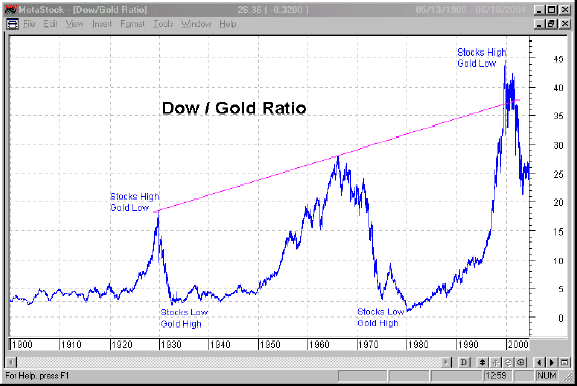
Marc Faber:"One Day the Price of Gold Will Be Higher than the Dow Jones."
The biggest gold bugs have said for years that the price of gold usually mirrors the Dow Jones stock market index, and that it will eventually end up there again. For example, Peter Cooper recently wrote:
The Dow Jones Index will plunge again, way beyond the 7,000 limit target I suggested long ago for 2008, and head to 4-5,000, while at the same time the price per ounce of the yellow metal will tip the $4-5,000 an ounce level, way above the $2,000 now predicted by CitigroupI've never paid much attention to such claims, because they seemed unsubstantiated.However, last year PhD economist Krassimir Petrov looked at this question and said pretty much the same thing:
On the other hand, secular stock bear markets usually coincide with secular gold bull markets. At the secular peak for gold, the Gold-Dow ratio is in the range of 1-2. As you can see on the chart, 1900 recorded a low of 1.7; 1929 recorded a low of two; 1980 recorded a low of about one. This means that when the gold bull market peaks, the price of gold will roughly equal the Dow Jones Index (DJI). Thus, we should expect that gold outperform the DJI in the coming 10-15 years about 10-20 times, in order to bring that Dow-Gold Ratio down to the range of 1-2.
[Click for full chart] So, how high will gold go? The correct answer is simple: as high as Dow Jones.

I don't know much about Petrov. So what really caught my eye is that Marc Faber is saying something similar:"One day the price of gold will be higher than the Dow Jones."
In 2005, Faber posted the following chart:
"The CRB, a broad index of commodities, fell for 20 years in nominal terms, from 1980 to 1999. It is now up 12% and is still inexpensive. The Dow and the S&P are up substantially from the 1980s or early 1990s. Everyone thinks fiscal and monetary measures will work to fix the financial system. I don't. They will be disastrous and fuel inflation.

Simply put, since 2000, gold has risen at a much faster clip than the Dow Jones and I would expect this out-performance to continue for the next few years until "gold currency" holders will be able to buy one Dow Jones with just one ounce of gold.So, if Mr. Bernanke does what he believes in - namely that asset deflation has to be avoided at all cost and, therefore, massively prints money, no matter where the Dow will be in future, at 36,000, 40,000, or at 100,000, as some pundits predicted in their in 1999 published books (of course shortly before the market tumbled), you will be able to buy the Dow with ounce of gold worth either $36,000, $40,000 or $100,000.
Now, you may think that I have become insane. That is partially true because I am convinced that the US Fed's monetary policies will lead to exponentially widening wealth inequity and impoverish the majority of US households, which will then lead to social strive, protectionism, war, and the breakdown of the capitalistic system. However, if one considers that in 1932 and in 1980 (see figure 5) one could indeed buy one Dow Jones Industrial Average with just one ounce of gold, then maybe my views are rather conservative. Possibly one will be able to buy, sometime in future, one Dow Jones with just half an ounce of gold!
The Maestro Changes His Tune
Alan Greenspan - nicknamed "The Maestro" for the way he "conducted" the economy - is changing his tune:
- One of the main cheerleaders for credit default swaps, he now admits they are extremely dangerous
- Greenspan previously argued that economists had conquered the business cycle, and that modern, technologically advanced financial markets are best left to police themselves. But he now says that we're in the worst crisis since the 1930's (modern technology didn't help), that regulation is needed, and that banks will need to be nationalized
- And last, but not least, the man who preached that a new bubble be blown every time the last one bursts is now warning against the government incurring too much debt:
“Much of the fiscal deficit is being funded by foreigners who see U.S. government debt as the ultimate safe haven in all this turbulence,” Greenspan said. “The long American history of honoring our obligations, dating back to Alexander Hamilton, remains a powerful attraction to foreign investors. But there is obviously a limit to the expansion of U.S. federal debt.”
Tuesday, February 17, 2009
What To Do For Fun in a Depression
Even in the middle of a depression, you can still have fun if you are creative or goofy enough:
Not Just a Few Bad Apples - Corruption is Systemic in America
In case you believe that there are only "a couple of bad apples" in the United States, here is an off-the-top-of-my-head list of corruption by leading pillars of American society:
- Senior military officials stole approximately $125 billion dollars out of Iraq reconstruction funds, dwarfing Madoff's $50 billion Ponzi scheme (in turn, the looting which is now occurring under the bailout/stimulus programs will far surpass $150 billion)
- Texas billionaire Robert Stanford ran a multi-billion dollar fraud scheme of his own
- Senior judges in Pennsylvania have pleaded guilty to falsely convicting and imprisoning hundreds of youths (they got kickbacks from the prisons).
- The government-endorsed ratings agencies which were supposed to accurately rate the credit-worthiness of companies and nations committed massive fraud
There are hundreds of similar stories of corruption which have come out recently.
But surely government employees would have done something to stop such corruption if had known about it, right?
Well, actually:
- Whistleblowers alerted the government about the looting of Iraq reconstruction funds, but nothing was done
- A whistleblower "gift-wrapped and delivered" the Madoff scandal to the SEC, but they refused to take action
- The Treasury department allowed banks to "cook their books"
- The Pennsylvania Supreme Court refused to hear a case regarding the corrupt judges. A month later, only after the judges confessed to criminal wrongdoing, did the Supreme Court change its mind and take any interest
- Instead of insisting on accurate books, the government encouraged fraudulent bookkeeping. For example, as of 2006:
"President George W. Bush has bestowed on his intelligence czar ... broad authority, in the name of national security, to excuse publicly traded companies from their usual accounting and securities-disclosure obligations."
- The government knew about mortgage fraud a long time ago. For example, the FBI warned of an "epidemic" of mortgage fraud in 2004. However, the FBI, DOJ and other government agencies then stood down and did nothing. See this and this
Economic News is Disastrous Worldwide
Indications from around the world show that the global depression is deepening. Here is a roundup giving the pulse of developments:
- Eastern Europe is tanking, and Moody's is warning that Eastern Europe's troubles could spell disaster for banks in Western Europe
- Indeed, the Telegraph paints a stark picture of the potential effects of Eastern Europe's meltdown:
If mishandled by the world policy establishment, this debacle is big enough to shatter the fragile banking systems of Western Europe and set off round two of our financial Götterdämmerung.
Austria's finance minister Josef Pröll made frantic efforts last week to put together a €150bn rescue for the ex-Soviet bloc. Well he might. His banks have lent €230bn to the region, equal to 70pc of Austria's GDP.
"A failure rate of 10pc would lead to the collapse of the Austrian financial sector," reported Der Standard in Vienna. Unfortunately, that is about to happen.
The European Bank for Reconstruction and Development (EBRD) says bad debts will top 10pc and may reach 20pc. The Vienna press said Bank Austria and its Italian owner Unicredit face a "monetary Stalingrad" in the East.
- Danske bank is saying that Central and Eastern European countries are "melting down"
- American banks may be insolvent, but Nouriel Roubini says that European banks may be in even worse shape than their U.S. counterparts
- China's much-touted recovery looks to be a mirage. It has now come out that many of the loans being given out were sham transactions just for show, and that a lot of China's stimulus package went to boosting the stock market, not real economic recovery
- Japan - which economists had predicted might ride out the crisis better than most - is tanking
- Huge moves are apparently being made in the forex and futures markets which do not bode well for economic stability
- The Leap2020 forecasters say that governments have not learned anything from the crisis, and are now predicting the collapse of nations and many currencies as a result of the financial crisis and the countries' failure to stabilize the economy
Respected Economist John Williams Advises Hoarding Gold And Booze To Barter
Respected economist John Williams has been tracking the real fundamentals of the economy for many years at his website Shadow Stats.
Williams believes that the printing of trillions of dollars to fight the depression will lead to a "hyperinflationary depression".
Williams is advising people to stock up on gold and booze to bargain with once the hyperinflation makes dollars worthless:
“Three or four years into the future I think we could be in a hyperinflation, within the current year you’re going to see much higher inflation than most people are looking at,” Williams told MarketWatch.
Williams said that his definition of hyperinflation would be a situation in which a $100 dollar bill would become more functional as a piece of toilet paper than a store of value.
“This is a time when you want to preserve your wealth and assets because inflation will knock the value out of it,” he added, advising that people buy physical gold and assets other than the U.S. dollar.
“Then when the hyperinflation hits you’ll see disruption of normal commerce, you won’t have enough $100 dollar bills to buy what you want,” said Williams, adding that items to barter with, such as a bottle of scotch, would be more valuable than actual cash, even in large quantities.


 Posts
Posts