Tuesday, December 1, 2009
Questions for Bernanke's Senate Confirmation Hearing
The Senate Banking Committee will be chatting with Ben Bernanke this Thursday to vote on his reappointment.
Demand that the Committee ask the following questions for our esteemed Esteemed Chairman (and contact your own Senators also and demand that they find out the answers to the following questions). If you are a Senate aide, please get these questions to your Senator.
High-Level Fed Officials Slam Bernanke
Fed Vice Chairman Donald Kohn conceded that the government's actions "will reduce [companies'] incentive to be careful in the future." In other words, he's admitting that the government's actions will encourage financial companies to make even riskier gambles in the future.
Kansas City Fed President and veteran Fed official Thomas Hoenig said:
Too big has failed....
The sequence of [the government's] actions, unfortunately, has added to market uncertainty. Investors are understandably watching to see which institutions will receive public money and survive as wards of the state...The current head of the Philadelphia fed bank, Charles Plosser, disagrees with Bernanke's strategy of the endless printing-press and ever-increasing fed balance sheet:
Any financial crisis leaves a stream of losses among the various participants, and these losses must ultimately be borne by someone. To start the resolution process, management responsible for the problems must be replaced and the losses identified and taken. Until these actions are taken, there is little chance to restore market confidence and get credit markets flowing. It is not a question of avoiding these losses, but one of how soon we will take them and get on to the process of recovery....
Many of the [government's current policy revolves around the idea of] "too big to fail" .... History, however, may show us a different experience. When examining previous financial crises, both in other countries as well as the United States, large institutions have been allowed to fail. Banking authorities have been successful in placing new and more responsible managers and directions in charge and then reprivatizing them. There is also evidence suggesting that countries that have tried to avoid taking such steps have been much slower to recover, and the ultimate cost to taxpayers has been larger...
Plosser urged the Fed to "proceed with caution" with the new policy. Others outside the Fed are much more strident and want plans in place immediately to reverse it. They believe an inflation storm is already in train.***
Bernanke argued that focusing on the size of the balance sheet misses the point, arguing the Fed's various asset purchase programs are not easily summarized in a single number.
But Plosser said that the growth of the Fed's balance sheet was a key metric."It is not appropriate to ignore quantitative metrics in this new policy environment," Plosser said...Plosser is bringing the spotlight right back to the Fed's balance sheet."The size of the balance sheet does offer a possible nominal anchor for monitoring the volume of our liquidity provisions," Plosser said.
The former head of the Fed's Open Market Operations says the bailout might make things worse. Specifically, the former head of the Fed's open market operation - the key Fed agency which has been loaning hundreds of billions of dollars to Wall Street companies and banks - was quoted in Bloomberg as saying:
"Every time you tinker with this delicate system even small changes can create big ripples,'' said Dino Kos, former head of the New York Fed's open-market operations . . . "This is the impossible situation they are in. The risks are that the government's $700 billion purchase of assets disturbs markets even more.''And William Poole, who recently left his post as president of the St. Louis Fed, is essentially calling Bernanke a communist:
But the strongest criticism may be from the former Vice President of Dallas Federal Reserve, who said that the failure of the government to provide more information about the bailout could signal corruption. As ABC writes:Poole said he was very concerned that the Fed could simply lend money to anyone, without constraint.In the Soviet Union and Eastern Europe during the Cold War era, economies were inefficient because they had a soft-budget constraint. If a firm got into trouble, the banking system would give them more money, Poole said.The current situation at the Fed seems eerily similar, he said."What is discipline - where are the hard choices - when does Fed say our resources are exhausted?" Poole asked.
Gerald O'Driscoll, a former vice president at the Federal Reserve Bank of Dallas and a senior fellow at the Cato Institute, a libertarian think tank, said he worried that the failure of the government to provide more information about its rescue spending could signal corruption.Of course, former Fed chairman Paul Volcker has also strongly criticized current Fed policies.
"Nontransparency in government programs is always associated with corruption in other countries, so I don't see why it wouldn't be here," he said.
Given such harsh criticism from within the Fed, how can Bernanke justify his actions to date?
Global Agencies Slam Bernanke
The Bank of International Settlements (BIS) - called "the central banks' central bank" - has slammed the Fed for blowing bubbles and then "using gimmicks and palliatives" which "will only make things worse".
As the Telegraph wrote in June 2007:
The Bank for International Settlements, the world's most prestigious financial body, has warned that years of loose monetary policy has fuelled a dangerous credit bubble, leaving the global economy more vulnerable to another 1930s-style slump than generally understood...
The BIS, the ultimate bank of central bankers, pointed to a confluence a worrying signs, citing mass issuance of new-fangled credit instruments, soaring levels of household debt, extreme appetite for risk shown by investors, and entrenched imbalances in the world currency system...
The bank said it was far from clear whether the US would be able to shrug off the consequences of its latest imbalances ...
"Sooner or later the credit cycle will turn and default rates will begin to rise," said the bank.
A year later, in June 2008, the Telegraph wrote:
A year ago, the Bank for International Settlements startled the financial world by warning that we might soon face challenges last seen during the onset of the Great Depression. This has proved frighteningly accurate...
[BIS economist] Dr White says the US sub-prime crisis was the "trigger", not the cause of the disaster.
Indeed, BIS slammed the Fed and other central banks for blowing the bubble, failing to regulate the shadow banking system, and then using gimmicks which will only make things worse. As the 2008 Telegraph article notes:
In a pointed attack on the US Federal Reserve, it said central banks would not find it easy to "clean up" once property bubbles have burst...
Nor does it exonerate the watchdogs. "How could such a huge shadow banking system emerge without provoking clear statements of official concern?"
"The fundamental cause of today's emerging problems was excessive and imprudent credit growth over a long period. Policy interest rates in the advanced industrial countries have been unusually low," he said.
The Fed and fellow central banks instinctively cut rates lower with each cycle to avoid facing the pain. The effect has been to put off the day of reckoning...
"Should governments feel it necessary to take direct actions to alleviate debt burdens, it is crucial that they understand one thing beforehand. If asset prices are unrealistically high, they must fall. If savings rates are unrealistically low, they must rise. If debts cannot be serviced, they must be written off.
"To deny this through the use of gimmicks and palliatives will only make things worse in the end," he said.
In other words, BIS slammed the easy credit policy of the Fed and other central banks, and the failure to regulate the shadow banking system.
More dramatically, BIS slammed "the use of gimmicks and palliatives", and said that anything other than (1) letting asset prices fall to their true market value, (2) increasing savings rates, and (3) forcing companies to write off bad debts "will only make things worse".
But Bernanke and the other central bankers (as well as Treasury and the Council of Economic Advisors and Barney Frank and Chris Dodd and the others in control of American and British and French and Japanese and German and virtually every other country's economic policy) ignored BIS' advice in 2007 and 2008, and they are still ignoring it today.
Instead, they are doing everything they can to (2) prop up asset prices by trying to blow a new bubble by giving banks trillions, (2) re-write accounting and reporting rules to let the big banks and other giants keep bad debts on their books (or in sivs or other "second sets of books") and to hide the fact that they are bad debts, and (3) encourage consumers to spend spend spend!
"The world's most prestigious financial body", "the ultimate bank of central bankers" has condemned Bernanke and all of the other G-8 central banks, and stripped bare their false claims that the crash wasn't their fault or that they are now doing the right thing to turn the economy around.
As Spiegel wrote in July of this year:
White and his team of experts observed the real estate bubble developing in the United States. They criticized the increasingly impenetrable securitization business, vehemently pointed out the perils of risky loans and provided evidence of the lack of credibility of the rating agencies. In their view, the reason for the lack of restraint in the financial markets was that there was simply too much cheap money available on the market...
As far back as 2003, White implored central bankers to rethink their strategies, noting that instability in the financial markets had triggered inflation, the "villain" in the global economy...
In the restrained world of central bankers, it would have been difficult for White to express himself more clearly...
It was probably the biggest failure of the world's central bankers since the founding of the BIS in 1930. They knew everything and did nothing. Their gigantic machinery of analysis kept spitting out new scenarios of doom, but they might as well have been transmitted directly into space...In their report, the BIS experts derisively described the techniques of rating agencies like Moody's and Standard & Poor's as "relatively crude" and noted that "some caution is in order in relation to the reliability of the results."...
In January 2005, the BIS's Committee on the Global Financial System sounded the alarm once again, noting that the risks associated with structured financial products were not being "fully appreciated by market participants." Extreme market events, the experts argued, could "have unanticipated systemic consequences."
They also cautioned against putting too much faith in the rating agencies, which suffered from a fatal flaw. Because the rating agencies were being paid by the companies they rated, the committee argued, there was a risk that they might rate some companies too highly and be reluctant to lower the ratings of others that should have been downgraded.
These comments show that the central bankers knew exactly what was going on, a full two-and-a-half years before the big bang. All the ingredients of the looming disaster had been neatly laid out on the table in front of them: defective rating agencies, loans repackaged to the point of being unrecognizable, dubious practices of American mortgage lenders, the risks of low-interest policies. But no action was taken. Meanwhile, the Fed continued to raise interest rates in nothing more than tiny increments...
The Fed chairman was not even impressed by a letter the Mortgage Insurance Companies of America (MICA), a trade association of US mortgage providers, sent to the Fed on Sept. 23, 2005. In the letter, MICA warned that it was "very concerned" about some of the risky lending practices being applied in the US real estate market. The experts even speculated that the Fed might be operating on the basis of incorrect data. Despite a sharp increase in mortgages being approved for low-income borrowers, most banks were reporting to the Fed that they had not lowered their lending standards. According to a study MICA cited entitled "This Powder Keg Is Going to Blow," there was no secondary market for these "nuclear mortgages."...
William White and his Basel team were dumbstruck. The central bankers were simply ignoring their warnings. Didn't they understand what they were being told? Or was it that they simply didn't want to understand?
The head of the World Bank also says:
Central banks [including the Fed] failed to address risks building in the new economy. They seemingly mastered product price inflation in the 1980s, but most decided that asset price bubbles were difficult to identify and to restrain with monetary policy. They argued that damage to the 'real economy' of jobs, production, savings, and consumption could be contained once bubbles burst, through aggressive easing of interest rates. They turned out to be wrong.
Given such piercing criticisms from BIS and the World Bank, how can Mr. Bernanke justify his actions to date?
Economists Slam Bernanke
Stephen Roach (former chief economist for Morgan Stanley, and now director of Morgan Stanley Asia) is one of the most influential and respected American economists. Roach told Charlie Rose recently that we have had terrible Federal Reserve policy for the past 12 years under Greenspan and Bernanke, that they concocted hair-brained theories (for example, that we should let the boom and bust cycle occur, but then "clean up the mess" once things fall apart), and that we really need to reform the Fed.
Specifically, here's the must-read portion of the interview:STEPHEN ROACH: And what’s missing in the debate that drives me nuts is going back to the very function of central banking that’s at the core of our financial system. Do we have the right model for the Fed to go forward? And, you know, I think we’ve minimized the role that the custodians, the stewards of our financial
system, the Federal Reserve, played in leading to this crisis and in making sure that we will never have this again. I think we’ve had horrible central banking in the United States for the past dozen of years. I mean, we elevate our central bankers, we probably .
CHARLIE ROSE: From Greenspan to Bernanke.
STEPHEN ROACH: Yeah.
CHARLIE ROSE: Both.
STEPHEN ROACH: We call them maestro, and, you know, we make them
sound larger than life. And, you know, and the fact is, they condoned
policies that took us from one bubble to another. They failed to live up
to their regulatory responsibility granted them by law. They concocted new
theories to explain why these things could go on forever, and they harbored
the belief, mistakenly in my view, that monetary policy is too big and
blunt an instrument, and so you just bring it in to clean up the mess
afterwards rather than prevent a mess ahead of time. Well, look at the
mess we’re in right now. We need a different approach here. We really do.
Moreover, prominent Wall Street economist Henry Kaufman says that the Federal Reserve is primarily to blame for the financial crisis:
Economist Marc Faber says that central bankers are money printers who create bubbles, and that the system would be much better now if the Fed hadn't intervened. Specifically, Faber says that - if the Fed hadn't intervened - the system would be cleaned out, the system would be healthier because debt load and burden on taxpayers would be reduced."I am convinced that the misbehavior of some would have been much rarer -- and far less damaging to our economy -- if the Federal Reserve and, to a lesser extent, other supervisory authorities, had measured up to their responsibilities ...
Kaufman directly criticized former Federal Reserve Chairman Alan Greenspan for not using his position to dissuade big banks and others from taking big risks.
"Alan Greenspan spoke about irrational exuberance only as a theoretical concept, not as a warning to the market to curb excessive behavior," Kaufman said. "It is difficult to believe that recourse to moral suasion by a Fed chairman would be ineffective."
Partly because the Fed did not strongly oppose the repeal in 1999 of the Depression-era Glass-Steagall Act, more large financial conglomerates that were "too big to fail" have formed, Kaufman said, citing a factor that has made the global credit crisis especially acute.
"Financial conglomerates have become more and more opaque, especially about their massive off-balance-sheet activities," he said. "The Fed failed to rein in the problem."...
"Much of the recent extreme financial behavior is rooted in faulty monetary policies," he said. "Poor policies encourage excessive risk taking."
Economist Jane D'Arista has shown that the Fed has failed miserably at its main task: providing a "counter-cyclical" influence (that is, taking the punch bowl away before the party gets too wild).
The Fed has also failed miserably in its role as regulator of banks and their affiliates. As well-known economist James Galbraith says:
The Federal Reserve has never been an effective regulator for the straightforward reason that it is dominated by economists and bankers and not by dedicated skeptics who make bank regulation a full-time profession.As PhD economist Steve Keen has pointed out, the Fed (along with Treasury) has also given money to the wrong people to kick-start the economy.
Given such devastating criticism from prominent economists, how can Mr. Bernanke justify his actions to date?
Unemployment
The Federal Reserve is mandated by law to maximize employment. The relevant statute states:
The Board of Governors of the Federal Reserve System and the Federal Open Market Committee shall maintain long run growth of the monetary and credit aggregates commensurate with the economy's long run potential to increase production, so as to promote effectively the goals of maximum employment, stable prices, and moderate long-term interest rates.However, PhD economist Dean Baker says:
The country now has almost 25 million people who are unemployed or underemployed as a result of the Fed's disastrous policies. Millions of people are losing their homes and tens of millions are losing their life savings. The country is likely to lose more than $6 trillion in output ($20,000 per person) due to the Fed's inept job performance.The Fed could have stemmed the unemployment crisis by demanding that banks lend more as a condition to the various government assistance programs, but Mr. Bernanke failed to do so.
Ryan Grim argues that the Fed might have broken the law by letting unemployment rise in order to keep inflation low:
In fact, the unemployment situation is getting worse, and many leading economists say that - under Mr. Bernanke's leadership - America is suffering a permanent destruction of jobs.The Fed is mandated by law to maximize employment, but focuses on inflation -- and "expected inflation" -- at the expense of job creation. At its most recent meeting, board members bluntly stated that they feared banks might increase lending, which they worried could lead to inflation.
Board members expressed concern "that banks might seek to reduce appreciably their excess reserves as the economy improves by purchasing securities or by easing credit standards and expanding their lending substantially. Such a development, if not offset by Federal Reserve actions, could give additional impetus to spending and, potentially, to actual and expected inflation." That summary was spotted by Naked Capitalism and is included in a summary of the minutes of the most recent meeting...
Suffering high unemployment in order to keep inflation low cuts against the Fed's legal mandate. Or, to put it more bluntly, it may be illegal.
For example, JPMorgan Chase’s Chief Economist Bruce Kasman told Bloomberg:
[We've had a] permanent destruction of hundreds of thousands of jobs in industries from housing to finance.The chief economists for Wells Fargo Securities, John Silvia, says:
And former Merrill Lynch chief economist David Rosenberg writes:Companies “really have diminished their willingness to hire labor for any production level,” Silvia said. “It’s really a strategic change,” where companies will be keeping fewer employees for any particular level of sales, in good times and bad, he said.
The number of people not on temporary layoff surged 220,000 in August and the level continues to reach new highs, now at 8.1 million. This accounts for 53.9% of the unemployed — again a record high — and this is a proxy for permanent job loss, in other words, these jobs are not coming back. Against that backdrop, the number of people who have been looking for a job for at least six months with no success rose a further half-percent in August, to stand at 5 million — the long-term unemployed now represent a record 33% of the total pool of joblessness.And see this.
Given that the law mandates that the Fed maximize employment, but that unemployment is instead becoming catastrophic under Mr. Bernanke's watch, how can Mr. Bernanke justify his actions to date?
The Fed says that we should reduce leverage, but is doing everything in its power to increase leverage.
Specifically, the New York Federal published a report in July entitled "The Shadow Banking System: Implications for Financial Regulation".
One of the main conclusions of the report is that leverage undermines financial stability:
Securitization was intended as a way to transfer credit risk to those better able to absorb losses, but instead it increased the fragility of the entire financial system by allowing banks and other intermediaries to “leverage up” by buying one another’s securities. In the new, post-crisis financial system, the role of securitization will likely be held in check by more stringent financial regulation and by the recognition that it is important to prevent excessive leverage and maturity mismatch, both of which can undermine financial stability.
And as a former economist at the New York Fed, Richard Alford, wrote recently:
On Friday, William Dudley, President of FRBNY, gave an excellent presentation on the financial crisis. The speech was a logically-structured, tightly-reasoned, and succinct retrospective of the crisis. It took one step back from the details and proved a very useful financial sector-wide perspective. The speech should be read by everyone with an interest in the crisis. It highlights the often overlooked role of leverage and maturity mismatches even as its stated purpose was examining the role of liquidity.
While most analysts attributed the crisis to either specific instruments, or elements of the de-regulation, or policy action, Dudley correctly identified the causes of the crisis as the excessive use of leverage and maturity mismatches embedded in financial activities carried out off the balance sheets of the traditional banking system. The body of the speech opens with: “..this crisis was caused by the rapid growth of the so-called shadow banking system over the past few decades and its remarkable collapse over the past two years.”
In fact, every independent economist has said that too much leverage was one of the main causes of the current economic crisis.
Federal Reserve Bank of San Francisco President Janet Yellen said recently that it’s “far from clear” whether the Fed should use interest rates to stem a surge in financial leverage, and urged further research into the issue.“Higher rates than called for based on purely macroeconomic conditions may help forestall a potentially damaging buildup of leverage and an asset-price boom”.And on September 24th, Congressman Keith Ellison wrote a letter to Mr. Bernanke and Geithner stating:
As you know, excessive leverage was a key component of the financial crisis. Investment banks leveraged their balance sheets to stratospheric levels by using short-term wholesale financing (like repurchase agreements and commercial paper). Meanwhile, some entities regulated as bank holding companies (BHCs) used off-balance-sheet entities to warehouse risky assets, thereby evading their regulatory capital requirements. These entities’ reliance on short-term debt to fund the purchase of oftentimes illiquid and risky assets made them susceptible to a classic bank panic. The key difference was that this panic wasn’t a run on deposits by scared individuals, but a run on collateral by sophisticated counterparties.On November 13th, Mr. Bernanke responded to Ellison (I received a copy of the letter from a Congressional source):
The Treasury highlights this very problem in its policy statement before the recent summit of G-20 finance ministers in London. To address this problem, the Treasury advocates stronger capital and liquidity standards for banking firms, including “a simple, non-risk-based leverage constraint.” The U.S. is one of only a few countries that already has leverage requirements for banks. Leverage requirements supplement risk-based capital requirements that federal banking regulators have in place pursuant to the Basel II Accord, an international capital agreement. While important features of our system of financial regulation, leverage requirements only apply to banks and bank holding companies and therefore have not covered a wide array of financial institutions, including many that are systemically important. Moreover, leverage requirements have generally not captured the considerable risks associated with off-balance-sheet activities.
Of course, the Administration looks to address the shortcomings in the existing regulatory system through a proposal to regulate large, systemically-significant financial institutions as Tier 1 Financial Holding Companies (FHCs). Building upon its existing authority as the consolidated supervisor of all BHCs (which includes FHCs), the Federal Reserve would be responsible for overseeing and regulating the Tier 1 FHCs under the plan. In the legislative draft of the proposal, the Federal Reserve would have the authority to prescribe capital requirements and other prudential standards for these institutions that are stronger than those for all other BHCs. To that point, the text specifically says, “The prudential standards shall be more stringent than the standards applicable to bank holding companies to reflect the potential risk posed to financial stability by United States Tier 1 financial holding companies and shall include, but not be limited to—(A) risk-based capital requirements; (B) leverage limits; (C) liquidity requirements; and (D) overall risk management requirements.”
The application of leverage limits – as advanced by the Treasury’s G-20 policy statement and by the Administration’s financial regulatory reform plan – is a simple and elegant way to limit risk at specific financial institutions (and within the overall financial system). The financial crisis has underscored the importance of leverage requirements and manifested the problems associated with relying upon risk-based capital requirements alone ...
Nevertheless, there are some open questions regarding exactly how a leverage requirement should be applied. Some scholars and policy experts have advocated putting in place a leverage requirement for banks and other financial institutions that is set in statute. As Congress moves forward on comprehensive financial regulatory reform, it may consider such a requirement. I would therefore be interested to hear your views regarding the wisdom of such an approach.
As you know, setting capital standards requires decisions regarding what institutions would be covered, how capital would be defined, and what levels the requirements would be set. In light of that, what specific difficulties would you anticipate Congress facing with respect to specifying such a requirement? In addition, would a statutory requirement be too inflexible and place too many constraints on regulators with respect to refining regulatory capital requirements and negotiating with bank regulators from other countries?
The Board's authority and flexibility in establishing capital requirements, including leverage requirements, have been key to the Board's ability to require additional capital where needed based on a banking organization's risk profile. One of the lessons learned in the recent financial crisis is the need for financial supervisors to have the ability to react quickly to changing circumstances, as in the capital assessments conducted in the Supervisory Capital Assessment Program. The Board and other federal banking agencies initiated this program to conduct a comprehensive, forward-looking assessment of the capital positions ofthe nation's 19 largest bank holding companies (BHCs). The Board's authority to mandate specific levels of capital was critical to this exercise because each BHC had a unique set of risks and circumstances that demanded careful supervisory scrutiny and evaluation in order to identify the amount of capital appropriate for its safe and sound operation. The Board required corrective actions on a case-by-case basis and continues to assess the capital positions ofthese institutions as well as all others under its supervision.The Supervisory Capital Assessment Program Mr. Bernanke refers to were the infamous "stress tests". There's just one little problem: the stress tests were a complete complete sham.
We note that in other contexts, statutorily prescribed minimum leverage ratios have not necessarily served prudential regulators of financial institutions well. Previously, the minimum capital requirements for the housing government-sponsored enterprises Fannie Mae and Freddie Mac (collectively, "GSEs") were fixed in statute; the risk-based capital requirement for the GSEs was based on a stress test that was also set forth in statute; and the GSE's regulator, the Director ofthe Office of Financial Housing Enterprise Oversight (the predecessor agency to the Federal Housing Finance Authority) did not have the authority to establish additional capital requirements for the GSEs. This limitation was different from the authority that the federal banking agencies have to set the leverage and risk-based capital requirements for banking organizations. In 2008, Congress enacted the Housing and Economic Recovery Act of 2008, which created FHFA and empowered it to establish additional minimum leverage and risk-based capital requirements for the GSEs.
With regard to the Board and other U.S. banking agencies' efforts to join with international supervisors to strengthen capital requirements for internationally active banking organizations, the Basel Committee is working on proposals for an international supplement to minimum risk-based capital ratios. While this work is in process, it is likely that these efforts will take the form of a minimum leverage ratio. It will be important for the international regulatory community to carefully calibrate the aggregate effect ofthis initiative, along with other efforts underway that are intended to strengthen capital requirements, to ensure that they protect against future financial crises while not raising capital requirements to such a degree that the availability of credit to support economic growth is unduly constrained. The current authority and flexibility the Board has to establish and modify leverage ratios as a banking organization regulator is very important to the successful participation of the Board in the process of establishing and calibrating an international leverage ratio.
In reality, the Fed has been one the biggest enablers for increased leverage. As anyone who has looked at Mr. Bernanke and Geithner's actions will tell you, many of the government's programs are aimed at trying to re-start securitization and the "shadow banking system", and to prop up asset prices for highly-leveraged financial products.
Indeed, Mr. Bernanke said in February:
In an effort to restart securitization markets to support the extension of credit to consumers and small businesses, we joined with the Treasury to announce the Term Asset-Backed Securities Loan Facility (TALF).And he said it again in September:
The Term Asset-Backed Securities Loan Facility, or TALF ... has helped restart the securitization markets for various types of consumer and small business credit. Securitization markets are an important source of credit, and their virtual shutdown during the crisis has reduced credit availability for many borrowers.Given that the Fed admits that too much leverage is destabilizing to our financial system, how can Mr. Bernanke justify his actions to date in increasing leverage?
Has the Fed Manipulated any Markets?
There are allegations that the Fed has manipulated the markets.
Has the Fed - directly or as part of the President's Working Group on Financial Markets or any other group or organization - manipulated any markets?
Trillions in Unnecessary Interest to the American People
Many people - including former analyst for the U.S. Treasury Richard Cook - argue that credit is too important a function to be left to the private banks. AFL-CIO president Richard Trumka told Congress recently:
If the Federal Reserve were made a fully public body, it would be an acceptable alternative.Bloomberg News columnist Matthew Lynn writes:
The U.K. government needs to start thinking about what it will do with all the banks it now owns. The answer is simple: Hand them to the people...Michael Moore recommends that the American people demand:
Instead of selling the stakes it acquired in the financial system to other banks, or listing the shares on the stock market, it could create mutually owned societies. Royal Bank of Scotland Group Plc could be a people’s bank, owned by everyone.That would ensure more diversity, competition and stability, all goals just as worthy as getting back the money Prime Minister Gordon Brown’s government spent on bank rescues...
Each of the 50 states must create a state-owned public bank like they have in North Dakota. Then congress MUST reinstate all the strict pre-Reagan regulations on all commercial banks, investment firms, insurance companies -- and all the other industries that have been savaged by deregulation: Airlines, the food industry, pharmaceutical companies -- you name it. If a company's primary motive to exist is to make a profit, then it needs a set of stringent rules to live by -- and the first rule is "Do no harm." The second rule: The question must always be asked -- "Is this for the common good?" (Click here for some info about the state-owned Bank of North Dakota.)As Moore notes, the state of North Dakota already has such a bank, and - because of that - North Dakota is just about the only state which is not running a huge deficit.
PhD economist and candidate for Florida governor Farid Khavari wants to create a Bank of the State of Florida, to create credit without burdening the state and its citizens with high interest charges by private banks. See this for details.
If the power to create credit were taken away from the Federal Reserve system and its private banks and given back to the government (as the Constitution envisioned), then American taxpayers would save hundreds of billions or trillions of dollars in unnecessary interest charges in paying off the national debt, as the government would not have to pay interest to finance its debt (sovereign nations such as the U.S. and England have the power to create credit and money; see this, this, this, and this).
Given that America is already deeply in debt, how can Mr. Bernanke justify the ongoing mountain of interest debts placed on the backs of the American people by the private credit-creation system of which the Fed is a part?
Failure to Disclose Who Received Bailout Money
The whole issue of the Fed's failure to disclose who received bailout money and other emergency largess courtesy of the American taxpayer is another important line of questioning. Many others have already written extensively on this issue, so I will not reinvent the wheel here.


Keynesians Are Wrong: We CAN (And Very Well May) Have Disinflation With Rising Real Interest Rates, Which Could Hasten the Decline of American Power
One of the world's leading economic historians - Niall Ferguson - has previously pointed out that too much debt can drive countries into default:
There are economic professors in American universities who think they are masters of the universe, but they don't have any historical knowledge. I have never believed that markets are self correcting. No historian could...
"The idea that countries don't go bust is a joke... The debt trap may be about to spring ... for countries that have created large stimulus packages in order to stimulate their economies."
(Keen, Roubini, Morgan Stanley and many others are warning about a debt crisis as well).
Ferguson now points out in a must-read article he wrote for Newsweek that we might get falling inflation (disinflation or deflation) and rising real interest rates:
So here's another scenario—which in many ways is worse than the inflation scenario. What happens is that we get a rise in the real interest rate, which is the actual interest rate minus inflation. According to a substantial amount of empirical research by economists, including Peter Orszag (now at the Office of Management and Budget), significant increases in the debt-to-GDP ratio tend to increase the real interest rate. One recent study concluded that "a 20 percentage point increase in the U.S. government-debt-to-GDP ratio should lead to a 20–120 basis points [0.2–1.2 percent] increase in real interest rates." This can happen in one of three ways: the nominal interest rate rises and inflation stays the same; the nominal rate stays the same and inflation falls; or—the nightmare case—the nominal interest rate rises and inflation falls.
Today's Keynesians deny that this can happen. But the historical evidence is against them. There are a number of past cases (e.g., France in the 1930s) when nominal rates have risen even at a time of deflation. What's more, it seems to be happening in Japan right now. Just last week Hirohisa Fujii, Japan's new finance minister, admitted that he was "highly concerned" about the recent rise in Japanese government bond yields. In the very same week, the government admitted that Japan was back in deflation after three years of modest price increases.
It's not inconceivable that something similar could happen to the United States. Foreign investors might ask for a higher nominal return on U.S. Treasuries to compensate them for the weakening dollar. And inflation might continue to surprise us on the downside. After all, consumer price inflation is in negative territory right now.
Why should we fear rising real interest rates ahead of inflation? The answer is that for a heavily indebted government and an even more heavily indebted public, they mean an increasingly heavy debt-service burden. The relatively short duration (maturity) of most of these debts means that a large share has to be rolled over each year. That means any rise in rates would feed through the system scarily fast.
Already, the federal government's interest payments are forecast by the CBO to rise from 8 percent of revenues in 2009 to 17 percent by 2019, even if rates stay low and growth resumes. If rates rise even slightly and the economy flatlines, we'll get to 20 percent much sooner. And history suggests that once you are spending as much as a fifth of your revenues on debt service, you have a problem. It's all too easy to find yourself in a vicious circle of diminishing credibility. The investors don't believe you can afford your debts, so they charge higher interest, which makes your position even worse....
The precedents are certainly there. Habsburg Spain defaulted on all or part of its debt 14 times between 1557 and 1696 and also succumbed to inflation due to a surfeit of New World silver. Prerevolutionary France was spending 62 percent of royal revenue on debt service by 1788. The Ottoman Empire went the same way: interest payments and amortization rose from 15 percent of the budget in 1860 to 50 percent in 1875. And don't forget the last great English-speaking empire. By the interwar years, interest payments were consuming 44 percent of the British budget, making it intensely difficult to rearm in the face of a new German threat.
Call it the fatal arithmetic of imperial decline. Without radical fiscal reform, it could apply to America next.
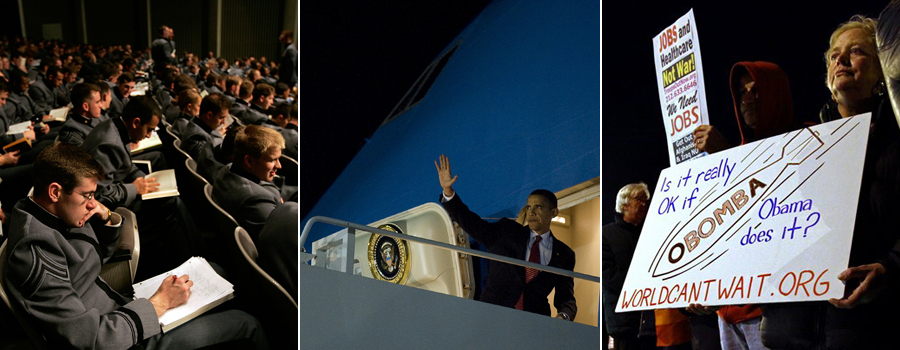
OBOMBA
One of the best comments on America's never-ending wars in Iraq and Afghanistan I've seen recently:
For evidence that the Iraq war is unnecessary, see this. Read this for evidence that the U.S. could have taken Bin Laden out years ago and avoided a decades-long war in Afghanistan. And for proof that the entire war on Muslim extremists is unnecessary for our national security, see this.OBOMBA
Is it really okay if Obama does it?
And for proof that war is very harmful to the economy, see this, this and this.
Yes, I know that Obama didn't start the wars. And I voted for Obama and had high hopes for him.
After all, on October 27, 2007, Obama said:
I will promise you this, that if we have not gotten our troops out by the time I am president, it is the first thing I will do. I will get our troops home. We will bring an end to this war. You can take that to the bank.
Obama broke his promise. There is absolutely no reason to still be in Iraq or Afghanistan. Obama is no different from Bush when it comes to elective warmongering.
Obama's new nickname: OBOMBA.
I originally saw the slogan here.
Monday, November 30, 2009
Taleb: "I Will ...Structure Trades With My Universa Friends To Bet On The Next Mistake By Bernanke, Summers, And Geithner."
Famed financial expert and investment advisor Nassim Nicholas Taleb has revealed his new trading strategy:
I will also structure trades with my Universa friends to bet on the next mistake by Bernanke, Summers, and Geithner.
In an investing climate where not much else is certain, Taleb is betting that the three stooges will continue to make staggeringly huge blunders.
Robert Reich: "Shame Won't Work. Only Political Muscle and Courage Will"
Obama is planning to "shame" the big banks who are not agreeing to modify mortgages.
This is a repeat of Bernanke's play book ... scold the giant banks for failing to lend, but then give them a pat on the back and a wink.
As Robert Reich points out:
Moreover, Dean Baker points out that modifying mortgages will help the too big to fails a lot more than the homeowners themselves.Shame? If we've learned anything over the last year, it's that Wall Street has none. Eight months ago Wall Street lobbyist beat back a proposal to give bankruptcy judges the right to amend mortgages in order to pressure lenders to reduce principle owed, just like Wall Street lobbyists are now beating back tough regulations to prevent the Street from causing another meltdown. Goldman Sachs, attempting to preempt a firestorm of public outrage when it dispenses its $17 billion of bonuses, is setting up a crudely conceived $500 million PR program to help Main Street.
Shame won't work. Only political muscle and courage will.
Economist: “What Passes For Help To Homeowners In The Capitol Might Look More Like Handing Out Money To Banks Anywhere Else”
PhD economist Dean Baker makes an interesting point in a new essay:
The big talk in Washington these days is "helping homeowners". Unfortunately, what passes for help to homeowners in the capitol might look more like handing out money to banks anywhere else...
It is extremely unlikely that the vast majority of underwater homeowners will ever accumulate a penny in equity. Keeping them in their homes as owners means wasting thousands of dollars a year on excess housing costs only to be forced to arrange a short sale or face a foreclosure at some future point in time.
So, who benefits from "helping homeowners" in this story? Naturally the big beneficiaries are the banks. If the government pays for a mortgage modification where the homeowner is still paying more for the mortgage than they would for rent, then the bank gets a big gift from the government, but the homeowner is still coming out behind.
In some cases the government may pay enough to buy down principle that the homeowner is no longer underwater, but the bulk of this money is a gift to the bank, not the homeowner. If a homeowner is $100,000 underwater and the government pays the bank $50,000 to write the loan down to the current value of the house, then the bank has pocketed $50,000, while the homeowner is essentially left breaking even. This is very generous to the bank, but homeowners have nothing to show in this story.
President Obama has proposed putting up $70bn to help homeowners in this way. This help for homeowners is likely to end up as a larger subsidy to the banks than the rest of the troubled asset relief programme (Tarp). The reason is that the rest of the Tarp programme was a loan. The loans were at below market interest rates - thereby providing a subsidy to the banks - but most of the money is getting paid back.
The original batch of lending to banks was $250bn. Even if we assume an average interest rate subsidy of 10 percentage points (a very large subsidy), this still implies that the lending portion of Tarp only handed $25 billion to the banks, far less than the $70 billion that we are prepared to hand them under the guise of helping homeowners.
There are simple, low-cost ways to help homeowners who were victims of the housing bubble and lending sharks. The most obvious way would be to give homeowner the right to rent their home at the market price for the next decade. But this would mean hurting the banks rather than giving them taxpayer dollars, and we still don't talk about hurting banks in Washington DC.
Maybe that's why a professor of law advises that underwater homeowners walk away from their mortgages, saying that it is not immoral to do so, Congresswoman Kaptur advises her constituents facing foreclosure to demand that the original mortgage papers be produced, and portfolio manager and investment advisor Marshall Auerback argues that a debtor's revolt would be a good thing.
Climate: We Can ALL Agree On Two Things
Whatever you think about the leaked emails showing that "tricks" were used to "hide the decline" in the climate data, and the fact that the original source data showing historical climate information was destroyed, you should agree on two things.
The Carbon Footprint of WarFirst, as Harvey Wasserman notes, continuing the wars in Afghanistan and Iraq will more than wipe out any reduction in carbon from the government's proposed climate measures. Writing about the escalation in the Afghanistan war, Wasserman says:
The war would also come with a carbon burst. How will the massive emissions created by 100,000-plus soldiers in wartime be counted in the 17% reduction rubric? Will the HumVees be converted to hybrids? What is the carbon impact of Predator bombs that destroy Afghan families and villages?
The continuance of the Afghanistan and Iraq wars completely and thoroughly undermines the government's claims that there is a global warming emergency and that reducing carbon output through cap and trade is needed to save the planet.
I can't take anything the government says about carbon footprints seriously until the government ends the unnecessary wars in Afghanistan and Iraq. For evidence that the Iraq war is unnecessary, see this. Read this for evidence that the U.S. could have taken Bin Laden out years ago and avoided a decades long war in Afghanistan. And for proof that the entire war on Muslim extremists is unnecessary for our national security, see this.
War is also very harmful to the economy. See this, this and this.
Carbon Trading
Second, the proposed solution to global warming - cap and trade - is a scam. Specifically:
- The economists who invented cap-and-trade say that it won't work for global warming
- Many environmentalists say that carbon trading won't effectively reduce carbon emissions
- Our bailout buddies over at Goldman Sachs, JP Morgan, Morgan Stanley, Citigroup and the other Wall Street behemoths are buying heavily into carbon trading (see this, this, this, this, this and this). As University of Maryland professor economics professor and former Chief Economist at the U.S. International Trade Commission Peter Morici writes:
Obama must ensure that the banks use the trillions of dollars in federal bailout assistance to renegotiate mortgages and make new loans to worthy homebuyers and businesses. Obama must make certain that banks do not continue to squander federal largess by padding executive bonuses, acquiring other banks and pursuing new high-return, high-risk lines of businesses in merger activity, carbon trading and complex derivatives. Industry leaders like Citigroup have announced plans to move in those directions. Many of these bankers enjoyed influence in and contributed generously to the Obama campaign. Now it remains to be seen if a President Obama can stand up to these same bankers and persuade or compel them to act responsibly.
In other words, the same companies that made billions off of derivatives and other scams and are now getting bailed out on your dime are going to make billions from carbon trading.
Consensus
Everyone should read the leaked emails and rationally think through what they mean. But whatever one believes about climategate (the leaked emails showing that "tricks" were used to "hide the decline" in the climate data and the destruction of the original source data), we should all be able to agree that:
(1) We should end the wars in Afghanistan and Iraq; and
(2) We should not let the financial giants who caused the financial crisis to profit off of cap and trade schemes.
The War Against Muslim Extremists is Wholly Unnecessary for Our National Security
In response to my essays documenting that war is harmful to the American economy and produces a huge carbon footprint, some commentators have argued that the Afghanistan and Iraq wars are necessary to combat Muslim extremists.
Even putting aside the fact that Saddam was an atheist who hated Muslims, the argument holds no credibility.
A leading advisor to the U.S. military, the Rand Corporation, released a study in 2008 called "How Terrorist Groups End: Lessons for Countering al Qa'ida".
The report confirms what experts have been saying for years: the war on terror is actually weakening national security (see this, this and this).
As a press release about the study states:
"Terrorists should be perceived and described as criminals, not holy warriors, and our analysis suggests that there is no battlefield solution to terrorism."
And key war on terror architect Douglas Feith has now confirmed Donald Rumsfeld, Paul Wolfowitz and Wesley Clark in admitting that the so-called War on Terror is a hoax.
In fact, starting right after 9/11 -- at the latest -- the goal has always been to create "regime change" and instability in Iraq, Iran, Syria, Libya, Sudan, Somalia and Lebanon so as to protect Israel. And the goal was never really to destroy Al Qaeda.
As reported in an article in Asia Times:
Three weeks after the September 11, 2001, terror attacks, former US defense secretary Donald Rumsfeld established an official military objective of not only removing the Saddam Hussein regime by force but overturning the regime in Iran, as well as in Syria and four other countries in the Middle East, according to a document quoted extensively in then-under secretary of defense for policy Douglas Feith's recently published account of the Iraq war decisions. Feith's account further indicates that this aggressive aim of remaking the map of the Middle East by military force and the threat of force was supported explicitly by the country's top military leaders.
Feith's book, War and Decision, released last month, provides excerpts of the paper Rumsfeld sent to President George W Bush on September 30, 2001, calling for the administration to focus not on taking down Osama bin Laden's al-Qaeda network but on the aim of establishing "new regimes" in a series of states...
***
General Wesley Clark, who commanded the North Atlantic Treaty Organization bombing campaign in the Kosovo war, recalls in his 2003 book Winning Modern Wars being told by a friend in the Pentagon in November 2001 that the list of states that Rumsfeld and deputy secretary of defense Paul Wolfowitz wanted to take down included Iraq, Iran, Syria, Libya, Sudan and Somalia [and Lebanon].
***
When this writer asked Feith . . . which of the six regimes on the Clark list were included in the Rumsfeld paper, he replied, "All of them."
***
The Defense Department guidance document made it clear that US military aims in regard to those states would go well beyond any ties to terrorism. The document said the Defense Department would also seek to isolate and weaken those states and to "disrupt, damage or destroy" their military capacities - not necessarily limited to weapons of mass destruction (WMD).
Where does Israel come in?
Well, the Asia Times article continues:
Rumsfeld's paper was given to the White House only two weeks after Bush had approved a US military operation in Afghanistan directed against bin Laden and the Taliban regime. Despite that decision, Rumsfeld's proposal called explicitly for postponing indefinitely US airstrikes and the use of ground forces in support of the anti-Taliban Northern Alliance in order to try to catch bin Laden.
Instead, the Rumsfeld paper argued that the US should target states that had supported anti-Israel forces such as Hezbollah and Hamas.
***
After the bombing of two US embassies in East Africa [in 1988] by al-Qaeda operatives, State Department counter-terrorism official Michael Sheehan proposed supporting the anti-Taliban Northern Alliance in Afghanistan against bin Laden's sponsor, the Taliban regime. However, senior US military leaders "refused to consider it", according to a 2004 account by Richard H Shultz, Junior, a military specialist at Tufts University.
A senior officer on the Joint Staff told State Department counter-terrorism director Sheehan he had heard terrorist strikes characterized more than once by colleagues as a "small price to pay for being a superpower".
Even Newsweek has now admitted that the war on terror is wholly unnecessary.
Indeed, a former U.S. National Security Adviser told the Senate that the war on terror is "a mythical historical narrative".
See also this Los Angeles Times Article, reviewing a BBC documentary entitled "The Power of Nightmares", showing that the threat from Al Qaeda has been vastly overblown (and see this article on who is behind the hype).
If you still believe that the war on terror is necessary, this may be why.
Sunday, November 29, 2009
The Tax Code ENCOURAGES Leverage
Among the most prophetic voices prior to the economic crash was UCLA economics professor Harold H. Somers, who warned in 1991 that revisions to the tax code would increase leverage, which could lead to economic disaster:
The result is to tilt the well-worn playing field even more in favor of leveraging, leading to the possibility of another leverage frenzy and debacle at some time in the future.
Professor Sommers explained:
The complete history of the causes of the junk bond debacle of 1989 and 1990 is yet to be written. But the tax incentive must have a prominent place in any comprehensive work. This comment applies to long-term debt where the interest deduction can be a major factor; short-term debt may be dominated by other considerations.
What is involved is essentially the shield against income tax that is provided by corporate debt compared with the shields that are provided for equity by the income tax rules ...
Former President of the St. Louis Federal reserve Bank - William Poole - agrees in a new paper:
Excessive leverage is highly destabilizing to the financial system (see this, for example). If a simple fix to the tax code could substantially reduce leverage, I'm all for it.A straightforward fix for excessive leverage can be achieved through the tax system. Companies borrow, in part, because they believe that debt capital is cheaper than equity capital. That is certainly the case under the U.S. corporate tax system because interest is a deductible business expense in calculating income subject to tax whereas dividends are not deductible.
Poole recommends the gradual phasing-in of changes to the tax code to reduce leverage:
Interest deductibility could be phased out over the next 10 years. Next year, 90 percent of interest would be deductible; the following year, 80 percent would be deductible, and so forth, until interest would no longer be deductible at all. The same reform would apply to all business entities; partnerships, for example, should not be able to deduct interest if corporations cannot.With this simple change, the federal government would encourage businesses and households to become less leveraged. We have learned that leverage makes not only individual companies more vulnerable to failure but also the economy less stable. We use tax laws all the time to promote socially desirable behavior; eliminating the deductibility of interest would reduce the risk of failure of large companies—especially, large firms—and thereby reduce the collateral damage inflicted by such failures.
The U.S. Could Have Killed Bin Laden in 2001 AND IN 2007
You've heard that - according to the U.S. Senate - Bin Laden was "within the grasp" of the U.S. military in Afghanistan in December 2001, but that then-secretary of defense Rumsfeld refused to provide the soldiers necessary to capture him.
This is not news: it was disclosed in 2005 by the CIA field commander for the area in Afghanistan where Bin Laden was holed up.
In addition, French soldiers allegedly say that they easily could have captured or killed Bin Laden in Afghanistan, but that the American commanders stopped them.
And the oldest - and second-largest - French newspaper claims that CIA agents met with Bin Laden two months before 9/11, when he was already wanted for the bombing of the U.S.S. Cole.At that point, it should have been obvious to the American and allied intelligence services that Bin Laden was involved in planning 9/11:
- America's close ally Israel tracked the hijackers' every move prior to the attacks, and sent agents to film the attack on the World Trade Centers
- The intelligence services of the French and other governments had infiltrated the highest levels of Al-Qaeda's camps, and actually listened to the hijackers' debates about which airlines' planes should be hijacked, and allied intelligence services also intercepted phone conversations between Al-Qaeda members regarding the attacks
- The National Security Agency and the FBI were each independently listening in on the phone calls between the supposed mastermind of the attacks and the lead hijacker. Indeed, the FBI built its own antenna in Madagascar specifically to listen in on the mastermind's phone calls
- The day before 9/11, the mastermind told the lead hijacker "tomorrow is zero hour" and gave final approval for the attacks. The NSA intercepted the message that day and the FBI was likely also monitoring the mastermind's phone calls
- Shortly before 9/11, the NSA also intercepted multiple phone calls to the United States from Bin Laden's chief of operations
- The CIA and the NSA had been intercepting phone calls by the hijackers for years (see also this)
- Indeed, two days before 9/11, Bin Laden called his stepmother and told her "In two days, you're going to hear big news and you're not going to hear from me for a while.” U.S. officials later told CNN that “in recent years they've been able to monitor some of bin Laden's telephone communications with his [step]mother. Bin Laden at the time was using a satellite telephone, and the signals were intercepted and sometimes recorded." Indeed, before 9/11, to impress important visitors, NSA analysts would occasionally play audio tapes of bin Laden talking to his stepmother.
- And according to CBS News, at 9:53 a.m on 9/11, just 15 minutes after the hijacked plane had hit the Pentagon, "the National Security Agency, which monitors communications worldwide, intercepted a phone call from one of Osama bin Laden's operatives in Afghanistan to a phone number in the former Soviet Republic of Georgia", and secretary of Defense Rumsfeld learned about the intercepted phone call in real-time (if the NSA monitored and transcribed phone calls in real-time on 9/11, that implies that it did so in the months leading up to 9/11 as well)
We know, with a 70 percent level of certainty — which is huge in the world of intelligence — that in August of 2007, bin Laden was in a convoy headed south from Tora Bora. We had his butt, on camera, on satellite. We were listening to his conversations. We had the world’s best hunters/killers — Seal Team 6 — nearby. We had the world class Joint Special Operations Command (JSOC) coordinating with the CIA and other agencies. We had unmanned drones overhead with missiles on their wings; we had the best Air Force on the planet, begging to drop one on the terrorist. We had him in our sights; we had done it ....Unbelievably, and in my opinion, criminally, we did not kill Usama bin Laden.Indeed, a United States Congressman claims that the Bush administration intentionally let Bin Laden escape in order to justify the Iraq war.
Postscript: Many people claim that Bin Laden died a long time ago. According to Israeli intelligence, Pakistani intelligence, and other sources, Bin Laden is dead.
According to video experts and and top Bin Laden experts, recent Bin Laden videos are fake.
So if Bin Laden is alive, American leaders have to explain why they have repeatedly chosen not to pull the trigger.
And if he is dead, they have to explain why they are claiming that he's alive and authenticating his videos.
What Happens to Citibank's $8 Billion Loan to Dubai?
On Friday, I provided some specifics about who had loaned Dubai money, and the potential fallout from Dubai's debt crisis.
But I just found another interesting tidbit.
Specifically, 7 Days - one of the largest papers in Dubai - wrote in March:
The US public will be “outraged” by Citibank’s $8 billion loan to Dubai just six weeks after the bank was bailed out, US House of Representatives domestic policy subcommittee chair-man has said. Dennis Kucinich commented on the Dubai loan and other US banking investments as a congressional panel released a report that strongly questioned Citibank’s actions. The report, shown to 7DAYS, cites the Dubai loan as the largest of the “questionable transactions” by banks after the US government bailed them out. It notes that the loan to Dubai’s public sector came on December 14, just six weeks after the US government gave Citibank a $25 billion bail-out.
Will Citi be repaid in full on its $8 Billion loan, which apparently came out taxpayer bailout money?
The report quotes Win Bischoof, then chairman of Citi, as saying the bank agreed to the Dubai loan because “we continue to place the Gulf region among our globally most significant markets”. The report also questions JP Morgan’s $1 billion investment in India and Bank of America’s $7 billion investment in China. “When the American people find that their tax dollars, which were supposed to be used to get us out of this financial crisis, are instead being used to ship jobs and investments overseas, there will be outrage,” Kucinich said. The report notes the loans were not illegal and that it is not known if they were directly funded by bail-out funds. A Citibank official was quoted at the time as saying the $8 billion came from the bank’s own funds and third party sources. The report was released as the committee prepares to question banking chiefs about their use of bail-out funds.
Friday, November 27, 2009
DuBubble DuBurst
You know about Dubai's economic crisis. But do you know the background to - and fallout from - the crisis?
A Brief History
Historically, Dubai had an oil-based economy.
But because Dubai's oil reserves were declining, the government - led by Sheikh Muhammed Al Maktoum - decided to diversify into other areas, especially tourism and commerce. See this and this.
That's why Dubai built the world's only 7 star hotel, a series of luxury islands, and the world's largest tower.
But the global property bubble is bursting.
As I wrote last December:
Housing bubbles are now bursting in China, France, Spain, Ireland, the United Kingdom, Eastern Europe, and many other regions.
And the bubble in commercial real estate is also bursting world-wide. See this.
But Dubai got hit the hardest.
As Bloomberg notes:
Dubai suffered the world’s steepest property slump in the global recession, with home prices dropping 50 percent from their 2008 peak, according to Deutsche Bank AG.
As the CBC notes, things went South quickly in Dubai:
Hundreds of billions of dollars worth of building projects were delayed or cancelled. Thousands of jobs disappeared.Dubai, playground of the über-extravagant, suddenly found itself facing the very real possibility that its biggest state-owned company, Dubai World, could go into bankruptcy. It warned it was having trouble making debt payments on $59 billion US — money borrowed to pay for all the excess.
Global Impact
The CBC also notes that Dubai World has holdings worldwide:
Dubai World is Dubai's main holding and investment enterprise, but its holdings range far beyond the Persian Gulf area ...
Another Dubai World holding — DP World — operates Centerm, a container terminal in Vancouver's inner harbour. DP World acquired the terminal when it bought the marine terminal assets of P&O Ports in 2006, and plans to spend $140 million to expand it.
That purchase also gave it ownership of many key U.S. ports — something that raised national security concerns in the U.S. Some American legislators didn't like the idea that U.S. ports would be controlled by Middle Eastern state-owned enterprises. DP World subsequently sold its U.S. port assets.
In Britain, another Dubai World subsidiary, Leisurecorp, bought the Turnberry Resort in Scotland in 2008 — home to the 2009 British Open — for more than 50 million pounds.
In the U.S., Dubai World's investment arm, Istithmar World, bought the luxury retailer Barneys New York in 2007 for almost $1 billion US. There were reports earlier this year it was trying to unload the retailer as the luxury market unwound and Istithmar racked up big losses from the global financial meltdown, but Dubai World's chair denied it.
In addition, Bloomberg notes that India might be effected by Dubai's economic problems:
About 4.5 million Indians live and work in the Gulf region and remit more than $10 billion annually, according to government data. The turmoil may affect remittances, said Thomas Issac, finance minister of the southern state of Kerala, which accounted for about a quarter India’s migrant labor in 2005...The Royal Bank of Scotland is Dubai's biggest creditor, with $2.3 billion, or 17 percent, of Dubai World loans since January 2007. HSBC, Europe’s biggest bank, has the “largest absolute exposure” in the U.A.E. with $17 billion of loans in 2008
Remittances from the Middle East account for about 25 percent of Kerala’s economy, Issac said
Yves Smith notes that Dubai's default caught creditors by surprise:
I got a message from someone who was on the conference call [with Dubai government officials]... Some European banks may be on the wrong side of this trade. As readers may know, EuroBanks went into the crisis with even lower capital levels than their US counterparts, and have taken fewer writedowns of their dodgy exposures:
The standstill announcement…was a massive surprise. One could sense the panic in those asking questions….this could be the turning point in spreads and could be viewed similar to the Russian debt crisis in 1998 or the Bear situation in 2007…based on companies and the accents of the people asking questions, it is obvious European institutions will be hit hard…Dubai made this announcement at the beginning of a four day holiday, so there will be little news until next week…There is another wave of pain out there. This information does not seem to be making its way to other markets. It will.
Zero Hedge has a good roundup of statistics regarding the biggest creditors of the United Arab Emirates, of which Dubai is a part:
Creditors:
Of United Arab Emirates (By Origin via Credit Suisse citing Bank for International Settlements):
United Kingdom: $50.2 billion
France: $11.3 billion
Germany: $10.6 billion
United States: $10.6 billion
Japan: $ 9.0 billion
Switzerland: $ 4.6 billion
Netherlands: $ 4.5 billionOf United Arab Emirates (By Entity via Credit Suisse, citing Emirates Bank Association):
HSBC Bank Middle East Limited: $17.0 billion
Standard Chartered Bank: $ 7.8 billion
Barlays Bank Plc: $ 3.6 billion
ABN-Amro (RBS): $ 2.1 billion
Arab Bank Plc: $ 2.1 billion
Citibank: $ 1.9 billion
Bank of Baroda: $ 1.8 billion
Bank Saderat Iran: $ 1.7 billion
BNP Parabas: $ 1.7 billion
Lloyds: $ 1.6 billion
The Associated Press has additional details.
Bloomberg notes that Dubai's default might increase risk aversion of investors to emerging markets:
“We’re bound to see a rise in risk aversion,” Arnab Das, the London-based head of market research and strategy at Roubini Global Economics said in an interview. “The Dubai situation signifies that although the major central banks around the world have stabilized the financial system, they can’t make all the excesses simply disappear.”
India’s stocks, currency and bonds fell on concern investors may shy away from riskier emerging market assets over losses stemming from the turmoil in Dubai. India’s benchmark stock index dropped 1.3 percent yesterday, while the rupee lost 0.5 percent.
Zero hedge also notes:
- UBS speculates that (among other possibilities) $80-90 billion (which is already over 100% of GDP) may be a low figure for Dubai's debt and that significant "off-balance sheet" amounts might explain the restructuring attempt
- The Dubai government is on holiday (Eid Al-Adha) until December 6th
- Abu Dhabi's Sovereign Wealth Fund (generally thought to command upwards of $500 billion) may have significantly less available. (Rumors of $125 billion in 2008 losses abounded last year). Bloomberg quotes sources to the effect that Abu Dhabi SWF's AUM has been "overstated, sometimes by as much as 100 percent."
British prime minister Gordon Brown has indicated how serious the situation is:
"Clearly the restructuring announcement has caused disruption and uncertainty in world markets,” Brown’s spokeswoman Vickie Sheriff told reporters in London. Brown’s “view is that U.K. banks are well capitalized having undergone rigorous stress testing,” she said.
And the Associated Press is asking whether Dubai's default will cause another financial panic.
The numbers involved are not that great for most creditors - on the order of hundreds of millions of dollars.
But the sense of shock and loss of confidence - when many had optimistically believed that the world economy was out of the woods - could indeed be profound.
Thursday, November 26, 2009
Happy Thanksgiving
I am thankful not only for my family and friends, but also for the millions of Americans and billions of people worldwide working for truth and sanity.
Happy thanksgiving.
Everyone Knew that Iraq Didn't Have WMDs
Everyone knew the WMD claims were fake. For example, Tony Blair - the British Prime Minister - knew that Saddam possessed no WMDs. If America's closest ally Britain knew, then the White House knew as well.
And the number 2 Democrat in the Senate -who was on the Senate intelligence committee - admitted that the Senate intelligence committee knew before the war started that Bush's public statements about Iraqi WMDs were false. If the committee knew, then the White House knew as well.
But we don't even have to use logic to be able to conclude that the White House knew.
Specifically, the former highest-ranking CIA officer in Europe says that Bush, Cheney and Rice were personally informed that Iraq had no WMDs in Fall 2002 (and see this).
Former Treasury Secretary O’Neil - who was a member of the National Security Council - said:
In the 23 months I was there, I never saw anything that I would characterize as evidence of weapons of mass destruction.The CIA warned the White House that claims about Iraq's nuclear ambitions (using forged documents) were false, and yet the White House made those claims anyway.
Indeed, a former high-level CIA analyst (who chaired National Intelligence Estimates and personally delivered intelligence briefings to Presidents Ronald Reagan and George H.W. Bush, their Vice Presidents, Secretaries of State, the Joint Chiefs of Staff, and many other senior government officials) says that falsified documents which were meant to show that Iraq's Saddam Hussein regime had been trying to procure yellowcake uranium from Niger can be traced back to Dick Cheney, and that:
CIA Director George Tenet told his "coterie of malleable managers" at the CIA to create a National Intelligence Estimate "to the terms of reference of Dick Cheney's speech of August 26, 2002, where Dick Cheney said for the first time Saddam Hussein could have a nuclear weapon in a year, he's got all kinds of chemical, he's got all kinds of biological weapons."Pulitzer prize-winning journalist Ron Suskind says:
Bush administration had information from a top Iraqi intelligence official "that there were no weapons of mass destruction in Iraq – intelligence they received in plenty of time to stop an invasion."The Washington Post reports that a secret, fact-finding team of scientists and engineers sponsored by the Pentagon determined in May 2003 that two small trailers captured by U.S. and Kurdish troops were not evidence of an Iraqi biological weapons program. The nine-member team “transmitted their unanimous findings to Washington in a field report on May 27, 2003.” Despite having authoritative evidence that the biological laboratories claim was false, the administration continued to repeat the myth over the next four months.
A British official said that “the intelligence and facts were being fixed around the policy”.
In January 2004, The Carnegie Endowment for International Peace report on WMDS in Iraq concluded that the evidence prior to the war indicated that Iraq’s nuclear program had been dismantled and its chemical weapons had lost most of their lethality. In addition, the report concluded that the administration “systematically misrepresented the threat from Iraq’s WMD and ballistic missile programs”.
Fool Me Once ...
In addition, it is a well-understood principle that if someone has been caught in a lie, we are less likely to believe him. For example, a witness who is caught in a lie during trial is unlikely to be believed by the jury when he makes another statement.
Well, Cheney and other high-level White House officials repeatedly implied that Saddam and Iraq had ties to Al Qaeda and 9/11, when they knew that wasn't true.
Indeed, Pulitzer prize-winning journalist Ron Suskind reports that the White House ordered the CIA to forge and backdate a document falsely linking Iraq with Muslim terrorists and 9/11 ... and that the CIA complied with those instructions and in fact created the forgery, which was then used to justify war against Iraq. And see this.
The government also spied on American citizens (even before 9/11 ... confirmed here and here), while saying "we don't spy".
And the government tortured prisoners in Iraq, but said "we don't torture".
In other words, high-level officials in the administration were caught in repeated untruths, and so their statements about believing good faith that Iraq had WMDs is less believable.
What Really Happened?
But if the White House knew that Iraq didn't have any WMDs, why did we go to war in Iraq?
Well, several very high-profile figures have said it was for the oil. See this, this, this. and this.
Perhaps Tom Brokaw says it most simply:
All wars on based on propaganda.If you still believe that the government invaded Iraq due to WMDs or links to terrorists, this is why.
Wednesday, November 25, 2009
Dollar: Steepest Drop Since July
Here's what the dollar did today:

That's the steepest drop since July.
No wonder the markets were up today.
The Fed Doesn't Want Banks to Increase Lending
Tim Duy - Director of Undergraduate Studies of the Department of Economics at the University of Oregon and the Director of the Oregon Economic Forum - noticed an amazing sentence in the minutes of the most recent meeting of the Fed Open Market Committee:
Yves Smith has the definitive last word on the issue:As has already been widely noted, the minutes of the most recent FOMC meeting reiterated the Fed’s eagerness to reverse, not extend, policy:
Overall, many participants viewed the risks to their inflation outlooks over the next few quarters as being roughly balanced. Some saw the risks as tilted to the downside in the near term, reflecting the quite elevated level of economic slack and the possibility that inflation expectations could begin to decline in response to the low level of actual inflation. But others felt that risks were tilted to the upside over a longer horizon, because of the possibility that inflation expectations could rise as a result of the public’s concerns about extraordinary monetary policy stimulus and large federal budget deficits. Moreover, these participants noted that banks might seek to reduce appreciably their excess reserves as the economy improves by purchasing securities or by easing credit standards and expanding their lending substantially. Such a development, if not offset by Federal Reserve actions, could give additional impetus to spending and, potentially, to actual and expected inflation. To keep inflation expectations anchored, all participants agreed that it was important for policy to be responsive to changes in the economic outlook and for the Federal Reserve to continue to clearly communicate its ability and intent to begin withdrawing monetary policy accommodation at the appropriate time and pace.
Read that carefully and realize this: An apparently not insignificant portion of the FOMC believes that there is a terrible risk that banks loosen their credit standards and increase lending at a time when, even if the economy posts expected gain, unemployment remains at unacceptably high levels. Silly me, I thought increased lending was the whole point of the exercise to lower interest and expand the balance sheet. That whole credit channel thing. If not to expand lending during a credit crunch, then what else are they expecting?
I am in shock that this sentence made it into the minutes. One can only conclude that a significant portion of policymakers are simply clueless. Or, more disconcerting, they have lost all faith in the ability of financial institutions to channel capital into activities with any hope of financial returns. Has the Fed now embraced the view that they manage the economy through little else then fueling and extinguishing bubbles?
These statement is an indication of intellectual bankruptcy at the Fed, that they have learned nothing from the crisis. But that isn’t surprising. CEOs usually need to be fired after they have presided over a disaster. They are incapable of seeing and remedying their errors. Why should senior bureaucrats be any different?


 Posts
Posts