Thursday, December 3, 2009
Goldman Predicts Gold Will Rise Above $1,400 An Ounce
Goldman Sachs is predicting that gold will shoot past $1,400/ounce by 2011, largely on the basis of central banks becoming net buyers of gold, gold ETFs continuing to buy substantial volumes, and real estate prices being depressed.
I agree.
In fact, I have previously argued that gold is a reasonable investment based on: 1) the dollar; 2) central banks; 3) declining production; 4) inflation; 5) deflation; 6) global short-term interest rates; 7) uncertainty and distrust in government; and 8) flight to safety.
Below is an updated version of my argument.
As everyone knows, gold is linked to the dollar.
As MarketWatch notes:
As I have recently argued, the dollar will likely strengthen during the next big decline in the stock market. But the long-term trend is strongly downward, favoring gold.Gold's performance in the euro, British pound and other currencies has been lackluster compared to its rise in U.S. dollars, a trend suggesting investors are more interested in bullion as a hedge against the greenback than global inflation.
That sensitivity also means the gold rally could quickly reverse if the U.S. dollar gains ground, one analyst warned.
"The lion's share of the gold-price increase is due to the weak dollar," said Carsten Fritsch, a commodities analyst for Commerzbank in Frankfurt. "Once things make a turn there, you could see a quite rapid correction in gold prices"...
In British pounds, gold has sunk about 6% from February highs and is up just 6% for the year, based on pricing of the most active contracts at the time.
In Australian dollars, the metal has tumbled about 25% from its February highs and has actually lost ground for the year.
The disparity reveals just how crucial a role the falling U.S. dollar has played in driving up gold and other commodities prices.
Gold is usually seen as the ultimate currency - a liquid investment that holds fast when paper currencies depreciate, potentially because inflation is rising. But in recent months, investors seem to be treating the metal specifically as a hedge against the dollar's drop than a deterioration in currencies in general.
China, India, Russia and Other Gold Buyers
According to Nouriel Roubini, central banks are drastically curtailing their sales of gold, which should support gold prices.
In fact, many central banks are buying large quantities of the shiny yellow metal.
China is said to be looking to buy large quantities.
Commentators such as Ambrose Evans-Pritchard and Byron King argue that China's hunger for gold will put a floor on gold prices. Specifically, they argue that China will "buy the dips" in gold prices, effectively putting a minimum on how low gold prices can go.
Indeed, former chief Merrill Lynch economist David Rosenberg argues that because China will buy a lot of gold, gold will shoot to $2,600/ounce.
India's central bank has also bought large amounts of gold, and Russia is said to be looking to buy gold as well.
Even small countries such as Sri Lanka and Mauritius are buying large quantities of gold.
Declining Production
The world's biggest gold producer - Barrick - says that the relatively easy-to-reach gold supplies are gone, and so supplies are getting more and more expensive to locate and extract:
Mining-Technology.com stated in March 2008:Aaron Regent, president of the Canadian gold giant [Barrick], said that global output has been falling by roughly 1m ounces a year since the start of the decade. Total mine supply has dropped by 10pc as ore quality erodes, implying that the roaring bull market of the last eight years may have further to run.
"There is a strong case to be made that we are already at 'peak gold'," he told The Daily Telegraph at the RBC's annual gold conference in London.
"Production peaked around 2000 and it has been in decline ever since, and we forecast that decline to continue. It is increasingly difficult to find ore," he said.
Global gold production has been in steady decline since 2002. Production in 2007 was around 2,444t, down 1% on the previous year.
Analysts note that virtually all of the low-lying fruit has now been picked with respect to gold, meaning that companies will have to take on more challenging and more expensive projects to meet supply. The extent to which the current high price of gold can translate into profits remains to be seen...
According to Bhavesh Morar, national leader of the mining, energy and infrastructure group with Deloitte Australia, frenzied exploration activity over the last few years has seen virtually all of the easy harvest been picked with respect to gold...
The high price of gold is however encouraging more adventurous projects, be they more challenging financially, geologically, geopolitically or all three. New projects for gold and other resources are mushrooming throughout Africa, China, the Middle East and the former Soviet Union; all areas where sovereign risk is potentially very high.
Zeal Speculation and Investment wrote in July of this year:
Miners have the same geological landscape to work with today as those miners thousands of years ago. The only difference is the low-hanging fruit has already been picked. Gold producers must now search for and mine their gold in locations that may not be very amenable to mining. Many of today’s gold mines are located in parts of the world that would not have even been considered in the past based on geography, geology, and/or geopolitics.
And these factors among many are attributable to an alarming trend we are seeing in global mined production volume. According to data provided by the US Geological Survey, global gold production is at a 12-year low. And provocatively this downward trend has accelerated during a period where the price of gold is skyrocketing.
You would think that with the price of gold rising at such a torrid pace gold miners would ramp up production in order to profit from this trend. But as you can see in this chart this has not been the case, at all. Not only has gold production not responded, but it has dropped at an unsightly pace that has sent shockwaves throughout the gold trade.
As the red line illustrates gold’s secular bull began in 2001, finally changing direction after a long and brutal bear market drove down prices to ridiculous lows in the $200s. To match this bull the blue-shaded area provides a picture of the corresponding global production trend. And you’ll notice that in the first 3 years of gold’s bull production was steady. This is not a surprise as you figure it would take the producers a few years to ramp up supply. But instead of supply increasing in response to growing demand and rising prices, it took a turn to the downside. And what’s even more amazing is the persistence of this downtrend. Since 2001 gold production is down a staggering 9.3%! In 2008 there were 7.7m fewer ounces of gold produced than in 2001.

Also in July, Whiskey and Gunpowder posted a chart on historical gold production, and argued for decreasing production:
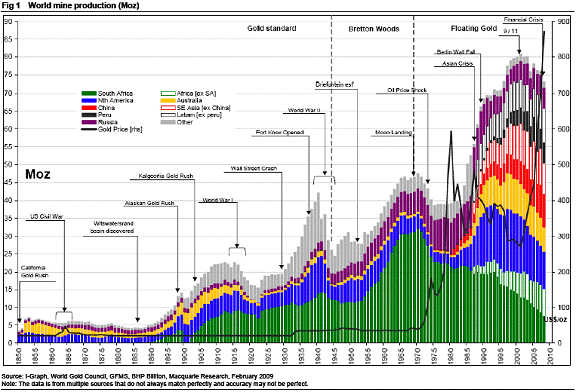
Take a look at the chart below from Macquarie Research, depicting world gold production 1850-2008...
[Click here for full chart]
For example, look at the very steep rise in gold output during the 1930s. That was during the depths of the worldwide Great Depression.
In both the US/Canada (blue area), and the rest of the world (gray area), people were digging more and more gold. The Soviets (purple area) increased their gold output too, courtesy of Joseph Stalin and his Gulag. Desperate times call for desperate measures, I suppose. Will that sort of history repeat this time around?
Or look at that massive run-up in gold output from South Africa (green area) in the 1950s and 1960s. That was during a time when South Africa was instituting its post-World War II system of apartheid. Labor was cheap (sorrowfully cheap), and quite a lot of international investment poured into South Africa without moral qualm. The South Africans dug deep and just plain tore into those gold-bearing reef structures of the Witwatersrand Basin.
But notice how quickly the South African gold output declined in the 1970s, as the mines got REALLY deep and the rest of the world began to institute sanctions against South Africa over its apartheid system.
And then look at the Gold Price run-up that followed in the late 1970s. It was a time of inflation, mainly coming from the US Dollar. Yet world gold mine output was dropping as well. Falling output, plus monetary inflation? The Gold Price skyrocketed. Another bit of useful history, right?
Now let's focus on more recent history, since about 1990. There were large increases in gold output from the US/Canada (blue), Australia (gold) and Asia (China orange, non-China open bar). By 2000 or so – the world production peak – Gold Prices were down toward $300 per ounce and below.
But as the chart shows, in the past 10 years, gold output has shown a marked DECLINE in the major historic Gold Mining regions. The prolific gold output from the US/Canada, Australia and South Africa has followed downward trends. Sure, these regions still lift a lot of ore and pour a lot of melt. But the production trend is DOWN.
The US/Canada, Australia and South Africa all have well-established and (more or less) workable mining laws – despite the best efforts of many current politicians and regulators to screw it all up. These historically producing areas are politically stable. Overall, there's good mining infrastructure, with road and rail networks, power systems, refining plants, a vendor base, mining personnel and access to capital.
But that's not the case in many areas of the developing parts of the world. Political stability? Security? Infrastructure? Transport? Power? Refining? Vendors? Personnel? Capital? Everywhere is different, of course. But overall, the entire process is much more problematic. So there's a lot more risk. When you move away from the traditional mining jurisdictions, the whole process of exploration, development and mining is more expensive.
Thus, the new gold discoveries of the future are going to lack some (if not most, or perhaps all) of the advantages of the developed mining world. That means that the ore deposits of the future will have to offer much higher profit margins, based on size and ore grade, to compensate for the increased risks. Too bad Mother Nature (or Saint Barbara, who looks after miners) doesn't work that way.
It also means the timeline to develop the mines of the future will likely be stretched over many years while political, legal, bureaucratic, logistical and social issues are ironed out.
The key driver for the future of worldwide gold supply will be DECLINING output overall over time.

Of course, if the price of gold warrant ramping up then production will increase. Just as with discussions about peak oil, the issue is not that the resource is totally running out, it is that it will be more and more expensive to extract.
Inflation
It is conventional wisdom that gold is a hedge against inflation.
For example, noted inflationist John Williams advises buying gold.
Axel Merk argues that gold is a better buy than TIPS as an inflation bet.
And Taleb advised buying gold in May, since currencies including the dollar and euro face pressures.
As of this writing, gold has had a good run, and might face a correction. But as hedge fund luminary John Paulson argues, its something you buy-and-hold for at least the medium term:
Paulson is convinced that gold will be a very good way to protect himself from the eventuality of currency debasement (i.e., inflation). He observed that if one thinks about gold in a three- or five-year time horizon (instead of hour to hour, day to day or week to week), the probability increases of gold being higher over time...
Deflation
If gold does well during times of inflation, it makes sense that it would perform poorly during deflationary periods.
But Examiner.com points out that such an assumption is probably untrue.
Specifically, as Examiner.com writes:
Eric Sprott - who manages $4.5 billion in assets, and correctly predicted in March of 2008 a "systemic financial meltdown” - says:“I believe no matter what environment you’re in - deflation or inflation - people will run to gold,” Sprott said. “Gold is proving exactly what we all would have expected, that in almost any environment, it’s a go-to asset.”
And investment analyst and financial writer Yves Smith argues that gold does well during both periods of deflation and high inflation. She argues:
Historically, gold does well [in] hyperinflation and deflationary [periods]. Gold does poorly under more normal conditions, and gets hammered in disinflationary conditions, a falling but positive rate of inflation.
Analyst Adrian Ash argues that gold's value actually increases during periods of deflation even if its price drops:
Does the price of gold rise or fall in a deflation?In other words, Ash argues that you can't take inflation or deflation in a vacuum. During deflationary periods - like we have now - governments always increase the money supply with a flood of new dollars, which is bullish for gold.Hint: It’s a trick question, already tripping up plenty of would-be advisors...
Absent the money-supply limits which the gold standard imposed on the world, people rightly guess that double-digit inflation would prove rocket-fuel for the bull market in gold. Yet the purchasing power of gold nearly doubled during the Great Depression, and it’s risen four-fold during this decade’s low consumer-price inflation as well.Why? Because both those periods of low price-inflation saw the money-issuing authorities devalue the currency, first with explicit reference to gold but now without daring to name it. Roosevelt in the mid-30s slashed the dollar’s gold content by 40%; the Greenspan/Bernanke Fed devalued the Dollar again to sidestep a DotCom Depression, keeping real interest rates at less than zero, between 2002-2005.
The maestro’s apprentice applied the same trick in the back-half of 2008, but so far to no avail. And now even the European Central Bank is pumping out money – a near half-trillion euros today alone – in a bid to revive bank lending, swamp the currency markets, and pull Germany out of its first flirt with deflation since the 1930s.
Just such a devaluation – and again, absent any stated reference to gold – was attempted by the Bank of Japan a little less than a decade ago.
Indeed, Japan is the only developed nation since the end of the gold standard to have suffered an extended deflation in prices. So far, at least. Germany and Switzerland look set to try for a re-wind, and unless the dollar can outpace the euro’s descent, we might yet see truly sub-zero inflation in the United States, too.
But whatever that should mean for gold prices, all other things being equal, just doesn’t matter. Because the gold price will not get a chance. All other things are not equal, and the policy solution – rank devaluation – can only make gold more appealing to investors and savers, whether the “monetarist experiment” of TARP, quantitative easing or a half-trillion euros proves successful or not.
Japan’s slump into deflation coincided with the Bank of Japan’s “zero interest rate policy” (ZIRP) at the start of this decade. It also saw the gold price worldwide hit rock-bottom and turn higher, a move that analysts (including us) have typically linked to US monetary moves and investment cash looking for safety as the Dotcom Bubble exploded.
But zero-rate money from the world’s second-largest economy shouldn’t be ignored. And today, zero-rate money is all the developed world has to offer – a trick that might not beat deflation, but might just spur a whole new rush into gold.
And PhD economist Marc Faber wrote in October 2007 that gold will do well even in a deflation:
How would gold perform in a deflationary global recession? Initially gold could come under some pressure as well but once the realization sinks in how messy deflation would be for over-indebted countries and households, its price would likely soar.
Therefore, under both scenarios - stagflation or deflationary recession - gold, gold equities and other precious metals should continue to perform better than financial assets.
Looking At the Charts
Is Faber right?
Well, take a look at the following charts showing gold's performance as compared to the yen during Japan's "lost decade" of deflation:

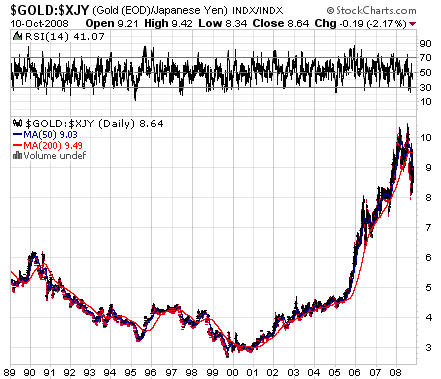
This provides some evidence that gold may tend to hold or increase its value at least in the later part of the deflationary period as compared with the relevant national currency.
Moreover - approximately half the time - gold has risen during recessions in the United States:

(The grey vertical bars show periods of recession; the chart gives gold prices in monthly averages; click here for larger image).
If you study the above chart, you will see that gold seems to often fall during the beginning stages of a recession, then rise in the later stages of the recession (before 1971, the dollar was still backed by gold at a fixed price, and so gold did not fluctuate).
But what about Ash's theory?
The American Enterprises Institute notes:
After five years in a deflationary economic wilderness, the Bank of Japan switched during the spring of 2001 to a policy of quantitative easing--targeting the growth of the money supply instead of nominal interest rates--in order to engineer a rebound in demand growth.
Look again at the first gold chart for Japan, above. Gold appears to start increasing against the Yen in 2001.
This may provide some evidence for Ash's thesis that it is an expansion of the money supply which pushes the price of gold up in the later stages of deflationary periods.
Uncertainty
Finally, Chris Martenson argues that - in prolonged periods of deflation - we usually see failures of large and significant banks, institutions, and perhaps even states and countries. Because gold traditionally does well during periods of uncertainty, Martenson likes gold during periods of deflation.
Examiner.com notes in a subsequent article:
Merrill Lynch agrees.Specifically, PhD economist Nouriel Roubini paraphrases a report from Merill Lynch (not available online) as follows:
Short-term rates of 0% are bullish for gold, which serves as a store of value but is a useful hedge against deflation as well, since deflation is inherently destabilizing for financial assets. In the 2001-03 deflationary period, gold rose more than 30%, not to mention the prospect of a return to a dollar bear market. "Gold is inversely correlated to global short-term interest rates and there is a race right now towards 0%. Production is down 4.0% y/y while fiat currencies globally are being created at a double digit rate by the world's central banks....As for all the talk of a 'gold bubble,' it would take a nearly 625% surge in gold to over US$6,000/oz and a flat stock market to actually get the ratio of the two asset classes back to where it was three decades ago when bullion was in an unsustainable bubble phase."
Gold tends to be less sensitive to global economic slowdown than industrial metals or energy and works better as a hedge against crisis than inflation.
See also Fred Sheehan's summary of Roy Jastram's study of the performance of gold during deflationary periods throughout history.
Global Short Term Interest Rates Are Low
The above-quoted Merrill article states:
Gold is inversely correlated to global short-term interest rates and there is a race right now towards 0%.
This argues for gold.
Distrust in Government
Time Magazine writes:
Traditionally, gold has been a store of value when citizens do not trust their government politically or economically.
Given the enormous levels of distrust in the government politically and/or economically (and the fact that some have warned of recession-induced violence), gold might do well.
Also, as mentioned above, gold tends to do well during periods of uncertainty. Given that the fundamental problems with the economy have not been fixed, things will likely become less certain.
Greenspan and Exeter
Professor Emeritus of Mathematics Antal Fekete has argued for years that gold is the ultimate - and only - safe haven when things really hit the fan.
For example, in 2007 Fekete wrote:
The grand old man of the New York Federal Reserve bank’s gold department, the last Mohican, John Exter explained the devolution of money (not his term) using the model of an inverted pyramid, delicately balanced on its apex at the bottom consisting of pure gold. The pyramid has many other layers of asset classes graded according to safety, from the safest and least prolific at bottom to the least safe and most prolific asset layer, electronic dollar credits on top. (When Exter developed his model, electronic dollars had not yet existed; he talked about FR deposits.) In between you find, in decreasing order of safety, as you pass from the lower to the higher layer: silver, FR notes, T-bills, T-bonds, agency paper, other loans and liabilities denominated in dollars. In times of financial crisis people scramble downwards in the pyramid trying to get to the next and nearest safer and less prolific layer underneath. But down there the pyramid gets narrower. There is not enough of the safer and less prolific kind of assets to accommodate all who want to "devolve”. Devolution is also called "flight to
safety”.
Darryl Schoon makes the same argument.
Here's a visual depiction Exeter's inverted pyramid, courtesy of Wikimedia:

(Click here for full image; I can't vouch for the accuracy of the rankings for all of the levels . . . for example, muni bonds versus corporate bonds)
Alan Greenspan has just lent some support to the theory. Specifically:
Gold prices that jumped above $1,000 an ounce this week are signaling that investors are buying metals to hedge against declines in currencies, former Federal Reserve Chairman Alan Greenspan said.
The gains are “strictly a monetary phenomenon,” Greenspan said today at an investment conference in New York. Rising prices of precious metals and other commodities are “an indication of a very early stage of an endeavor to move away from paper currencies,” he said...
“What is fascinating is the extent to which gold still holds reign over the financial system as the ultimate source of payment,” Greenspan said.
In other words, Greenspan is saying that investors are moving out of the second-to-lowest step on the pyramid (currencies and government bonds) and into the lowest step (gold).
Greenspan is also verifying what goldbugs like Exeter, Fekete and Schoon have been claiming: that "the barbarous relic" still holds an important place in the modern investor's psyche.
Are Exeter, Fekete and Schoon right? I don't know. And Greenspan might be wrong, or trying to excuse weakness in the dollar (as opposed to all paper currencies).
Note 1: Of course, when everyone is on one side of a trade, it means that the market is about to crash. Some of the best recent arguments I've heard against investing in gold are written by Vitaliy Katsenelson. Read this, this, this and this.
Note 2: While Schoon alleges the manipulation of gold prices, he argues that gold manipulation will end because the world's central banks (and their primary dealers) will no longer be able to afford it. Specifically, he argues that they will simply run out of money to keep playing the game. If he is right, then manipulation of gold prices - even if real - would end up being moot at some point.
Note 3: I am not an investment advisor and this should not be taken as investment advice.


Has America Suffered a PERMANENT Loss of Jobs?
Some of the top economists say that America has suffered a permanent loss of jobs:
- JPMorgan Chase’s Chief Economist Bruce Kasman told Bloomberg:
[We've had a] permanent destruction of hundreds of thousands of jobs in industries from housing to finance.
- The chief economists for Wells Fargo Securities, John Silvia, says:
Companies “really have diminished their willingness to hire labor for any production level,” Silvia said. “It’s really a strategic change,” where companies will be keeping fewer employees for any particular level of sales, in good times and bad, he said.
- Former Merrill Lynch chief economist David Rosenberg writes:
The number of people not on temporary layoff surged 220,000 in August and the level continues to reach new highs, now at 8.1 million. This accounts for 53.9% of the unemployed — again a record high — and this is a proxy for permanent job loss, in other words, these jobs are not coming back. Against that backdrop, the number of people who have been looking for a job for at least six months with no success rose a further half-percent in August, to stand at 5 million — the long-term unemployed now represent a record 33% of the total pool of joblessness.
- Nobel Prize winner Edmund Phelps and Pacific Investment Management Co. Chief Executive Officer Mohamed El-Erian say the fallout from the deepest recession in more than five decades is driving the so-called natural rate higher, perhaps to 7 percent.
- And Former Labor Secretary Robert Reich wrote yesterday:
And see this.The basic assumption that jobs will eventually return when the economy recovers is probably wrong. Some jobs will come back, of course. But the reality that no one wants to talk about is a structural change in the economy that's been going on for years but which the Great Recession has dramatically accelerated.
Under the pressure of this awful recession, many companies have found ways to cut their payrolls for good. They've discovered that new software and computer technologies have made workers in Asia and Latin America just about as productive as Americans, and that the Internet allows far more work to be efficiently outsourced abroad.
This means many Americans won't be rehired unless they're willing to settle for much lower wages and benefits. Today's official unemployment numbers hide the extent to which Americans are already on this path. Among those with jobs, a large and growing number have had to accept lower pay as a condition for keeping them. Or they've lost higher-paying jobs and are now in a new ones that pays less.
Yet reducing unemployment by cutting wages merely exchanges one problem for another. We'll get jobs back but have more people working for pay they consider inadequate, more working families at or near poverty, and widening inequality. The nation will also have a harder time restarting the economy because so many more Americans lack the money they need to buy all the goods and services the economy can produce.
Heck of a job, Larry, Tim and Ben.
Prolonging the War is a "Threat to Our National Security"
Congressman Kucinich said today:
America is in the fight of its life and that fight is not in Afghanistan -- it's here ... We are deeply in debt. Our GDP is down. Our manufacturing is down. Our savings are down. The value of the dollar is down. Our trade deficit is up. Business failures are up. Bankruptcies are up.Is he right?The war is a threat to our national security. We’ll spend over $100 billion next year to bomb a nation of poor people while we reenergize the Taliban, destabilize Pakistan, deplete our army and put more of our soldiers’ lives on the line. Meanwhile, back here in the USA, 15 million people are out of work. People are losing their jobs, their health care, their savings, their investments, and their retirement security. $13 trillion in bailouts for Wall Street, trillions for war; when are we going to start taking care of things here at home?
Well, the director of U.S. national intelligence, retired Admiral Dennis Blair, said in February that the economic crisis was the biggest national security threat to the United States. See this and this.
And - contrary to common beliefs - economists say that prolonged wars increase unemployment, shrink the economy, and cause rather than solve recessions. See this, this and this. And to those who say that deficits don't matter, please read this.
As ABC notes:
U.S. intelligence officials have concluded there are only about 100 al Qaeda fighters in the entire country...
With 100,000 troops in Afghanistan at an estimated yearly cost of $30 billion, it means that for every one al Qaeda fighter, the U.S. will commit 1,000 troops and $300 million a year.
And TalkingPointsMemo reported yesterday that - in addition to the troops - the US now has more than 104,000 defense contractors in the country. So that drives up the cost per al Qaeda fighter even higher.
Moreover, a leading advisor to the U.S. military - the very hawkish Rand Corporation - released a study in 2008 called "How Terrorist Groups End: Lessons for Countering al Qa'ida". The report confirms what experts have been saying for years: the war on terror is actually weakening national security.
As a press release about the study states:
"Terrorists should be perceived and described as criminals, not holy warriors, and our analysis suggests that there is no battlefield solution to terrorism."As one blogger commented in response to a previous essay:
If we continue to react as we did after 9-11 then al Qaeda will win. This primarily being a financial site, everyone here should understand ROI [return on investment]. They invested less than a million and made us spend 1 trillion+. They could pass the collection plate around at the average mosque in Pakistan and bankrupt us with 1 more operation. Even if you are not convinced that we are creating more extremists than we are killing, we simply cannot afford to "win the war on terrorism". Fighting fire with fire just makes things burn faster...Kucinich is right.
Keep in mind as well that most empires that have been defeated were not annihilated on the battlefield, but rather in the bank account.
Wednesday, December 2, 2009
Robert Reich Confirms Permanent Destruction of Jobs in America
Former Labor Secretary Robert Reich writes today:
The basic assumption that jobs will eventually return when the economy recovers is probably wrong. Some jobs will come back, of course. But the reality that no one wants to talk about is a structural change in the economy that's been going on for years but which the Great Recession has dramatically accelerated.
Under the pressure of this awful recession, many companies have found ways to cut their payrolls for good. They've discovered that new software and computer technologies have made workers in Asia and Latin America just about as productive as Americans, and that the Internet allows far more work to be efficiently outsourced abroad.
This means many Americans won't be rehired unless they're willing to settle for much lower wages and benefits. Today's official unemployment numbers hide the extent to which Americans are already on this path. Among those with jobs, a large and growing number have had to accept lower pay as a condition for keeping them. Or they've lost higher-paying jobs and are now in a new ones that pays less.
Yet reducing unemployment by cutting wages merely exchanges one problem for another. We'll get jobs back but have more people working for pay they consider inadequate, more working families at or near poverty, and widening inequality. The nation will also have a harder time restarting the economy because so many more Americans lack the money they need to buy all the goods and services the economy can produce.
Reich is only confirming what many others have said:
- JPMorgan Chase’s Chief Economist Bruce Kasman told Bloomberg:
[We've had a] permanent destruction of hundreds of thousands of jobs in industries from housing to finance.
- The chief economists for Wells Fargo Securities, John Silvia, says:
Companies “really have diminished their willingness to hire labor for any production level,” Silvia said. “It’s really a strategic change,” where companies will be keeping fewer employees for any particular level of sales, in good times and bad, he said.
- And former Merrill Lynch chief economist David Rosenberg writes:
And see this.The number of people not on temporary layoff surged 220,000 in August and the level continues to reach new highs, now at 8.1 million. This accounts for 53.9% of the unemployed — again a record high — and this is a proxy for permanent job loss, in other words, these jobs are not coming back. Against that backdrop, the number of people who have been looking for a job for at least six months with no success rose a further half-percent in August, to stand at 5 million — the long-term unemployed now represent a record 33% of the total pool of joblessness.
Heck of a job, Larry, Tim and Ben.
What Empires Have Said Throughout History: "One More Surge"
A leading advisor to the U.S. military, the Rand Corporation, released a study in 2008 called "How Terrorist Groups End: Lessons for Countering al Qa'ida". The report confirms what experts have been saying for years: the war on terror is actually weakening national security.
As a press release about the study states:
"Terrorists should be perceived and described as criminals, not holy warriors, and our analysis suggests that there is no battlefield solution to terrorism."In fact, starting right after 9/11 -- at the latest -- the goal has always been to create "regime change" and instability in Iraq, Iran, Syria, Libya, Sudan, Somalia, Lebanon and other countries.
As American historian, investigative journalist and policy analyst Gareth Porter writes in the Asia Times:
Three weeks after the September 11, 2001, terror attacks, former US defense secretary Donald Rumsfeld established an official military objective of not only removing the Saddam Hussein regime by force but overturning the regime in Iran, as well as in Syria and four other countries in the Middle East, according to a document quoted extensively in then-under secretary of defense for policy Douglas Feith's recently published account of the Iraq war decisions. Feith's account further indicates that this aggressive aim of remaking the map of the Middle East by military force and the threat of force was supported explicitly by the country's top military leaders.
Feith's book, War and Decision, released last month, provides excerpts of the paper Rumsfeld sent to President George W Bush on September 30, 2001, calling for the administration to focus not on taking down Osama bin Laden's al-Qaeda network but on the aim of establishing "new regimes" in a series of states...
***
General Wesley Clark, who commanded the North Atlantic Treaty Organization bombing campaign in the Kosovo war, recalls in his 2003 book Winning Modern Wars being told by a friend in the Pentagon in November 2001 that the list of states that Rumsfeld and deputy secretary of defense Paul Wolfowitz wanted to take down included Iraq, Iran, Syria, Libya, Sudan and Somalia [and Lebanon].
***
When this writer asked Feith . . . which of the six regimes on the Clark list were included in the Rumsfeld paper, he replied, "All of them."
***
The Defense Department guidance document made it clear that US military aims in regard to those states would go well beyond any ties to terrorism. The document said the Defense Department would also seek to isolate and weaken those states and to "disrupt, damage or destroy" their military capacities - not necessarily limited to weapons of mass destruction (WMD).
The goal was never focused on destroying Al Qaeda. As just one example, the U.S. let Bin Laden escape in 2001 and again in 2007.
Indeed, the goal seems to have more to do with being a superpower (i.e. an empire) than stopping terrorism.
As Porter writes:
After the bombing of two US embassies in East Africa [in 1988] by al-Qaeda operatives, State Department counter-terrorism official Michael Sheehan proposed supporting the anti-Taliban Northern Alliance in Afghanistan against bin Laden's sponsor, the Taliban regime. However, senior US military leaders "refused to consider it", according to a 2004 account by Richard H Shultz, Junior, a military specialist at Tufts University.A senior officer on the Joint Staff told State Department counter-terrorism director Sheehan he had heard terrorist strikes characterized more than once by colleagues as a "small price to pay for being a superpower".
One More Surge in Afghanistan
Empire after empire has broken its back trying to control Afghanistan.
Why?
It is the crossroads between East, West, South Asia and Central Asia. And now it is the proposed site for a Trans-Afghanistan gas pipeline.
If you believe President Obama's statement that America will be out of Afghanistan in 18 months, I have some barren, rocky hills to sell you. Indeed:
[Presidential] aides said that by announcing a date for beginning a withdrawal, the president was not setting an end date for the war.And as CNN notes, the 2011 date for the beginning of withdrawal is not fixed in stone.
And it is important to note that - contrary to conventional wisdom - extended wars cause rather than end recessions. See this, this and this.
Michael Rivero summarizes Obama's Afghanistan war surge in the context of the 2,000-plus-year history of empires trying to conquer that country:
"Just one more surge!" -- The Indus
"Just one more surge!" -- The Kushan
"Just one more surge!" -- The Scythians
"Just one more surge!" -- The Parthians
"Just one more surge!" -- The Saffarid
"Just one more surge!" -- The Ghaznavid
"Just one more surge!" -- The Ghorid
"Just one more surge!" -- The Timurid
"Just one more surge!" -- The Hotaki
"Just one more surge!" -- The Durrani
"Just one more surge!" -- The Aryan
"Just one more surge!" -- The Persians
"Just one more surge!" -- The Sassanids
"Just one more surge!" -- The Hephthalites
"Just one more surge!" -- The Huns
"Just one more surge!" -- The Mughals
"Just one more surge!" -- The Arabs
"Just one more surge!" -- The Turkic
"Just one more surge!" -- The Hazaras
"Just one more surge!" -- The Khwarezmids
"Just one more surge!" -- The Mongols
"Just one more surge!" -- The British
"Just one more surge!" -- The British (again)
"Just one more surge!" -- The British (Yet again)
"Just one more surge!" -- The USSR
"Just one more surge!" -- The United States
Former Managing Director of Goldman Sachs: Accounting Fraud of the Too Big to Fails May Be Worse Than Enron
Nomi Prins - former managing director of Goldman Sachs and head of the international analytics group at Bear Stearns in London - is saying the same thing that financial bloggers have been saying: The giant banks are manipulating their books to make themselves look profitable.
In fact, Prins says that this might be worse than the fraud which occurred at Enron:
Surely someone with Prins' financial background can sort out the accounting of the TBTFs?Enron was the financial scandal that kicked off the decade: a giant energy trading company that appeared to be doing brilliantly—until we finally noticed that it wasn’t. It’s largely been forgotten given the wreckage that followed, and that’s too bad: we may be repeating those mistakes, on a far larger scale.
Specifically, as the largest Wall Street banks return to profitability—in some cases, breaking records—they say everything is rosy. They’re lining up to pay back their TARP money and asking Washington to back off. But why are they doing so well? Remember that Enron got away with their illegalities so long because their financials were so complicated that not even the analysts paid to monitor the Houston-based trading giant could cogently explain how they were making so much money.
In fact, no:
The giant banks have played so many games of massaging numbers (see this), hiding losses off the books (see this) and - as Prins documents - failing to report core data and shuffling things around so that it is impossible to tell what they are doing.After two weeks sifting through over one thousand pages of SEC filings for the largest banks, I have the same concerns. While Washington ponders what to do, or not do, about reforming Wall Street, the nation’s biggest banks, plumped up on government capital and risk-infused trading profits, have been moving stuff around their balance sheets like a multi-billion dollar musical chairs game.
I was trying to answer the simple question that you'd think regulators should want to know: how much of each bank’s revenue is derived from trading (taking risk) vs. other businesses? And how can you compare it across the industry—so you can contain all that systemic risk?
Indeed, financial writers (like Reggie Middleton, Mike Shedlock, Tyler Durden, Karl Denninger and others) who have dug deep and analyzed the underlying data say that the giant banks are totally insolvent. This wouldn't be the first time that the biggest banks went bust and then covered it up over a period of many years.
Prins offers a solution:
Yes, and break up the too big to fails.The long-term solution is bringing back Glass-Steagall. Being big doesn’t just risk bringing down a financial system—it means you can also more easily hide things. Remember the lesson from the Enron saga: when things look too good to be true, they usually are.
In addition, Congresswoman Marcy Kaptur, Tarp overseer Elizabeth Warren, prominent economists such as James Galbraith, Simon Johnson, Max Wolff and William Black, and financial experts such as Janet Tavakoli have all said that fraud was a primary cause of the financial crisis.
Galbraith and others say that unless past fraud is prosecuted so that Americans trust that the system is fair, the economy will not stabilize.
By allowing the giant banks' shenanigans to continue, the government is guaranteeing that the economy cannot truly recover.
Tuesday, December 1, 2009
Questions for Bernanke's Senate Confirmation Hearing
The Senate Banking Committee will be chatting with Ben Bernanke this Thursday to vote on his reappointment.
Demand that the Committee ask the following questions for our esteemed Esteemed Chairman (and contact your own Senators also and demand that they find out the answers to the following questions). If you are a Senate aide, please get these questions to your Senator.
High-Level Fed Officials Slam Bernanke
Fed Vice Chairman Donald Kohn conceded that the government's actions "will reduce [companies'] incentive to be careful in the future." In other words, he's admitting that the government's actions will encourage financial companies to make even riskier gambles in the future.
Kansas City Fed President and veteran Fed official Thomas Hoenig said:
Too big has failed....
The sequence of [the government's] actions, unfortunately, has added to market uncertainty. Investors are understandably watching to see which institutions will receive public money and survive as wards of the state...The current head of the Philadelphia fed bank, Charles Plosser, disagrees with Bernanke's strategy of the endless printing-press and ever-increasing fed balance sheet:
Any financial crisis leaves a stream of losses among the various participants, and these losses must ultimately be borne by someone. To start the resolution process, management responsible for the problems must be replaced and the losses identified and taken. Until these actions are taken, there is little chance to restore market confidence and get credit markets flowing. It is not a question of avoiding these losses, but one of how soon we will take them and get on to the process of recovery....
Many of the [government's current policy revolves around the idea of] "too big to fail" .... History, however, may show us a different experience. When examining previous financial crises, both in other countries as well as the United States, large institutions have been allowed to fail. Banking authorities have been successful in placing new and more responsible managers and directions in charge and then reprivatizing them. There is also evidence suggesting that countries that have tried to avoid taking such steps have been much slower to recover, and the ultimate cost to taxpayers has been larger...
Plosser urged the Fed to "proceed with caution" with the new policy. Others outside the Fed are much more strident and want plans in place immediately to reverse it. They believe an inflation storm is already in train.***
Bernanke argued that focusing on the size of the balance sheet misses the point, arguing the Fed's various asset purchase programs are not easily summarized in a single number.
But Plosser said that the growth of the Fed's balance sheet was a key metric."It is not appropriate to ignore quantitative metrics in this new policy environment," Plosser said...Plosser is bringing the spotlight right back to the Fed's balance sheet."The size of the balance sheet does offer a possible nominal anchor for monitoring the volume of our liquidity provisions," Plosser said.
The former head of the Fed's Open Market Operations says the bailout might make things worse. Specifically, the former head of the Fed's open market operation - the key Fed agency which has been loaning hundreds of billions of dollars to Wall Street companies and banks - was quoted in Bloomberg as saying:
"Every time you tinker with this delicate system even small changes can create big ripples,'' said Dino Kos, former head of the New York Fed's open-market operations . . . "This is the impossible situation they are in. The risks are that the government's $700 billion purchase of assets disturbs markets even more.''And William Poole, who recently left his post as president of the St. Louis Fed, is essentially calling Bernanke a communist:
But the strongest criticism may be from the former Vice President of Dallas Federal Reserve, who said that the failure of the government to provide more information about the bailout could signal corruption. As ABC writes:Poole said he was very concerned that the Fed could simply lend money to anyone, without constraint.In the Soviet Union and Eastern Europe during the Cold War era, economies were inefficient because they had a soft-budget constraint. If a firm got into trouble, the banking system would give them more money, Poole said.The current situation at the Fed seems eerily similar, he said."What is discipline - where are the hard choices - when does Fed say our resources are exhausted?" Poole asked.
Gerald O'Driscoll, a former vice president at the Federal Reserve Bank of Dallas and a senior fellow at the Cato Institute, a libertarian think tank, said he worried that the failure of the government to provide more information about its rescue spending could signal corruption.Of course, former Fed chairman Paul Volcker has also strongly criticized current Fed policies.
"Nontransparency in government programs is always associated with corruption in other countries, so I don't see why it wouldn't be here," he said.
Given such harsh criticism from within the Fed, how can Bernanke justify his actions to date?
Global Agencies Slam Bernanke
The Bank of International Settlements (BIS) - called "the central banks' central bank" - has slammed the Fed for blowing bubbles and then "using gimmicks and palliatives" which "will only make things worse".
As the Telegraph wrote in June 2007:
The Bank for International Settlements, the world's most prestigious financial body, has warned that years of loose monetary policy has fuelled a dangerous credit bubble, leaving the global economy more vulnerable to another 1930s-style slump than generally understood...
The BIS, the ultimate bank of central bankers, pointed to a confluence a worrying signs, citing mass issuance of new-fangled credit instruments, soaring levels of household debt, extreme appetite for risk shown by investors, and entrenched imbalances in the world currency system...
The bank said it was far from clear whether the US would be able to shrug off the consequences of its latest imbalances ...
"Sooner or later the credit cycle will turn and default rates will begin to rise," said the bank.
A year later, in June 2008, the Telegraph wrote:
A year ago, the Bank for International Settlements startled the financial world by warning that we might soon face challenges last seen during the onset of the Great Depression. This has proved frighteningly accurate...
[BIS economist] Dr White says the US sub-prime crisis was the "trigger", not the cause of the disaster.
Indeed, BIS slammed the Fed and other central banks for blowing the bubble, failing to regulate the shadow banking system, and then using gimmicks which will only make things worse. As the 2008 Telegraph article notes:
In a pointed attack on the US Federal Reserve, it said central banks would not find it easy to "clean up" once property bubbles have burst...
Nor does it exonerate the watchdogs. "How could such a huge shadow banking system emerge without provoking clear statements of official concern?"
"The fundamental cause of today's emerging problems was excessive and imprudent credit growth over a long period. Policy interest rates in the advanced industrial countries have been unusually low," he said.
The Fed and fellow central banks instinctively cut rates lower with each cycle to avoid facing the pain. The effect has been to put off the day of reckoning...
"Should governments feel it necessary to take direct actions to alleviate debt burdens, it is crucial that they understand one thing beforehand. If asset prices are unrealistically high, they must fall. If savings rates are unrealistically low, they must rise. If debts cannot be serviced, they must be written off.
"To deny this through the use of gimmicks and palliatives will only make things worse in the end," he said.
In other words, BIS slammed the easy credit policy of the Fed and other central banks, and the failure to regulate the shadow banking system.
More dramatically, BIS slammed "the use of gimmicks and palliatives", and said that anything other than (1) letting asset prices fall to their true market value, (2) increasing savings rates, and (3) forcing companies to write off bad debts "will only make things worse".
But Bernanke and the other central bankers (as well as Treasury and the Council of Economic Advisors and Barney Frank and Chris Dodd and the others in control of American and British and French and Japanese and German and virtually every other country's economic policy) ignored BIS' advice in 2007 and 2008, and they are still ignoring it today.
Instead, they are doing everything they can to (2) prop up asset prices by trying to blow a new bubble by giving banks trillions, (2) re-write accounting and reporting rules to let the big banks and other giants keep bad debts on their books (or in sivs or other "second sets of books") and to hide the fact that they are bad debts, and (3) encourage consumers to spend spend spend!
"The world's most prestigious financial body", "the ultimate bank of central bankers" has condemned Bernanke and all of the other G-8 central banks, and stripped bare their false claims that the crash wasn't their fault or that they are now doing the right thing to turn the economy around.
As Spiegel wrote in July of this year:
White and his team of experts observed the real estate bubble developing in the United States. They criticized the increasingly impenetrable securitization business, vehemently pointed out the perils of risky loans and provided evidence of the lack of credibility of the rating agencies. In their view, the reason for the lack of restraint in the financial markets was that there was simply too much cheap money available on the market...
As far back as 2003, White implored central bankers to rethink their strategies, noting that instability in the financial markets had triggered inflation, the "villain" in the global economy...
In the restrained world of central bankers, it would have been difficult for White to express himself more clearly...
It was probably the biggest failure of the world's central bankers since the founding of the BIS in 1930. They knew everything and did nothing. Their gigantic machinery of analysis kept spitting out new scenarios of doom, but they might as well have been transmitted directly into space...In their report, the BIS experts derisively described the techniques of rating agencies like Moody's and Standard & Poor's as "relatively crude" and noted that "some caution is in order in relation to the reliability of the results."...
In January 2005, the BIS's Committee on the Global Financial System sounded the alarm once again, noting that the risks associated with structured financial products were not being "fully appreciated by market participants." Extreme market events, the experts argued, could "have unanticipated systemic consequences."
They also cautioned against putting too much faith in the rating agencies, which suffered from a fatal flaw. Because the rating agencies were being paid by the companies they rated, the committee argued, there was a risk that they might rate some companies too highly and be reluctant to lower the ratings of others that should have been downgraded.
These comments show that the central bankers knew exactly what was going on, a full two-and-a-half years before the big bang. All the ingredients of the looming disaster had been neatly laid out on the table in front of them: defective rating agencies, loans repackaged to the point of being unrecognizable, dubious practices of American mortgage lenders, the risks of low-interest policies. But no action was taken. Meanwhile, the Fed continued to raise interest rates in nothing more than tiny increments...
The Fed chairman was not even impressed by a letter the Mortgage Insurance Companies of America (MICA), a trade association of US mortgage providers, sent to the Fed on Sept. 23, 2005. In the letter, MICA warned that it was "very concerned" about some of the risky lending practices being applied in the US real estate market. The experts even speculated that the Fed might be operating on the basis of incorrect data. Despite a sharp increase in mortgages being approved for low-income borrowers, most banks were reporting to the Fed that they had not lowered their lending standards. According to a study MICA cited entitled "This Powder Keg Is Going to Blow," there was no secondary market for these "nuclear mortgages."...
William White and his Basel team were dumbstruck. The central bankers were simply ignoring their warnings. Didn't they understand what they were being told? Or was it that they simply didn't want to understand?
The head of the World Bank also says:
Central banks [including the Fed] failed to address risks building in the new economy. They seemingly mastered product price inflation in the 1980s, but most decided that asset price bubbles were difficult to identify and to restrain with monetary policy. They argued that damage to the 'real economy' of jobs, production, savings, and consumption could be contained once bubbles burst, through aggressive easing of interest rates. They turned out to be wrong.
Given such piercing criticisms from BIS and the World Bank, how can Mr. Bernanke justify his actions to date?
Economists Slam Bernanke
Stephen Roach (former chief economist for Morgan Stanley, and now director of Morgan Stanley Asia) is one of the most influential and respected American economists. Roach told Charlie Rose recently that we have had terrible Federal Reserve policy for the past 12 years under Greenspan and Bernanke, that they concocted hair-brained theories (for example, that we should let the boom and bust cycle occur, but then "clean up the mess" once things fall apart), and that we really need to reform the Fed.
Specifically, here's the must-read portion of the interview:STEPHEN ROACH: And what’s missing in the debate that drives me nuts is going back to the very function of central banking that’s at the core of our financial system. Do we have the right model for the Fed to go forward? And, you know, I think we’ve minimized the role that the custodians, the stewards of our financial
system, the Federal Reserve, played in leading to this crisis and in making sure that we will never have this again. I think we’ve had horrible central banking in the United States for the past dozen of years. I mean, we elevate our central bankers, we probably .
CHARLIE ROSE: From Greenspan to Bernanke.
STEPHEN ROACH: Yeah.
CHARLIE ROSE: Both.
STEPHEN ROACH: We call them maestro, and, you know, we make them
sound larger than life. And, you know, and the fact is, they condoned
policies that took us from one bubble to another. They failed to live up
to their regulatory responsibility granted them by law. They concocted new
theories to explain why these things could go on forever, and they harbored
the belief, mistakenly in my view, that monetary policy is too big and
blunt an instrument, and so you just bring it in to clean up the mess
afterwards rather than prevent a mess ahead of time. Well, look at the
mess we’re in right now. We need a different approach here. We really do.
Moreover, prominent Wall Street economist Henry Kaufman says that the Federal Reserve is primarily to blame for the financial crisis:
Economist Marc Faber says that central bankers are money printers who create bubbles, and that the system would be much better now if the Fed hadn't intervened. Specifically, Faber says that - if the Fed hadn't intervened - the system would be cleaned out, the system would be healthier because debt load and burden on taxpayers would be reduced."I am convinced that the misbehavior of some would have been much rarer -- and far less damaging to our economy -- if the Federal Reserve and, to a lesser extent, other supervisory authorities, had measured up to their responsibilities ...
Kaufman directly criticized former Federal Reserve Chairman Alan Greenspan for not using his position to dissuade big banks and others from taking big risks.
"Alan Greenspan spoke about irrational exuberance only as a theoretical concept, not as a warning to the market to curb excessive behavior," Kaufman said. "It is difficult to believe that recourse to moral suasion by a Fed chairman would be ineffective."
Partly because the Fed did not strongly oppose the repeal in 1999 of the Depression-era Glass-Steagall Act, more large financial conglomerates that were "too big to fail" have formed, Kaufman said, citing a factor that has made the global credit crisis especially acute.
"Financial conglomerates have become more and more opaque, especially about their massive off-balance-sheet activities," he said. "The Fed failed to rein in the problem."...
"Much of the recent extreme financial behavior is rooted in faulty monetary policies," he said. "Poor policies encourage excessive risk taking."
Economist Jane D'Arista has shown that the Fed has failed miserably at its main task: providing a "counter-cyclical" influence (that is, taking the punch bowl away before the party gets too wild).
The Fed has also failed miserably in its role as regulator of banks and their affiliates. As well-known economist James Galbraith says:
The Federal Reserve has never been an effective regulator for the straightforward reason that it is dominated by economists and bankers and not by dedicated skeptics who make bank regulation a full-time profession.As PhD economist Steve Keen has pointed out, the Fed (along with Treasury) has also given money to the wrong people to kick-start the economy.
Given such devastating criticism from prominent economists, how can Mr. Bernanke justify his actions to date?
Unemployment
The Federal Reserve is mandated by law to maximize employment. The relevant statute states:
The Board of Governors of the Federal Reserve System and the Federal Open Market Committee shall maintain long run growth of the monetary and credit aggregates commensurate with the economy's long run potential to increase production, so as to promote effectively the goals of maximum employment, stable prices, and moderate long-term interest rates.However, PhD economist Dean Baker says:
The country now has almost 25 million people who are unemployed or underemployed as a result of the Fed's disastrous policies. Millions of people are losing their homes and tens of millions are losing their life savings. The country is likely to lose more than $6 trillion in output ($20,000 per person) due to the Fed's inept job performance.The Fed could have stemmed the unemployment crisis by demanding that banks lend more as a condition to the various government assistance programs, but Mr. Bernanke failed to do so.
Ryan Grim argues that the Fed might have broken the law by letting unemployment rise in order to keep inflation low:
In fact, the unemployment situation is getting worse, and many leading economists say that - under Mr. Bernanke's leadership - America is suffering a permanent destruction of jobs.The Fed is mandated by law to maximize employment, but focuses on inflation -- and "expected inflation" -- at the expense of job creation. At its most recent meeting, board members bluntly stated that they feared banks might increase lending, which they worried could lead to inflation.
Board members expressed concern "that banks might seek to reduce appreciably their excess reserves as the economy improves by purchasing securities or by easing credit standards and expanding their lending substantially. Such a development, if not offset by Federal Reserve actions, could give additional impetus to spending and, potentially, to actual and expected inflation." That summary was spotted by Naked Capitalism and is included in a summary of the minutes of the most recent meeting...
Suffering high unemployment in order to keep inflation low cuts against the Fed's legal mandate. Or, to put it more bluntly, it may be illegal.
For example, JPMorgan Chase’s Chief Economist Bruce Kasman told Bloomberg:
[We've had a] permanent destruction of hundreds of thousands of jobs in industries from housing to finance.The chief economists for Wells Fargo Securities, John Silvia, says:
And former Merrill Lynch chief economist David Rosenberg writes:Companies “really have diminished their willingness to hire labor for any production level,” Silvia said. “It’s really a strategic change,” where companies will be keeping fewer employees for any particular level of sales, in good times and bad, he said.
The number of people not on temporary layoff surged 220,000 in August and the level continues to reach new highs, now at 8.1 million. This accounts for 53.9% of the unemployed — again a record high — and this is a proxy for permanent job loss, in other words, these jobs are not coming back. Against that backdrop, the number of people who have been looking for a job for at least six months with no success rose a further half-percent in August, to stand at 5 million — the long-term unemployed now represent a record 33% of the total pool of joblessness.And see this.
Given that the law mandates that the Fed maximize employment, but that unemployment is instead becoming catastrophic under Mr. Bernanke's watch, how can Mr. Bernanke justify his actions to date?
The Fed says that we should reduce leverage, but is doing everything in its power to increase leverage.
Specifically, the New York Federal published a report in July entitled "The Shadow Banking System: Implications for Financial Regulation".
One of the main conclusions of the report is that leverage undermines financial stability:
Securitization was intended as a way to transfer credit risk to those better able to absorb losses, but instead it increased the fragility of the entire financial system by allowing banks and other intermediaries to “leverage up” by buying one another’s securities. In the new, post-crisis financial system, the role of securitization will likely be held in check by more stringent financial regulation and by the recognition that it is important to prevent excessive leverage and maturity mismatch, both of which can undermine financial stability.
And as a former economist at the New York Fed, Richard Alford, wrote recently:
On Friday, William Dudley, President of FRBNY, gave an excellent presentation on the financial crisis. The speech was a logically-structured, tightly-reasoned, and succinct retrospective of the crisis. It took one step back from the details and proved a very useful financial sector-wide perspective. The speech should be read by everyone with an interest in the crisis. It highlights the often overlooked role of leverage and maturity mismatches even as its stated purpose was examining the role of liquidity.
While most analysts attributed the crisis to either specific instruments, or elements of the de-regulation, or policy action, Dudley correctly identified the causes of the crisis as the excessive use of leverage and maturity mismatches embedded in financial activities carried out off the balance sheets of the traditional banking system. The body of the speech opens with: “..this crisis was caused by the rapid growth of the so-called shadow banking system over the past few decades and its remarkable collapse over the past two years.”
In fact, every independent economist has said that too much leverage was one of the main causes of the current economic crisis.
Federal Reserve Bank of San Francisco President Janet Yellen said recently that it’s “far from clear” whether the Fed should use interest rates to stem a surge in financial leverage, and urged further research into the issue.“Higher rates than called for based on purely macroeconomic conditions may help forestall a potentially damaging buildup of leverage and an asset-price boom”.And on September 24th, Congressman Keith Ellison wrote a letter to Mr. Bernanke and Geithner stating:
As you know, excessive leverage was a key component of the financial crisis. Investment banks leveraged their balance sheets to stratospheric levels by using short-term wholesale financing (like repurchase agreements and commercial paper). Meanwhile, some entities regulated as bank holding companies (BHCs) used off-balance-sheet entities to warehouse risky assets, thereby evading their regulatory capital requirements. These entities’ reliance on short-term debt to fund the purchase of oftentimes illiquid and risky assets made them susceptible to a classic bank panic. The key difference was that this panic wasn’t a run on deposits by scared individuals, but a run on collateral by sophisticated counterparties.On November 13th, Mr. Bernanke responded to Ellison (I received a copy of the letter from a Congressional source):
The Treasury highlights this very problem in its policy statement before the recent summit of G-20 finance ministers in London. To address this problem, the Treasury advocates stronger capital and liquidity standards for banking firms, including “a simple, non-risk-based leverage constraint.” The U.S. is one of only a few countries that already has leverage requirements for banks. Leverage requirements supplement risk-based capital requirements that federal banking regulators have in place pursuant to the Basel II Accord, an international capital agreement. While important features of our system of financial regulation, leverage requirements only apply to banks and bank holding companies and therefore have not covered a wide array of financial institutions, including many that are systemically important. Moreover, leverage requirements have generally not captured the considerable risks associated with off-balance-sheet activities.
Of course, the Administration looks to address the shortcomings in the existing regulatory system through a proposal to regulate large, systemically-significant financial institutions as Tier 1 Financial Holding Companies (FHCs). Building upon its existing authority as the consolidated supervisor of all BHCs (which includes FHCs), the Federal Reserve would be responsible for overseeing and regulating the Tier 1 FHCs under the plan. In the legislative draft of the proposal, the Federal Reserve would have the authority to prescribe capital requirements and other prudential standards for these institutions that are stronger than those for all other BHCs. To that point, the text specifically says, “The prudential standards shall be more stringent than the standards applicable to bank holding companies to reflect the potential risk posed to financial stability by United States Tier 1 financial holding companies and shall include, but not be limited to—(A) risk-based capital requirements; (B) leverage limits; (C) liquidity requirements; and (D) overall risk management requirements.”
The application of leverage limits – as advanced by the Treasury’s G-20 policy statement and by the Administration’s financial regulatory reform plan – is a simple and elegant way to limit risk at specific financial institutions (and within the overall financial system). The financial crisis has underscored the importance of leverage requirements and manifested the problems associated with relying upon risk-based capital requirements alone ...
Nevertheless, there are some open questions regarding exactly how a leverage requirement should be applied. Some scholars and policy experts have advocated putting in place a leverage requirement for banks and other financial institutions that is set in statute. As Congress moves forward on comprehensive financial regulatory reform, it may consider such a requirement. I would therefore be interested to hear your views regarding the wisdom of such an approach.
As you know, setting capital standards requires decisions regarding what institutions would be covered, how capital would be defined, and what levels the requirements would be set. In light of that, what specific difficulties would you anticipate Congress facing with respect to specifying such a requirement? In addition, would a statutory requirement be too inflexible and place too many constraints on regulators with respect to refining regulatory capital requirements and negotiating with bank regulators from other countries?
The Board's authority and flexibility in establishing capital requirements, including leverage requirements, have been key to the Board's ability to require additional capital where needed based on a banking organization's risk profile. One of the lessons learned in the recent financial crisis is the need for financial supervisors to have the ability to react quickly to changing circumstances, as in the capital assessments conducted in the Supervisory Capital Assessment Program. The Board and other federal banking agencies initiated this program to conduct a comprehensive, forward-looking assessment of the capital positions ofthe nation's 19 largest bank holding companies (BHCs). The Board's authority to mandate specific levels of capital was critical to this exercise because each BHC had a unique set of risks and circumstances that demanded careful supervisory scrutiny and evaluation in order to identify the amount of capital appropriate for its safe and sound operation. The Board required corrective actions on a case-by-case basis and continues to assess the capital positions ofthese institutions as well as all others under its supervision.The Supervisory Capital Assessment Program Mr. Bernanke refers to were the infamous "stress tests". There's just one little problem: the stress tests were a complete complete sham.
We note that in other contexts, statutorily prescribed minimum leverage ratios have not necessarily served prudential regulators of financial institutions well. Previously, the minimum capital requirements for the housing government-sponsored enterprises Fannie Mae and Freddie Mac (collectively, "GSEs") were fixed in statute; the risk-based capital requirement for the GSEs was based on a stress test that was also set forth in statute; and the GSE's regulator, the Director ofthe Office of Financial Housing Enterprise Oversight (the predecessor agency to the Federal Housing Finance Authority) did not have the authority to establish additional capital requirements for the GSEs. This limitation was different from the authority that the federal banking agencies have to set the leverage and risk-based capital requirements for banking organizations. In 2008, Congress enacted the Housing and Economic Recovery Act of 2008, which created FHFA and empowered it to establish additional minimum leverage and risk-based capital requirements for the GSEs.
With regard to the Board and other U.S. banking agencies' efforts to join with international supervisors to strengthen capital requirements for internationally active banking organizations, the Basel Committee is working on proposals for an international supplement to minimum risk-based capital ratios. While this work is in process, it is likely that these efforts will take the form of a minimum leverage ratio. It will be important for the international regulatory community to carefully calibrate the aggregate effect ofthis initiative, along with other efforts underway that are intended to strengthen capital requirements, to ensure that they protect against future financial crises while not raising capital requirements to such a degree that the availability of credit to support economic growth is unduly constrained. The current authority and flexibility the Board has to establish and modify leverage ratios as a banking organization regulator is very important to the successful participation of the Board in the process of establishing and calibrating an international leverage ratio.
In reality, the Fed has been one the biggest enablers for increased leverage. As anyone who has looked at Mr. Bernanke and Geithner's actions will tell you, many of the government's programs are aimed at trying to re-start securitization and the "shadow banking system", and to prop up asset prices for highly-leveraged financial products.
Indeed, Mr. Bernanke said in February:
In an effort to restart securitization markets to support the extension of credit to consumers and small businesses, we joined with the Treasury to announce the Term Asset-Backed Securities Loan Facility (TALF).And he said it again in September:
The Term Asset-Backed Securities Loan Facility, or TALF ... has helped restart the securitization markets for various types of consumer and small business credit. Securitization markets are an important source of credit, and their virtual shutdown during the crisis has reduced credit availability for many borrowers.Given that the Fed admits that too much leverage is destabilizing to our financial system, how can Mr. Bernanke justify his actions to date in increasing leverage?
Has the Fed Manipulated any Markets?
There are allegations that the Fed has manipulated the markets.
Has the Fed - directly or as part of the President's Working Group on Financial Markets or any other group or organization - manipulated any markets?
Trillions in Unnecessary Interest to the American People
Many people - including former analyst for the U.S. Treasury Richard Cook - argue that credit is too important a function to be left to the private banks. AFL-CIO president Richard Trumka told Congress recently:
If the Federal Reserve were made a fully public body, it would be an acceptable alternative.Bloomberg News columnist Matthew Lynn writes:
The U.K. government needs to start thinking about what it will do with all the banks it now owns. The answer is simple: Hand them to the people...Michael Moore recommends that the American people demand:
Instead of selling the stakes it acquired in the financial system to other banks, or listing the shares on the stock market, it could create mutually owned societies. Royal Bank of Scotland Group Plc could be a people’s bank, owned by everyone.That would ensure more diversity, competition and stability, all goals just as worthy as getting back the money Prime Minister Gordon Brown’s government spent on bank rescues...
Each of the 50 states must create a state-owned public bank like they have in North Dakota. Then congress MUST reinstate all the strict pre-Reagan regulations on all commercial banks, investment firms, insurance companies -- and all the other industries that have been savaged by deregulation: Airlines, the food industry, pharmaceutical companies -- you name it. If a company's primary motive to exist is to make a profit, then it needs a set of stringent rules to live by -- and the first rule is "Do no harm." The second rule: The question must always be asked -- "Is this for the common good?" (Click here for some info about the state-owned Bank of North Dakota.)As Moore notes, the state of North Dakota already has such a bank, and - because of that - North Dakota is just about the only state which is not running a huge deficit.
PhD economist and candidate for Florida governor Farid Khavari wants to create a Bank of the State of Florida, to create credit without burdening the state and its citizens with high interest charges by private banks. See this for details.
If the power to create credit were taken away from the Federal Reserve system and its private banks and given back to the government (as the Constitution envisioned), then American taxpayers would save hundreds of billions or trillions of dollars in unnecessary interest charges in paying off the national debt, as the government would not have to pay interest to finance its debt (sovereign nations such as the U.S. and England have the power to create credit and money; see this, this, this, and this).
Given that America is already deeply in debt, how can Mr. Bernanke justify the ongoing mountain of interest debts placed on the backs of the American people by the private credit-creation system of which the Fed is a part?
Failure to Disclose Who Received Bailout Money
The whole issue of the Fed's failure to disclose who received bailout money and other emergency largess courtesy of the American taxpayer is another important line of questioning. Many others have already written extensively on this issue, so I will not reinvent the wheel here.
Keynesians Are Wrong: We CAN (And Very Well May) Have Disinflation With Rising Real Interest Rates, Which Could Hasten the Decline of American Power
One of the world's leading economic historians - Niall Ferguson - has previously pointed out that too much debt can drive countries into default:
There are economic professors in American universities who think they are masters of the universe, but they don't have any historical knowledge. I have never believed that markets are self correcting. No historian could...
"The idea that countries don't go bust is a joke... The debt trap may be about to spring ... for countries that have created large stimulus packages in order to stimulate their economies."
(Keen, Roubini, Morgan Stanley and many others are warning about a debt crisis as well).
Ferguson now points out in a must-read article he wrote for Newsweek that we might get falling inflation (disinflation or deflation) and rising real interest rates:
So here's another scenario—which in many ways is worse than the inflation scenario. What happens is that we get a rise in the real interest rate, which is the actual interest rate minus inflation. According to a substantial amount of empirical research by economists, including Peter Orszag (now at the Office of Management and Budget), significant increases in the debt-to-GDP ratio tend to increase the real interest rate. One recent study concluded that "a 20 percentage point increase in the U.S. government-debt-to-GDP ratio should lead to a 20–120 basis points [0.2–1.2 percent] increase in real interest rates." This can happen in one of three ways: the nominal interest rate rises and inflation stays the same; the nominal rate stays the same and inflation falls; or—the nightmare case—the nominal interest rate rises and inflation falls.
Today's Keynesians deny that this can happen. But the historical evidence is against them. There are a number of past cases (e.g., France in the 1930s) when nominal rates have risen even at a time of deflation. What's more, it seems to be happening in Japan right now. Just last week Hirohisa Fujii, Japan's new finance minister, admitted that he was "highly concerned" about the recent rise in Japanese government bond yields. In the very same week, the government admitted that Japan was back in deflation after three years of modest price increases.
It's not inconceivable that something similar could happen to the United States. Foreign investors might ask for a higher nominal return on U.S. Treasuries to compensate them for the weakening dollar. And inflation might continue to surprise us on the downside. After all, consumer price inflation is in negative territory right now.
Why should we fear rising real interest rates ahead of inflation? The answer is that for a heavily indebted government and an even more heavily indebted public, they mean an increasingly heavy debt-service burden. The relatively short duration (maturity) of most of these debts means that a large share has to be rolled over each year. That means any rise in rates would feed through the system scarily fast.
Already, the federal government's interest payments are forecast by the CBO to rise from 8 percent of revenues in 2009 to 17 percent by 2019, even if rates stay low and growth resumes. If rates rise even slightly and the economy flatlines, we'll get to 20 percent much sooner. And history suggests that once you are spending as much as a fifth of your revenues on debt service, you have a problem. It's all too easy to find yourself in a vicious circle of diminishing credibility. The investors don't believe you can afford your debts, so they charge higher interest, which makes your position even worse....
The precedents are certainly there. Habsburg Spain defaulted on all or part of its debt 14 times between 1557 and 1696 and also succumbed to inflation due to a surfeit of New World silver. Prerevolutionary France was spending 62 percent of royal revenue on debt service by 1788. The Ottoman Empire went the same way: interest payments and amortization rose from 15 percent of the budget in 1860 to 50 percent in 1875. And don't forget the last great English-speaking empire. By the interwar years, interest payments were consuming 44 percent of the British budget, making it intensely difficult to rearm in the face of a new German threat.
Call it the fatal arithmetic of imperial decline. Without radical fiscal reform, it could apply to America next.
OBOMBA
One of the best comments on America's never-ending wars in Iraq and Afghanistan I've seen recently:
For evidence that the Iraq war is unnecessary, see this. Read this for evidence that the U.S. could have taken Bin Laden out years ago and avoided a decades-long war in Afghanistan. And for proof that the entire war on Muslim extremists is unnecessary for our national security, see this.OBOMBA
Is it really okay if Obama does it?
And for proof that war is very harmful to the economy, see this, this and this.
Yes, I know that Obama didn't start the wars. And I voted for Obama and had high hopes for him.
After all, on October 27, 2007, Obama said:
I will promise you this, that if we have not gotten our troops out by the time I am president, it is the first thing I will do. I will get our troops home. We will bring an end to this war. You can take that to the bank.
Obama broke his promise. There is absolutely no reason to still be in Iraq or Afghanistan. Obama is no different from Bush when it comes to elective warmongering.
Obama's new nickname: OBOMBA.
I originally saw the slogan here.
Monday, November 30, 2009
Taleb: "I Will ...Structure Trades With My Universa Friends To Bet On The Next Mistake By Bernanke, Summers, And Geithner."
Famed financial expert and investment advisor Nassim Nicholas Taleb has revealed his new trading strategy:
I will also structure trades with my Universa friends to bet on the next mistake by Bernanke, Summers, and Geithner.
In an investing climate where not much else is certain, Taleb is betting that the three stooges will continue to make staggeringly huge blunders.
Robert Reich: "Shame Won't Work. Only Political Muscle and Courage Will"
Obama is planning to "shame" the big banks who are not agreeing to modify mortgages.
This is a repeat of Bernanke's play book ... scold the giant banks for failing to lend, but then give them a pat on the back and a wink.
As Robert Reich points out:
Moreover, Dean Baker points out that modifying mortgages will help the too big to fails a lot more than the homeowners themselves.Shame? If we've learned anything over the last year, it's that Wall Street has none. Eight months ago Wall Street lobbyist beat back a proposal to give bankruptcy judges the right to amend mortgages in order to pressure lenders to reduce principle owed, just like Wall Street lobbyists are now beating back tough regulations to prevent the Street from causing another meltdown. Goldman Sachs, attempting to preempt a firestorm of public outrage when it dispenses its $17 billion of bonuses, is setting up a crudely conceived $500 million PR program to help Main Street.
Shame won't work. Only political muscle and courage will.
Economist: “What Passes For Help To Homeowners In The Capitol Might Look More Like Handing Out Money To Banks Anywhere Else”
PhD economist Dean Baker makes an interesting point in a new essay:
The big talk in Washington these days is "helping homeowners". Unfortunately, what passes for help to homeowners in the capitol might look more like handing out money to banks anywhere else...
It is extremely unlikely that the vast majority of underwater homeowners will ever accumulate a penny in equity. Keeping them in their homes as owners means wasting thousands of dollars a year on excess housing costs only to be forced to arrange a short sale or face a foreclosure at some future point in time.
So, who benefits from "helping homeowners" in this story? Naturally the big beneficiaries are the banks. If the government pays for a mortgage modification where the homeowner is still paying more for the mortgage than they would for rent, then the bank gets a big gift from the government, but the homeowner is still coming out behind.
In some cases the government may pay enough to buy down principle that the homeowner is no longer underwater, but the bulk of this money is a gift to the bank, not the homeowner. If a homeowner is $100,000 underwater and the government pays the bank $50,000 to write the loan down to the current value of the house, then the bank has pocketed $50,000, while the homeowner is essentially left breaking even. This is very generous to the bank, but homeowners have nothing to show in this story.
President Obama has proposed putting up $70bn to help homeowners in this way. This help for homeowners is likely to end up as a larger subsidy to the banks than the rest of the troubled asset relief programme (Tarp). The reason is that the rest of the Tarp programme was a loan. The loans were at below market interest rates - thereby providing a subsidy to the banks - but most of the money is getting paid back.
The original batch of lending to banks was $250bn. Even if we assume an average interest rate subsidy of 10 percentage points (a very large subsidy), this still implies that the lending portion of Tarp only handed $25 billion to the banks, far less than the $70 billion that we are prepared to hand them under the guise of helping homeowners.
There are simple, low-cost ways to help homeowners who were victims of the housing bubble and lending sharks. The most obvious way would be to give homeowner the right to rent their home at the market price for the next decade. But this would mean hurting the banks rather than giving them taxpayer dollars, and we still don't talk about hurting banks in Washington DC.
Maybe that's why a professor of law advises that underwater homeowners walk away from their mortgages, saying that it is not immoral to do so, Congresswoman Kaptur advises her constituents facing foreclosure to demand that the original mortgage papers be produced, and portfolio manager and investment advisor Marshall Auerback argues that a debtor's revolt would be a good thing.


 Posts
Posts