
Sunday, December 13, 2009
The Fed's "Independence" Argument Is False
The House has passed a bill to audit the Federal Reserve. 79% of the American people support a full audit.
In response, the Fed says that an audit would interfere with its "independence".
However, the Constitution does not empower a central bank. And Congress - which created the Federal Reserve in 1913 and which has the power to create credit and money - certainly has the power to audit, dissolve, or do whatever it likes with the central bank (including stripping it of the power to create credit).
I have previously demonstrated that the Fed has done a terrible job of managing the economy, keeping unemployment low, and regulating banks.
And I have previously pointed out that the the independence argument is a red herring.
Indeed, the whole idea of independence means that the Fed should be shielded from political pressure to artificially pump up the economy with easy money right before elections. Congress never intended Fed "independence" to mean independence from Congressional oversight to ensure that the Fed is acting within its mandate and in the best interests of the country. These are two totally different concepts, and the Fed and its boosters are being disingenuous when they argue that an audit will interfere with independence from pressure to pump up the economy right before elections.
SPIEGEL: Lawmakers on Capitol Hill are thinking about tougher controls over the Federal Reserve.
Volcker: I think the loss of independence and authority of the Federal Reserve would be a very serious matter for the United States. Not just in terms of monetary policy but in terms of our place in the world. People look to strong, credible institutions and I think the Federal Reserve has been such an institution. If that's lost or too hamstrung by legislation I think we will regret it.
SPIEGEL: But is the Fed still the same kind of institution as during your tenure as chairman? Or is it now more of a governmental instrument? The Fed is managing the TARP program and is also buying government bonds.
Volcker: In some sense the Federal Reserve is always an instrument of the government. It is a government body but it is independent within government. But you are right in the sense that part of the concern is that they have involved themselves quantitatively in entering markets and in that process, you are supporting some markets and not others. That is an area in which the Federal Reserve has never wanted to get into and one that most central banks don't want to get into. If you are going to maintain your independence you have to avoid that. To intervene in particular sectors of the market is not the proper role for the central bank over time. It could be justified only by extreme emergency.
Intervening and supporting some market players (Goldman, AIG, etc.) and not others (Lehman, etc.) is precisely what Bernanke has been doing. Whatever can be said for the Fed in the past, picking winners and losers is "not the proper role for the central bank", in Volcker's words. Without an audit, we will never know which "winners" were saved and which "losers" were left to die, or why. Nor do we really currently know which bailouts and other actions were truly performed under emergency conditions - to stave off catastrophe - and which were done to help out financial companies for other reasons.
Moreover, Bernanke gave many billions to private foreign banks and foreign central banks (and see this). Has the Fed been picking winners and losers among countries? Among private banks?
As former Federal Reserve economist William Bergman wrote (he sent me this by email; it was previously published in article form, but is not available on the Web):
One of the principal laws governing audits in the Federal Reserve was passed in 1978, the Federal Banking Agency Audit Act. This law established audit authority in the Comptroller General of the United States, who leads today’s General Accountability Office (GAO). The GAO conducts audits and surveys for a wide range of Federal Reserve activities, with over 100 conducted since 1978. Audit authority also resides in the Federal Reserve Board’s Office of Inspector General, who can audit Board programs as well as Reserve Bank operations when carrying out functions delegated by the Board.
The Federal Reserve’s financial statements are audited every year. The Board of Governor’s financial statements are audited by an independent auditor selected by the Board’s Office of Inspector General. The Reserve Banks’ statements are also subjected to outside audits, conducted by firms retained by the Board of Governors. These latter audits must have been an interesting exercise this year, given the massive expansion in Reserve Bank balance sheets in 2008. In turn, more generally, the Board of Governors conducts a wide range of reviews of Reserve Bank operations as part of its mandated oversight authority.
In this brief review of the Fed audit landscape, it’s worth noting that things haven’t always been this way. From the early 1930s to the early 1950s, for example, one of the shoes was on the other foot, as audit teams from the Reserve Banks examined the Board of Governors books. The GAO was actually precluded by law, law passed by Congress, from audit responsibility for the Fed, at least until the 1978 act referred to above. The main lesson here is that the structure of reporting and audit authority has changed in the past, and it can change again in the future.
But today, authority for auditing the Fed is in place. So why do so many people think we need an Audit the Fed Act?
Well, for one thing, the appearance of extensive auditing authority doesn’t mean audits are effective. Good auditing requires the willingness and ability of auditors to do their jobs. Some people view the Inspectors General, generally, and the Federal Reserve Board’s Office of Inspector General, specifically, as less than effective or independent in pursuing their mandates. In turn, some people question whether the Board’s oversight of the Reserve Banks, including the Federal Reserve Bank of New York, might be less than arms-length. More fundamentally, from the point of view of the supporters of the recently introduced legislation, there are a variety of restrictions on the ability of the GAO to audit the Fed. There are significant exceptions for monetary policy and transactions with foreign central banks and international organizations like the Bank for International Settlements and the IMF. The law proscribes GAO inspections of ‘deliberations, decisions, or actions on monetary policy,’ for example, as well as ‘transactions made under the direction of the Federal Open Market Committee.’ The proposed legislation under H.R. 1207 and S. 604 would remove those exceptions.
Why are the exceptions there in the first place? Well, a widespread mantra has it that Federal Reserve independence is crucial in allowing it to effectively pursue the statutory goals of maximum employment and stable prices. If we let politicians start mucking around in that arena too much, Fed leaders and supporters stress, we aren’t going to see very effective monetary policy. At a ‘town hall’ meeting last weekend, while addressing the audit issue, Fed Chairman Bernanke said ‘I don’t think people want Congress making monetary policy.’ But these audit bills don’t call for the Congress to make monetary policy. They call for broader authority for an independent audit of the Fed, from the General Accountability Office. Supporters feel it this authority would allow the Congress to do a better job of overseeing the performance of an entity to which the Congress has delegated the authority to ‘coin money, and regulate the value thereof,’ under Article I of the U.S. Constitution.
How independent is the Fed, right now, to begin with? The Fed is not an apolitical beast. It has had politicians working there in formal leadership positions as well as staffing roles. The Fed’s regulatory performance matters for the conduct of monetary policy, and the Fed’s relationships with the banks it regulates and bails out deserve scrutiny. Recently, we’ve been through a financial calamity, and have endured the biggest spike in the unemployment rate since World War II. Investment returns crumbled in 2007 and 2008, and Federal Reserve monetary and other regulatory policy played a significant role in this calamity. Looking back a little further, how effective has the ‘independent’ Fed been as source of stable prices? Congress passed the law first mandating ‘stable prices’ as a goal for Fed monetary policy in 1977, and the CPI has tripled since then.
The debate over curtailing the current legal restriction on GAO audits for ‘transactions made under the direction of the Federal Open Market Committee’ makes for a good case in point. This provision, on the surface, helps insulate monetary policy from Congressional oversight and/or second-guessing, promoting independent policymaking. But the FOMC conducts monetary policy under authority delegated by the Congress. It seems reasonable to allow for some form of stronger inquiry in this area, especially after the worst financial and economic crisis since the Great Depression. One facet of a possible future investigation could deal with individual monetary policy ‘transactions.’ Under the quantitative easing posture adopted by the Fed in recent years, with a wider range of financial instruments bought to liquify the banking system and promote monetary and credit growth, the question arises – at what price were those instruments bought? Were they ‘market’ prices, or were they another way to apply public resources to overpay for bad assets and help large financial firms that got into trouble?
That may or may not be a valid avenue of inquiry, but it seems like we could benefit greatly from learning about the broader range of issues that could be tackled.
Audit the Fed? Sounds good to me.


Volcker: There's No Growth Other Than What The Fed's Pouring Into The Economy
Here is an interesting excerpt from an interview of Paul Volcker by Spiegel this weekend:
SPIEGEL: The US has not yet instituted any kind of reform policy. What we see is the government and the Federal Reserve pouring money into the economy. If one looks beyond that money, one sees that the economy is in fact still shrinking.
Volcker: What should I say? That's right. We have not yet achieved self-reinforcing recovery. We are heavily dependent upon government support so far. We are on a government support system, both in the financial markets and in the economy.
Friday, December 11, 2009
House Passes Bill to Audit the Fed
I have just received confirmation from a very credible Congressional source that the bill to audit the Federal Reserve is included in the House financial reform legislation which passed today. My source says:
The Fed audit provision which passed the Financial Services Committee a few weeks ago is part of the bill. This is a real milestone, as it means that the full House of Representatives has passed a bill that mandates a complete audit of the Fed.
The effort to audit the Fed - supported by 79% of the American people - is gaining traction.
UPDATE: Congressman Grayson has confirmed that the bill to audit the Fed passed:
The bill includes the Paul-Grayson amendment, which calls for the first independent audit of the Federal Reserve in the 96-year history of the central bank. Congressman Grayson teamed with Rep. Ron Paul to push for the “Audit The Fed” legislation. Congressman Grayson discovered that the Federal Reserve has conducted secret bailouts that range in the hundreds of billions of dollars since 2008. The bill grants authority to the non-partisan General Accountability Office to conduct the audit. “Exposing how the Federal Reserve operates is a crucial component to any meaningful reform. We need to find out what they’ve done and then we can figure out how to respond,” Congressman Grayson said.
My source says that it will take a couple of days for the GAO to assemble all of the amendments into a single text.
In the meantime, you can view the version of the bill provided by Congress' Thomas website here or here.
The New York Times has also posted what it claims is the final version of the bill (see below). If accurate, the relevant provisions appear to be the following.
SEC. 1000A. RESTRICTIONS ON THE FEDERAL RESERVE SYSTEM PENDING AUDIT REPORT.
(a) In General- Notwithstanding any other provision of law, the Comptroller General of the United States shall perform an audit of all actions taken by the Board of Governors of the Federal Reserve System and the Federal reserve banks during the current economic crisis pursuant to the authority granted under section 13(c) of the Federal Reserve Act. Such audit shall be completed as expeditiously as possible after the date of the enactment of the Financial Stability Improvement Act of 2009.
(b) Report-
(1) REQUIRED- Not later than the end of the 90-day period beginning on the date the audit referred to in subsection (a) is completed, the Comptroller General of the United States shall submit a report to the Congress, and make such report available to the public.
(2) CONTENTS- The report under paragraph (1) shall include a detailed description of the findings and conclusion of the Comptroller General with respect to the audit that is the subject of the report, together with such recommendations for legislative or administrative action as the Comptroller General may determine to be appropriate.
***
SEC. 1008. OVERSIGHT BY GAO.
(a) Authority to Audit- The Comptroller General of the United States may audit the activities and financial transactions of--
(1) the Council; and
(2) any person or entity acting on behalf of or under the authority of the Council, to the extent such activities and financial transactions relate to such person's or entity's work for the Council.
(b) Access to Information-
(1) IN GENERAL- Notwithstanding any other provision of law, the Comptroller General of the United States shall have access, upon request and at such reasonable time and in such reasonable form as the Comptroller General may request, to--
***
(B) any records or other information under the control of a person or entity acting on behalf of or under the authority of the Council, to the extent such records or other information is relevant to an audit under subsection (a).
SEC. 1001. FINANCIAL SERVICES OVERSIGHT COUNCIL ESTABLISHED.
(a) Establishment- Immediately upon enactment of this title, there is established a Financial Services Oversight Council.
(b) Membership- The Council shall consist of the following:
(1) VOTING MEMBERS- Voting members, who shall each have one vote on the Council, as follows:
***
(B) The Chairman of the Board of Governors of the Federal Reserve System.
Call your Senator and demand that the Senate approve the bill to audit the Fed (and demand that the language be tightened up to close all loopholes).
Copenhagen Framework Demands Huge Amounts of Spending, But Allows Enron-Style Accounting Tricks So That Carbon Isn't Actually Reduced
The UN and other agencies calling for a war on global warming say the price tag will be trillions.
But - according to top experts on climate and cap and trade - the regulatory framework being rammed through in America and internationally won't actually reduce carbon to any meaningful degree. See this, this, this and this.
Now, the Independent notes that the Copenhagen framework uses Enron-style accounting tricks to give the impression of cutting carbon, without really doing so:
The first week of this summit is being dominated by the representatives of the rich countries trying to lace the deal with Enron-style accounting tricks that will give the impression of cuts, without the reality. It's essential to understand these shenanigans this week, so we can understand the reality of the deal that will be announced with great razzmatazz next week ...
A study by the University of Stanford found that most of the projects that are being funded as "cuts" either don't exist, don't work, or would have happened anyway. Yet this isn't a small side-dish to the deal: it's the main course ...
Trick one: hot air. The nations of the world were allocated permits to release greenhouse gases back in 1990, when the Soviet Union was still a vast industrial power – so it was given a huge allocation. But the following year, it collapsed, and its industrial base went into freefall – along with its carbon emissions. It was never going to release those gases after all. But Russia and the eastern European countries have held on to them in all negotiations as "theirs". Now, they are selling them to rich countries who want to purchase "cuts". Under the current system, the US can buy them from Romania and say they have cut emissions – even though they are nothing but a legal fiction.
We aren't talking about climatic small change. This hot air represents 10 gigatonnes of CO2. By comparison, if the entire developed world cuts its emissions by 40 per cent by 2020, that will only take six gigatonnes out of the atmosphere.
Trick two: double-counting. This is best understood through an example. If Britain pays China to abandon a coal power station and construct a hydro-electric dam instead, Britain pockets the reduction in carbon emissions as part of our overall national cuts. In return, we are allowed to keep a coal power station open at home. But at the same time, China also counts this change as part of its overall cuts. So one tonne of carbon cuts is counted twice. This means the whole system is riddled with exaggeration – and the figure for overall global cuts is a con.
Trick three: the fake forests ... the Canadian, Swedish and Finnish logging companies have successfully pressured their governments into inserting an absurd clause into the rules. The new rules say you can, in the name of "sustainable forest management", cut down almost all the trees – without losing credits. It's Kafkaesque: a felled forest doesn't increase your official emissions... even though it increases your actual emissions.
There are dozens more examples like this, but you and I would lapse into a coma if I listed them. This is deliberate. This system has been made incomprehensible because if we understood, ordinary citizens would be outraged. If these were good faith negotiations, such loopholes would be dismissed in seconds. And the rich countries are flatly refusing to make even these enfeebled, leaky cuts legally binding. You can toss them in the bin the moment you leave the conference centre, and nobody will have any comeback.
Can Nobel Prize Winner Obama At LEAST Stop the Torture?
On Thursday, President Obama said:
We lose ourselves when we compromise the very ideals that we fight to defend.
Presumably, complying with American and international law are some of the ideals that we fight to defend.
Torture is a violation of both international and American law. Specifically, the Geneva Convention makes it illegal to inflict mental or physical torture or inhuman treatment.
As I pointed out in 2005:
The War Crimes Act of 1996, a federal statute set forth at 18 U.S.C. § 2441, makes it a federal crime for any U.S. national, whether military or civilian, to violate the Geneva Convention by engaging in murder, torture, or inhuman treatment.Have Things Changed Under the Obama Administration?
The statute applies not only to those who carry out the acts, but also to those who ORDER IT, know about it, or fail to take steps to stop it. The statute applies to everyone, no matter how high and mighty.
***
Indeed, even the lawyers and other people who aided in the effort may be war criminals; see also this article , this one, and this press release.
You may assume that things have changed after President Obama was sworn in.
However, the Obama Department of Justice is trying to protect torture memo writer John Yoo. As constitutional law expert Jonathan Turley notes:
The president literally has gotten onto a plane this evening to go to Norway to accept the Nobel Prize, while his Justice Department is effectively gutting a major part of Nuremberg.
The Obama administration is arguing not only that they shouldn't be prosecuted, but it's now saying that you shouldn't even be able to sue them civilly .... It's an international disgrace.
Well, it may be a disgrace, but at least torture isn't continuing under the Obama administration, right?
As Spiegel wrote on September 21, 2009, in an article entitled "Prisoner Abuse Continues at Bagram Prison in Afghanistan":
US President Barack Obama has spoken out against CIA prisoner abuse and wants to close Guantanamo. But he tolerates the existence of Bagram military prison in Afghanistan, where more than 600 people are being held without charge. The facility makes Guantanamo look like a "nice hotel," in the words of one military prosecutor...
Bagram is "the forgotten second Guantanamo," says American military law expert Eugene Fidell, a professor at Yale Law School. "But apparently there is a continuing need for this sort of place even under the Obama administration.
"From the beginning, "Bagram was worse than Guantanamo," says New York-based attorney Tina Foster, who has argued several cases on behalf of detainee rights in US courts. "Bagram has always been a torture chamber."
And what does Obama say? Nothing. He never so much as mentions Bagram in any of his speeches. When discussing America's mistreatment of detainees, he only refers to Guantanamo.
Obama still never mentions Bagram.
Spiegel continues:
From the beginning, Bagram was notorious for the brutal forms of torture employed there. Former inmates report incidents of sleep deprivation, beatings and various forms of sexual humiliation [and rape with sticks]...
At least two men died during imprisonment. One of them, a 22-year-old taxi driver named Dilawar, was suspended by his hands from the ceiling for four days, during which US military personnel repeatedly beat his legs. Dilawar died on Dec. 10, 2002. In the autopsy report, a military doctor wrote that the tissue on his legs had basically been "pulpified." As it happens, his interrogators had already known -- and later testified -- that there was no evidence against Dilawar...
However attorney Tina Foster feels that the new initiative is just a cosmetic measure. "There is absolutely no difference between the Bush administration and the Obama administration's position with respect to Bagram detainees' rights," she says during an interview with SPIEGEL in her office in the New York borough of Queens.
And see this.
Moreover, Obama is still apparently allowing "rendition flights" - where prisoners are flown to countries which freely torture - to continue. This itself violates the Geneva Convention and the War Crimes Act of 1996.
Specifically, to the extent that the U.S. is sending prisoners to other countries for the express purpose of being tortured are true, violation of the war crimes act by the highest officials of our country would be probable. For who else but Obama, Gates and other top officials would have the ability to authorize such flights? How could such a program be undertaken without their knowledge? And how could such a program be anything but the intentional "ordering" of torture, or at least "knowing about it" and "failing to take steps to stop it"?
Finally, Jeremy Scahill - the reporter who broke most of the stories on Blackwater - says that some forms of torture at Guantanamo have continued under Obama, and may even have gotten worse. For example, Scahill points out that:
The Center for Constitutional Rights released a report titled "Conditions of Confinement at Guantánamo: Still In Violation of the Law," which found that abuses continued. In fact, one Guantanamo lawyer, Ahmed Ghappour, said that his clients were reporting "a ramping up in abuse" since Obama was elected.But Torture Is a Necessary Evil
Many would say that this is disgusting, but that torture is a necessary evil to defend our national security.
But as I have previously pointed out:
- Torture actually reduces our national security
- Most of those tortured were innocent
- Torture has also been used throughout history as a form of intimidation, to terrorize people into obedience, not for gathering information
Moreover, the type of torture used by the U.S. in the last 10 years is of a special type. Senator Levin revealed that the U.S. used torture techniques aimed at extracting false confessions.
McClatchy subsequently filled in some of the details:
Former senior U.S. intelligence official familiar with the interrogation issue said that Cheney and former Defense Secretary Donald H. Rumsfeld demanded that the interrogators find evidence of al Qaida-Iraq collaboration...
For most of 2002 and into 2003, Cheney and Rumsfeld, especially, were also demanding proof of the links between al Qaida and Iraq that (former Iraqi exile leader Ahmed) Chalabi and others had told them were there."It was during this period that CIA interrogators waterboarded two alleged top al Qaida detainees repeatedly — Abu Zubaydah at least 83 times in August 2002 and Khalid Sheik Muhammed 183 times in March 2003 — according to a newly released Justice Department document...
When people kept coming up empty, they were told by Cheney's and Rumsfeld's people to push harder," he continued."Cheney's and Rumsfeld's people were told repeatedly, by CIA . . . and by others, that there wasn't any reliable intelligence that pointed to operational ties between bin Laden and Saddam . . .
A former U.S. Army psychiatrist, Maj. Charles Burney, told Army investigators in 2006 that interrogators at the Guantanamo Bay, Cuba, detention facility were under "pressure" to produce evidence of ties between al Qaida and Iraq.
"While we were there a large part of the time we were focused on trying to establish a link between al Qaida and Iraq and we were not successful in establishing a link between al Qaida and Iraq," Burney told staff of the Army Inspector General. "The more frustrated people got in not being able to establish that link . . . there was more and more pressure to resort to measures that might produce more immediate results."
"I think it's obvious that the administration was scrambling then to try to find a connection, a link (between al Qaida and Iraq)," [Senator] Levin said in a conference call with reporters. "They made out links where they didn't exist."
Levin recalled Cheney's assertions that a senior Iraqi intelligence officer had met Mohammad Atta, the leader of the 9/11 hijackers, in the Czech Republic capital of Prague just months before the attacks on the World Trade Center and the Pentagon.
The FBI and CIA found that no such meeting occurred.
In other words, top Bush administration officials not only knowingly lied about a non-existent connection between Al Qaida and Iraq, but they pushed and insisted that interrogators use special torture methods aimed at extracting false confessions to attempt to create such a false linkage. See also this and this.
Paul Krugman summarized eloquently summarized the truth about the type of torture used:
Let’s say this slowly: the Bush administration wanted to use 9/11 as a pretext to invade Iraq, even though Iraq had nothing to do with 9/11. So it tortured people to make them confess to the nonexistent link.
There’s a word for this: it’s evil.
Torture Is Antithetical to American Ideals
All torture is unjustifiable, as it produces no good intelligence and weakens national security. I think that - as Congress recognized in passing the War Crimes Act of 1996 - all torture is antithetical to American ideals.
The surge in Afghanistan is not necessary. For example, the U.S. admits there are only a small handful of Al Qaeda in Afghanistan. As ABC notes:
U.S. intelligence officials have concluded there are only about 100 al Qaeda fighters in the entire country.And a leading advisor to the U.S. military - the very hawkish Rand Corporation - released a study in 2008 called "How Terrorist Groups End: Lessons for Countering al Qa'ida". As a press release about the study states:
With 100,000 troops in Afghanistan at an estimated yearly cost of $30 billion, it means that for every one al Qaeda fighter, the U.S. will commit 1,000 troops and $300 million a year.
Terrorists should be perceived and described as criminals, not holy warriors, and our analysis suggests that there is no battlefield solution to terrorism.There are additional reasons why prolonging the Afghan war may reduce our national security, such as arguably weakening our economy.
Many experts also say that a surge in Afghanistan will actually weaken our national security by pushing the few remaining Al Qaeda into Pakistan - a county with nuclear weapons. See this and this.
If Nobel Peace Prize winner Obama is going to escalate the war in Afghanistan anyway, the least he should do is stop all torture.
Thursday, December 10, 2009
Are Food Stamps the Soup Lines of this Great Recession?
Bloomberg notes that, as of 2007:
In Missouri, about 100 percent who were eligible [for food stamps] that year took advantage of the program, the highest rate in the nation, followed by residents of Maine and Michigan, at 91 percent and 89 percent, respectively ...Things have gotten much worse since 2007:
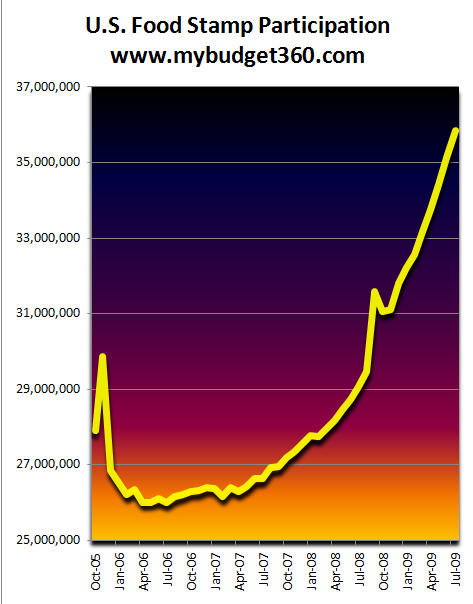
As the New York Times notes, "one in eight Americans and one in four children" receive food stamps.
Many economists and financial experts have said that we are in a depression. See this, this and this.
I hope they are wrong, or that - if we were in a depression - we're out of it now.
But it is indisputable that the unemployment numbers are still grim. Specifically:
- More people will be unemployed than during the Great Depression
- Some of the top economists say that America has suffered a permanent loss of jobs
- By some measures, unemployment is worse than it was during a comparable time-frame in the Great Depression
- Vice President Biden said recently: "It's a depression for millions of Americans"
Given the above, Stacy Herbert's question of today is compelling:
The food stamps story seems to be one that keeps popping up; I guess food stamps are the soup lines of this Great Depression?
Note: At least some economists say that food stamps give more bang for the buck in stimulating the economy than just about anything else. And see this. But economic, political and moral questions surrounding food stamps are beyond the scope of this essay.
Financial Reform Is Being Gutted ... And Congress Might Not Even Realize It
As I have repeatedly pointed out, proposed derivatives legislation will not make things better:
- A leading credit default swap expert (Satyajit Das) says that the new credit default swap regulations not only won't help stabilize the economy, they might actually help to destabilize it.
- Senator Cantwell says that the new derivatives legislation is weaker than current regulation
Now, Mike Konzkal points out that the new derivatives bill may be completed gutted, and that Congress might not even realize it:
Have lobbyists snuck another major loophole into the OTC Derivatives bill? This week the final touches are being put on Barney Frank’s financial regulation bill – H.R. 4173 - “Wall Street Reform and Consumer Protection Act of 2009.” One of the centerpieces of this reform is Title III: Over-the-Counter Derivatives Markets Act. And one of the goals of this reform would be to get as many derivatives as possible to trade on exchanges...
For a while, reformers have been worried about an “alternative swap execution facility.” This would be a way of essentially allowing the current way things are done to be allowed to count as an exchange. Fighting off this loophole was a battle from a month ago, and it had appeared to be won. Now many are worried that this language appears to have snuck back into the final bill now.Colin Peterson (D-MN), Chairman of the House Committee on Agriculture, along with Barney Frank, has added an amendment to the OTC Bill (opens large pdf) ...
The definition of a swap execution facility has been expanded to include “a person” (different from the “or entity”). It’s also expanded to an “or trading” definition, and includes voice brokerage firms. So now we are moving from the definition of something that is a platform for swaps to be traded on to instead something that simply helps swaps get traded. This could, quite simply, be a telephone over which two people trade a derivative (with one person declaring himself to be the exchange?). Instead of changing the way business is done for reform it looks like it redefines reform as the way things are currently done...
[Another provision] here allows an intermediary to execute a swap, ignoring the section 2(k) which is the meat of the reform, as long as the swap is recorded somewhere. Now we already have, from above, that a swap execution facility can be something other than the exchange. This is a rule that guts the regulation right out the door, and for no apparent benefit to reform. Many of these alternative swap facilities will be owned by the banks, so it won’t necessarily force the price transparency that has been promised. To trust regulators to simply do the right thing is naive at best when the ability to follow fixed rules is available.
From what I’m hearing, it is possible Frank doesn’t even know that this language, once in the bill as an amendment but removed, has snuck back into his reform legislation. Things are moving very quickly on the hill right now, and this is scheduled to be wrapped up by tomorrow. However this new language runs counter to the reforms Frank has promised to deliver to the American people. Either this language needs to be clarified before the bill is complete, or removed entirely.
As Ryan Grim notes, many other aspects of the financial reform package - such as the Consumer Financial Protection Agency - are being gutted as well. He points out that the states' ability to rein in financial fraud is also under attack.
Congressional Quarterly summarizes the fight over consumer protection (subscription required):
House leaders are trying to settle a dispute between liberal and moderate Democrats that threatens to sideline, at least temporarily, a bill to overhaul regulation of the financial system.
The battle centers on two proposed amendments to the bill’s consumer protection provisions that moderate Democrats are demanding a vote on. Should those amendments not be made in order, members of the New Democrat and Blue Dog caucuses probably would vote against a rule to commence debate on the bill (HR 4173), a House aide said. That would in all likelihood quash the rule, given that Republicans are likely to oppose it unanimously.
But liberal Democrats are staunchly opposed to the amendments, and have threatened to abandon the bill if at least one of them is adopted. But the liberals also fear they do not have the votes to kill either amendment.
One amendment would allow federal regulators to preempt state financial laws and the other essentially would scrap the creation of a Consumer Financial Protection Agency.
“We still have some details to hammer out,” said Michael E. McMahon, D-N.Y., a New Democrat who has played a prominent role in the caucus negotiations over the final regulatory overhaul bill.
The amendment that would give the federal government the ability preempt state laws on financial protection issues is being offered by Melissa Bean of Illinois, a New Democrat. Supporters argue that, without it, financial companies would face a patchwork of state and federal regulations.
The other amendment, to replace the proposed consumer agency with a council of regulators that would oversee consumer protections for financial products, was offered by Idaho Democrat Walt Minnick, a Blue Dog.
The financial industry staunchly opposes creation of the agency, saying it will squelch innovation. The Chamber of Commerce is “whipping the vote hard” on the Minnick amendment, a House aide said.
Investment analyst and financial writer Yves Smith exhorts her readers to call Congress today to fight back against the lobbyists:
OK, sports fans, I know politics sucks, but it takes VERY LITTLE time to call or e-mail your representative to give him or her a piece of your mind. If you are not trying to be part of the solution, you are part of the problem. And if you can take a few minutes to call, be sure to call an in-state office, not the DC office. One big issue is a late addition to the House financial reform bill which would further crimp state’s rights (and recall it was the states, that led the charge on dot-com abuses, auction rate securities, and now on alleged rating agency fraud. This is an effort to gut the last channel willing to take on the banksters). Even Reuters is putting the state of play in unusually stark terms:
An army of lobbyists from banks and Wall Street have worked for months to block, water down and delay the bill, which would threaten the profits of many financial services firms.
Of course, the giant banks and their boosters in Congress are also close to making the bailouts permanent.
A summary of all proposed amendments to the financial reform bill has been put together by the Committee on Rules.
The 242-page "manager’s amendment" - a kitchen-sink amendment that pulls in all the last minute deals (so you can actually see handwriting on the PDF) is where you can see a lot of important policy changes.
Giant Banks Are Trying to Make Bailouts Permanent. They'll Succeed Unless We Raise a Ruckus
According to the following Democratic and Republican congress members, economists, financial experts and journalists, the "too big to fails" (with help from bank-friendly voices in Congress) are trying to make the bailouts permanent:
- Congressman Brad Sherman, who serves on the House Financial Services Committee, and was formerly an accountant, and other Democrats in Congress
- Congressman Spencer Bachus, the ranking Republican on the House Financial Services Committee, and other Republicans in Congress
- Former Fed chairman Paul Volcker
- Senior Harvard economist Jeffrey Miron
- Peter Wallison, financial policy study analyst at the American Enterprise Institute
- Veteran financial writer William Greider
- Journalist Matt Taibbi
Wednesday, December 9, 2009
Volcker: Financial Innovation is Worthless, and Banks Should Be Limited to Traditional Depository Functions
The Telegraph notes:
The former US Federal Reserve chairman told an audience that included some of the world's most senior financiers that their industry's "single most important" contribution in the last 25 years has been automatic telling machines, which he said had at least proved "useful".
Echoing FSA chairman Lord Turner's comments that banks are "socially useless", Mr Volcker told delegates who had been discussing how to rebuild the financial system to "wake up". He said credit default swaps and collateralised debt obligations had taken the economy "right to the brink of disaster" and added that the economy had grown at "greater rates of speed" during the 1960s without such products.
When one stunned audience member suggested that Mr Volcker did not really mean bond markets and securitisations had contributed "nothing at all", he replied: "You can innovate as much as you like, but do it within a structure that doesn't put the whole economy at risk."
He said he agreed with George Soros, the billionaire investor, who said investment banks must stick to serving clients and "proprietary trading should be pushed out of investment banks and to hedge funds where they belong".
It is not just George Soros.
Nassim Nicholas Taleb has repeatedly said that speculation should be limited to hedge funds, and that banks should solely engage in traditional depository functions, and - because of their power to create credit - be treated as public utilities.
Many other top economists and financial experts have said that financial innovation is harmful, and have called for reimposing Glass-Steagall and for separating traditional banking from investment banking.
As I wrote in June:
Geithner said we need [credit default swaps] for financial "creativity" and "innovation"...
Is Geithner right that financial "creativity" and "innovation" are good things?
No.
The Canadian banking system is the world's most stable banking system precisely because it is boring instead of innovative.
Paul Krugman writes that banking has to be made boring again, to prevent the kinds of results which came from high -flying finance in the 1920's (the Great Depression) and late 1990s early 2000s (the current melt down). Krugman also notes:Part of the problem is that boring banking would mean poorer bankers, and the financial industry still has a lot of friends in high places. But it’s also a matter of ideology: Despite everything that has happened, most people in positions of power still associate fancy finance with economic progress.
Tuesday, December 8, 2009
In 2008, British Intelligence Concluded that the Afghanistan War Is Unwinnable . . . No Matter How Many Troops Were Sent In
Obama was warned . . .
As I wrote in November 2008:
Veteran journalist Tariq Ali said this morning that the war in Afghanistan is lost.
Specifically, he said that British intelligence has concluded that - no matter how many troops are sent in - the war is already lost and is unwinnable in the future.
Ali also said that, should Obama follow through on his campaign promise to send more troops into Afghanistan, it would be a foreign policy blunder as big as Bush getting us into Iraq.
Specifically, Ali told Democracy Now:
Once [Obama] is in power and sees the intelligence reports coming in from Afghanistan, he will realize that that’s not a serious option. I mean, the British are already saying that sending in more troops isn’t going to help, because the war is lost. The United States intelligence agencies are already involved in panic discussions with the people they are fighting, the neo-Taliban, to try and persuade them to join the coalition, which they’re refusing to do as long as there are foreign troops there. So, escalating the war I don’t think is a serious option. And if he does it, it will be a very, very serious mistake, on the same level in scale as invading Iraq.
Top Military Commander Says Getting Bin Laden is Key to Defeating Al Qaeda. Why Now, When the Government Has Ignored Bin Laden for the Past 8 Years?
The top military commander in Afghanistan - Stanley McChrystal - says that getting Bin Laden is the key to defeating Al Qaeda.
Getting Bin Laden sounds fine to me. But apparently the Bush administration couldn't have cared less about him.
The oldest - and second-largest - French newspaper claims that CIA agents met with Bin Laden two months before 9/11, when he was already wanted for the bombing of the U.S.S. Cole. Sibel Edmonds (the former FBI translator, who Department of Justice's Inspector General and several senators have called extremely credible, and some of whose previous claims have been confirmed by the British press) makes similar allegations. Bear with me, the rest of this essay is less speculative. If true, then the CIA could have nabbed Bin Laden before 9/11.
On October 14, 2001, the Taliban offered to hand over Osama bin Laden to a neutral country if the US halted bombing gave the Taliban evidence of Bin Laden's involvement in 9/11. As the Guardian writes:
Returning to the White House after a weekend at Camp David, the president said the bombing would not stop, unless the ruling Taliban "turn [bin Laden] over, turn his cohorts over, turn any hostages they hold over." He added, "There's no need to discuss innocence or guilt. We know he's guilty" ...
Afghanistan's deputy prime minister, Haji Abdul Kabir, told reporters that the Taliban would require evidence that Bin Laden was behind the September 11 terrorist attacks in the US.
"If the Taliban is given evidence that Osama bin Laden is involved" and the bombing campaign stopped, "we would be ready to hand him over to a third country", Mr Kabir added.
The Guardian subsequently points out:
So the U.S. could have had Bin Laden led away in handcuffs in October 2001.A senior Taliban minister has offered a last-minute deal to hand over Osama bin Laden during a secret visit to Islamabad, senior sources in Pakistan told the Guardian last night.
For the first time, the Taliban offered to hand over Bin Laden for trial in a country other than the US without asking to see evidence first in return for a halt to the bombing, a source close to Pakistan's military leadership said.
According to the U.S. Senate - Bin Laden was "within the grasp" of the U.S. military in Afghanistan in December 2001, but that then-secretary of defense Rumsfeld refused to provide the soldiers necessary to capture him.
This story was disclosed years ago. It was confirmed in 2005 by the CIA field commander for the area in Afghanistan where Bin Laden was holed up.
In addition, French soldiers allegedly say that they easily could have captured or killed Bin Laden in Afghanistan, but that the American commanders stopped them.
In 2005, Cenk Uygur pointed out:The New York Times reported this weekend that we sent in 36 U.S. Special Forces troops to get Osama bin Laden when we knew he was in Tora Bora. By contrast, we sent nearly 150,000 soldiers to get Saddam Hussein. In case you're keeping count at home, we got Saddam and we didn't get Osama. What does that tell you about this administration’s priorities? This goes beyond incompetence. If you send only 36 soldiers to get somebody in the middle of Afghanistan, it means you don’t want to get him...In 2007, Uygur rounded up evidence that the White House didn't care much about Bin Laden:
Osama had about 1,500-2,000 well-armed, well-trained men in the region. 36 guys to get 2,000? Why would we let ourselves be outgunned like that?...
There is an inescapable fact – if you put this little effort into capturing someone, it means you don’t want to capture him.
A retired Colonel said that the U.S. could have killed Bin Laden again in 2007, but didn't:Gen. Peter J. Schoomaker, Army Chief of Staff, on captruing Osama bin Laden:
"I don't know that it's all that important, frankly."Dick Cheney downplaying the importance of capturing Osama bin Laden:
"He's not the only source of the problem, obviously. . . . If you killed him tomorrow, you'd still have a problem with al-Qaeda."President Bush on how important he thinks capturing Osama bin Laden is:
"So I don't know where he is. You know, I just don't spend that much time on him. ... And, again, I don't know where he is. I -- I'll repeat what I said. I truly am not that concerned about him.""Deep in my heart I know the man's on the run, if he's alive at all...I just don't spend much time on it, really, to be honest with you."President Bush also shut down the CIA operation trying to capture Osama bin Laden. And let him escape in Tora Bora.
If they care about capturing the man who actually attacked us on 9/11 and killed nearly 3,000 Americans, they have a funny way of showing it.
We know, with a 70 percent level of certainty — which is huge in the world of intelligence — that in August of 2007, bin Laden was in a convoy headed south from Tora Bora. We had his butt, on camera, on satellite. We were listening to his conversations. We had the world’s best hunters/killers — Seal Team 6 — nearby. We had the world class Joint Special Operations Command (JSOC) coordinating with the CIA and other agencies. We had unmanned drones overhead with missiles on their wings; we had the best Air Force on the planet, begging to drop one on the terrorist. We had him in our sights; we had done it ....Unbelievably, and in my opinion, criminally, we did not kill Usama bin Laden.And Margie Burns argues that a request under the Freedom of Information Act confirms that the Bush White House didn't care very much about Bin Laden at all. Among the millions of emails, only a few refer to Bin Laden, and those are mainly public press releases:
“Missing” White House emails retrieved from Bush administration records indicate that top Bush Justice Department officials had little interest in the pursuit of Osama bin Laden or Mullah Mohammed Omar, head of the Taliban in Afghanistan...If capturing or killing Bin Laden is so important, why didn't we do it in early 2001, or October 2001, or December 2001, or 2007?
Given all the public emphasis on “information sharing” and cooperation among law enforcement and security entities, and the speechifying against a purported “wall” between domestic and foreign information gathering, one would think there would have been extensive correspondence about bin Laden and Omar among others.Again, either there was such extensive correspondence, and it is being suppressed; or there was no such interest in bin Laden at the highest levels of government, meaning that indeed the previous administration viewed bin Laden chiefly as a public relations tool.
What did they know about bin Laden that they did not share with the public? Were they confident, for undisclosed reasons, that he posed no threat? Why are there no expressions of concern about his whereabouts?
Head of California's Cap and Trade Offsets Program: Cap and Trade Won't Work for Climate, It's a Scam
Paul Krugman argues that cap and trade worked to reduce sulfur dioxide and stop acid rain, and so it will work to reduce C02.
However, two EPA lawyers with more than 40 years of cumulative experience - including the guy who has been head of California's cap and trade offset programs for more than 20 years - say that sulfur dioxide was different, and that cap and trade for climate is a scam which only benefits the financial players.
Specifically, they point out that:
- Cap and trade was tried in Europe, but ended up raising energy prices, creating volatility, produced few greenhouse gas reductions, but made billions for the financial players
- Even the guy who invented the cap and trade concept doesn't think it will work in regards to climate change (see this and this)
- Carbon offsets - which are part of the cap and trade plan - increase pollution
- One reason that offsets lead to more pollution is that investors fight to keep toxic chemicals legal, so they can make more money off of trading the offsets
- Like subprime mortgages and other creative financial instruments which brought us the economic crisis, carbon offsets lack integrity and don't work (see this)
Monday, December 7, 2009
Woman Who Invented Credit Default Swaps is One of the Key Architects of Carbon Derivatives, Which Would Be at the Very CENTER of Cap and Trade
As I have previously shown, speculative derivatives (especially credit default swaps or "CDS") are a primary cause of the economic crisis. They were largely responsible for bringing down Bear Stearns, AIG (and see this), WaMu and other mammoth corporations.
According to top experts, risky derivatives were not only largely responsible for bringing down the American (and world) economy, but they still pose a substantial systemic risk:
- A Nobel prize-winning economist (George Akerlof) predicted in 1993 that CDS would cause the next meltdown
- Warren Buffett called them “weapons of mass destruction” in 2003
- Warren Buffett’s sidekick Charles T. Munger, has called the CDS prohibition the best solution, and said “it isn’t as though the economic world didn’t function quite well without it, and it isn’t as though what has happened has been so wonderfully desirable that we should logically want more of it”
- Former Federal Reserve Chairman Alan Greenspan - after being one of their biggest cheerleaders - now says CDS are dangerous
- Former SEC chairman Christopher Cox said "The virtually unregulated over-the-counter market in credit-default swaps has played a significant role in the credit crisis''
- Newsweek called CDS "The Monster that Ate Wall Street"
- President Obama said in a June 17 speech on his plans for finance industry regulatory reform that credit swaps and other derivatives “have threatened the entire financial system”
- George Soros says the market is still unsafe, and that credit- default swaps are “toxic” and “a very dangerous derivative” because it’s easier and potentially more profitable for investors to bet against companies using them than through so-called short sales.
- U.S. Congresswoman Maxine Waters introduced a bill in July that tried to ban credit-default swaps because she said they permitted speculation responsible for bringing the financial system to its knees.
- Nobel prize-winning economist Myron Scholes - who developed much of the pricing structure used in CDS - said that over-the-counter CDS are so dangerous that they should be “blown up or burned”, and we should start fresh
- A leading credit default swap expert (Satyajit Das) says that the new credit default swap regulations not only won't help stabilize the economy, they might actually help to destabilize it.
- Senator Cantwell says that the new derivatives legislation is weaker than current regulation
Round Two: Carbon Derivatives
Now, Bloomberg notes that the carbon trading scheme will be largely centered around derivatives:
The banks are preparing to do with carbon what they’ve done before: design and market derivatives contracts that will help client companies hedge their price risk over the long term. They’re also ready to sell carbon-related financial products to outside investors.
[Blythe] Masters says banks must be allowed to lead the way if a mandatory carbon-trading system is going to help save the planet at the lowest possible cost. And derivatives related to carbon must be part of the mix, she says. Derivatives are securities whose value is derived from the value of an underlying commodity -- in this case, CO2 and other greenhouse gases...
Who is Blythe Masters?
She is the JP Morgan employee who invented credit default swaps, and is now heading JPM's carbon trading efforts. As Bloomberg notes (this and all remaining quotes are from the above-linked Bloomberg article):
Masters, 40, oversees the New York bank’s environmental businesses as the firm’s global head of commodities...Some in congress are fighting against carbon derivatives:As a young London banker in the early 1990s, Masters was part of JPMorgan’s team developing ideas for transferring risk to third parties. She went on to manage credit risk for JPMorgan’s investment bank.
Among the credit derivatives that grew from the bank’s early efforts was the credit-default swap.
“People are going to be cutting up carbon futures, and we’ll be in trouble,” says Maria Cantwell, a Democratic senator from Washington state. “You can’t stay ahead of the next tool they’re going to create.”
Cantwell, 51, proposed in November that U.S. state governments be given the right to ban unregulated financial products. “The derivatives market has done so much damage to our economy and is nothing more than a very-high-stakes casino -- except that casinos have to abide by regulations,” she wrote in a press release...
However, Congress may cave in to industry pressure to let carbon derivatives trade over-the-counter:
The House cap-and-trade bill bans OTC derivatives, requiring that all carbon trading be done on exchanges...The bankers say such a ban would be a mistake...The banks and companies may get their way on carbon derivatives in separate legislation now being worked out in Congress...
Financial experts are also opposed to cap and trade:
Even George Soros, the billionaire hedge fund operator, says money managers would find ways to manipulate cap-and-trade markets. “The system can be gamed,” Soros, 79, remarked at a London School of Economics seminar in July. “That’s why financial types like me like it -- because there are financial opportunities”...Hedge fund manager Michael Masters, founder of Masters Capital Management LLC, based in St. Croix, U.S. Virgin Islands [and unrelated to Blythe Masters] says speculators will end up controlling U.S. carbon prices, and their participation could trigger the same type of boom-and-bust cycles that have buffeted other commodities...
The hedge fund manager says that banks will attempt to inflate the carbon market by recruiting investors from hedge funds and pension funds.
“Wall Street is going to sell it as an investment product to people that have nothing to do with carbon,” he says. “Then suddenly investment managers are dominating the asset class, and nothing is related to actual supply and demand. We have seen this movie before.”
Indeed, as I have previously pointed out, many environmentalists are opposed to cap and trade as well. For example:
How the Movie EndsMichelle Chan, a senior policy analyst in San Francisco for Friends of the Earth, isn’t convinced.
“Should we really create a new $2 trillion market when we haven’t yet finished the job of revamping and testing new financial regulation?” she asks. Chan says that, given their recent history, the banks’ ability to turn climate change into a new commodities market should be curbed...
“What we have just been woken up to in the credit crisis -- to a jarring and shocking degree -- is what happens in the real world,” she says...
Friends of the Earth’s Chan is working hard to prevent the banks from adding carbon to their repertoire. She titled a March FOE report “Subprime Carbon?” In testimony on Capitol Hill, she warned, “Wall Street won’t just be brokering in plain carbon derivatives -- they’ll get creative.”
Yes, they'll get "creative", and we have seen this movie before ...an inadequately-regulated carbon derivatives boom will destabilize the economy and lead to another crash.
I have previously pointed out that CDS sellers - like the big sellers of other financial products - know that the government will bail them out if CDS crash again. So they have strong incentives to sell them and to recreate huge levels of leverage. Indeed, the same dynamic that led to the S&L crisis also led to last year's CDS crisis, and will lead to the next crisis as well. So - while CDS might be a particularly dangerous type of "weapon of mass destruction" (in Warren Buffet's words), the new carbon derivatives may very well become the new form of looting on the public's dime. If the government allows massive carbon derivatives trading with as little oversight as over the CDS market, taxpayers will end up spending many trillions bailing out the giant banks and propping up the economy when the carbon market bubble bursts.
And as I have previously pointed out: (1) the giant banks will make a killing on carbon trading, (2) while the leading scientist crusading against global warming says it won't work, and (3) there is a very high probability of massive fraud and insider trading in the carbon trading markets.
Sunday, December 6, 2009
79% of Americans Want an Audit of the Fed, Only 21% are in Favor of Confirming Bernanke, and Only 20% Think Geithner is Doing a Good Job
79 percent of the American public is in favor of auditing the Fed, according to a new poll by Rassumussen. Because another 14% are not sure, that leaves only 7% opposed to an audit. And as Rassumussen, the support for auditing the Fed is nonpartisan and very widespread:
Unlike many issues tracked by Rasmussen Reports, there is virtually no partisan disagreement on the issue of auditing the Fed.
Similarly, investors and non-investors are equally supportive of the idea. Generally speaking, there is overwhelming support for such auditing across all demographic categories.
Rasumussen also points out:
Americans continue to be critical of another key player on the economic front, Treasury Secretary Timothy Geithner. Forty-two percent (42%) of Americans say Geithner has done a poor job handling the credit crisis and federal bailout programs. Twenty percent (20%) rate Geithner’s performance in these areas as good or excellent.
Consumer confidence as measured by the Rasmussen Consumer Index has fallen to a four-month low.
Small Businesses Have Lost Confidence Also
You might assume that - despite the public's lack of confidence in Bernanke, Geithner and the economy - at least businesses are confident.
However, as Rassumussen notes:
After three months of gains, the Rasmussen Employment Index dropped more than four points in November to its lowest level since July. Just 14% of workers now say their employers are hiring, the lowest total since February.
Economic confidence among America's small business owners in the Discover (R) Small Business Watch(SM) index plummeted in November, as more owners cited serious concerns about cash flow and saw economic conditions for their own businesses getting worse.
Specifically, Discover reports:
Wall Street might believe that everything is grand, but small businesses are the engines which create job growth in America, and if they are pessimistic, they won't hire.Economic confidence among America's small business owners plummeted in November, as more owners cited serious concerns about cash flow and saw economic conditions for their own businesses getting worse. The Discover Small Business Watch index fell 12 points in November to 76.5 from 88.5 in October...
- The mood of small business owners generally has soured in November for three straight years, as economic confidence dropped from October to November in 2007 and 2008. The November 2008 index of 67.5 is the low point for the Watch since it started in August 2006.
- 52 percent of owners say they have experienced cash flow issues in the past 90 days, up from 44 percent in October. Forty-one percent of owners say they have not experienced cash flow issues, which is the lowest response in this category since the Watch began. The remaining 6 percent said they weren't sure.
- 53 percent of small business owners see conditions getting worse in the next six months, up from 43 percent in October; while 19 percent report that conditions are improving, a sharp decline from 29 percent in October; 23 percent see conditions as the same, and 5 percent weren't sure.
- 62 percent of small business owners rate the economy as poor, an increase from 55 percent in October; 30 percent rate it as fair, and 8 percent say it is good or excellent.
- 53 percent of small business owners think the overall economy is getting worse, up from 44 percent in October but still significantly lower than the 69 percent of owners who felt that way in February 2009, the last time the Watch index was this low. For November; 28 percent say the economy is getting better, down from 35 percent in October; 16 percent see it staying the same, and 3 percent are not sure.
The Economy Cannot Recover Until Bernanke and Geithner are replaced
As I have repeatedly written, the economy cannot fundamentally stabilize until trust is restored.
Former Secretary of Labor Robert Reich wrote that Wall Street's biggest problem right now is the collapse of trust:
The problem is, government bailouts, subsidies, and insurance aren't really helping Wall Street. The Street's fundamental problem isn't lack of capital. It's lack of trust. And without trust, Wall Street might as well fold up its fancy tents.
A 2005 letter in premier scientific journal Nature reviews the research on trust and economics:
Trust ... plays a key role in economic exchange and politics. In the absence of trust among trading partners, market transactions break down. In the absence of trust in a country's institutions and leaders, political legitimacy breaks down. Much recent evidence indicates that trust contributes to economic, political and social success.
Forbes wrote an article in 2006 entitled "The Economics of Trust". The article summarizes the importance of trust in creating a healthy economy:
Similarly, market psychologists Richard L. Peterson M.D. and Frank Murtha, Ph.D. wrote in 2008:Imagine going to the corner store to buy a carton of milk, only to find that the refrigerator is locked. When you've persuaded the shopkeeper to retrieve the milk, you then end up arguing over whether you're going to hand the money over first, or whether he is going to hand over the milk. Finally you manage to arrange an elaborate simultaneous exchange. A little taste of life in a world without trust--now imagine trying to arrange a mortgage.
Being able to trust people might seem like a pleasant luxury, but economists are starting to believe that it's rather more important than that. Trust is about more than whether you can leave your house unlocked; it is responsible for the difference between the richest countries and the poorest.
"If you take a broad enough definition of trust, then it would explain basically all the difference between the per capita income of the United States and Somalia," ventures Steve Knack, a senior economist at the World Bank who has been studying the economics of trust for over a decade. That suggests that trust is worth $12.4 trillion dollars a year to the U.S., which, in case you are wondering, is 99.5% of this country's income. ***
Above all, trust enables people to do business with each other. Doing business is what creates wealth. ***
Economists distinguish between the personal, informal trust that comes from being friendly with your neighbors and the impersonal, institutionalized trust that lets you give your credit card number out over the Internet.
Trust is the oil in the engine of capitalism, without it, the engine seizes up.And two professors of finance write:
Confidence is like the gasoline, without it the machine won't move.
Trust is gone: there is no longer trust between counterparties in the financial system. Furthermore, confidence is at a low. Investors have lost their confidence in the ability of shares to provide decent returns (since they haven't).
They quote a Nobel laureate economist on the subject:The drop in trust, we believe, is a major factor behind the deteriorating economic conditions. To demonstrate its importance, we launched the Chicago Booth/Kellogg School Financial Trust Index. Our first set of data—based on interviews conducted at the end of December 2008—shows that between September and December, 52 percent of Americans lost trust in the banks. Similarly, 65 percent lost trust in the stock market. A BBB/Gallup poll that surveyed a similar sample of Americans last April confirms this dramatic drop. At that time, 42 percent of Americans trusted financial institutions, versus 34 percent in our survey today, while 53 percent said they trusted U.S. companies, versus just 12 percent today.
As trust declines, so does Americans’ willingness to invest their money in the financial system. Our data show that trust in the stock market affects people’s intention to buy stocks, even after accounting for expectations of future stock-market performance. Similarly, a person’s trust in banks predicts the likelihood that he will make a run on his bank in a moment of crisis: 25 percent of those who don’t trust banks withdrew their deposits and stored them as cash last fall, compared with only 3 percent of those who said they still trusted the banks. Thus, trust in financial institutions is a key factor for the smooth functioning of capital markets and, by extension, the economy. Changes in trust matter.
“Virtually every commercial transaction has within itself an element of trust,” writes economist Kenneth Arrow, a Nobel laureate. When we deposit money in a bank, we trust that it’s safe. When a company orders goods, it trusts its counterpart to deliver them in good faith. Trust facilitates transactions because it saves the costs of monitoring and screening; it is an essential lubricant that greases the wheels of the economic system.Although it is easy to demonstrate that Bernanke and Geithner's actions have harmed the economy, it is not even necessary to show what a poor job they have done economically.
America knows that Bernanke and Geithner have acted in the interests of the largest banks, and have done too little to help Main street and the American people.
Trust will not be restored until Bernanke and Geithner are replaced with people whose loyalty is to the American public and small businesses, rather than the Wall Street giants, and whose track record demonstrates that they will put the American people and entire economy as a whole - rather than the big boys - first.
Saturday, December 5, 2009
Little Known Facts About Afghanistan and Bin Laden
Evidence which has come out over the last couple of years makes it clear that top Bush administration officials knew that Saddam didn't have weapons of mass destruction and knew that Saddam had no connection with 9/11.
It is now reasonably obvious that the Bush administration was looking for an excuse to oust Saddam, and - in the words of the Downing Street Memo - “the intelligence and facts were being fixed around the policy”.
Indeed, former CIA director George Tenet said that the White House wanted to invade Iraq long before 9/11, and inserted "crap" in its justifications for invading Iraq. Former Treasury Secretary Paul O'Neill - who sat on the National Security Council - also says that Bush planned the Iraq war before 9/11. And top British officials say that the U.S. discussed Iraq regime change long before 9/11 (one month after Bush took office).
Saddam's Offer
Saddam allegedly offered to let weapons inspectors in the country and to hold new elections:
In the few weeks before its fall, Iraq's Ba'athist regime made a series of increasingly desperate peace offers to Washington, promising to hold elections and even to allow US troops to search for banned weapons. But the advances were all rejected by the Bush administration, according to intermediaries involved in the talks.
Moreover, Saddam allegedly offered to leave Iraq:
According to the tapes, Bush told Aznar that whether Saddam was still in Iraq or not, "We'll be in Baghdad by the end of March." See also this and this."Fearing defeat, Saddam was prepared to go peacefully in return for £500million ($1billion)".
"The extraordinary offer was revealed yesterday in a transcript of talks in February 2003 between George Bush and the then Spanish Prime Minister Jose Maria Aznar at the President's Texas ranch."
"The White House refused to comment on the report last night. But, if verified, it is certain to raise questions in Washington and London over whether the costly four-year war could have been averted."
Afghanistan Is Different
But Afghanistan is much different.
As President Obama said Tuesday night as justification for the surge in troops in Afghanistan:
We did not ask for this fight. On September 11, 2001, 19 men hijacked four airplanes and used them to murder nearly 3,000 people.
Al Qaeda’s base of operations was in Afghanistan, where they were harbored by the Taliban”, who refused to turn over Osama bin Laden.
Is that true?
The Taliban OfferOn October 14, 2001, the Taliban offered to hand over Osama bin Laden to a neutral country if the US halted bombing if the Taliban were given evidence of Bin Laden's involvement in 9/11.
Specifically, as the Guardian writes:
Returning to the White House after a weekend at Camp David, the president said the bombing would not stop, unless the ruling Taliban "turn [bin Laden] over, turn his cohorts over, turn any hostages they hold over." He added, "There's no need to discuss innocence or guilt. We know he's guilty" ...
Afghanistan's deputy prime minister, Haji Abdul Kabir, told reporters that the Taliban would require evidence that Bin Laden was behind the September 11 terrorist attacks in the US.
"If the Taliban is given evidence that Osama bin Laden is involved" and the bombing campaign stopped, "we would be ready to hand him over to a third country", Mr Kabir added.
However, as the Guardian subsequently points out:
And yet, as with Saddam, the U.S. turned down the offer and instead prosecuted war.A senior Taliban minister has offered a last-minute deal to hand over Osama bin Laden during a secret visit to Islamabad, senior sources in Pakistan told the Guardian last night.
For the first time, the Taliban offered to hand over Bin Laden for trial in a country other than the US without asking to see evidence first in return for a halt to the bombing, a source close to Pakistan's military leadership said.
Little-Known Facts About Afghanistan and Bin Laden
The government apparently planned the Afghanistan war before 9/11 (see this and this).
And the government apparently could have killed Bin Laden in 2001 and AGAIN in 2007, but failed to do so.
In fact, starting right after 9/11 -- at the latest -- the goal has always been to create "regime change" and instability in Iraq, Iran, Syria, Libya, Sudan, Somalia, Lebanon and other countries. As American historian, investigative journalist and policy analyst Gareth Porter writes in the Asia Times:Three weeks after the September 11, 2001, terror attacks, former US defense secretary Donald Rumsfeld established an official military objective of not only removing the Saddam Hussein regime by force but overturning the regime in Iran, as well as in Syria and four other countries in the Middle East, according to a document quoted extensively in then-under secretary of defense for policy Douglas Feith's recently published account of the Iraq war decisions. Feith's account further indicates that this aggressive aim of remaking the map of the Middle East by military force and the threat of force was supported explicitly by the country's top military leaders.
Feith's book, War and Decision, released last month, provides excerpts of the paper Rumsfeld sent to President George W Bush on September 30, 2001, calling for the administration to focus not on taking down Osama bin Laden's al-Qaeda network but on the aim of establishing "new regimes" in a series of states...
***
General Wesley Clark, who commanded the North Atlantic Treaty Organization bombing campaign in the Kosovo war, recalls in his 2003 book Winning Modern Wars being told by a friend in the Pentagon in November 2001 that the list of states that Rumsfeld and deputy secretary of defense Paul Wolfowitz wanted to take down included Iraq, Iran, Syria, Libya, Sudan and Somalia [and Lebanon].
***
When this writer asked Feith . . . which of the six regimes on the Clark list were included in the Rumsfeld paper, he replied, "All of them."
***
The Defense Department guidance document made it clear that US military aims in regard to those states would go well beyond any ties to terrorism. The document said the Defense Department would also seek to isolate and weaken those states and to "disrupt, damage or destroy" their military capacities - not necessarily limited to weapons of mass destruction (WMD).
Indeed, the goal seems to have more to do with being a superpower (i.e. an empire) than stopping terrorism.
As Porter writes:
After the bombing of two US embassies in East Africa [in 1988] by al-Qaeda operatives, State Department counter-terrorism official Michael Sheehan proposed supporting the anti-Taliban Northern Alliance in Afghanistan against bin Laden's sponsor, the Taliban regime. However, senior US military leaders "refused to consider it", according to a 2004 account by Richard H Shultz, Junior, a military specialist at Tufts University.And recall that former U.S. National Security Adviser (and top foreign policy advisor) Zbigniew Brzezinski told the Senate that the war on terror is "a mythical historical narrative".A senior officer on the Joint Staff told State Department counter-terrorism director Sheehan he had heard terrorist strikes characterized more than once by colleagues as a "small price to pay for being a superpower".
Cynics argue that America is just the latest in a long string of empires trying to control the "crossroads" between East and West.
And people such as the former UK ambassador to Afghanistan argue that there are even uglier reasons for America's involvement in Afghanistan.
This essay does not address such questions. All I'm asking is whether the U.S. refusal to accept the Taliban's offer to hand over Bin Laden should be viewed as similar to its refusal to accept Saddam's offer to go into exile for $1 billion dollars. In other words, we should ask whether the U.S. was hell-bent on going to war against Afghanistan and Saddam, without - contrary to official statements - really caring about the bad guys.
Looking Ahead
These questions are not just stale, historical questions.
The U.S. military is currently pursuing a strategy in Afghanistan that - according to some - will decrease national security and spend our nation's blood and treasure, all for the sake of killing only 100 Al Qaeda fighters in the entire country, while we could spend much less to capture or kill those bad guys.


 Posts
Posts



