
Sunday, September 5, 2010
Dick Cheney's Oily Dream
Former British Prime Minister Tony Blair is currently saying that Dick Cheney's vision of policy towards the Middle East after 9/11 was to re-draw the map:
Vice-President Dick Cheney's vision of completely redrawing the map of the Middle East following the 9/11 attacks is "not stupid," and is "possible over time," former British Prime Minister Tony Blair says.
In his new book, A Journey, the former Labour Party leader wrote that Cheney wanted a wholesale reorganization of the political map of the Middle East after 9/11. The vice president "would have worked through the whole lot, Iraq, Syria, Iran, dealing with all their surrogates in the course of it -- Hezbollah, Hamas, etc," Blair wrote.
What does this mean?
Well, as I have repeatedly pointed out, the "war on terror" in the Middle East has nothing to do with combating terror, and everything to do with remaking that region's geopolitical situation to America's advantage.
For example, as I noted in January::
Starting right after 9/11 -- at the latest -- the goal has always been to create "regime change" and instability in Iraq, Iran, Syria, Libya, Sudan, Somalia and Lebanon; the goal was never really to destroy Al Qaeda. As American reporter Gareth Porter writes in Asia Times:
Three weeks after the September 11, 2001, terror attacks, former US defense secretary Donald Rumsfeld established an official military objective of not only removing the Saddam Hussein regime by force but overturning the regime in Iran, as well as in Syria and four other countries in the Middle East, according to a document quoted extensively in then-under secretary of defense for policy Douglas Feith's recently published account of the Iraq war decisions. Feith's account further indicates that this aggressive aim of remaking the map of the Middle East by military force and the threat of force was supported explicitly by the country's top military leaders.Feith's book, War and Decision, released last month, provides excerpts of the paper Rumsfeld sent to President George W Bush on September 30, 2001, calling for the administration to focus not on taking down Osama bin Laden's al-Qaeda network but on the aim of establishing "new regimes" in a series of states...***General Wesley Clark, who commanded the North Atlantic Treaty Organization bombing campaign in the Kosovo war, recalls in his 2003 book Winning Modern Wars being told by a friend in the Pentagon in November 2001 that the list of states that Rumsfeld and deputy secretary of defense Paul Wolfowitz wanted to take down included Iraq, Iran, Syria, Libya, Sudan and Somalia [and Lebanon].***When this writer asked Feith . . . which of the six regimes on the Clark list were included in the Rumsfeld paper, he replied, "All of them."***The Defense Department guidance document made it clear that US military aims in regard to those states would go well beyond any ties to terrorism. The document said the Defense Department would also seek to isolate and weaken those states and to "disrupt, damage or destroy" their military capacities - not necessarily limited to weapons of mass destruction (WMD)...Rumsfeld's paper was given to the White House only two weeks after Bush had approved a US military operation in Afghanistan directed against bin Laden and the Taliban regime. Despite that decision, Rumsfeld's proposal called explicitly for postponing indefinitely US airstrikes and the use of ground forces in support of the anti-Taliban Northern Alliance in order to try to catch bin Laden.Instead, the Rumsfeld paper argued that the US should target states that had supported anti-Israel forces such as Hezbollah and Hamas.***After the bombing of two US embassies in East Africa [in 1998] by al-Qaeda operatives, State Department counter-terrorism official Michael Sheehan proposed supporting the anti-Taliban Northern Alliance in Afghanistan against bin Laden's sponsor, the Taliban regime. However, senior US military leaders "refused to consider it", according to a 2004 account by Richard H Shultz, Junior, a military specialist at Tufts University.A senior officer on the Joint Staff told State Department counter-terrorism director Sheehan he had heard terrorist strikes characterized more than once by colleagues as a "small price to pay for being a superpower".
No wonder former U.S. National Security Adviser Zbigniew Brzezinski told the Senate that the war on terror is "a mythical historical narrative".
But can Cheney's desires can't be equated to U.S. foreign policy as a whole? Well, the number two man at the State Department, Lawrence Wilkerson, said:The vice president and the secretary of defense created a "Cheney-Rumsfeld cabal" that hijacked U.S. foreign policy.And Cheney was the guy who set up the secret shop at the Pentagon to bypass the intelligence agencies and push fake "intelligence" showing that Iraq had weapons of mass destruction.
And as I wrote in 2009:
Indeed, the torture program which Cheney created was specifically aimed at producing false confessions in an attempt to link Iraq and 9/11.5 hours after the 9/11 attacks, Donald Rumsfeld said "my interest is to hit Saddam".
He also said "Go massive . . . Sweep it all up. Things related and not."
And at 2:40 p.m. on September 11th, in a memorandum of discussions between top administration officials, several lines below the statement "judge whether good enough [to] hit S.H. [that is, Saddam Hussein] at same time", is the statement "Hard to get a good case." In other words, top officials knew that there wasn't a good case that Hussein was behind 9/11, but they wanted to use the 9/11 attacks as an excuse to justify war with Iraq anyway.
Moreover, "Ten days after the September 11, 2001, terrorist attacks on the World Trade Center and the Pentagon, President Bush was told in a highly classified briefing that the U.S. intelligence community had no evidence linking the Iraqi regime of Saddam Hussein to the [9/11] attacks and that there was scant credible evidence that Iraq had any significant collaborative ties with Al Qaeda".
And a Defense Intelligence Terrorism Summary issued in February 2002 by the United States Defense Intelligence Agency cast significant doubt on the possibility of a Saddam Hussein-al-Qaeda conspiracy.And yet Bush, Cheney and other top administration officials claimed repeatedly for years that Saddam was behind 9/11. See this analysis. Indeed, Bush administration officials apparently swore in a lawsuit that Saddam was behind 9/11.
Moreover, President Bush's March 18, 2003 letter to Congress authorizing the use of force against Iraq, includes the following paragraph:(2) acting pursuant to the Constitution and Public Law 107-243 is consistent with the United States and other countries continuing to take the necessary actions against international terrorists and terrorist organizations, including those nations, organizations, or persons who planned, authorized, committed, or aided the terrorist attacks that occurred on September 11, 2001.Therefore, the Bush administration expressly justified the Iraq war to Congress by representing that Iraq planned, authorized, committed, or aided the 9/11 attacks. See this.
So it should be clear to any honest, thinking person that Cheney and the U.S. used 9/11 as a pretext to redraw the map of the Middle East.
Cheney's Oily Dream
But that doesn't mean the Cheney's goals had any impact on 9/11, right?
Well, it is surely just a coincidence that the Afghanistan war was planned before 9/11. See this and this.
And that top British officials, former CIA director George Tenet, former Treasury Secretary Paul O'Neill and many others say that the Iraq war was planned before 9/11.
Alan Greenspan, John McCain, George W. Bush, a high-level National Security Council officer and others say that the Iraq war was really about oil. They must be conspiracy theorists.
And it is surely meaningless that Cheney made Iraqi's oil fields a national security priority before 9/11. As I pointed out in 2008:
As I wrote last year:You may have heard that the Energy Task Force chaired by Dick Cheney prior to 9/11 collected maps of Iraqi oil, Saudi and United Arab Emerates fields and potential suitors for that oil. And you might have heard that the oil bigs attended the Task Force meetings.
But you probably haven't heard that - according to the New Yorker - a secret document written by the National Security Council (NSC) on February 3, 2001 directed NSC staff to cooperate fully with the Energy Task Force as it considered the “melding” of two seemingly unrelated areas of policy:"The review of operational policies towards rogue states,” such as Iraq, and “actions regarding the capture of new and existing oil and gas fields”.It is difficult to brush off Cheney's Energy Task Force's examination of arab oil maps as a harmless comparison of American energy policy with known oil reserves because the NSC explicitly linked the Task Force, oil, and regime change.
But don't believe me...
The above-linked New Yorker article quotes a former senior director for Russian, Ukrainian, and Eurasian affairs at the NSC said:If this little group was discussing geostrategic plans for oil, it puts the issue of war in the context of the captains of the oil industry sitting down with Cheney and laying grand, global plans.See also this essay.
CIA director Leon Panetta told the New Yorker:When you read behind it, it’s almost as if he’s wishing that this country would be attacked again, in order to make his point.News commentator Ed Schultz said today that Cheney is wishing for a terrorist attack on the U.S.What should we make of all this?
Well, everyone knows that Cheney is ruthless:
- Cheney is the guy who pushed for torture, pressured the Justice Department lawyers to write memos saying torture was legal, and made the pitch to Congress justifying torture. The former director of the CIA accused Cheney of overseeing American torture policies
Cheney is also the guy who:
- Helped found the Project for a New American Century, which called for a new American empire well before 9/11, and lamented that, without a "catastrophic and catalyzing event — like a new Pearl Harbor", transformation of America into an empire would be very slow.
- In the 70's -- Cheney was instrumental in generating fake intelligence exaggerating the Soviet threat in order to undermine coexistence between the U.S. and Soviet Union, which conveniently justified huge amounts of cold war spending. See also this article.
- 30 years later, Cheney was largely responsible for generating fake intelligence about Iraq in order to justify the war. And, according to former British Defense Secretary, Cheney has called the shots in the failed Iraq war.
- According to former high-level intelligence officer Melvin Goodman, Cheney orchestrated phony intelligence for the Congress in order to get an endorsement for covert arms shipments to anti-government forces in Angola
- Cheney was involved in debates concerning illegal wiretaps 30 years ago
- Cheney was probably responsible for outing CIA agent Valerie Plame.
- Pulitzer-prize winning investigative reporter Seymour Hersh says that the military ran an "Executive Assassination Ring" throughout the Bush years which reported directly to Cheney.
***
- Hersh also says that Cheney is the main guy helping to fund groups which the U.S. claims are terrorists (see confirming articles here and here)
A well-known writer said of Dick Cheney:For his entire career, he sought untrammeled power. The Bush presidency and 9/11 finally gave it to him . . . .
***Could it be that Cheney got so lost in his dreams of redrawing the map of the Middle East (and grabbing some oil along the way) that he - as the guy in charge of all counter-terrorism efforts for the United States on 9/11 - spaced out and forgot to engage America's standard air defenses?Cheney also knew 9/11 was going to happen. The government knew that terrorists could use planes as weapons -- and had even run its own drills of planes being used as weapons against the World Trade Center and other U.S. high-profile buildings, using REAL airplanes -- all before 9/11. Indeed, the government heard the 9/11 plans from the hijackers' own mouths before 9/11.
Indeed, Cheney was in charge of all counter-terrorism exercises, activities and responses on 9/11 (see this Department of State announcement; this CNN article; and this essay).
***
The Secretary of Transportation testified to the 9/11 Commission:"During the time that the airplane was coming into the Pentagon, there was a young man who would come in and say to the Vice President … the plane is 50 miles out…the plane is 30 miles out….and when it got down to the plane is 10 miles out, the young man also said to the vice president “do the orders still stand?” And the Vice President turned and whipped his neck around and said “Of course the orders still stand, have you heard anything to the contrary!?"
(this testimony is confirmed here and here).
I don't know ... But - unfortunately - Cheney's oily dream has turned into a nightmare for America. See this, this and this.


Saturday, September 4, 2010
Will Americans Pay to Bailout Yet Another Foreign Bank ... in Afghanistan?
As I have repeatedly pointed out, American taxpayers have been bailing out foreign banks for years.
For example, I noted in May:
As the Wall Street Journal points out, the Federal Reserve might open up its "swap lines" again to bail out the Europeans:
The Fed is considering whether to reopen a lending program put in place during the financial crisis in which it shipped dollars overseas through foreign central banks like the European Central Bank, Swiss National Bank and Bank of England.
***
At a crescendo in the crisis in December 2008, the Fed had shipped $583 billion overseas in the form of these swaps.
As the BBC's Robert Peston writes:
There is talk of the ECB providing some kind of one year repo facility (where government bonds are swapped for 12-month loans) in collaboration with the US Federal Reserve.
See this for more information on swap lines.
Indeed, the Federal Reserve has been helping to bail out foreign central banks and private banks for years.
For example, $40 billion in bailout money given to AIG went to foreign banks. Indeed, even AIG's former chief said that the government used AIG "to funnel money to other Institutions, including foreign banks".As the Telegraph wrote in September 2008:
The Fed has also just offered another $125bn of liquidity to banks outside the US that are desperate for dollars and can't access America's frozen credit markets.Congressman Grayson said that the Fed secretly "stuffed" half a trillion dollars in foreign pockets.
(Of course, the Fed won't tell Congress or the TARP overseer - let alone the American people - who got the cash).
And as I pointed out the same month:A Fact Sheet from the U.S. Treasury says:Of course, even much of the bailout money which went to American banks ended up being shuttled abroad. As I wrote in March 2009:Participating financial institutions must have significant operations in the U.S., unless the Secretary makes a determination, in consultation with the Chairman of the Federal Reserve, that broader eligibility is necessary to effectively stabilize financial markets.An article from today in Politico explains
"In a change from the original proposal sent to Capitol Hill, foreign-based banks with big U.S. operations could qualify for the Treasury Department’s mortgage bailout, according to the fine print of an administration statement Saturday night."So not only are Americans bailing out our own too big to fail banks, but we're bailing out foreign mega-banks as well.Moreover, bailout money that went to Citigroup was loaned to Dubai, bailout money that went to Bank of America China was invested in China, and bailout money given to JP Morgan was invested in India.
And the government is in the process of providing billions more - along with trillions more in guarantees of worthless assets - to sovereign wealth funds and hedge funds.
Even though bailing out Europe might make sense if America was flush with cash, things are different now. As Congressmen Kucinich and Filner wrote last June:Our country and this body cannot afford to spend American tax payer dollars to bail out private European banks.In addition, the U.S. is - of course - also contributing tens of billions of dollars towards the Greek bailout through its contributions to the International Monetary Fund. Some allege that the U.S. will secretly help bailout of all of Europe. See this and this.
As Tyler Durden pointed out last week, the IMF has now abandoned any cap on the bailouts it gives, and the U.S. is the largest funder of the IMF.
Now, the New York Times says that the U.S. is going to bail out Afghanistan's biggest bank:
Details of the deal, including how much each government would contribute, were still being worked out on Saturday between the Central Bank of Afghanistan and the United States Treasury Department, officials said...Top officials at Kabul Bank and a senior leader at the Central Bank declined to comment publicly on the proposed bailout, which was still being negotiated. However a manager at the Central Bank and a senior American official confirmed what the American official called an "intervention."
Not surprisingly, there have been numerous allegations of corruption at the Kabul Bank.
Update: The New York Times has updated their story with comments from U.S. Treasury officials insisting that no American money will be used to recapitalize the Kabul Bank:
"No American taxpayer funds will be used to support Kabul Bank," said Jenni LeCompte, a Treasury Department spokeswoman.
Of course, the IMF, World Bank or a foreign country could funnel the bailout moneys and then the U.S. could print more money to "repay" them later. Accounting shenanigans and under-the-table deals can work wonders to hide the truth from angry American serfs taxpayers.
Roubini: India May Overtake China within a Year
Nouriel Roubini made an interesting point about India and China this week:
Roubini warned that world growth leader China was too dependent on exports to the struggling West and predicted that within a year its economic growth will be overtaken by India, a huge nation much more reliant on its domestic market for development.
India and China are the two most populous nations on Earth.
The 2009 World Population Datasheet - published by the Population Reference Bureau - states that India will have more people than China within a couple of decades.
India has a very young age demographic, as shown by the following age pyramids:
India Population Pyramid for 1995
Age and sex distribution for the year 1995:India Population Pyramid for 2000
Age and sex distribution for the year 2000:India Population Pyramid for 2003
Age and sex distribution for the year 2003:India Population Pyramid for 2005
Age and sex distribution for the year 2005:India Population Pyramid for 2010
Age and sex distribution for the year 2010:India Population Pyramid for 2020
Predicted age and sex distribution for the year 2020:India Population Pyramid for 2050
Predicted age and sex distribution for the year 2050:


Moreover, as the following chart shows, India will have a very low percentage of elderly who need to be taken care of by the young:
Chart 2: Old Age Dependency Ratios for Selected Countries
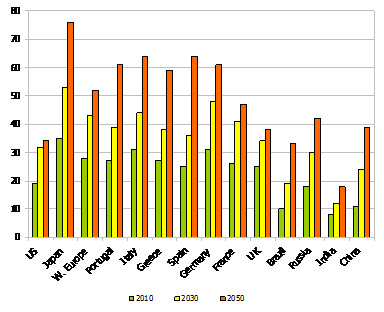
Note: This is not to say that India will surpass China as the world's second biggest economy any time soon. Roubini is talking about the rate of growth, not GDP.
Friday, September 3, 2010
Government Policy Caused America's Unemployment Crisis

The unemployment rate has risen again for the the first time in 4 months. I predicted a growing, long-term unemployment problem last year.
Indeed, even after the government plays with the numbers to make them look better (using inaccurate birth-death models and other tricks-of-the-trade), this is how the current jobs downturn compares with other post-WWII recessions:

In fact, as demonstrated below, the government's actions have directly contributed to the rising tide of unemployment.
The Government Has Encouraged the Offshoring of American Jobs for More Than 50 Years
President Eisenhower re-wrote the tax laws so that they would favor investment abroad. President Kennedy railed against tax provisions that "consistently favor United States private investment abroad compared with investment in our own economy", but nothing has changed under either Democratic or Republican administrations.
For the last 50-plus years, the tax benefits to American companies making things abroad has encouraged jobs to move out of the U.S.
The Government Has Encouraged Mergers
The government has actively encouraged mergers, which destroy jobs.
For example, the Treasury Department encouraged banks to use the bailout money to buy their competitors, and pushed through an amendment to the tax laws which rewards mergers in the banking industry.
This is nothing new.
Citigroup's former chief executive says that when Citigroup was formed in 1998 out of the merger of banking and insurance giants, Alan Greenspan told him, “I have nothing against size. It doesn’t bother me at all”.
And the government has actively encouraged the big banks to grow into mega-banks.
The Government Has Let Unemployment Rise in an Attempt to Fight Inflation
As I noted last year:
In fact, the Fed intentionally curbed lending by banks in an attempt to stem inflation, without addressing whether public banks could provide credit.The Federal Reserve is mandated by law to maximize employment. The relevant statute states:
***The Board of Governors of the Federal Reserve System and the Federal Open Market Committee shall maintain long run growth of the monetary and credit aggregates commensurate with the economy's long run potential to increase production, so as to promote effectively the goals of maximum employment, stable prices, and moderate long-term interest rates.The Fed could have stemmed the unemployment crisis by demanding that banks lend more as a condition to the various government assistance programs, but Mr. Bernanke failed to do so.
Ryan Grim argues that the Fed might have broken the law by letting unemployment rise in order to keep inflation low:In fact, the unemployment situation is getting worse, and many leading economists say that - under Mr. Bernanke's leadership - America is suffering a permanent destruction of jobs.The Fed is mandated by law to maximize employment, but focuses on inflation -- and "expected inflation" -- at the expense of job creation. At its most recent meeting, board members bluntly stated that they feared banks might increase lending, which they worried could lead to inflation.
Board members expressed concern "that banks might seek to reduce appreciably their excess reserves as the economy improves by purchasing securities or by easing credit standards and expanding their lending substantially. Such a development, if not offset by Federal Reserve actions, could give additional impetus to spending and, potentially, to actual and expected inflation." That summary was spotted by Naked Capitalism and is included in a summary of the minutes of the most recent meeting...
Suffering high unemployment in order to keep inflation low cuts against the Fed's legal mandate. Or, to put it more bluntly, it may be illegal.
For example, JPMorgan Chase’s Chief Economist Bruce Kasman told Bloomberg:
[We've had a] permanent destruction of hundreds of thousands of jobs in industries from housing to finance.The chief economists for Wells Fargo Securities, John Silvia, says:And former Merrill Lynch chief economist David Rosenberg writes:Companies “really have diminished their willingness to hire labor for any production level,” Silvia said. “It’s really a strategic change,” where companies will be keeping fewer employees for any particular level of sales, in good times and bad, he said.
The number of people not on temporary layoff surged 220,000 in August and the level continues to reach new highs, now at 8.1 million. This accounts for 53.9% of the unemployed — again a record high — and this is a proxy for permanent job loss, in other words, these jobs are not coming back. Against that backdrop, the number of people who have been looking for a job for at least six months with no success rose a further half-percent in August, to stand at 5 million — the long-term unemployed now represent a record 33% of the total pool of joblessness.And see this.
The Government Has Allowed Wealth to be Concentrated in Fewer and Fewer Hands
As I pointed out a year ago:
A new report by University of California, Berkeley economics professor Emmanuel Saez concludes that income inequality in the United States is at an all-time high, surpassing even levels seen during the Great Depression.
The report shows that:
- Income inequality is worse than it has been since at least 1917
- "The top 1 percent incomes captured half of the overall economic growth over the period 1993-2007"
- "In the economic expansion of 2002-2007, the top 1 percent captured two thirds of income growth."
As others have pointed out, the average wage of Americans, adjusting for inflation, is lower than it was in the 1970s. The minimum wage, adjusting for inflation, is lower than it was in the 1950s. See this. On the other hand, billionaires have never had it better.
As I wrote in September:
The economy is like a poker game . . . it is human nature to want to get all of the chips, but - if one person does get all of the chips - the game ends.
In other words, the game of capitalism only continues as long as everyone has some money to play with. If the government and corporations take everyone's money, the game ends.
The fed and Treasury are not giving more chips to those who need them: the American consumer. Instead, they are giving chips to the 800-pound gorillas at the poker table, such as Wall Street investment banks. Indeed, a good chunk of the money used by surviving mammoth players to buy the failing behemoths actually comes from the Fed...
This is not a question of big government versus small government, or republican versus democrat. It is not even a question of Keynes versus Friedman (two influential, competing economic thinkers).
It is a question of focusing any government funding which is made to the majority of poker players - instead of the titans of finance - so that the game can continue. If the hundreds of billions or trillions spent on bailouts had instead been given to ease the burden of consumers, we would have already recovered from the financial crisis.
I noted in April:
FDR’s Fed chairman Marriner S. Eccles explained:
As in a poker game where the chips were concentrated in fewer and fewer hands, the other fellows could stay in the game only by borrowing. When their credit ran out, the game stopped.***
When most people lose their poker chips - and the game is set up so that only those with the most chips get more - free market capitalism is destroyed, as the "too big to fails" crowd out everyone else.
And the economy as a whole is destroyed. Remember, consumer spending accounts for the lion's share of economic activity. If most consumers are out of chips, the economy slumps.
And unemployment soars.
As former Secretary of Labor Robert Reich wrote yesterday:
Where have all the economic gains gone? Mostly to the top.
***
It’s no coincidence that the last time income was this concentrated was in 1928. I do not mean to suggest that such astonishing consolidations of income at the top directly cause sharp economic declines. The connection is more subtle.
The rich spend a much smaller proportion of their incomes than the rest of us. So when they get a disproportionate share of total income, the economy is robbed of the demand it needs to keep growing and creating jobs.
What’s more, the rich don’t necessarily invest their earnings and savings in the American economy; they send them anywhere around the globe where they’ll summon the highest returns — sometimes that’s here, but often it’s the Cayman Islands, China or elsewhere. The rich also put their money into assets most likely to attract other big investors (commodities, stocks, dot-coms or real estate), which can become wildly inflated as a result.
***
THE Great Depression and its aftermath demonstrate that there is only one way back to full recovery: through more widely shared prosperity.
***
And as America’s middle class shared more of the economy’s gains, it was able to buy more of the goods and services the economy could provide. The result: rapid growth and more jobs. By contrast, little has been done since 2008 to widen the circle of prosperity.
So through it's policies encouraging the offshoring of jobs, mergers, decreasing of economic activity to fight inflation, allowing wealth to be concentrated in fewer and fewer hands, and other policy mistakes (like pretending that there is a "jobless recovery"), the government has channeled water away from U.S. jobs, creating a worsening unemployment drought.
Note for Keynesians: As I have repeatedly explained, the government hasn't spent money on the right kind of things to stimulate employment. See this and this.
Note for followers of Austrian economic theory: I have repeatedly railed against the government artificially propping up asset prices and leverage, so that malinvestments can't be cleared, and we have a stagnant, zombie economy which prevents job creation.
Thursday, September 2, 2010
Government Economic Leaders Surprised that Real World Isn't Responding to their Magic Pixie Dust
Fed chief Ben Bernanke told the financial crisis inquiry commission today:
If the crisis has a single lesson, it is that the too-big-to-fail problem must be solved
***
Too-big-to-fail financial institutions were both a source ... of the crisis and among the primary impediments to policymakers' efforts to contain it ....
That's funny, given that Bernanke has been one of the biggest defenders of the too big to fail banks, arguing strenuously against breaking them up, throwing trillions of dollars their way, and begging the banks to play nice with one hand, while patting them on the back with the other hand and giving them a big wink.
And Christina Romer - Obama's outgoing chief economist and Chair of the Council of Economic Advisers - said in her outgoing speech yesterday, as summarized by Dana Milbank at the Washington Post:
She had no idea how bad the economic collapse would be. She still doesn't understand exactly why it was so bad. The response to the collapse was inadequate. And she doesn't have much of an idea about how to fix things.
Many have tried to explain to the neoclassical economists running the show exactly how bad the economic collapse would be, why it was so bad, and how to mount an adequate response to fix things. But Bernanke, Romer and the rest of the gang ignored them.
Who Knew?

As I pointed out in March:
Greenspan's big defense is that the financial crisis was caused by a "once-in-a-century" event.
Forget about the fact that the "once-in-a-century event" couldn't have happened if Greenspan's Fed hadn't:
- Turned its cheek and allowed massive fraud
- Acted as cheerleader in chief for unregulated use of derivatives at least as far back as 1999 (see this and this)
- And for subprime loans
- Allowed the giant banks to grow into mega-banks. For example, Citigroup's former chief executive says that when Citigroup was formed in 1998 out of the merger of banking and insurance giants, Greenspan told him, “I have nothing against size. It doesn’t bother me at all”
- Argued that economists had conquered the business cycle, and that modern, technologically advanced financial markets are best left to police themselves
- Preached that a new bubble be blown every time the last one bursts
- Kept interest rates too low
- And did alot of other hinky things
More importantly, as Nassim Taleb repeatedly points out, financial experts who don't plan for rare events are like pilots who don't know about storms.
There are storms out there, Taleb says, and any pilot who doesn't know how to deal with storms shouldn't be flying. Similarly, no one should be in a position of financial leadership if they don't know about - and plan for - the infrequent event:
 As economists have been acting like religious fundamentalists
Bernanke’s failure to realize this: it’s a failing that he shares in common with the vast majority of economists. His problem is the theory he learnt in high school and university that he thought was simply “economics”—as if it was the only way one could think about how the economy operated. In reality, it was “Neoclassical economics”, which is just one of the many schools of thought within economics. In the same way that Christianity is not the only religion in the world, there are other schools of thought in economics. And just as different religions have different beliefs, so too do schools of thought within economics—only economists tend to call their beliefs “assumptions” because this sounds more scientific than “beliefs”.Indeed, as I wrote in June:Let’s call a spade a spade: two of the key beliefs of the Neoclassical school of thought are now coming to haunt Bernanke—because they are false. These are that the economy is (almost) always in equilibrium, and that private debt doesn’t matter.
Most economists don't exercise any independent thinking because economists are trained to ignore reality:
Michael Rivero may have the hardest-hitting critique of all:As I have repeatedly noted, mainstream economists and financial advisors have been using faulty and unrealistic models for years. See this, this, this, this, this and this.
And I have pointed out numerous times that economists and advisors have a financial incentive to use faulty models. For example, I pointed out last month:
The decision to use faulty models was an economic and political choice, because it benefited the economists and those who hired them.
For example, the elites get wealthy during booms and they get wealthy during busts. Therefore, the boom-and-bust cycle benefits them enormously, as they can trade both ways.
Specifically, as Simon Johnson, William K. Black and others point out, the big boys make bucketloads of money during the booms using fraudulent schemes and knowing that many borrowers will default. Then, during the bust, they know the government will bail them out, and they will be able to buy up competitors for cheap and consolidate power. They may also bet against the same products they are selling during the boom (more here), knowing that they'll make a killing when it busts.
But economists have pretended there is no such thing as a bubble. Indeed, BIS slammed the Fed and other central banks for blowing bubbles and then using "gimmicks and palliatives" afterwards.
It is not like economists weren't warning about booms and busts. Nobel prize winner Hayek and others were, but were ignored because it was "inconvenient" to discuss this "impolite" issue.
Likewise, the entire Federal Reserve model is faulty, benefiting the banks themselves but not the public.
However, as Huffington Post notes:The problems of a massive debt overhang were also thoroughly documented by Minsky, but mainstream economists pretended that debt doesn't matter.The Federal Reserve, through its extensive network of consultants, visiting scholars, alumni and staff economists, so thoroughly dominates the field of economics that real criticism of the central bank has become a career liability for members of the profession, an investigation by the Huffington Post has found.
This dominance helps explain how, even after the Fed failed to foresee the greatest economic collapse since the Great Depression, the central bank has largely escaped criticism from academic economists. In the Fed's thrall, the economists missed it, too.
"The Fed has a lock on the economics world," says Joshua Rosner, a Wall Street analyst who correctly called the meltdown. "There is no room for other views, which I guess is why economists got it so wrong."
And - even now - mainstream economists are STILL willfully ignoring things like massive leverage, hoping that the economy can be pumped back up to super-leveraged house-of-cards levels.
As the Wall Street Journal article notes:As they did in the two revolutions in economic thought of the past century, economists are rediscovering relevant work.It is only "rediscovered" because it was out of favor, and it was only out of favor because it was seen as unnecessarily crimping profits by, for example, arguing for more moderation during boom times.
The powers-that-be do not like economists who say "Boys, if you don't slow down, that bubble is going to get too big and pop right in your face". They don't want to hear that they can't make endless money using crazy levels of leverage and 30-to-1 levels of fractional reserve banking, and credit derivatives. And of course, they don't want to hear that the Federal Reserve is a big part of the problem.
Indeed, the Journal and the economists it quotes seem to be in no hurry whatsoever to change things:The quest is bringing financial economists -- long viewed by some as a curiosity mostly relevant to Wall Street -- together with macroeconomists. Some believe a viable solution will emerge within a couple of years; others say it could take decades.Saturday, PhD economist Michael Hudson made the same point:
***I think that the question that needs to be asked is how the discipline was untracked and trivialized from its classical flowering? How did it become marginalized and trivialized, taking for granted the social structures and dynamics that should be the substance and focal point of its analysis?...
To answer this question, my book describes the "intellectual engineering" that has turned the economics discipline into a public relations exercise for the rentier classes criticized by the classical economists: landlords, bankers and monopolists. It was largely to counter criticisms of their unearned income and wealth, after all, that the post-classical reaction aimed to limit the conceptual "toolbox" of economists to become so unrealistic, narrow-minded and self-serving to the status quo. It has ended up as an intellectual ploy to distract attention away from the financial and property dynamics that are polarizing our world between debtors and creditors, property owners and renters, while steering politics from democracy to oligarchy...
[As one Nobel prize winning economist stated,] "In pointing out the consequences of a set of abstract assumptions, one need not be committed unduly as to the relation between reality and these assumptions."This attitude did not deter him from drawing policy conclusions affecting the material world in which real people live. These conclusions are diametrically opposed to the empirically successful protectionism by which Britain, the United States and Germany rose to industrial supremacy.
Typical of this now widespread attitude is the textbook Microeconomics by William Vickery, winner of the 1997 Nobel Economics Prize:"Economic theory proper, indeed, is nothing more than a system of logical relations between certain sets of assumptions and the conclusions derived from them... The validity of a theory proper does not depend on the correspondence or lack of it between the assumptions of the theory or its conclusions and observations in the real world. A theory as an internally consistent system is valid if the conclusions follow logically from its premises, and the fact that neither the premises nor the conclusions correspond to reality may show that the theory is not very useful, but does not invalidate it. In any pure theory, all propositions are essentially tautological, in the sense that the results are implicit in the assumptions made."Such disdain for empirical verification is not found in the physical sciences. Its popularity in the social sciences is sponsored by vested interests. There is always self-interest behind methodological madness. That is because success requires heavy subsidies from special interests, who benefit from an erroneous, misleading or deceptive economic logic. Why promote unrealistic abstractions, after all, if not to distract attention from reforms aimed at creating rules that oblige people actually to earn their income rather than simply extracting it from the rest of the economy?This seems to be a return to the mindset of the middle ages where only the clergy were allowed to read and interpret the bible and the laity were presumed incapable of comprehending the intricacies and subtle nuances of the faith.And indeed there is a great deal of similarity between economics and [fundamentalist version of] religion in that both depend on the unquestioning faith of the masses that those pretty printed pieces of paper represent something real, albeit invisible.
But the advent of the printing press led people to take a closer look at the actual content of [fundamentalist version of] religion and it has been revealed not as a complex and sophisticated system but as a mish-mash of half-baked myths and legends often in contradiction with itself and used to enrich the church ....
The same is true of economics. the advent of the blog has led people to take a closer look at the actual content of economics and it has been revealed not as a complex and sophisticated system but as a mish-mash of half-baked theories and math often in contradiction with itself and used to enrich the bankers and conceal their fraud against the public. [Federal Reserve economist Karthik Athreya, who claims that only people with a PhD in economics can comment on economic policy] is reacting to the blogs the way [fundamentalist] priests reacted to Gutenberg's Printing Press.
The fraud and danger of the Federal Reserve system of banking stands exposed to the public eye, sans the "benefit" of correct interpretation by the self-appointed priests of Mammon. The public now understands that when a private bank issues the public currency at interest, debt will always exceed the available money supply. The public now understands that the Federal Reserve is no more Federal than Federal Express. The public now understands that the Federal Reserve is a legalized counterfeiting operation, that creates the money they loan out out of thin air! The public now understands that the Federal Reserve system of banking, since its creation in 1913, has reduced the value of a dollar down to about four cents! The public now understands that the Federal Reserve system is a pyramid scam that only works when ever larger populations of borrowers can be found, and that once an entire nation or planet has borrowed to the max, the system must crash (which is what is happening now).
Just as the [fundamentalist] priests, stripped of the arcane scriptures and rituals, stand exposed ... so too the economists, stripped of their arcane equations and theories, stand exposed ....
Karthik Athreya doesn't like that fact that the public sees the Federal Reserve for what it really is.
What Could Possibly Go Wrong?
Not only have our government "leaders" in the Fed, Treasury, Congress and White House ignored the real world, they have taunted it - like monkeys who pull the tail of the lion and then are surprised when the lion attacks:
 They have:
- Covered up all of the fraud which led to the crisis
- Rewarded looting by the big banks
- Given trillions in bailout or other emergency funds to private companies, but then refusing to disclose to either the media, the American people or even Congress where the money went
- Let banks buy the government lock, stock and barrel (and see this and this)
- Blown bubble after bubble
- Plundered the treasury to effect "a massive redistribution of wealth to the bank shareholders and their top executives"
- Allowed high-frequency trading to completely warp the markets
- Waged unnecessary wars all over the world, so that even our top military commanders are begging to slash defense costs, and otherwise buried our nation under mountains of debt (see this, this, this, this, this and this)
Wednesday, September 1, 2010
Scientists: Dispersants May Delay Recovery of the Gulf By Years ... Or Decades
The government and BP claim that the combination of Corexit and crude oil is less toxic than crude oil by itself.
Is that true?Well, scientists have found that when Corexit is applied to the actual crude oil from BP's well, it releases 35 times more toxic chemicals into the water column than would be released with crude alone.
And the tests conducted by the EPA which purport to show that dispersant plus crude is less toxic than oil alone used a combination of Corexit with Louisiana light crude oil. However, the oil coming out of BP's leaking well contains an unusually high concentration of methane. As CBS notes:
The oil emanating from the seafloor contains about 40 percent methane, compared with about 5 percent found in typical oil deposits, said John Kessler, a Texas A&M University oceanographer who is studying the impact of methane from the spill.It is doubtful that the EPA used such unusually methane-rich oil in their testing.
More importantly, EPA toxicity tests on the dispersant-oil mixture were conducted at sea level pressures (in other words, the pressure at the surface of the ocean). But enormous quantities of Corexit have been applied 5,000 feet under the ocean at the leaking wellhead.
As the New York Times noted in May:
There has been significant research in response to spills over the past few decades, especially the Exxon-Valdez spill in Alaska in 1989 and the Prestige spill in 2002 off the coast of Spain.
But all of the scientific precedent is from spills from tankers or near shore.
"We are working with reliable knowledge from that science," Plumb said, "but it is limited and not across the scale or scope of the ecosystem we are in now."
Scientists and responders are prepared to deal with oiled birds and shoreline effects, because those are the usual problems. An ongoing oil spill a mile under water is unchartered ground.
"We've never dealt with this kind of deep water, we've never dealt with this amount of dispersants, we've never dealt with the Gulf," [Roger Helm, chief of the contaminants division of the Fish and Wildlife Service] said. "We're in a very early phase of the science here; there is not a lot of experimental work or practical work upon which to base the work we're doing."
Marine biologist and toxicologist Dr. Chris Pincetich - who has an extensive background in testing the effects of chemicals on fish - told me yesterday that scientists have no idea what compounds will be formed when Corexit dispersant and oil interact under the high pressures and temperatures present at BP's deepwater spill site (Dr. Pincetich directed environmental toxicity testing as a consultant and lab supervisor for many years, and now works to protect endangered sea turtles at the Sea Turtle Restoration Project, http://www.seaturtles.org).
And as Scientific American notes, breakdown products from the dispersant might be toxic as well:
For example, more testing will be needed to determine if the breakdown of Corexit 9500 - either into other chemicals or when metabolized by animals - produces toxic products of its own. "In toxicology, it's quite often not the original compound that's the toxic entity," [toxicologist Cary Mitchelmore of the University of Maryland, who co-authored a National Research Council report on dispersants in 2005] notes.
Indeed, even Sergio Alex Villalobos, toxicologist for Nalco - maker of the Corexit dispersant - says:
Once it’s mixed with oil, that’s where you get the most impact, that’s where you see most of the toxicity.
Government Testing is "Embarrassing"
Dr. Pincetich says that he's "embarrassed" that the government is using inadequate tests regarding the toxicity of Corexit. For example, when I asked whether he thought the EPA's screening level for Corexit in the Gulf of 750 parts per million is based on sound science, Dr. Pincetich said no. He pointed me to a 1996 study which found that exposures of less than 20 ppm can adversely affect abalone.
Dr. Pincetich also noted that the tests being used in the Gulf are not the standard type of tests used to measure toxicity of long-term chronic exposure, but are typically only used for initial screening of effluent from coastal dischargers. There is no scientific evidence to support using only such a short-term, acute exposure test. The EPA training manual contains dozens of better testing protocols, and toxicity tests are usually run on 7 different species when there is a screening of unknown toxic chemicals involved (and even basic national pollution discharge standards require testing for 3 species), but - in the Gulf - the EPA has only been testing using 2 species.
Dr. Pincetich has also noted that EPA toxicity testing for Corexit is woefully inadequate, since EPA testing was only for mortality and only used a 48- and 96-hour time frame. His doctoral research found that fish that were alive at 96 hours after exposure to pesticide were dead at two weeks, so the chemicals were considered non-lethal for the purposes of the test:
Dr. Pincetich explained that many standardized EPA bioassay toxicity testing protocols exist to measure growth and reproduction in marine early life stage organisms, but EPA is just using the cheapest possible tests. He says that standard tests should be run, and BP should pick up the tab.
Corexit May Delay Recovery of the Gulf for Years ... Or Even Decades
Dr. Pincetich told me that he believes that use of dispersant may - in certain circumstances - delay recovery of the ecosystem for years.
Indeed, PhD toxicologist Ricki Ott noted in a New York Times Op Ed that dispersants like Corexit can persist in the ocean for decades:
[Dispersants] can linger in the water for decades, especially when used in deep water, where low temperatures can inhibit biodegradation.Some experts have also said that the use of Corexit has prolonged by decades the presence of toxic crude oil, because the dispersant sinks the oil beneath the ocean surface, where it cannot be quickly broken down by sun, waves and microbes.
And the head of Lawrence Berkeley National Laboratory's Ecology Department - Terry Hazen - argues that the use of dispersants can delay recovery of ocean ecosystems by decades:
Hazen has more than 30 years experience studying the effects of oil spills. He says the oil will be damaging enough; toxic dispersants will just make it worse. He points to the 1978 Amoco Cadiz Spill off the coast of Normandy as an example. He says areas where dispersants were used still have not fully recovered, while areas where there was no human intervention are now fine.
As Hazen has noted:
"The untreated coastal areas were fully recovered within five years of the Amoco Cadiz spill," says Hazen. "As for the treated areas, ecological studies show that 30 years later, those areas still have not recovered."Admittedly, chemicals other than Corexit were used in the Amoco Cadiz spill. But the precautionary tale still holds: chemicals should not be applied to oil spills unless scientists are positive that they will provide a net long-term benefit.
Disturbingly, Corexit is apparently still being sprayed in the Gulf. See this, this and this.
Tuesday, August 31, 2010
Is BP's Gulf Oil Radioactive?
New Orleans attorney Stuart Smith knows something about radiation from oil drilling:
Smith is well known for his role as lead counsel in an oilfield radiation case that resulted in a verdict of $1.056 billion against ExxonMobil for contaminating land it leased from the Grefer family in Harvey, Louisiana –– and attempting to cover it up.
***
The court stated that from June 1986 to March 1987, “Exxon officials intentionally withheld information,” and that the company “knew the [radioactive] scale posed a direct danger to the physical health of those workers.” Oilfield waste, or TERM, is primarily composed of radium, a highly radioactive chemical element. Exposure to radium is known to cause a variety of devastating illnesses, including cancer. Radium’s impact on the human body is particularly acute because it is similar chemically to calcium –– and as such is frequently absorbed into bones after entering the body.
But at least there's no radiation being released from BP's oil spill in the Gulf, right?
Well, as Smith wrote on August 4th:
This is directly from the EPA website discussing oil drilling activity:
“These processes may leave behind waste containing concentrations of naturally-occurring radioactive material (NORM) from the surrounding soils and rocks. Once exposed or concentrated by human activity, this naturally-occurring material becomes Technologically-Enhanced NORM or TENORM. Radioactive materials are not necessarily present in the soils at every well or drilling site. However in some areas of the country, such as the upper Midwest or Gulf Coast states, the soils are more like to contain radioactive material.”“Radioactive wastes from oil and gas drilling take the form of produced water, drilling mud, sludge, slimes, or evaporation ponds and pits. It can also concentrate in the mineral scales that form in pipes (pipe scale), storage tanks, or other extraction equipment. Radionuclides in these wastes are primarily radium-226, radium-228, and radon gas. The radon is released to the atmosphere, while the produced water and mud containing radium are placed in ponds or pits for evaporation, re-use, or recovery.”
“The people most likely to be exposed to this source of radiation are workers at the site. They may inhale radon gas which is released during drilling and produced by the decay of radium, raising their risk of lung cancer. In addition, they are exposed to alpha and gamma radiation released during the decay of radium-226 and the low-energy gamma radiation and beta particles released by the decay of radium-228. (Gamma radiation can also penetrate the skin and raise the risk of cancer.) Workers following safety guidance will reduce their total on-site radiation exposure.”
It’s time BP comes clean as to the levels and amounts of radioactive material released from this oil spill.
Here's the EPA website which Smith is quoting.
As Scientific American noted last November:What scientists call naturally occurring radioactive materials—known by the acronym NORM—are common in oil and gas drilling waste, and especially in brine, the dirty water that has been soaking in the shale for centuries. Radium, a potent carcinogen, is among the most dangerous of these metals because it gives off radon gas, accumulates in plants and vegetables and takes 1,600 years to decay.The American Petroleum Institute recognizes radiation as a common enough problem in petroleum production to sell a variety of publications on the topic, such as:
***
Federal laws don't directly address naturally occurring radioactivity, and the oil and gas industry is exempt from federal laws dictating handling of toxic waste ....
Environmentalists argue that we can achieve energy independence by cutting demand and ramping up renewables. They add that the thousands of gallons of mud deepwater drilling unearths contain toxic metals—mercury, lead, and cadmium—that may end up in the seafood supply. The water that comes up from wells contains a toxic mix of benzene, arsenic, lead, and various radioactive pollutants, according to studies by the Natural Resources Defense Council.This is not to say that radiation is being released from the well at dangerous levels for the general public. Obviously, BP and the government should be pressed to release all radiation test results (or to do them if they haven't already). I haven't heard any information indicating dangerous levels, and I'll assume for now that radiation levels in the Gulf as a whole are low and not much more than background levels.
However, for the clean up workers, and when it is concentrated in landfills, crude oil from the Gulf might be a real health threat. As Smith writes:
This is all bad enough at the spill and cleanup sites, and it’s not nearly the near-term danger of all the toxins in the oil-dispersant stew. But it can become a danger when you start concentrating it in normal landfills. Remember, oil was exempted from hazmat regulations for political reasons, not because it’s not hazardous.
And, as far as we can tell, nobody is even testing the BP waste going into those landfills and if the oil company knows radiation levels, we can expect them to keep it secret. Hey, this is the company that required a Congressional order and a Federal Court Subpoena just to release video of the spill … we have no way of knowing what else they’re not telling us.
And it’s not comforting that the EPA, which allowed BP to use toxic dispersant to hide the oil and is now minimizing what’s left through bogus science, and the Coast Guard, which allowed dispersant use even in excess of what the EPA approved, are in charge of all this. And the EPA knows better, of course.


 Posts



