Tuesday, June 30, 2009

Even BIS Slams "Too Big to Fail"


The Bank of International Settlements - the "Central Banks' Central Bank" - slammed too big to fail. As summarized by the Financial Times:

The report was particularly scathing in its assessment of governments’ attempts to clean up their banks. “The reluctance of officials to quickly clean up the banks, many of which are now owned in large part by governments, may well delay recovery,” it said, adding that government interventions had ingrained the belief that some banks were too big or too interconnected to fail.

This was dangerous because it reinforced the risks of moral hazard which might lead to an even bigger financial crisis in future.
Given that BIS is the ultimate insider, this is quite a criticism.

Update on the Chinese Economy


On June 5th, I wrote an essay called Has the Chinese Economy Really Recovered? The Signs are Mixed.

Here's an update.

One China commentator argues that the West is misreading the meaning China's commodity buying spree:

Andy Xie, a Sino-bear and commentator for Caijing, said Western analysts are in for a rude shock if they think that China's surging demand for raw materials implies genuine recovery.

Commodity speculators have been using cheap credit to play the arbitrage spread between futures and spot on the oil markets. They have even found ways to trade lumber to iron ore by sheer scale of leverage. "They've made everything open to speculation," he said.

Mr Xie thinks the spring recovery is an inventory spike, to be followed a double-dip downturn into next year as stimulus wears off.

In any event, that buying spree may be ending:

A key state planning official has signalled a halt to government buying of copper, aluminium and other high-value metals because prices have risen too high.

"We don't anticipate that the country will continue to build its reserves," said Yu Dongming, the head of the metallurgical department of the National Development and Reform Commission...

Zhang Bin, an economist with the Government's most influential advisers, the Chinese Academy of Social Sciences, warned that Beijing was leaning against Chinese speculative buying of a range of commodities including Australia's most lucrative exports, coal and iron ore.

"The commission is acting to reduce pressure on commodities prices and discourage over-production in heavy industry, including guiding steel production and reducing the building of excess capacity," Dr Zhang told the Herald.

"Too much increase in inventories of commodities is not a good thing because the economy is still not that strong and cannot consume this level of imports of iron ore and coal."

In other news, the Telegraph's Malcolm Moore notes:

Half of the 5.8 trillion yuan (£522bn) of stimulus loans issued by Chinese banks have flowed into the country's stock and property markets, inflating new bubbles, according to senior Communist officials

While the Telegraph's Ambrose Evans-Pritchard argues:

China's banks are an accident waiting to happen...

Fitch Ratings has been warning for some time that China's lenders are wading into dangerous waters, but its latest report is even grimmer than bears had suspected.

"With much of the world immersed in crisis, China appears to be one of the few countries where the financial system continues to function largely without a glitch, but Fitch is growing increasingly wary," it said.

"Future losses on stimulus could turn out to be larger than expected, and it is unclear what share the central and/or local governments ultimately will be willing or able to bear."

Note the phrase "able to bear". Fitch's "macro-prudential risk" indicator for China threatens to jump from category 1 (safe) to category 3 (Iceland, et al). This is a surprise to me but Michael Pettis from Beijing University says China's public debt may be as high as 50pc-70pc of GDP when "correctly counted".

The regime is so hellbent on meeting its growth target of 8pc that it has given banks an implicit guarantee for what Fitch calls a "massive lending spree"

Finally, in the most bearish essay I've ever read on China, Terence Doherty argues:

The Chinese banks have avoided writing down bad debt. I should have assumed this would happen, since it is hard to see how it could be avoided, given the nature of the Chinese culture. This is NOT a good idea. It is like pretending that defaults and bad debt simply don’t exist, and this is very bad for the financial sector in the long run.

This is exactly what the Japanese banks have done, and it is partly because of this that their stock markets have imploded over the last 20 years, and their economy has been stagnant for many years...

You have the exact same lethal combination in 1989 Japan as you do now in China: dual bubbles in real estate and stocks (one has imploded), and a decided reluctance to face facts and write down bad debt and defaults.


Why Gold's Value Increases During the Later Stages of Deflation


Adrian Ash argues that gold's value actually increases during periods of deflation:

Does the price of gold rise or fall in a deflation?

Hint: It’s a trick question, already tripping up plenty of would-be advisors...

Absent the money-supply limits which the gold standard imposed on the world, people rightly guess that double-digit inflation would prove rocket-fuel for the bull market in gold. Yet the purchasing power of gold nearly doubled during the Great Depression, and it’s risen four-fold during this decade’s low consumer-price inflation as well.

Why? Because both those periods of low price-inflation saw the money-issuing authorities devalue the currency, first with explicit reference to gold but now without daring to name it. Roosevelt in the mid-30s slashed the dollar’s gold content by 40%; the Greenspan/Bernanke Fed devalued the Dollar again to sidestep a DotCom Depression, keeping real interest rates at less than zero, between 2002-2005.

The maestro’s apprentice applied the same trick in the back-half of 2008, but so far to no avail. And now even the European Central Bank is pumping out money – a near half-trillion euros today alone – in a bid to revive bank lending, swamp the currency markets, and pull Germany out of its first flirt with deflation since the 1930s.

Just such a devaluation – and again, absent any stated reference to gold – was attempted by the Bank of Japan a little less than a decade ago.

Indeed, Japan is the only developed nation since the end of the gold standard to have suffered an extended deflation in prices. So far, at least. Germany and Switzerland look set to try for a re-wind, and unless the dollar can outpace the euro’s descent, we might yet see truly sub-zero inflation in the United States, too.

But whatever that should mean for gold prices, all other things being equal, just doesn’t matter. Because the gold price will not get a chance. All other things are not equal, and the policy solution – rank devaluation – can only make gold more appealing to investors and savers, whether the “monetarist experiment” of TARP, quantitative easing or a half-trillion euros proves successful or not.

Japan’s slump into deflation coincided with the Bank of Japan’s “zero interest rate policy” (ZIRP) at the start of this decade. It also saw the gold price worldwide hit rock-bottom and turn higher, a move that analysts (including us) have typically linked to US monetary moves and investment cash looking for safety as the Dotcom Bubble exploded.

But zero-rate money from the world’s second-largest economy shouldn’t be ignored. And today, zero-rate money is all the developed world has to offer – a trick that might not beat deflation, but might just spur a whole new rush into gold.

In other words, Ash argues that you can't take inflation or deflation in a vacuum. During deflationary periods - like we have now - governments increase the money supply with a flood of new dollars, which is bullish for gold.

I have previously argued that gold may do well during the later stages of deflation:
Marc Faber wrote in October 2007 that gold will do well even in a deflation:
How would gold perform in a deflationary global recession? Initially gold could come under some pressure as well but once the realization sinks in how messy deflation would be for over-indebted countries and households, its price would likely soar.

Therefore, under both scenarios - stagflation or deflationary recession - gold, gold equities and other precious metals should continue to perform better than financial assets.

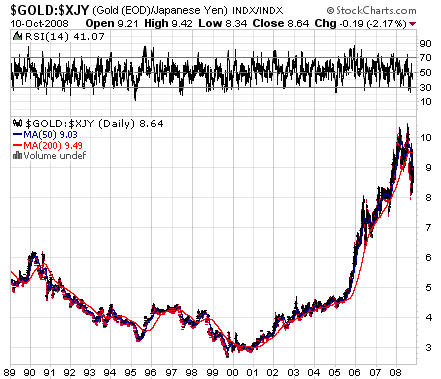
Faber's argument is supported by the following charts showing gold's performance as compared to the yen during Japan's "lost decade" of deflation:


Japan's deflation didn't definitively end until 2007 or 2008.

This provides some evidence that gold may tend to hold or increase its value at least in the later part of the deflationary period as compared with the relevant national currency.

Moreover, about half the time, gold has risen during recessions in the United States:

(The grey vertical bars show periods of recession; if your browser is cutting off the right edge of the chart, click here for full image; the chart gives gold prices in monthly averages).

Close examination shows that gold often falls during the beginning stages of a recession, then rises in the later stages of the recession.
But is there proof for Ash's thesis that it is an expansion of the money supply which pushes the price of gold up in the later stages of deflationary periods?

There might be.

As the American Enterprises Institute notes:

After five years in a deflationary economic wilderness, the Bank of Japan switched during the spring of 2001 to a policy of quantitative easing--targeting the growth of the money supply instead of nominal interest rates--in order to engineer a rebound in demand growth.
Look again at the first gold chart for Japan, above. Gold appears to start increasing against the Yen in 2001.

Note:
I am not an investment advisor and this should not be taken as investment advice.


Financial Writer Calls for Boycott of Discretionary Consumer Spending Until Honest Free Market Capitalism is Restored


Financial writer Karl Denninger is calling for a boycott of all discretionary consumer spending until free market capitalism is restored.

Specifically, Denninger says that we've tried to ask the government and big banks to start acting honestly, but we're just being ignored. The only thing which is both (1) legal and (2) effective is a boycott.

We can all live without a new ipod or big flatscreen tv until our boycott brings results, right?

Denninger provides a specific set of demands:

What are our demands? Here's the list:

  • All the financial fraudsters are investigated, indicted, and prosecuted. This includes the con artists in CONgress who got "special deals" from Mozilo and his "Friends of Angelo" program (and who are blocking a subpoena to BofA as it would implicate them), it includes those past and current members of Government Sachs, and it includes all those other financial "professionals" who deceived Americans and others with their sale of toxic exploding mortgage products along with the securities supposedly backed by them.

  • Glass-Steagall is restored, in full, and all the firms that can't exist under it are broken up. Period.

  • The insider-trading that has become blatant and outrageous is prosecuted where illegal and where not, is made illegal and then prosecuted, with the focus being on the size of the scam. This includes obvious circumstances such as August 2007 (Bernanke's phone logs were FOIA'd) where trading patterns made clear that "certain someones" had foreknowledge of the discount rate cut along with Congresspeople who were briefed on the TARP and within hours or days made significant stock trades. Today if you're Martha Stewart you're prosecuted where if you make millions in an hour by exploiting government information "leaks" the SEC and FBI look the other way.

  • The Government withdraws all of its backstopping of financial firms who created this mess. All of it. If you're a bank or other firm and did something imprudent, you fail. Period. This is true whether you're a small regional bank (as is happening now; 5 in the last week) or a big behemoth like Citibank or Bank Of America. No "special deals", no "special guarantees", nothing of the kind. If the government wishes to avoid "systemic risk" then the government regulators can do their damn job.

  • The Fed disgorges all of its improperly-acquired MBS and other related securities. If it doesn't have a full-faith-and-credit guarantee and was bought, it is disgorged - period.

  • The Fed agrees to full annual audits without exception.

  • Those people inside government who conspired with certain bankers to cook the books, along with those in the banks who did so, go to jail. Our own Office of The Inspector General in the government has confirmed that there was an active conspiracy to break the law within the OTS, but not one indictment has been issued.

  • Those who committed fraud in the creation of this economic mess, whether they be mortgage lenders, those who packaged up securities while intentionally omitting credit information, those in the real estate industry to pressed for appraisal fraud and others are investigated, prosecuted and if convicted jailed. All of them.

  • Losses are born by those who made bad decisions, not the taxpayer generally. Those who made good decisions get to reap the benefits, while those who made bad decisions eat the losses. No exceptions.

  • Government cuts the annual budget deficit to zero. If government wants to blow the money it has to have the money. If they can't raise the money they don't spend it. It is time to live within our means and hold government to account for its profligate spending along with promises of "benefits" they know they cannot actually deliver down the road such as Medicare Part D.

Monday, June 29, 2009

Debasing the Currency is Leading to Financial Collapse . . . Just As It Has for Thousands of Years


In a fascinating 22-page study of money and currency, Christopher Weber shows that every government - from Athens, to pre-collapse Rome, to the Islamic countries in the Middle Ages - which stuck to the Greek standard of coins has been stable and prosperous.

Specifically, the Athenian Drachma contained 65.6 grains of silver. Even after Greece declined as a superpower, its currency remained stable.

The Roman Denarius, Byzantine Bezant, and Islamic Dinar all copied the Drachma, using around 65.6 grains of gold or silver in their coins.

For the many centuries the Romans, Byzantines, and Islamic rulers left this precious metal content alone, they had stable and prosperous money supplies and nations.

But after the Romans and Byzantines started to whittle down the precious metal content of their coins - and after the Muslims started issuing paper money - their currency went down the drain, their prosperity plummeted and their empires collapsed.

This may all sound like ancient history, except that Weber points out that:

The US dollar has been depreciating for generations. Seventy years ago it was first devalued from $20.67 a gold ounce to $35. Then 35 years ago the devaluation started gaining strength. The dollar has lost over 90% of its gold value since August 15, 1971.

History is repeating . . . Sound money is again being trashed, which is causing the collapse of the American empire.

Sunday, June 28, 2009

“In a Society Governed Passively by Free Markets and Free Elections, Organized Greed Always Defeats Disorganized Democracy”


In his excellent new essay arguing that "Goldman Sachs has engineered every major market manipulation since the Great Depression", Matt Taibbi writes:

In a society governed passively by free markets and free elections, organized greed always defeats disorganized democracy.
I agree.

This same thinking applies to the government's lies about Iraq, as more and more evidence proves that the American government knowingly lied when it claimed that Iraq had wmds, and when it claimed there was a link between Iraq and 9/11. The "organized greed" of those in government who wanted to invade Iraq defeated the "disorganized democracy" of everyone else.

If asked, Taibbi might even admit this parallel.

But Taibbi and many other quasi-mainstream writers have a blind spot when it comes to the ultimate example of where "organized greed ... defeats disorganized democracy": false flag operations.

Financial commentator and former broker and options trader Max Keiser is perhaps less shy than Taibbi. As Keiser said of Goldman's manipulation:

This was a controlled demolition sponsored by Goldman Sachs . . .

This is a false flag operation. The American people were scared out of their wits due to the financially engineered financial collapse . . .
Keiser's analogy is, of course, to the "false flag operation" of 9/11 and the "controlled demolition" of the World Trade Centers.

In a false flag operation, the "organized greed" of certain elements within a government and/or its military and intelligence services use fear-inducing attacks to "scare people out of their wits" in order to drum up a sufficiently scary enemy to justify its military and political objectives defeats the disorganized democratic wish for peace, truth and justice.

It is ironic that writers such as Taibbi don't seem to be able to distinguish between insane conspiracy theories which are contrary to the weight of scientific and historical evidence, on the one hand, and real conspiracies such as Goldman's manipulation of the markets (which many other financial writers also acknowledge) and 9/11, on the other hand.

Those who cling to the official story of 9/11 are like the old people in Russia who cling to their idols and momentos of Communist rule - the photos of Stalin, or handkerchiefs emblazoned with the old Soviet symbol - long after the Russian leaders themselves say that free market capitalism is the way to go:

  • The Senior Counsel to the 9/11 Commission (John Farmer) - who led the 9/11 staff's inquiry - said "At some level of the government, at some point in time...there was an agreement not to tell the truth about what happened". He also said "I was shocked at how different the truth was from the way it was described .... The tapes told a radically different story from what had been told to us and the public for two years.... This is not spin. This is not true."
  • The Commission's co-chairs said that the CIA (and likely the White House) "obstructed our investigation"

And given that all of the so-called "confessions" of the alleged 9/11 plotters have turned out to be worthless, it is stunning that people like Taibbi can't admit their assumptions were wrong, and re-examine the evidence anew.

Judges have had to distinguish between real conspiracies and false allegations of conspiracies for hundreds of years, based upon well-established rules of evidence and logic. High-level legal scholars have looked at the evidence and found the government's explanation of the 9/11 conspiracy (solely involving Al Qaeda) to be wanting. I don't know why writers like Taibbi can't do the same in regards to 9/11.

Taibbi and others like him use their keen analytical abilities to address certain conspiracies, but then dismiss others as "insane" without actually looking at the evidence put forward by numerous high level military leaders, intelligence professionals, Congressmen, FBI officials, structural engineers, architects, scientists and other credible people who doubt the government's version of 9/11.

They are insightful intellectuals on some subjects, and like the old Russians fools on others. Perhaps honestly discussing 9/11 is rocking the boat too much even for those journalists who are insightful reporters on other issues.

Liberals often mistakenly assume that only those on the right question 9/11. But in fact, many prominent liberals don't buy the government's story. Likewise, conservatives often assume that only liberals question 9/11, but that is not true.

Saturday, June 27, 2009

What China's Push for An Alternative World Reserve Currency Means


Yesterday, after China called for a super-sovereign currency, the dollar slid as investors started seeing the writing on the wall. Specifically, the People’s Bank of China said the International Monetary Fund should manage part of members’ foreign-exchange reserves. See this.

“To prevent the deficiencies in the main reserve currency, there’s a need to create a new currency that’s delinked from the economies of the issuers,” the People’s Bank of China (PBOC) said in a review of the economy in 2008 released today. In March, the PBOC had urged the IMF to expand operations of its Special Drawing Rights currency (SDRs) and move toward a “super-sovereign reserve currency.”

The PBOC argues that the frequency and intensity of financial crises following the collapse of the Bretton Woods system suggests costs of the dollar-based system may have exceeded its benefits and that that the SDR could take on a key global role.

The PBOC statement comes a day after a top Communist Party research chief said that China should buy gold and U.S. real estate rather than Treasurys.

American officials and talking heads have attempted to downplay the irreversible trend of the dollar fading as the world's reserve currency. They have argued that China is in a dollar trap. With trillions in dollars, they argue, China cannot let the dollar tank.

But as Marc Faber has pointed out, 2 trillion dollars in reserves isn't really that much for a country with as many people as China has. And China long ago signaled that it was gradually moving out of dollars. The signals came in the form of (1) China moving out of long treasuries and into treasuries with a duration of 3 years or less, and (2) China using its reserves to buy commodities, instead of more dollars.

Nouriel Roubini argues:

The process that will lead - in the medium-long term - to a challenge of the US dollar as the major global reserve currency has started. The US creditors - the BRICs, the Gulf states and others - are becoming increasingly alarmed that the US will deal with its unsustainable fiscal path via inflation and debasement of the value of the dollar via depreciation. So they will not sit idly waiting for this to happen: they are already diversifying into gold, into resources (as China purchases mines and energy, mineral and commodity resources all over the world).

And the senior economist at the Federal Reserve Bank of Cleveland argued last month:

While SDRs may be declared an official international reserve asset today, they are not likely to become the world’s key international currency anytime soon.

In other words, as explained by Nouriel Roubini, the Fed economist believes that the SDR may be declared the world reserve currency, but the current usefulness of the dollar as a highly liquid, international medium of exchange means that it won't be replaced in the near future as the key unit of international trade.

Would the SDR be a Better Reserve Currency than the Dollar?

Given the IMF's history of imposing draconian, destructive and anti-democratic measures on third world countries, I'm not sure that appointing the IMF as the issuer of the world reserve currency is a great idea.

But to understand the big picture on SDRs, dollars and other potential reserve currencies and mediums of exchange, we have to take a step back and look at what money really is.

It should be remembered that money does not itself have to be a valuable commodity. Obviously, gold is a valuable commodity and can serve as money. And, in many ways, having a gold-backed currency is better than having a fiat currency.

But in its most essential form, currency is solely a way to keep track of the exchange of goods and services. In other words, money is simply a way of keeping tally, a scoreboard, a record keeping system.

As such, money could be pegged to just about anything objective, such as the consumer price index (as long as it included food and energy) or - as China has proposed - a basket of 30 or so commodities.

In fact, there is no need for the U.S. or any other country to cede its sovereignty to a group of international bankers. On the other hand, there is no need for the rest of the world to be beholden to the dictatorial one-sidedness inherent in using the dollar as the world's reserve currency.

Instead, money can be returned to its most minimalist function of being a neutral yardstick to measure goods and services exchanged. In other words, instead of being an instrument of financial warfare and oppression, money can return to its function simply as an objective tally of who owes who what for the good and services they have provided.

As Ellen Brown explains in her book Web of Debt (as summarized by Stephen Lendman):

A global currency is another proposal - one that creates more problems than it solves. The world "is not one nation or one region," and who's to be boss and in charge. Further, if all governments issued the same currency, "the global money supply (would be) vulnerable to irresponsible governments (issuing) too much." Strong ones would end up dominating the weak, and national sovereignty would be weakened, perhaps ended. A "fully dollarized" world is a prescription for trouble enough to make scarcity "the order of the day."

Rather than one currency, "a single global yardstick" is needed "against which governments can value their currencies - some independent measure (by) which merchants can negotiate their contracts and be sure of getting what they bargained for"...

National currencies "would become what (they) should have been all along - (contracts) or promise(s) to return value in goods and services of a certain worth, as measured against a universally recognized yardstick for determining value."

Friday, June 26, 2009

No, Mr. Geithner . . . Financial Innovation is NOT a Good Thing


Tim Geithner was asked whether credit default swaps should be abolished altogether.

Remember, the Nobel economist who helped create the pricing formulas for CDS said the CDS are so dangerous that existing over-the-counter contracts should be voided:

The “solution is really to blow up or burn the OTC market, the CDSs and swaps and structured products, and let us start over,” he said, referring to credit-default swaps and other complex securities that are traded off exchanges. “One way to do that, through the auspices of regulators or the banking commissioners, is to try to close all contracts at mid-market prices.”

Many other economists agree.

But in a question and answer session, Geithner said we need CDS for financial "creativity" and "innovation":

Question: During questioning before Congress you were asked why exotic investment instruments like credit default swaps shouldn’t just be done away with. You responded that you did not want to stifle “creativity” in the financial markets. Why do we want a “creative” financial market? – Anonymous

Answer: We want a creative financial market because a creative economy requires it—the innovations generated by our markets and institutions help to make our economy the most vibrant and flexible in the world. The new products, services and capital, they produce are exactly what help turn a new idea into the next big company. Overall, we do not believe that you can build a system based on banning individual products—our core challenge is ensuring we have a system that has a proper balance between innovation on the one hand and consumer protection on the other. We propose keeping the system safe for innovation by having stronger protections against risk in CDS and other derivative markets with stronger capital buffers, greater disclosure so investors and consumers can make more informed financial decisions, and a system that is better able to evolve as innovation advances and the structure of the financial system changes.
Here's the actual exchange (page 8):
GeithnerAnswers -

Of course, the U.S. economy is not "the most vibrant and flexible in the world". It is the most broke in the world.

But is Geithner right that financial "creativity" and "innovation" are good things?

No.

The Canadian banking system is the world's most stable banking system precisely because it is boring instead of innovative.

As Paul Krugman writes that banking has to be made boring again, to prevent the kinds of results which came from high -flying finance in the 1920's (the Great Depression) and late 1990s early 2000s (the current melt down). Krugman also notes:
Part of the problem is that boring banking would mean poorer bankers, and the financial industry still has a lot of friends in high places. But it’s also a matter of ideology: Despite everything that has happened, most people in positions of power still associate fancy finance with economic progress.
Indeed, the most "boring" type of banking system imaginable would be to take the power to create credit away from the private banking giants and give it back to the government, as the Founding Fathers originally intended. By abandoning the "creativity" and "innovation" which has allowed the banksters to charge trillions in unnecessary interest fees to the American people bankrupt our nation and drive us into a Depression, we can get back to the "pursuit of happiness" which our forefathers fought and died for and which the Declaration of Independence promises.

See also this.

Thursday, June 25, 2009

Triple Cross or Inside Job?


In his just-released book, Triple Cross, former ABC News investigative reporter Peter Lance says (as summarized by Raw Story):

Ali Mohamed ... was something of an al Qaeda super-spy who managed to work with terrorists, the Green Berets, the CIA and become an FBI informant, even while ensuring Osama bin Laden’s safe passage around the middle east. For years, Triple Cross alleges, the FBI and specifically [prosecutor Patrick] Fitzgerald, knew about him but allowed Mohamed’s activities to continue unchecked.

Mohamed ... was actually responsible for writing portions of the terror network’s training manual and played a key role in the bombings of U.S. embassies in Africa which left over 200 dead...

“He believes that chagrin over the fact that bin Laden’s spy stole top-secret intelligence (including, for example, the positions of all Green Beret and SEAL units worldwide) led to a decision on high to bury the entire Able Danger intelligence program, which identified the Al Qaeda cell active in Brooklyn months before the 9/11 attacks, and also identified Ali Mohamed as a member of bin Laden’s inner circle as early as March 2000.”

“In 1996, Fitzgerald and other top officials discredited a treasure trove of al Qaeda-related evidence, including evidence of an active al Qaeda cell operating in NYC five years before 9/11 and of a bin Laden plot to hijack a plane to free Sheikh Omar Abdel Rahman—intelligence considered so important that it was later cited in the infamous Presidential Daily Briefing given to George W. Bush just weeks before 9/11,” noted HarperCollins in a press release.

Mohamed is allegedly still alive today, though his whereabouts is unknown.

Is Lance right that Mohamed tricked the FBI?

Maybe.

But the government has a history of entrapping semi-retarded people who are then labeled as terrorists.

And remember before you make up your mind about Ali Mohamed that the mainstream British paper, the Independent, writes:

There is a concerted strategy to manipulate global perception. And the mass media are operating as its compliant assistants, failing both to resist it and to expose it. The sheer ease with which this machinery has been able to do its work reflects a creeping structural weakness which now afflicts the production of our news.

And that the British government was really behind the leading neo-nazi.

And that the U.S. government has used black propaganda - for example, forging a letter from al Zarqawi to the "inner circle" of al-Qa'ida's leadership, urging them to accept that the best way to beat US forces in Iraq was effectively to start a civil war.

And that the Congressional Joint Inquiry into 9/11 discovered that an FBI informant had hosted and rented a room to two hijackers in 2000 and that, when the Inquiry sought to interview the informant, the FBI refused outright, and then hid him in an unknown location, and that a high-level FBI official stated these blocking maneuvers were undertaken under orders from the White House (confirmed here by the Co-Chair of the Joint Inquiry and former Head of the Senate Intelligence Committee, Bob Graham; and see this Newsweek article).

And as Professor emeritus Peter Dale Scott writes about Ali Mohamed (see original for annotations):

In our book, 9/11 and Empire: Intellectuals Speak Out, I wrote of Ali Mohamed, the close ally of Osama bin Laden and his mentor Ayman al-Zawahiri. It is now generally admitted that Ali Mohamed (known in the al Qaeda camps as Abu Mohamed al Amriki — "Father Mohamed the American") worked for the FBI, the CIA, and U.S. Special Forces. As he later confessed in court, he also aided the terrorist Ayman al-Zawahiri, a co-founder of the Egyptian Islamic Jihad, and by then an aide to bin Laden, when he visited America to raise money.

The 9/11 Report mentioned him, and said that the plotters against the U.S. Embassy in Kenya were “led” (their word) by Ali Mohamed. That’s the Report’s only reference to him, though it’s not all they heard.

Patrick Fitzgerald, U.S. Attorney who negotiated a plea bargain and confession from Ali Mohamed, said this in testimony to the Commission

Ali Mohamed. …. trained most of al Qaeda’s top leadership – including Bin Laden and Zawahiri – and most of al Qaeda’s top trainers. He gave some training to persons who would later carry out the 1993 World Trade Center bombing…. From 1994 until his arrest in 1998, he lived as an American citizen in California, applying for jobs as an FBI translator.

Patrick Fitzgerald knew Ali Mohamed well. In 1994 he had named him as an unindicted co-conspirator in the New York landmarks case, yet allowed him to remain free. This was because, as Fitzgerald knew, Ali Mohamed was an FBI informant, from at least 1993 and maybe 1989. Thus, from 1994 “until his arrest in 1998 [by which time the 9/11 plot was well under way], Mohamed shuttled between California, Afghanistan, Kenya, Somalia and at least a dozen other countries.” Shortly after 9/11, Larry C. Johnson, a former State Department and CIA official, faulted the FBI publicly for using Mohamed as an informant, when it should have recognized that the man was a high-ranking terrorist plotting against the United States.

As I say in our book, in 1993 Ali Mohamed had been detained by the Royal Canadian Mounted Police in Canada, when he inquired at an airport after an incoming al Qaeda terrorist who turned out to be carrying two forged Saudi passports. Mohamed immediately told the RCMP to make a phone call to the United States, and the call secured his release. We’ve since been told that it was Mohamed’s West coast FBI handler, John Zent, “who vouched for Ali and got him released.”

This release enabled Ali to go on to Kenya, take pictures of the U.S. Embassy, and deliver them to bin Laden for the Embassy bombing plot.

In August 2006 there was a National Geographic Special on Ali Mohamed. We can take this as the new official fallback position on Ali Mohamed, because John Cloonan, the FBI agent who worked with Fitzgerald on Mohamed, helped narrate it. I didn’t see the show, but here’s what TV critics said about its contents:

Ali Mohamed manipulated the FBI, CIA and U.S. Army on behalf of Osama bin Laden. Mohamed trained terrorists how to hijack airliners, bomb buildings and assassinate rivals. [D]uring much of this time Mohamed was …, an operative for the CIA and FBI, and a member of the U.S. Army. …Mohamed turned up in FBI surveillance photos as early as 1989, training radical Muslims who would go on to assassinate Jewish militant Meir Kahane and detonate a truck bomb at the World Trade Center. He not only avoided arrest, but managed to become an FBI informant while writing most of the al Qaeda terrorist manual and helping plan attacks on American troops in Somalia and U.S. embassies in Africa.

That Mohamed trained al Qaeda in hijacking planes and wrote most of the al Qaeda terrorist manual is confirmed in a new book by Lawrence Wright, who has seen US Government records. Let me say this again: one of al-Qaeda’s top trainers in terrorism and how to hijack airplanes was an operative for FBI, CIA, and the Army...

Within days of 9/11 Cloonan rushed backed from Yemen and interviewed Ali, whom the Feds had allowed to slip into witness protection, and demanded to know the details of the plot. At that point Ali wrote it all out - including details of how he'd counseled would-be hijackers on how to smuggle box cutters on board aircraft and where to sit, to effect the airline seizures.

If all these latest revelations about Ali Mohamed are true, then:

1) a key planner of the 9/11 plot, and trainer in hijacking, was simultaneously an informant for the FBI.

2) This operative trained the members for all of the chief Islamist attacks inside the United States – the first WTC bombing, the New York landmarks plot, and finally 9/11, as well as the attacks against Americans in Somalia and Kenya.

3) And yet for four years Mohamed was allowed to move in and out of the country as an unindicted conspirator. Then, unlike his trainees, he was allowed to plea-bargain. To this day he may still not have been sentenced for any crime.22...

All three had been trained by Ali Mohamed back in the late 1980s at a rifle range, where the FBI had photographed them, before terminating this surveillance in the fall of 1989.

The U.S. Government was thus in an excellent position to arrest, indict, and convict all of the terrorists involved, including Mohamed...

As a first step, all U.S. agencies should release the full documentary record of their dealings with Ali Mohamed, the FBI and CIA informant who allegedly planned the details of the airline seizures.

So did Ali Mohamed fool the U.S. in a triple cross, as Lance alleges?

Or was he acting as an American agent in facilitating the attacks?


Wednesday, June 24, 2009

How To Increase Your Intelligence and Get Smarter


A new study by Utrecht University finds that speeding up the brain's network may increase intelligence.

In the multi-billion dollar herbal supplement market, many claims have been made that the following supplements speed up brain waves:

  • Essential fatty acids in general
  • Omega 3 fatty acids (As one article says: "Recall that your brain is comprised of at least 60% fat and the fatty or lipid part of your brain helps to transmit information rapidly across your neural networks".)
  • Phosphatidylserine, commonly known by the initials "PS"

  • DHA
And certain types of music - such as certain selections of Mozart - allegedly can speed up your brain waves

But the Utrecht study doesn't just say speed of brain waive propagation is important:
A new study has finally solved the decade-old mystery about where exactly intelligence lies in human brains after scientists found that it's everywhere.

A team at Utrecht University has found that the most efficiently wired brains belong to the most intelligent people -- a finding that suggests that improving this efficiency with drugs could offer a tantalising means of boosting IQ.

According to lead scientist Martijn van den Heuvel, "The concept of a networked brain isn't so different from the transportation grids used by cars and planes.
In other words, it is efficiency in the brain's connectivity which may be the key.

Scientists have also discovered that the Dasm1 protein plays an important part in neural connectivity:

Researchers have discovered a critical protein that regulates the growth and activation of neural connections in the brain. The protein functions in the developing brain, where it controls the sprouting of new connections and stimulates otherwise silent connections among immature neurons, and potentially in the mature brain as well, where it may play a role in memory formation.

And as Kenneth Wesson writes:

Greater brain stimulation promotes an increase in the number of dendrites ("little trees") connecting the billions of cells in the brain. Neurons sprout and re-sprout new dendrites connecting more and more brain cells throughout one's life giving all of us the neuro-physiological wherewithal to learn throughout our entire lifetime.

Multisensory experiences further extend these plentiful and precious connections throughout the entire cerebral cortex and they form additional links with other sub-cortical structures inside the brain. Conversely, reducing the quantity and/or quality of experiences and learning opportunities diminishes the brain's neural pathways permanently decreasing one's ability to learn. However, the human brain is capable of creating trillions of interrelated neural networks rendering our capacity to learn virtually limitless, if the proper foundations are laid early in life during the critical periods of the developing brain.

New neural connections are created as a result of incoming information from at least 19 sensory systems (there are not just five senses)...

While the "power" of a brain can increase in direct relationship to the number of cells composing it, the human brain's capability is best calibrated by the number of connections that develop among its billions of brain cells. Neurons are constantly rearranging their 500 trillion-plus connections (via the dendrites) in response to new information and experiences. UCLA's Arnold Scheibel stated that, "Only when the neuron develops these extensions from itself, does it begin to significantly increase its surface area as a total unit and provide more and more of a ‘landing field' for other incoming neural messages" coming in from active healthy neurons...

Music at sixty beats per minute (Baroque music, Mozart, Bach, Handel, Vivaldi, and others) helps to lower blood pressure and aids in relaxing the body's large muscle groups, which allows for a greater amount of blood flow and blood utilization in the human brain. Although the brain is only 2% of the body's weight, it consumes over 20% of the body's energy, nutrients, and oxygen.

Reducing this vital supply of nutrients and energy to the brain limit its ability to function at its optimal levels. The brain requires an excessively large and disproportionate amount of our blood supply. Unlike other organs and muscles, it cannot store energy. Consequently, a pint and a half or blood must flow through the carotid artery (in the neck) and into the brain single every minute.

You can also play games to increase your brain function (see this, for example).

Exercise also helps keep your brain

You can also play games to increase your brain function (see this, for example).

Moreover, relaxing activities like meditation and prayer have been shown to increase brain mass and connectivity in certain areas of the brain.

On the other hand, high levels of cortisol - the chemical released by the body when one is under continuous, unrelenting stress - and poverty can physically impair the brain and people's ability to learn.


Tuesday, June 23, 2009

Spacefaring Bacteria

In 2002, several scientists claimed that bacteria high in Earth's atmosphere came from space.

Last year, scientists said that bacteria in the upper atmosphere may actually make rain. Specifically, they said that bacteria can freeze at fairly warm temperatures, so that the "biological ice nuclei" form condensation nuclei which triggers rain.

Indeed, some scientists have speculated that bacteria cause rain as a means of transportation, so that they will "rain out" from the upper atmosphere to the surface of a planet.

Now, scientists have discovered a "hibernating" bacteria in a salt mine in Utah which they believe has been in suspended animation for 250 million years. There is evidence that this ability to hibernate for long periods of time is also useful for travel through space by the bacteria:

Bacteria have the ability to go into a kind of semi-permanent hibernation, but survival for this long was unheard of. After lying dormant in the salt crystal for 250 million years, the scientists added fresh nutrients and a new salt solution, and the ancient bacteria "re-animated."

Dr. Russell Vreeland, one of the biologists who found the bacteria, pointed out that bacteria can survive the forces [of] acceleration via rubble thrown into space via a meteor impact. If it is possible for a bacteria to survive being [thrown] off the planet and to stay alive within a salt chunk for 250 million years, then in a sort of "reverse-exogenesis" it may be possible that earth's own microbes are already out there.

Indeed, there is a more down-to-earth analogy to the idea of spacefaring bacteria: the humble coconut. Coconuts can float across long distances of water in the ocean, and when they land on a hospitable island, start growing.


Monday, June 22, 2009

Hit the Corporate Big-Wigs Who Commited Fraud With Huge Fines to Reduce Future Fraud


Huffington Post notes:

A state judge on Thursday ordered former HealthSouth CEO Richard Scrushy to pay nearly $2.9 billion to shareholders who sued over a massive accounting fraud that nearly sent the rehabilitation chain into bankruptcy.

The judgment is very good for America.

Why?

Because the current incentive for high-level corporate people is to commit fraud. Even if they are caught and go to jail, they'll be rich when they get out.

Hitting the crooks in the wallet is the only thing which will motivate people not to rip off their shareholders, the taxpayers and the American treasury.

As Paul Volcker says, the incentive systems at financial firms are broken.

Hitting wrongdoers with big fines will help fix them.

As William K. Black - the senior regulator during the S&L crisis, and an Associate Professor of Economics and Law at the University of Missouri said:

Failing bankers ha[ve] perverse incentives to "live large" and cause larger losses to the FDIC and taxpayers.
And Nobel prize-winning economist George Akerlof co-wrote a paper in 1993 describing the reasons for financial meltdowns:

Financial crises in the 1980s, like the Texas real estate bust, had been the result of private investors taking advantage of the government. The investors had borrowed huge amounts of money, made big profits when times were good and then left the government holding the bag for their eventual (and predictable) losses.

In a word, the investors looted. Someone trying to make an honest profit, Professors Akerlof and Romer [co-author and himself a leading expert on economic growth] said, would have operated in a completely different manner. The investors displayed a “total disregard for even the most basic principles of lending,” failing to verify standard information about their borrowers or, in some cases, even to ask for that information.

The investors “acted as if future losses were somebody else’s problem,” the economists wrote. “They were right.”

If enough people like the HealthSouth CEO are hit with multi-billion dollar fines for fraud, future losses will not be somebody else's problems, but their own.

That would make the game of financial fraud a lot less profitable, and so undermine much of the motivation of corporate big-wigs to commit fraud. And - given that Black says that massive fraud is what caused the economic crisis - that in turn would save the taxpayers from having to fund many billions in bailouts . . .


Sunday, June 21, 2009

CIA Agent: "Government Officials Like Cheney Are Not To Be Trusted When They Assert Something Without The Support Of Incontrovertible Evidence"

Former senior CIA Agent Philip Giraldi writes:

If there has been any "lesson learned" from the past eight years it is that government officials like Cheney are not to be trusted when they assert something without the support of incontrovertible evidence.

While Giraldi's article was about torture, his point applies to 9/11 as well.

Instead of "incontrovertible evidence" for Cheney's version of 9/11, the 9/11 Commissioners themselves now doubt the "official" 9/11 story:
  • The Senior Counsel to the 9/11 Commission (John Farmer) - who led the 9/11 staff's inquiry - said "At some level of the government, at some point in time...there was an agreement not to tell the truth about what happened". He also said "I was shocked at how different the truth was from the way it was described .... The tapes told a radically different story from what had been told to us and the public for two years.... This is not spin. This is not true."
  • The Commission's co-chairs said that the CIA (and likely the White House) "obstructed our investigation"
In fact, many high-level intelligence officials at the CIA and other government agencies doubt the government's version of 9/11:
  • A decorated 20-year CIA veteran, who Pulitzer-Prize winning investigative reporter Seymour Hersh called "perhaps the best on-the-ground field officer in the Middle East”, and whose astounding career formed the script for the Academy Award winning motion picture Syriana (Robert Baer) said that"the evidence points at" 9/11 having had aspects of being an inside job .
  • The Division Chief of the CIA’s Office of Soviet Affairs, who served as Senior Analyst from 1966 - 1990. He also served as Professor of International Security at the National War College from 1986 - 2004 (Melvin Goodman) said "The final [9/11 Commission] report is ultimately a coverup."
  • Professor of History and International Relations, University of Maryland. Former Executive Assistant to the Director of the National Security Agency, former military attaché in China, with a 21-year career in U.S. Army Intelligence (Major John M. Newman, PhD, U.S. Army) questions the government's version of the events of 9/11.

Saturday, June 20, 2009

The Four Reasons the Mainstream Media Is Worthless


There are four reasons that the mainstream media is worthless.

1. Self-Censorship by Journalists

Initially, there is tremendous self-censorship by journalists.

For example, several months after 9/11, famed news anchor Dan Rather told the BBC that American reporters were practicing "a form of self-censorship":
"there was a time in South Africa that people would put flaming tires around peoples' necks if they dissented. And in some ways the fear is that you will be necklaced here, you will have a flaming tire of lack of patriotism put around your neck. Now it is that fear that keeps journalists from asking the toughest of the tough questions.... And again, I am humbled to say, I do not except myself from this criticism.

"What we are talking about here - whether one wants to recognise it or not, or call it by its proper name or not - is a form of self-censorship."

Keith Olbermann agreed that there is self-censorship in the American media, and that:

"You can rock the boat, but you can never say that the entire ocean is in trouble .... You cannot say: By the way, there's something wrong with our .... system".

As former Washington Post columnist Dan Froomkin wrote in 2006:

Mainstream-media political journalism is in danger of becoming increasingly irrelevant, but not because of the Internet, or even Comedy Central. The threat comes from inside. It comes from journalists being afraid to do what journalists were put on this green earth to do. . . .

There’s the intense pressure to maintain access to insider sources, even as those sources become ridiculously unrevealing and oversensitive. There’s the fear of being labeled partisan if one’s bullshit-calling isn’t meted out in precisely equal increments along the political spectrum.

If mainstream-media political journalists don’t start calling bullshit more often, then we do risk losing our primacy — if not to the comedians then to the bloggers.

I still believe that no one is fundamentally more capable of first-rate bullshit-calling than a well-informed beat reporter - whatever their beat. We just need to get the editors, or the corporate culture, or the self-censorship – or whatever it is – out of the way.

And Air Force Colonel and key Pentagon official Karen Kwiatkowski wrote:

I have been told by reporters that they will not report their own insights or contrary evaluations of the official 9/11 story, because to question the government story about 9/11 is to question the very foundations of our entire modern belief system regarding our government, our country, and our way of life. To be charged with questioning these foundations is far more serious than being labeled a disgruntled conspiracy nut or anti-government traitor, or even being sidelined or marginalized within an academic, government service, or literary career. To question the official 9/11 story is simply and fundamentally revolutionary. In this way, of course, questioning the official story is also simply and fundamentally American.
(page 26).

2. Censorship by Higher-Ups

If journalists do want to speak out about an issue, they also are subject to tremendous pressure by their editors or producers to kill the story.

The Pulitzer prize-winning reporter who uncovered the Iraq prison torture scandal and the Mai Lai massacre in Vietnam, Seymour Hersh, said:
"All of the institutions we thought would protect us -- particularly the press, but also the military, the bureaucracy, the Congress -- they have failed. The courts . . . the jury's not in yet on the courts. So all the things that we expect would normally carry us through didn't. The biggest failure, I would argue, is the press, because that's the most glaring....

Q: What can be done to fix the (media) situation?

[Long pause] You'd have to fire or execute ninety percent of the editors and executives. You'd actually have to start promoting people from the newsrooms to be editors who you didn't think you could control. And they're not going to do that."

In fact many journalists are warning that the true story is not being reported. See this announcement and this talk.

And a series of interviews with award-winning journalists also documents censorship of certain stories by media editors and owners (and see these samples).

There are many reasons for censorship by media higher-ups.

One is money.

The media has a strong monetary interest to avoid controversial topics in general. It has always been true that advertisers discourage stories which challenge corporate power. Indeed, a 2003 survey reveals that 35% of reporters and news executives themselves admitted that journalists avoid newsworthy stories if “the story would be embarrassing or damaging to the financial interests of a news organization’s owners or parent company.”

In addition, the government has allowed tremendous consolidation in ownership of the airwaves during the past decade. The large media players stand to gain billions of dollars in profits if the Obama administration continues to allow monopoly ownership of the airwaves by a handful of players. The media giants know who butters their bread. So there is a spoken or tacit agreement: if the media cover the administration in a favorable light, the MSM will continue to be the receiver of the government's goodies.

3. Drumming Up Support for War

In addition, the owners of American media companies have long actively played a part in drumming up support for war.

It is painfully obvious that the large news outlets studiously avoided any real criticism of the government's claims in the run up to the Iraq war. It is painfully obvious that the large American media companies acted as lapdogs and stenographers for the government's war agenda.

Veteran reporter Bill Moyers criticized the corporate media for parroting the obviously false link between 9/11 and Iraq (and the false claims that Iraq possessed WMDs) which the administration made in the run up to the Iraq war, and concluded that the false information was not challenged because:

"the [mainstream] media had been cheerleaders for the White House from the beginning and were simply continuing to rally the public behind the President — no questions asked."

And as NBC News' David Gregory (later promoted to host Meet the Press) said:

"I think there are a lot of critics who think that . . . . if we did not stand up [in the run-up to the war] and say 'this is bogus, and you're a liar, and why are you doing this,' that we didn't do our job. I respectfully disagree. It's not our role"
But this is nothing new. In fact, the large media companies have drummed up support for all previous wars.

For example, Hearst helped drum up support for the Spanish-American War.

And an official summary of America's overthrow of the democratically-elected president of Iran in the 1950's states, "In cooperation with the Department of State, CIA had several articles planted in major American newspapers and magazines which, when reproduced in Iran, had the desired psychological effect in Iran and contributed to the war of nerves against Mossadeq." (page x)

The mainstream media also may have played footsie with the U.S. government right before Pearl Harbor. Specifically, a highly-praised historian (Bob Stineet) argues that the Army’s Chief of Staff informed the Washington bureau chiefs of the major newspapers and magazines of the impending Pearl Harbor attack BEFORE IT OCCURRED, and swore them to an oath of secrecy, which the media honored (page 361) .

And the military-media alliance has continued without a break (as a highly-respected journalist says, "viewers may be taken aback to see the grotesque extent to which US presidents and American news media have jointly shouldered key propaganda chores for war launches during the last five decades.")

As the mainstream British paper, the Independent, writes:

There is a concerted strategy to manipulate global perception. And the mass media are operating as its compliant assistants, failing both to resist it and to expose it. The sheer ease with which this machinery has been able to do its work reflects a creeping structural weakness which now afflicts the production of our news.
The article in the Independent discusses the use of "black propaganda" by the U.S. government, which is then parroted by the media without analysis; for example, the government forged a letter from al Zarqawi to the "inner circle" of al-Qa'ida's leadership, urging them to accept that the best way to beat US forces in Iraq was effectively to start a civil war, which was then publicized without question by the media..

So why has the American press has consistenly served the elites in disseminating their false justifications for war?


One of of the reasons is because the large media companies are owned by those who support the militarist agenda or even directly profit from war and terror (for example, NBC is owned by General Electric, one of the largest defense contractors in the world -- which directly profits from war, terrorism and chaos).

Another seems to be an unspoken rule that the media will not criticize the government's imperial war agenda.

And the media support isn't just for war: it is also for various other shenanigans by the powerful. For example, a BBC documentarysdocuments:

There was "a planned coup in the USA in 1933 by a group of right-wing American businessmen . . . . The coup was aimed at toppling President Franklin D Roosevelt with the help of half-a-million war veterans. The plotters, who were alleged to involve some of the most famous families in America, (owners of Heinz, Birds Eye, Goodtea, Maxwell Hse & George Bush’s Grandfather, Prescott) believed that their country should adopt the policies of Hitler and Mussolini to beat the great depression."

Moreover, "the tycoons told the general who they asked to carry out the coup that the American people would accept the new government because they controlled all the newspapers." See also this book.

Have you ever heard of this scheme before? It was certainly a very large one. And if the conspirators controlled the newspapers then, how much worse is it today with media consolidation?

4. Censorship by the Government

Finally, as if the media's own interest in promoting war is not strong enough, the government has exerted tremendous pressure on the media to report things a certain way. Indeed, at times the government has thrown media owners and reporters in jail if they've been too critical. The media companies have felt great pressure from the government to kill any real questioning of the endless wars.

For example, Dan Rather said, regarding American media, "What you have is a miniature version of what you have in totalitarian states".

Tom Brokaw said "all wars are based on propaganda.

And the head of CNN said:

"there was 'almost a patriotism police' after 9/11 and when the network showed [things critical of the administration's policies] it would get phone calls from advertisers and the administration and "big people in corporations were calling up and saying, 'You're being anti-American here.'"
Indeed, former military analyst and famed Pentagon Papers whistleblower Daniel Ellsberg said that the government has ordered the media not to cover 9/11:
Ellsberg seemed hardly surprised that today's American mainstream broadcast media has so far failed to take [former FBI translator and 9/11 whistleblower Sibel] Edmonds up on her offer, despite the blockbuster nature of her allegations [which Ellsberg calls "far more explosive than the Pentagon Papers"].

As Edmonds has also alluded, Ellsberg pointed to the New York Times, who "sat on the NSA spying story for over a year" when they "could have put it out before the 2004 election, which might have changed the outcome."

"There will be phone calls going out to the media saying 'don't even think of touching it, you will be prosecuted for violating national security,'" he told us.

* * *

"I am confident that there is conversation inside the Government as to 'How do we deal with Sibel?'" contends Ellsberg. "The first line of defense is to ensure that she doesn't get into the media. I think any outlet that thought of using her materials would go to to the government and they would be told 'don't touch this . . . .'"

Of course, if the stick approach doesn't work, the government can always just pay off reporters to spread disinformation. Indeed, an expert on propaganda testified under oath during trial that the CIA employs THOUSANDS of reporters and OWNS its own media organizations (the expert has an impressive background).

And famed Watergate reporter Carl Bernstein says the CIA has already bought and paid for many successful journalists. See also this New York Times piece, this essay by the Independent, this speech by one of the premier writers on journalism, and this and this roundup.

Indeed, in the final analysis, the main reason today that the media giants will not cover the real stories or question the government's actions or policies in any meaningful way is that we live in a country that is not all that free (see point number 6). Mussolini said that fascism is the blending of the government and corporate interests, and the American government and mainstream media have in fact been blended together to an unprecedented degree.

See this book and the following 5-part interview for further information on 9/11 and the media: (Part 1Part 2Part 3Part 4Part 5

Can We Win the Battle Against Censorship?

We cannot just leave governance to our "leaders", as "The price of freedom is eternal vigilance" (Jefferson). Similarly, we cannot leave news to the corporate media. We need to "be the media" ourselves.

"To stand in silence when they should be protesting makes cowards out of men."
- Abraham Lincoln

"Our lives begin to end the day we become silent about things that matter."
- Dr. Martin Luther King Jr.

"Powerlessness and silence go together. We...should use our privileged positions not as a shelter from the world's reality, but as a platform from which to speak. A voice is a gift. It should be cherished and used."
– Margaret Atwood

"There is no act too small, no act too bold. The history of social change is the history of millions of actions, small and large, coming together at points in history and creating a power that [nothing] cannot suppress."
- Howard Zinn (historian)

"All tyranny needs to gain a foothold is for people of good conscience to remain silent"
- Thomas Jefferson

Out of Pocket

I'll be largely out of pocket for the next week. I'll post occasionally . . .

Until I'm back to normal posting, please check to see if I've previously posted on your topic of interest (you might be surprised) by searching in the search box at the upper right of this site.

Feel free to let me know what's on your mind, post comments, news tips, etc.


Friday, June 19, 2009

If the Feds are Going to Bail Out Anyone, They Should Bail out the PEOPLE and the STATES, Not the Financial Giants


Fitch's downgraded Ohio's bond credit rating Wednesday.

Moody's has warned that it will probably downgrade California's debt rating in the near future.

Many other states are not far behind.

Downgrading a state's rating increases borrowing costs, and thus destabilizes the state's economy. And, of course, many states may have more problems than just credit downgrades.

As I have long argued, if the feds are going to give bailouts to anyone, it should be individuals and the states - not the big financial giants - because preserving the states which make up the United States is a lot more important than maintaining the status quo financial system.

And unless the people have some relief, they will not be motivated to borrow from the banks, so all of the bank bailouts will be useless in restarting the economy. Indeed, if the government had just given the money handed out so far to the people instead of the big banks and financial companies, we'd be on our way out of this financial crisis already.

Leading Economist: We Need a Trust-Buster Like Teddy Roosevelt So We Can Get Rid of the Herbert Hoover-Like Status Quo


Former chief IMF economist Simon Johnson has another great post today:

Writing in the New York Times today, Joe Nocera sums up, “If Mr. Obama hopes to create a regulatory environment that stands for another six decades, he is going to have to do what Roosevelt did once upon a time. He is going to have make some bankers mad.”

Good point – but Nocera is thinking about the wrong Roosevelt (FDR). In order to get to the point where you can reform like FDR, you first have to break the political power of the big banks, and that requires substantially reducing their economic power - the moment calls more for Teddy Roosevelt-type trustbusting, and it appears that is exactly what we will not get.

For background, see this and this.

Translate Messages Written in Iranian Language, Or Write to Those in Iran


Google has released a beta version of a Farsi translation program, so you can translate messages being written in the Iranian language, or communicate with people in Iran.

Click here to go directly to the Farsi translation web page.

As anyone who has used online translation tools knows, they are not 100% accurate. But they are often good enough to get a sense of what is being said.

Obviously, there are issues with censorship and firewalls. I am not an IT or tech guy, and have no insights into that issue.

The Role of the Shadow Banking System in the Inflation Debate


Ellen Brown has an interesting analysis on the effect of the shadow banking system on the inflation debate (edited for brevity):

In a Washington Times article titled “Banks Still Standing Amid Credit Rubble,” Patrice Hill wrote:

“Before last fall’s financial crisis, banks provided only $8 trillion of the roughly $25 trillion in loans outstanding in the United States, while traditional bond markets provided another $7 trillion, according to the Federal Reserve. The largest share of the borrowed funds - $10 trillion - came from securitized loan markets that barely existed two decades ago. . . .

Mr. Regalia [chief economist at the U.S. Chamber of Commerce] said ... 70 percent of the system isn’t there anymore,’ he said.”

Seventy percent of the system isn’t there anymore because the traditional bond markets and securitized loan markets have dried up. Writes Hill:

“Congress’ demand that banks fill in for collapsed securities markets poses a dilemma for the banks, not only because most do not have the capacity to ramp up to such large-scale lending quickly. The securitized loan markets provided an essential part of the machinery that enabled banks to lend in the first place. By selling most of their portfolios of mortgages, business and consumer loans to investors, banks in the past freed up money to make new loans. . . .

“The market for pooled subprime loans, known as collateralized debt obligations (CDOs), collapsed at the end of 2007 and, by most accounts, will never come back. Because of the surging defaults on subprime and other exotic mortgages, investors have shied away from buying the loans, forcing banks and Wall Street firms to hold them on their books and take the losses.”

Brown shows - as Mish, Tyler Durden and others have - that the amount of wealth destroyed is far greater than the amount of money the feds are pumping into the system. She also shows that the shadow banking systems CDO market dwarfed other loan considerations, and argues that the collapse of the CDO market means that deflation will - with certainty - continue to trump inflation unless and until one of the following 2 things happen:
  1. The fed monetizes the debt on a much bigger scale than it is currently doing, or

  2. The government reclaims its power to print money itself (see this and this)
And see this.

Thursday, June 18, 2009

Dodd: Giving the Fed More Power is like Awarding a Son a “Bigger, Faster Car Right after He Crashed the Family Station Wagon"


The chairman of the senate banking committee - Christopher Dodd - quoted a critic of the plan to expand the Federal Reserve's powers as being:

like awarding a son a “bigger, faster car right after he crashed the family station wagon.” He added that he hadn’t made a conclusion on the issue.
The critic is correct.

The Fed caused the Great Depression, according to Bernanke himself. The Fed largely caused the current financial crisis. The Fed creates new "money" out of thin air, and then charges massive amounts in interest to the federal government, impoverishing the nation and stealing its natural wealth. And the Fed has refused to tell Congress or the American people where the trillions of dollars in bailout money are going (see this, this, this, and this).

And the Fed is not even really a governmental institution. The Fed itself states that its 12 member banks are private institutions, owned by private banks.

However, Dodd's statement that he hasn't yet made up his mind about expanding the Fed's powers is just for show. In fact, Dodd and House banking committee chair Barney Frank were involved with Summers and Geithner every step of the way in drafting the plan to give the Fed more power.

According to an article by AP, Democratic leaders have committed to enacting the plan before the end of the year and Republicans in both the House and Senate have indicated that they won’t stand in the way of the overhaul.

Paul Joseph Watson and Steve Watson have some strong words and straightforward advice about the issue:

It can be no more apparent than at this time that legislation to audit, repeal and eventually end the Federal Reserve, must be supported by Americans if they want to see their children and their grandchildren grow up without indentured debt and entrenched servitude to a fascistic marriage of private banks and hugely inflated government.
And as Kurt Nimmo notes:

Our only hope at this point is the Federal Reserve Transparency Act, HR 1207, now up to 232 co-sponsors. It needs a two-thirds vote with 290 members on board so ... Obama will not veto it.

Yes, Conspiracy Theorists ARE Crazy


Many people have given talks, and written articles and books about how "conspiracies" are a well-recognized legal principal, about documented conspiracies throughout history, and about the overwhelming evidence that some recent events were conspiracies.

But it has just dawned on me that - much of the time - the opposite approach might be more effective.

First, let me summarize the suggested approach, and then I'll explain why it works.

An Example

You start speaking about 9/11.

They guy you're talking with immediately says "Conspiracy theorists are crazy!"

Instead of getting defensive, you respond:
Yeah, conspiracy theorists are crazy. Little green men on the moon, and all that craziness. Some people are gullible!

But here, the 9/11 Commissioners themselves say the government lied about what happened on 9/11. The senior counsel to the 9/11 Commission - John Farmer - said
"At some level of the government, at some point in time...there was an agreement not to tell the truth about what happened".
And the co-chairs of the Commission - Republican Kean and Democrat Hamilton - said that the military's lies to the Commission were so bad that the Commission considered recommending criminal charges for willfully lying.

And ...
Why This Works

People make snap judgments about others. Salesmen, dating experts and trial lawyers tell you that first impressions are very important.

Moreover, people tend to like those who are like themselves. If you come across as being completely different, people will often take a dislike to you.

Moreover, the fear of being labeled a "conspiracy theorist" has been so thoroughly taught to the American public that many people automatically discard any theory that even sounds like a conspiracy theory.

Instead of trying to fight this wave, it is better to surf with it. If you start off by dissing crazy conspiracy theorists, and then launch into the authorities who say the official explanation cannot be true (such as this in regards to 9/11), then you will sidestep the whole us-versus-them defense against conspiracy theories.

And remember, there really are some crazy conspiracy theorists. Have you ever had street people yell at you that you killed Elvis, or that you and the CIA are out to get them or some other nutty thing?

Have you ever heard that claim by mass murderer that devil worshippers were broadcasting messages to kill into his skull?

Some people really are crazy, and crazy people tend to spout crazy theories.

You may know the facts so well that you know it is obvious that there was a conspiracy, and that anyone who doesn't see it is an idiot or a fool. But you have to look at things from the other guy's perspective. How does he know that you're not one of the crazies? Until you show him otherwise, he doesn't.

So you want to distinguish yourself right off the bat from these nutters, so that your listener can put you in the "not a nut" category in their mind.

This insight came to me today when I was speaking with an intelligent person about 9/11. He asked me "don't you think that a person who sees a picture of a frisbee and is convinced that it is a U.F.O. also thinks that everyone else is blind to the truth?"

His question made me realize that I had to distinguish myself from the frisbee person before he would listen to anything else I had to say. I could have mentioned the many psychiatrists and psychologists who say that those who question 9/11 are the sane ones, but - in a verbal conversation - there is not always time for that. Unless we instantly can distinguish ourselves as not-nuts, we may push the person we are trying to persuade into a defensive position of shutting out all "conspiracy theories".

Wednesday, June 17, 2009

America - Like Iran - Has Been Run By Religious Fanatics


Yesterday, I showed that Iran and the U.S. are not really that different when it comes to police suppression of human rights.

But - you might say - Iran is totally different from the U.S. because it is run by a bunch of religious fanatics.

Yes, that's true. The Mullahs are religious fanatics. Indeed, most of the people of Iran hate the heavy-handed influence of the Mullahs on their country.

But America's war in Iraq is also a crusade. And torture is largely driven by Christian fundamentalism (see this, this and this).

Indeed, much of America's policy in the middle east is largely driven by Christian zionism and Jewish zionism.

America's religious fundamentalism happens to be Judeo-Christian, and Iran's Islamic. But fanaticism is the same no matter what you call it.

Psychiatrist and Christian writer M. Scott Peck said there are 4 stages of spiritual belief people go through. Fundamentalism is only stage 2.

In stage 3, people become skeptical of religious dogma. In stage 4, people retain their skepticism, but also allow themselves to feel a sense of awe at the universe.

I am not in any way anti-spirituality. I am simply pointing out that both Iran and America have largely been run by stage 2 fundamentalists.

And I know many Christians, Muslims, Jews, Hindus and Buddhists who are very smart, open-minded people. So Peck's four stages aren't based on what people call themselves, they are based on what is going on inside people's heads and hearts.


Former Guantanamo Prosecutor: Prosecute Those Who Authorized Torture

Darrel Vandeveld served as a prosecutor in the Guantanamo military commissions. He resigned due to ethical problems with the tribunal system, and is currently serving as a Lieutenant Colonel in the Army Reserve.

Vandeveld co-wrote an op-ed with the president of the ACLU calling for the prosecution of torture:

Torture is a crime and the United States engaged in it. Those are two indisputable facts...

The process of self-examination and accountability has been, and remains, the only way to move forward and regain our moral and legal grounding...

We have a Department of Justice for a reason, and now it's up to Attorney General Holder, the nation's top law enforcement officer, to do his job and appoint an independent prosecutor to follow the evidence where it may lead...

It is critical that we hold accountable those who authorized, those who legally sanctioned and those who implemented the torture policies of one of the darkest periods in our nation's history. What is at stake is nothing less than our democracy.

Thank you to Colonel Vandeveld for being a patriot and standing up for the United States. You are in very good company, sir.

Throwing a BRIC Through America's Window

I wrote an essay in November called "Throwing a BRIC Through America's Windshield?" in which I predicted:

Will the BRIC countries and Japan demand a shift away from the dollar at the G-20 summit later this month?

My prediction is that at the G-20 this month, Japan, Brazil and India will drag their feet, and that China and Russia won't turn their bark into a bite.

However, I predict that America's economic meltdown will occur so quickly that the BRIC countries and Japan will force a change in the world reserve currency within the next year.

Well, yesterday, the BRIC countries said they might be each others' bonds (and not just U.S. Treasury bonds). As Bloomberg writes:

Brazil, Russia, India and China are considering buying each other’s bonds and swapping currencies to lessen dependence on the U.S. dollar as their leaders meet for a summit in Russia’s Ural Mountains.

The leaders of the so-called BRIC countries will discuss measures to promote regional currencies, including “possibly placing part of reserves in the financial instruments of partner countries” ...

The BRIC countries have combined reserves of $2.8 trillion and are among the biggest holders of U.S. Treasuries. The first BRIC summit comes after Brazil, China and Russia announced plans to shift some foreign reserves into International Monetary Fund bonds, driving Treasuries and the dollar lower.

The BRIC countries accounted for about 22 percent of the world economy in 2008, up from 16 percent a decade earlier, based on purchasing power parity.

And today, Russia and China announced that they will greatly increase their use of yuan and rubles in trade between the two countries. Given that Russia is currently the world's largest producer of crude oil and that China holds more monetary reserves than anyone else (more than a quarter of the world’s reserves), this could be substantial.

Indeed, as AFP writes:
The dollar fell against the euro and yen on Wednesday after major emerging economies cast doubt on its long-term future as the world's main reserve currency, dealers said.
My prediction might not have been so crazy after all.

For background, see this, this, this and this.

Obama Says He Can't Deliver Change Because "We Don’t Want to Tilt at Windmills”


America elected Obama because he promised to bring change, including a change to the financial system.

But, as the New York Times reports:

The president’s [economic reform] plan results from many compromises with industry executives and lawmakers, and is not as bold as some had hoped.

Mr. Obama seemed to acknowledge as much when he posed the question: “Did, you know, any considerations of sort of politics play into it? We want to get this thing passed, and, you know, we think that speed is important. We want to do it right. We want to do it carefully. But we don’t want to tilt at windmills.”

Obama is not Don Quixote, but the President of the United States. He has the power to reign in the financial fraudsters and gamblers, especially since his party - the Democrats - are in control of both houses of Congress.

If he is not doing so, it is because his loyalty is with the banksters and not the people of the United States. It is not because he doesn't have the power.

Note: Don Quixote is the senile old fool in the novel Man of La Mancha. The expression "titling at windmills" refers to Quixote's antics.

Congressman on Obama's "Financial Reform": "Too Little, Too Late"


Congressman Brad Sherman says about Obama's finanical reform plan - which will be announced today - "This is too little, too late" and "It's going to be way less than it should be."

Is Sherman right?

Well, page 3 of the white paper supporting Obama's plan says that one of the policies implemented will be "Comprehensive regulation of over-the-counter derivatives". This sounds good.

But the devil is in the details.

Page 6 of the white paper says:

We also propose to strengthen the prudential regulation of all dealers in the OTC derivative markets and to reduce systemic risk in these markets by requiring all standardized OTC derivative transactions to be executed in regulated and transparent venues and cleared through regulated central counterparties.
This confirms that regulation will only really target standardized OTC contracts. Indeed, this is what the derivatives industry itself requested. And see this.

Despite the high-sounding rhetoric about regulating derivatives, this creates a loophole large enough to drive an AIG-sized fiasco through, and to crash the financial system in the future.

Remember that Nobel prize-winning economist George Akerlof co-wrote a paper in 1993 describing the causes of financial meltdowns. As summarized by the New York Times:
In the paper, they argued that several financial crises in the 1980s, like the Texas real estate bust, had been the result of private investors taking advantage of the government. The investors had borrowed huge amounts of money, made big profits when times were good and then left the government holding the bag for their eventual (and predictable) losses. In a word, the investors looted.
The authors of the paper predicted in 1993 that the next form the looting dynamic would take was through credit default swaps - then a very-obscure financial instrument (indeed, one interpretation of why CDS have been so deadly is that they were the simply the favored instrument for the current round of looting).

Given this background, and given that Obama's plan will not aggressively regulate non-standardized OTC derivatives contracts, it doesn't take a Nobel prize-winner to predict that unscrupulous financial players will use new, creative forms of non-standardized OTC derivatives contracts to loot the financial system in the future.

Moreover, existing credit default swaps are so deadly that a Nobel prize-winning economist said they should be “blown up or burned”, and we should start fresh.Obama instead leaves most of the existing CDS intact to continue to drag the economy into a black hole of debt.

Taking the Wrong Actions

Moreover, Obama's plan will do some things which are 180 degrees in the wrong direction. For example:
  • Obama will CUT the number of bank regulators, according to Reuters (I am all for free market competition IF the banks have to compete on their own. But if they are being propped up by trillions in taxpayer dollars, then there should be regulators crawling all over them to make sure they aren't commiting fraud)
  • The Fed will be given massive NEW powers, even though:
  • The Fed has refused to tell Congress or the American people where the trillions of dollars in bailout money are going (see this, this, this, and this)
As economic blogger Mish wrote more than a year ago:
The government/quasi-government body most responsible for creating this mess (the Fed), will attempt a big power grab, purportedly to fix whatever problems it creates. The bigger the mess it creates, the more power it will attempt to grab. Over time this leads to dangerously concentrated power into the hands of those who have already proven they do not know what they are doing.

Tuesday, June 16, 2009

How Different are the U.S. and Iran?


The West is rightly horrified by the scenes of police violence against protesters in Iran*.

But how different is American?

According to Department of Defense training manuals, protest is considered "low-level terrorism". And see this.

An FBI memo also labels peace protesters as "terrorists".

Indeed, police have been terrorizing children, little old ladies and other "dangerous" people who attempted to protest peacefully.

And just as the Iranian government is cracking down on journalists, a 2003 FBI memo describes protesters' use of videotaping as an "intimidation" technique, even though - as the ACLU points out - "Most mainstream demonstrators often use videotape during protests to document law enforcement activity and, more importantly, deter police from acting outside the law." The FBI appears to be objecting to the use of cameras to document unlawful behavior by law enforcement itself.

The Internet has been labeled as a breeding ground for terrorists, with anyone who questions the government's versions of history being especially equated with terrorists.

And the state of Missouri tried to label as terrorists current Congressman Ron Paul and his supporters, former Congressman Bob Barr, libertarians in general, anyone who holds gold, and a host of other people.

Indeed, the government labels anyone who disagrees with it a "terrorist", and government apologists are eager to label anyone "taking a cynical stance toward politics, mistrusting authority, endorsing democratic practices, ... and displaying an inquisitive, imaginative outlook" as worthy of a Stalinist trip to the insane asylum.

But There Hasn't Been Mass Police Violence in America

You will no doubt argue that comparing the U.S. to Iran is nonsense, as there hasn't been mass violence in America like we've seen in Iran.

Well, there were the Kent state shootings.

And at the RNC protests last year, police fired rubber bullets, teargas, pepper spray and concussion grenades at protesters, then arrested them en masse.

But I think the most important reason that police violence against protesters appears to be less in American than Iran is that the Iranian protests threaten to become a mass movement, while the Americans have largely been cowed into quiet complacency. If American protests were large and aggressive, the police would use at least as much violence as the Iranians are using.

I'm not trying to single out the U.S. The UK, Italy and other countries are becoming more violent well.

Of course the U.S. tortures people at least as brutally as Iran, but that's another story.

*Note: I'm not taking any position on who really won the Iranian election, as I have no insight into this issue. Also, as stated above, I obviously condemn the Iranian police brutality.


Dick Cheney Only Had to Delay Things a COUPLE OF MINUTES to Reach his Long-Sought Goals


CIA director Leon Panetta told the New Yorker:
When you read behind it, it’s almost as if he’s wishing that this country would be attacked again, in order to make his point.
News commentator Ed Schultz said today that Cheney is wishing for a terrorist attack on the U.S.

What should we make of all this?

Well, everyone knows that Cheney is ruthless:

Cheney is also the guy who:

Blast from the Past

Okay, Cheney is a bad apple. But that's not all.

Remember that Cheney falsely claimed that there was a link between 9/11 and Iraq, but has recently admitted there was never any evidence to back up such a claim.

Remember also that the torture program which Cheney created was specifically aimed at producing false confessions in an attempt to link Iraq and 9/11.

A well-known writer said of Dick Cheney:
For his entire career, he sought untrammeled power. The Bush presidency and 9/11 finally gave it to him . . . .

Indeed, as I've previously pointed out:

  • The decision to launch the Iraq war was made before 9/11
  • The neocons who now run the U.S. government lamented, before 9/11, that they could not institute their plans for global domination without a "new Pearl Harbor"

So Cheney had a lot of motivation to "accidentally" let 9/11 happen.

Cheney also knew 9/11 was going to happen. The government knew that terrorists could use planes as weapons -- and had even run its own drills of planes being used as weapons against the World Trade Center and other U.S. high-profile buildings, using REAL airplanes -- all before 9/11. Indeed, the government heard the 9/11 plans from the hijackers' own mouths before 9/11.

Indeed, Cheney was in charge of all counter-terrorism exercises, activities and responses on 9/11 (see this Department of State announcement; this CNN article; and this essay). So he was in a perfect position to "accidentally" let it happen.

He Only Had to Wait a Couple of Minutes

Before you say "that's a crazy conspiracy theory", please note that Cheney would have only had to delay normal military response a couple of minutes to let the 9/11 attacks succeed.

Specifically, the Secretary of Transportation testified to the 9/11 Commission:
"During the time that the airplane was coming into the Pentagon, there was a young man who would come in and say to the Vice President … the plane is 50 miles out…the plane is 30 miles out….and when it got down to the plane is 10 miles out, the young man also said to the vice president “do the orders still stand?” And the Vice President turned and whipped his neck around and said “Of course the orders still stand, have you heard anything to the contrary!?"
(this testimony is confirmed here and here).

A retired 27-year CIA analyst who prepared and presented Presidential Daily Briefs and served as a high-level analyst for several presidents stated that the Pentagon is a heavily-defended building, with defensive weapons on the roof. This matches a Pentagon employee’s statement that she was told "you are now standing in one of the most secure building in all of the United States".

And a former air traffic controller, who knows the flight corridor which the two planes which hit the Twin Towers flew "like the back of my hand", and who handled two actual hijackings, says that that planes can be tracked on radar even when their transponders are turned off, and that Donald Rumsfeld and the Pentagon tracked three of the four flights from the point of their hijacking to hitting their targets (also, listen to this interview).

Moreover, this diagram shows that the hijacked planes flew over numerous military bases on 9/11 before crashing. See also this essay regarding the stand down of the military; and see this war game proposal created before 9/11 revolving around Bin Laden and including "live-fly exercises" involving real planes, later confirmed by this official Department of Defense website. And remember that, according to CBS news, radar shows Flight 77 did a downward spiral, turning almost a complete circle and dropping the last 7,000 feet in two-and-a-half minutes.

All Cheney had to do was delay normal defensive procedures a couple of minutes to let the plane slam into the Pentagon. It was obvious by that time that the 9/11 attacks were not random instances of "pilot error". Cheney - in charge of counter-terrorism on 9/11 - simply had to watch the plane approach from many miles away and yell at everyone that “the orders still stand” to let the attacks succeed.

By just delaying for a few minutes, Cheney's long-dreamed Iraq and Afghanistan wars, imperial ambitions as described by the Project for a New American Century, and increase of powers domestically would all be justified.

Given Cheney's masterminding of a program torture to produce false information about 9/11, fake intelligence regarding wmds to justify the Iraq war, centralization of power in the executive branch, assassinations and other hanky panky, and the rest of Cheney's biography, do you really think he couldn't delay things a couple of minutes to reach all of this goals?

Postscript: The 9/11 Commissioners themselves now doubt the "official" 9/11 story:

  • The Senior Counsel to the 9/11 Commission (John Farmer) - who led the 9/11 staff's inquiry - said "At some level of the government, at some point in time...there was an agreement not to tell the truth about what happened". He also said "I was shocked at how different the truth was from the way it was described .... The tapes told a radically different story from what had been told to us and the public for two years.... This is not spin. This is not true."
  • The Commission's co-chairs said that the CIA (and likely the White House) "obstructed our investigation"

Monday, June 15, 2009

MSM Finally Covers False Confessions of Khalid Sheik Mohammed


The Miami Herald is running a story entitled "Alleged 9/11 mastermind: `I make up stories' ".

In the story, the Herald notes:

Accused al Qaeda mastermind Khalid Sheik Mohammed complained that interrogators tortured lies out of him...

''I make up stories,'' Mohammed said ...

In broken English, he described an interrogation in which he was asked the location of al Qaeda leader Osama bin Laden.

''Where is he? I don't know,'' Mohammed said. 'Then he torture me. Then I said, 'Yes, he is in this area or this is al Qaeda which I don't know him.' I said no, they torture me.''

This is not new. It has already been documented that Mohammed confessed to crimes which he could not have committed, and that he said that he gave the interrogators a lot of false information - telling them what he thought they wanted to hear - in an attempt to stop the torture.

The only thing that's new is that a mainstream American media outlet is covering the story.

Update: The Washington Post has now covered part of this story, as well as the claim that the CIA thought that Abu Zubaida was Al Qaeda's number 3 man, when he was just a bit player.

Is the First World Being Turned into the Third World?


When the International Monetary Fund or World Bank offer to lend money to a struggling third-world country (or "emerging market"), they demand "austerity measures".

As Wikipedia describes it:

In economics, austerity is when a national government reduces its spending in order to pay back creditors. Austerity is usually required when a government's fiscal deficit spending is felt to be unsustainable.

Development projects, welfare programs and other social spending are common areas of spending for cuts. In many countries, austerity measures have been associated with short-term standard of living declines until economic conditions improved once fiscal balance was achieved (such as in the United Kingdom under Margaret Thatcher, Canada under Jean Chrétien, and Spain under González).

Private banks, or institutions like the International Monetary Fund (IMF), may require that a country pursues an 'austerity policy' if it wants to re-finance loans that are about to come due. The government may be asked to stop issuing subsidies or to otherwise reduce public spending. When the IMF requires such a policy, the terms are known as 'IMF conditionalities'.

Wikipedia goes on to point out:

Austerity programs are frequently controversial, as they impact the poorest segments of the population and often lead to a wider separation between the rich and poor. In many situations, austerity programs are imposed on countries that were previously under dictatorial regimes, leading to criticism that populations are forced to repay the debts of their oppressors.

What Does This Have to Do With the First World?

Since the IMF and World Bank lend to third world countries, you may reasonably assume that this has nothing to do with "first world" countries like the US and UK.

But England's economy is in dire straight, and rumors have abounded that the UK might have to rely on a loan from the IMF.

And as former U.S. Comptroller General David Walker said :

People seem to think the [American] government has money. The government doesn't have any money.
Indeed, the IMF has already performed a complete audit of the whole US financial system, something which they have only previously done to broke third world nations.

Al Martin - former contributor to the Presidential Council of Economic Advisors and retired naval intelligence officer - observed in an April 2005 newsletter that the ratio of total U.S. debt to gross domestic product (GDP) rose from 78 percent in 2000 to 308 percent in April 2005. The International Monetary Fund considers a nation-state with a total debt-to-GDP ratio of 200 percent or more to be a "de-constructed Third World nation-state."

Martin explained:
What "de-constructed" actually means is that a political regime in that country, or series of political regimes, have, through a long period of fraud, abuse, graft, corruption and mismanagement, effectively collapsed the economy of that country.
What Does It Mean?

Some have asked questions like, "Is the goal to force the US into the same kinds of IMF austerity programs that have caused riots in so many other nations?" Some predicted years ago that the "international bankers" would bring down the American economy.

I used to think, frankly, that such kinds of talk were crazy-talk. I'm not so sure anymore.

Catherine Austin Fitts - former managing director of a Wall Street investment bank and Assistant Secretary of the Department of Housing and Urban Development (HUD) under President George Bush Sr. - calls what is happening to the economy "a criminal leveraged buyout of America," something she defines as "buying a country for cheap with its own money and then jacking up the rents and fees to steal the rest." She also calls it the "American Tapeworm" model, explaining:
[T]he American Tapeworm model is to simply finance the federal deficit through warfare, currency exports, Treasury and federal credit borrowing and cutbacks in domestic "discretionary" spending .... This will then place local municipalities and local leadership in a highly vulnerable position - one that will allow them to be persuaded with bogus but high-minded sounding arguments to further cut resources. Then, to "preserve bond ratings and the rights of creditors," our leaders can he persuaded to sell our water, natural resources and infrastructure assets at significant discounts of their true value to global investors .... This will be described as a plan to "save America" by recapitalizing it on a sound financial footing. In fact, this process will simply shift more capital continuously from America to other continents and from the lower and middle classes to elites.
Writer Mike Whitney wrote in CounterPunch in April 2005:
[T]he towering [U.S.] national debt coupled with the staggering trade deficits have put the nation on a precipice and a seismic shift in the fortunes of middle-class Americans is looking more likely all the time... The country has been intentionally plundered and will eventually wind up in the hands of its creditors This same Ponzi scheme has been carried out repeatedly by the IMF and World Bank throughout the world Bankruptcy is a fairly straightforward way of delivering valuable public assets and resources to collaborative industries, and of annihilating national sovereignty. After a nation is successfully driven to destitution, public policy decisions are made by creditors and not by representatives of the people .... The catastrophe that middle class Americans face is what these elites breezily refer to as "shock therapy"; a sudden jolt, followed by fundamental changes to the system. In the near future we can expect tax reform, fiscal discipline, deregulation, free capital flows, lowered tariffs, reduced public services, and privatization.

And given that experts on third world banana republics from the IMF and the Federal Reserve have said the U.S. has become a third world banana republic (and see this and this), maybe the process of turning first world into the third world is already complete.


In Opposition to People's Wishes, Obama to Give Fed MORE Power


The people are demanding that the Fed be audited, and then closed. In fact, so many people have demanded that their Congress members audit the Fed, that a majority of Congressional representatives have signed on to Ron Paul's bill to audit the Fed.

In response, what is the Obama administration doing?

Endorsing an audit? Saying that the Fed should be shut down?

Nope. As the Wall Street Journal reports:

President Barack Obama is expected Wednesday to propose the most sweeping reorganization of financial-market supervision since the 1930s, a revamp that would touch almost every corner of banking from how mortgages are underwritten to the way exotic financial instruments are traded.

At the center of the plan, which administration officials are referring to as a "white paper," is a move to remake powers of the Federal Reserve to oversee the biggest financial players, give the government the power to unwind and break up systemically important companies -- much like the Federal Deposit Insurance Corp. does with failed banks

Is it wise to give the Fed more powers?

Judge for yourself:

  • This is the Fed that won't tell Congress or the American people where the trillions of dollars in bailout money are going
  • This is the Fed that states that its 12 member banks are private - not governmental - institutions, owned by private banks:
The New York Fed and other regional banks maintain they are separate institutions, owned by their member banks, and not subject to federal restrictions.

It is not an exaggeration to say that - while we want government of the people, by the people and for the people - we're getting government of the banks, by the banks and for the banks.

"Our Earth Is Degenerate in These Latter Days. There Are Signs That the World Is Speedily Coming to an End. Bribery and Corruption Are Common"


The quote above probably sounds like a garden-variety quote from a fundamentalist, right?

Why am I wasting space by repeating the quote?

It is actually from an Assyrian tablet from 2800 B.C.

Sunday, June 14, 2009

"Yes, We've Got Peak Oil ... But It Will Be a Broad Peak"


I spoke with the head geologist of one of the world's largest oil companies Saturday. He's the guy whose job it is to find new oil.

I said that I had heard that it's now official that we have peak oil. I asked him if that is true.

He replied:

Yes, it is true . . . We are no longer on the ascending part of the curve.

In other words, instead of finding more and more oil reserves - the left side of the bell curve - we have hit the peak of oil extraction.

However, he said:

But it is a broad peak.

In other words, he was saying that we might remain at the top of oil extraction for a long time before hitting the right side of the bell curve - decreasing oil reserves.

Finally, I asked him whether the science is accurate within decades - as opposed to years. He said "that's right". In other words, while he thinks that we will remain at the peak of the bell curve for some time, no one is really sure whether world-wide oil production will start declining in a couple of years or a couple of decades.

Faber: Bernanke is a "Criminal", a "Mad Man", a "Destroyer of Wealth"

In an interview on King World News, PhD economist Marc Faber called Bernanke a "mad man", a "destroyer of wealth", and a "criminal".

He also called Geithner a "liar".

Saturday, June 13, 2009

The History of the Financial Crisis


Here are a few quotes which may explain at least part of what's going on financially:

“Whoever controls the volume of money in any country is absolute master of all industry and commerce... And when you realize that the entire system is very easily controlled, one way or another, by a few powerful men at the top, you will not have to be told how periods of inflation and depression originate.”
- President James Garfield (he was assassinated within 4 months).

"If the people only understood the rank injustice of our Money and Banking system, there would be a revolution before morning."
- Andrew Jackson

“[Banks] do not really pay out loans from the money they receive as deposits. If they did this, no additional money would be created. What they do when they make loans is to accept promissory notes in exchange for credits to the borrowers' transaction accounts."
- 1960s Chicago Federal Reserve Bank booklet entitled “Modern Money Mechanics”

"The modern banking system manufactures money out of nothing. The process is perhaps the most astounding piece of sleight of hand that was ever invented. Banking was conceived in inequity and born in sin . . . . Bankers own the earth. Take it away from them but leave them the power to create money, and, with a flick of a pen, they will create enough money to buy it back again. . . . Take this great power away from them and all great fortunes like mine will disappear, for then this would be a better and happier world to live in. . . . But, if you want to continue to be the slaves of bankers and pay the cost of your own slavery, then let bankers continue to create money and control credit."
- Sir Josiah Stamp, president of the Bank of England and the second richest man in Britain in the 1920s.

Banks create money. That is what they are for. . . . The manufacturing process to make money consists of making an entry in a book. That is all. . . . Each and every time a Bank makes a loan . . . new Bank credit is created -- brand new money.
- Graham Towers, Governor of the Bank of Canada from 1935 to 1955

“Henry Ford thinks its stupid and so do I, that for the loan of its own money the United States should be compelled to pay . . . interest. Why must we pay interest to money-brokers for the use of our own money!”
- Thomas Edison.

[W]hen a bank makes a loan, it simply adds to the borrower's deposit account in the bank by the amount of the loan. The money is not taken from anyone else's deposit; it was not previously paid in to the bank by anyone. It's new money, created by the bank for the use of the borrower.
- Robert B. Anderson, Secretary of the Treasury under Eisenhower, in an interview reported in the August 31, 1959 issue of U.S. News and World Report

"You do not have too many workers, you have too little money in circulation, and that which circulates, all bears the endless burden of unrepayable debt and usury...[the Colonial Scrip was issued] with our money [with no interest owed to anyone.]”
- Benjamin Franklin, explaining to the British parliament why the American colonies were prosperous while Britain experienced rampant unemployment and poverty.

"[It was] the poverty caused by the bad influence of the English bankers on the Parliament which has caused in the colonies hatred of the English and . . . the Revolutionary War."
- Benjamin Franklin

"There are two ways to conquer and enslave a nation. One is by the sword. The other is by debt."
- John Adams

"The real rulers in Washington are invisible, and exercise power from behind the scenes."
- Supreme Court Justice Felix Frankfurter, 1952

"I believe that banking institutions are more dangerous to our liberties than standing armies...The issuing power should be taken from the banks and restored to the Government, to whom it properly belongs."
- Thomas Jefferson

"A power has risen up in the government greater than the people themselves, consisting of many and various powerful interests, combined in one mass, and held together by the cohesive power of the vast surplus in banks."
- John C. Calhoun, Vice President of the United States

"There is an evil which ought to be guarded against in the indefinite accumulation of property from the capacity of holding it in perpetuity by…corporations. The power of all corporations ought to be limited in this respect. The growing wealth acquired by them never fails to be a source of abuses."
- James Madison

“Some people think the Federal Reserve Banks are US government institutions They are not… they are private credit monopolies which prey upon the people of the US. for the benefit of themselves and their foreign and domestic swindlers, and rich and predatory money lenders. The sack of the United States by the Fed is the greatest crime in history. Every effort has been made by the Fed to conceal its powers, but the truth is the Fed has usurped the government. It controls everything here and it controls all our foreign relations. It makes and breaks governments at will”.
-Congressman Charles McFadden, Chairman, House Banking and Currency Committee, June 10, 1932

“The Federal Reserve Bank of New York is eager to enter into close relationship with the Bank for International Settlements….The conclusion is impossible to escape that the State and Treasury Departments are willing to pool the banking system of Europe and America, setting up a world financial power independent of and above the Government of the United States… The United States under present conditions will be transformed from the most active of manufacturing nations into a consuming and importing nation with a balance of trade against it.”
- Congressman McFadden, quoted in the New York Times (June 1930)

"The real truth of the matter is that a financial element in the large centers has owned the government since the days of Andrew Jackson."
- Franklin D Roosevelt

“This is a staggering thought. We are completely dependent on the commercial Banks. Someone has to borrow every dollar we have in circulation, cash or credit. If the Banks create ample synthetic money we are prosperous; if not, we starve. We are absolutely without a permanent money system. When one gets a complete grasp of the picture, the tragic absurdity of our hopeless position is almost incredible, but there it is. It is the most important subject intelligent persons can investigate and reflect upon. It is so important that our present civilization may collapse unless it becomes widely understood and the defects remedied very soon.”
-Robert Hemphill, Credit manager of Federal Reserve Bank in Atlanta.

“The Founding Fathers of this great land had no difficulty whatsoever understanding the agenda of bankers, and they frequently referred to them and their kind as, quote, ‘friends of paper money. They hated the Bank of England, in particular, and felt that even were we successful in winning our independence from England and King George, we could never truly be a nation of freemen, unless we had an honest money system. Through ignorance, but moreover, because of apathy, a small, but wealthy, clique of power brokers have robbed us of our Rights and Liberties, and we are being raped of our wealth. We are paying the price for the near-comatose levels of complacency by our parents, and only God knows what might become of our children, should we not work diligently to shake this country from its slumber! Many a nation has lost its freedom at the end of a gun barrel, but here in America, we just decided to hand it over voluntarily. Worse yet, we paid for the tyranny and usurpation out of our own pockets with “voluntary” tax contributions and the use of a debt-laden fiat currency!”.
-Peter Kershaw, author of the 1994 booklet “Economic Solutions”

“I have never seen more Senators express discontent with their jobs … we have been accomplices to doing something terrible and unforgivable to this wonderful country… we have given our children a legacy of bankruptcy. We have defrauded our country to get ourselves elected”.
-John Danforth, Republican Senator from Missouri, in an interview in The Arizona Republic on April 22, 1992

These statements were made during hearings of the House Committee on Banking and Currency, September 30, 1941.

Members of the Federal Reserve Board call themselves “Governors”. Governor Eccles was Chairman of the Federal Reserve Board at the time of these hearings.

Congressman Patman: “How did you get the money to buy those two billion dollars worth of Government securities in 1933?”

Governor Eccles: “Out of the right to issue credit money.”

Patman: “And there is nothing behind it, is there, except our Government’s credit?”

Eccles: “That is what our money system is. If there were no debts in our money system, there wouldn’t be any money.”

Congressman Fletcher: “Chairman Eccles, when do you think there is a possibility of returning to a free and open market, instead of this pegged and artificially controlled financial market we now have?”

Governor Eccles: “Never, not in your lifetime or mine.”

"The privileged princes of these new economic dynasties, thirsting for power, reached out for control over government itself. They created a new despotism and wrapped it in the robes of legal sanction. ...And as a result the average man once more confronts the problem that faced the Minute Man....
- Franklin Roosevelt

"I care not what puppet (sits on) the throne of England to rule the Empire on which the sun never sets. The man who controls Britain's money supply controls the British empire, and I (when he ran the Bank of England) control the British money supply."
- Nathan Rothschild

Caveat: Most - but not all - of the quotes have been verified as historically accurate. For background on many of the quotes, see this.

Friday, June 12, 2009

Fed Putting Brakes on Quantitative Easing?


According to the Wall Street Journal:

Federal Reserve officials are unlikely to significantly boost purchases of U.S. Treasurys and mortgage-backed securities when they meet in late June ...

Interest rates on everything from business loans to home mortgages tend to move in tandem with Treasury rates [which have spiked in recent weeks]. If government-bond rates rise too much too fast, they could short-circuit a recovery by choking off consumer and business borrowing and spending.

Fed officials aren’t convinced that is happening yet, so they aren’t inclined to use their muscle to restrain bond yields any more than they have already set out to do. That could change if their views of markets and the economy change. Fed officials say much needs to be hashed out at the next meeting.
As Rolfe Winkler notes:

Over the last two weeks, while purchases of Treasurys have continued ($16 billion this week, $9 billion last week), purchases of agency debt have been small ($4 billion total) and in MBS the Fed has been a seller (-$3.5 billion).

One reason asset purchases may have slowed is that the Fed doesn’t want to waste the $1.75 trillion worth of ammunition it has. Besides $200 billion of Fan/Fred debt, they’ve committed to buying $1.25 trillion of MBS by the end of this year and $300 billion of Treasurys by August. They’ve already bought $157 billion of Treasurys, according to WSJ, and $556 billion of mortgage securities. There’s no reason the Fed needs to limit itself to $1.75 trillion, of course. It can print as much cash as it wants. But if central bankers spend too much too soon, they may have to increase their purchase commitments later.

Remember when Hank Paulson said his “bazooka” would save Fan and Fred? Bondholders called his bluff and forced the government to take the two into conservatorship.

My point is that the bond market is bigger than the Fed. If the Fed makes an open commitment to print money, inflation expectations may get out of hand quickly. That’s unlikely to be sure. Given the massive pile of debt under which we’re suffocating, deflation remains the biggest risk. (As debtors default, “wealth” is destroyed hence “debt deflation.”)

The REAL Holocaust Deniers Are Those Who Accept the Government's Version of 9/11


A reader named Patrick made a very insightful comment about the propaganda effort to link 9/11 truth activists with holocaust deniers (edited for readability):

Glenn Beck - while no more than a good telepromt reader - as opposed to reporter or commentator, made some disturbing parallels between the 9/11 truth movement and a crazed gunman. Nothing could be further from the truth. I have found, in my experience, that 9/11 truth members are polite, courteous, and friendly. They want nothing more than a criminal investigation of the events of 9/11.

Beck labels many as unpatriotic for not going along with the status quo. As if our government can do no wrong. It goes along with the notion that no one needs to be blamed for anything.

A form of bias that is, in fact, most common is uncritical patriotism, which leads people to believe that their political leaders never knowingly do anything terribly evil. One example is the fact that although credible reports about the genocide against Jews being perpetrated by the Nazis were circulating within Germany in the 40s, many Germans refused to believe the stories, holding that the leaders of their highly civilized nation could not commit such atrocities. Indeed, these Germans were the original ‘Holocaust deniers’.

In the 9/11 case, it is acknowledged that a national government committed a heinous crime; in the other case, the claim that a national government committed a heinous crime is denied. The true parallel with Americans who accuse the Bush administration of complicity in the 9/11 attacks is, therefore, with those German citizens who accused the Nazi leaders of conspiring to commit genocide. And the true parallel with the original Holocaust deniers would be with those Americans who deny their government’s responsibility for 9/11.
As Jon Gold, a Jewish 9/11 activist, wrote last year:

How many times have you seen someone try to compare [the 9/11 truth] movement to "Holocaust Revisionists" (Holocaust Deniers)? I've seen it too many times to count...

None of us deny that 2,973 people were brutally murdered on 9/11. We deny the bogus story we were told about how and why it happened...

The individuals that try and connect the 9/11 Truth Movement with "Holocaust Deniers" are essentially trying to rationalize, justify, protect, and defend the polices of the Bush Regime.

Sound familiar?

If I were to compare the 9/11 Truth Movement to anything, it would be to the White Rose.

According to Wikipedia, the White Rose "was a non-violent resistance group in Nazi Germany, consisting of a number of students from the University of Munich and their philosophy professor. The group became known for an anonymous leaflet campaign, lasting from June 1942 until February 1943, that called for active opposition to German dictator Adolf Hitler's regime." [...] "Today, the members of the White Rose are honoured in Germany as some of its greatest heroes because they opposed the Third Reich ...."

And see this.

Soros: Credit Default Swaps Should be "Banned", are "Truly Toxic", "Like Buying Life Insurance on Someone Else's Life and Owning a License to Kill”


Billionaire investor George Soros told a group of bankers who trade credit default swaps:

Some derivatives ought not to be allowed to be traded at all. I have in mind credit default swaps. The more I've heard about them, the more I've realized they're truly toxic...

CDS are instruments of destruction which ought to be outlawed ...

People buy a CDS not because they expect an eventual default but because they expect them to appreciate in response to adverse developments...

It's like buying life insurance on someone else's life and owning a license to kill.

Propaganda: Not Limited to Fox News


History professor Joseph A. Palermo writes at Huffington Post:

Somewhere behind Glenn Beck's talking points there is real thinking going on. No one should dismiss Beck as a hack or "entertainer." He is a propagandist...

The television and radio producers behind Beck's shows are bright, highly educated Republican strategists at FOX News who are expert at calculating each talking point for the host to pull on the jingoistic heartstrings of his viewers. And it works...

Beck's good at what he does. I'm sure his viewers get fired up during every show.
I agree with Palermo.

Liberals like Huffington and Palermo are good at spotting propaganda on the right.

But Palermo's point applies to the left as well.

For example, polls show that Obama is very popular. With his quick smile and relaxed-but-intelligent personality, people still believe that Obama will bring change.

But - contrary to my hopes when I voted for him - his actions show that he is not going to bring change. Just like Beck, Obama is acting like a carefully scripted actor who is an expert at pushing people's emotional buttons.

In fact, Obama is continuing Bush's policies regarding torture, spying, indefinite detention without trial, war and economic policy.

Propaganda is not limited to Fox News.

Thursday, June 11, 2009

"What Are The Odds Obama Will Win His Bet [On the Economy]? Not So Hot Right Now, Despite Frequent Pep Talks From His Economic Advisers"


William Greider is no radical.

A former Washington Post and Rolling Stone editor, Greider has written numerous books and articles on the economy over the course of many decades.

In a new essay for the Nation, Greider nails the Obama economic team on their response to the financial crisis in a way that even a mainstream audience can understand.

Here's the money quote:

The essential bet Obama made as president was to insist on a "voluntary" approach to rescuing the financial system, picking up the main policies launched by his predecessor. An odd-lot chorus of left and right critics (myself included) urged Obama to step up and employ the full force of government's emergency powers to take charge of the troubled system and direct their behavior. Heal the wounded banks or liquidate them, use government financing to insure the lending and investing needed to finance economic recovery. Don't leave it to the bank executives who will naturally take care of themselves first, maybe the country later.

Obama rejected that option. He was most reluctant to nationalize banks or to assert full control of those zombies that government has had to keep on life support. His political logic was obvious--maintain the appearance of temporary interventions to assist private enterprise and avoid any accusations of left-wing activism. The right called him a socialist anyway.

What are the odds Obama will win his bet? Not so hot right now, despite frequent pep talks from his economic advisers. If you think back to where this crisis began last year and what the authorities described then as their emergency response, big pieces are still missing in action.

Bush's treasury secretary, Hank Paulson, stampeded the Democratic Congress into providing $750 billion to soak up the rotten assets burdening the balance sheets of the largest banks. That plan was not pursued. The rotten assets are still largely there.

Obama's treasury secretary, Timothy Geithner, came up with an alternative approach--a complicated Monopoly game in which government would underwrite private investors to buy up the bad financial paper. That didn't happen either. The bankers let it be known they would not sell the stuff--not at discounted prices, not if it meant admitting the depths of their true losses.

Meanwhile, the government has also ducked the explosive question of derivatives--the casino-like "credit default swaps" that were very, very profitable for banks like JP Morgan Chase but became the time bomb threatening to blow up the entire system. The time bomb is still ticking. The bankers don't want give up that lucrative business. The Obama officials have not yet found the nerve to go against the bankers' desires.

Finally, there is the real economy where most Americans dwell. Obama's team is counting on a recovery in the second half of this year and his advisors keep predicting it with increasing confidence. The president is betting on that too. If his optimism is not confirmed by events, his problems multiply. The stock-market restoration celebrated by the bankers will begin to look like another financial bubble, driven by false hopes. Banking problems will worsen and they will he back for still more bailouts. And President Obama will have to take a second look at his happy assumptions. He might start by replacing some of the cheerleaders.

Congressmen Kucinich and Filner: No U.S. Bailout for Foreign Banks


Congressmen Kucinich and Filner wrote a letter to fellow Congress members today, saying:

The most plausible explanation for the request [of $108 Billion dollars in funding for the IMF] is that the funding would be used to bail out private European banks with U.S. taxpayer money...

Our country and this body cannot afford to spend American tax payer dollars to bail out private European banks.

Of course, that would be in addition to the $40 billion or so which has already been paid to foreign banks through backdoor channels (and see this).

Buy hey, who's counting?

Update: Secretary of Defense Robert Gates, National Security Advisor General James Jones, and Secretary of State Hillary Clinton wrote a letter to congressional leaders urging them to approve the IMF funding for national security reasons.

"Debts Are Being Fought With Debts, Meaning That Not Only Banks But Entire Countries Could End Up Bankrupt."

Spiegel wrote in April:

Unlike 1929, the world's major countries are flooding the economy with money to prevent deflation and, with it, a downward spiral of declining prices and income.

But no one knows whether this will suffice, or whether all the money being thrown at the aggressive virus fueling this crisis will only make it worse. Debts are being fought with debts, meaning that not only banks but entire countries could end up bankrupt. Perhaps the efforts to combat the current crisis are merely laying the foundations for the next crisis, which will be bigger still.

Indeed, one of the world's leading economic historians - Harvard professor Niall Ferguson - recently warned of huge government debts threatening the solvency of entire nations:

"The idea that countries don't go bust is a joke... The debt trap may be about to spring ... for countries that have created large stimulus packages in order to stimulate their economies."

And even BIS (the "Central Banks' Central Bank") says that the massive bailouts are putting nations at risk, as confirmed by higher credit default swap spreads.

"Grandparents for 9/11 Truth", "Working Parents for 9/11 Truth" and "Soccer Moms for 9/11 Truth"


Given the false claim being made that people who question 9/11 are terrorists (and see this), I encourage people to form groups that show how mainstream questioning the government's version of 9/11 really is.

For example, I encourage people to form groups such as:

  • "Grandparents for 9/11 Truth"
  • "Working Parents for 9/11 Truth"
  • "Soccer Moms for 9/11 Truth"
  • "Sports Fans for 9/11 Truth"
  • "Weekend Athletes for 9/11 Truth"

There are already many excellent expert groups questioning 9/11, such as Political Leaders for 9/11 Truth, Lawyers for 9/11 Truth, Architects and Engineers for 9/11 Truth, Firefighters for 9/11 Truth, Medical Professionals for 9/11 Truth, Veterans for 9/11 Truth, Medical Professionals for 9/11 Truth, Religious Leaders for 9/11 Truth, Pilots for 9/11 Truth and Scholars for 9/11 Truth & Justice. And there are many excellent websites rounding up those who question 9/11.

But those don't necessarily reflect the mainstream, everyman quality of those who question 9/11.

World Bank: Global Economy Will Contract 3% in 2009


The World Bank is forecasting that the world's economy will contract close to 3% in 2009.

Previously, the Bank had forecast a 1.75 % contraction, but rising unemployment and underutilization of capacity have depressed the global economy more than expected.

For background, read Professor Eichengreen and O'Rourke's essay showing that the global downturn is worse than during the Great Depression.

Wednesday, June 10, 2009

Guantanamo Prisoners Were Starved


A new report by Andy Worthington reviewing Pentagon documents released in 2007 reveals:

Throughout Guantánamo's history, one in ten of the total population -- 80 prisoners in total -- weighed, at some point, less than 112 pounds (eight stone, or 50 kg), and 20 of these prisoners weighed less than 98 pounds (seven stone, or 44 kg).
Note: At least some of these weights may reflect prisoners on hunger strikes.

Nobel Economist: Government's Response is WORSE than Socialism


Nobel prize winning economist Joseph Stiglitz says that the government's response to the financial crisis is worse than socialism:

Some have called this "socialism with American characteristics". But socialism is concerned about ordinary individuals. By contrast, the US has provided little help for the millions of its people who are losing their homes. Workers who lose their jobs receive only 39 weeks of limited unemployment benefits, and are then left on their own. And, when they lose their jobs, most also lose their health insurance.

America has expanded its corporate safety net in unprecedented ways, from commercial banks to investment banks, then to insurance, and now to cars, with no end in sight. In truth, this is not socialism, but an extension of long-standing corporate welfarism. The rich and powerful turn to the Government to help them whenever they can, while needy individuals get little social protection.

We need to break up the too-big-to-fail banks; there is no evidence that these behemoths deliver societal benefits that are commensurate with the costs they have imposed.

This raises another problem with America's too-big-to-fail, too-big-to-be-restructured banks: they are too politically powerful. Their lobbying efforts worked well, first to deregulate, and then to have taxpayers pay for the clean-up. Their hope is that it will work again to keep them free to do as they please, regardless of the risks for taxpayers and the economy. We cannot afford to let that happen.

I believe the word Stiglitz is looking for is oligarchy.

What the Murders of Dr. Tiller and Holocaust Museum Guard Really Mean


I believe that anyone who promotes further murders like Dr. Tiller or the guard at the holocaust museum are guilty of terrorism. As a Muslim blogger wrote about the Tiller murder:

Two men commit murder with the goal of influencing government policy in the United States. The crimes occur one day apart. Both are religiously motivated. The Muslim is charged with terrorism. The Christian is not.

On the other hand, anyone who tries to label the maniacs who committed the murders as "right wingers" is painting with too wide a brush.

The murders - and the prevention of potential future attacks - are part of an important law enforcement issue. But just as it was insane to invade Iraq based upon a false linkage with 9/11, it would be insane to try to label millions of Americans as being dangerous just because they are republicans, or liberals or any other group.

Remember, many on the left say that the people and the treasury are being looted by the big corporations and fat cats. See this, this and this. So don't fall for the old divide and conquer trick of trying to distract from the populist anger which both the right and the left righteously feel at being ripped off.

And the fact that the guy who murdered the guard is anti-semitic does not mean that everyone who questions Israel's oppressive policies is a bad guy. Remember, many Israeli citizens question their government's actions.

And the fact that the murderer previously tried to take Federal Reserve employees hostage does not mean that everyone who criticizes the Federal Reserve is crazy. Indeed, many high-level Federal Reserve officials themselves criticize the Fed's actions.

Finally, don't buy Glenn Beck's shallow attempt to link the Holocaust Museum murderer with 9/11 truthers. Geraldo Rivera previously tried to do the exact same thing in connection with the Times Square bombing, and failed miserably. And the Simon Weisenthal Center previously accused credible 9/11 truth organizations of being terrorists, or at least helping to radicalize people into becoming terrorists.

In reality, psychiatrists and psychologists have said that 9/11 truth activists are sane, and even the 9/11 Commissioners themselves no longer believe the government's version of 9/11. Should we really label the high level military leaders, intelligence professionals, Congressmen, FBI officials and legal scholars who doubt the government's version of 9/11 as terrorists?

In fact, the government labels anyone who disagrees with it a "terrorist", and government apologists are eager to label anyone "taking a cynical stance toward politics, mistrusting authority, endorsing democratic practices, ... and displaying an inquisitive, imaginative outlook" as worthy of a Stalinist trip to the insane asylum.

The overwhelming majority of people who protest the aggressive actions of the government of Israel, the Federal Reserve's policies, or the official explanation of 9/11 are peaceful grandparents, mothers, father, ministers, lawyers, doctors, accountants, firefighters, children and other healthy, stable people.

Don't paint with the same with-us-or-against-us broad brush that George W. Bush did. Judge individuals on a case-by-case basis.

Why We NEED Torture To Keep Us Safe


You've heard people say that we should end all torture.

But do you want to hear why all of those naive and pampered idiots are wrong when they say we don't need torture? And why - in the real world in which we live - Dick Cheney is right?

Do you want to know the cold, hard facts about why we need torture?

There are none. None of the top military or defense experts think we need to torture. See for yourself ...

All of the Experts Say that Torture Doesn't Work.

The top interrogation experts all say torture that doesn't work:

  • Army Field Manual 34-52 Chapter 1 says:
    "Experience indicates that the use of force is not necessary to gain the cooperation of sources for interrogation. Therefore, the use of force is a poor technique, as it yields unreliable results, may damage subsequent collection efforts, and can induce the source to say whatever he thinks the interrogator wants to hear."
  • A 30-year veteran of CIA’s operations directorate who rose to the most senior managerial ranks, says:
    “The administration’s claims of having ‘saved thousands of Americans’ can be dismissed out of hand because credible evidence has never been offered — not even an authoritative leak of any major terrorist operation interdicted based on information gathered from these interrogations in the past seven years. … It is irresponsible for any administration not to tell a credible story that would convince critics at home and abroad that this torture has served some useful purpose.

    This is not just because the old hands overwhelmingly believe that torture doesn’t work — it doesn’t — but also because they know that torture creates more terrorists and fosters more acts of terror than it could possibly neutralize.”
  • The FBI interrogators who actually interviewed some of the 9/11 suspects say torture didn't work
  • A former US Air Force interrogator said that information obtained from torture is unreliable, and that torture just creates more terrorists
  • A former high-level CIA officer states:
Many governments that have routinely tortured to obtain information have abandoned the practice when they discovered that other approaches actually worked better for extracting information. Israel prohibited torturing Palestinian terrorist suspects in 1999. Even the German Gestapo stopped torturing French resistance captives when it determined that treating prisoners well actually produced more and better intelligence.
Still don't believe it? These people also say torture doesn't produce usable intelligence:
  • Former high-level CIA official Bob Baer said "And torture -- I just don't think it really works ... you don't get the truth. What happens when you torture people is, they figure out what you want to hear and they tell you."
  • Rear Admiral (ret.) John Hutson, former Judge Advocate General for the Navy, said "Another objection is that torture doesn't work. All the literature and experts say that if we really want usable information, we should go exactly the opposite way and try to gain the trust and confidence of the prisoners."
  • Michael Scheuer, formerly a senior CIA official in the Counter-Terrorism Center, said "I personally think that any information gotten through extreme methods of torture would probably be pretty useless because it would be someone telling you what you wanted to hear."
  • Dan Coleman, one of the FBI agents assigned to the 9/11 suspects held at Guantanamo said "Brutalization doesn't work. We know that. "
Many other professional interrogators say the same thing (see this, this, and this).

In fact, one of the top interrogators in Iraq got information from a high-level Al Qaeda suspect not through torture, but by giving him cookies.

And top American World War 2 interrogators got more information using chess or Ping-Pong instead of torture than those who use torture are getting today.

And the head of Britain's wartime interrogation center in London said:
“Violence is taboo. Not only does it produce answers to please, but it lowers the standard of information.”
Indeed, one of the top military interrogators said that torture does not work, that it has resulted in hundreds or thousands of deaths of U.S. soldiers, and that torture by Americans of innocent Iraqis is the main reason that foreign fighters started fighting against Americans in Iraq in the first place (in fact, the experts agree that torture reduces national security).

And - according to the experts - torture is unnecessary even to prevent "ticking time bombs" from exploding (see this, this and this). Indeed, a top expert says that torture would fail in a real 'ticking time-bomb' situation And Dick Cheney's claim that waterboarding Khalid Shaikh Mohammed stopped a terror attack on L.A.? As the Chicago Tribune notes:
The Bush administration claimed that the waterboarding of Khalid Shaikh Mohammed helped foil a planned 2002 attack on Los Angeles -- forgetting that he wasn't captured until 2003.
(see this confirmation from the BBC: "Khalid Sheikh Mohammed ... was captured in Pakistan in 2003").

Indeed, Khalid Sheikh Mohammed himself said:
During the harshest period of my interrogation I gave a lot of false information in order to satisfy what I believed the interrogators wished to hear in order to make the ill-treatment stop. I later told the interrogators that their methods were stupid and counterproductive. I'm sure that the false information I was forced to invent in order to make the ill-treatment stop wasted a lot of their time and led to several false red-alerts being placed in the U.S.
And "the CIA inspector general in 2004 found that there was no conclusive proof that waterboarding or other harsh interrogation techniques helped the Bush administration thwart any 'specific imminent attacks,' according to recently declassified Justice Department memos."

And when long-time FBI director Mueller was asked whether any attacks on America been disrupted thanks to intelligence obtained through “enhanced techniques”, he responded “I don’t believe that has been the case.”

And see this.

And if you believe that the military was pushing for "enhanced interrogation", think again (and see this).

All of the Top Experts say Torture HURTS National Security

Torture REDUCES, rather than protects, American national security:

  • The head of all U.S. intelligence said:
    "The bottom line is these techniques have hurt our image around the world," [Director of National Intelligence Dennis] Blair said in the statement. "The damage they have done to our interests far outweighed whatever benefit they gave us and they are not essential to our national security."
  • A top counter-terrorism expert says torture increases the risk of terrorism (and see this).
  • One of the top military interrogators said that torture by Americans of innocent Iraqis is the main reason that foreign fighters started fighting against Americans in Iraq in the first place (and see this).
  • Former counter-terrorism czar Richard A. Clarke says that America's indefinite detention without trial and abuse of prisoners is a leading Al Qaeda recruiting tool
  • A 30-year veteran of CIA’s operations directorate who rose to the most senior managerial ranks, says:
    "This is not just because the old hands overwhelmingly believe that torture doesn’t work — it doesn’t — but also because they know that torture creates more terrorists and fosters more acts of terror than it could possibly neutralize.”
"The administration’s policies concerning [torture] and the resulting controversies ... strengthened the hand of our enemies."
  • The reporter who broke Iran-Contra and other stories says that torture actually helped Al Qaeda, by giving false leads to the U.S. which diverted its military, intelligence and economic resources into wild goose chases
  • Raw Story says that torture might have resulted in false terror alerts
  • Hundreds of other experts have said the same things
As Andrew Sullivan writes:
We have expended enormous resources in fighting threats that are not there, while failing to expend the necessary resources and time to figure out accurately what exact threats we do face. When you hear of the intelligence extracted by torture, remember that it was the intelligence that "proved" that Saddam and WMDs and links to al Qaeda.
And remember, our military and intelligence leaders say that the economic crisis is now the biggest threat to America's national security.

Guess what one of the major causes of the economic crisis was? According to a Nobel prize-winning economist, the head of JP Morgan and others, the Iraq war and the war on terror in general were huge factors in destroying our economy.

The Senate Armed Services Committee concluded that creating a link between Al Qaeda and Iraq was one of the main purposes of the torture program. And the fake connection between Al Qaeda and Iraq was - in fact - one of the main justifications for the Iraq war.

And see this.

So it is indisputable that torture has reduced our national security in numerous ways.

Most of Those Tortured Were INNOCENT

One of the main justifications for torture is that the people being tortured were bloodthirsty terrorists, who would do far worse to us if we didn't stop them.

Is that true?

Judge for yourself:

Note: This essay is more appropriately titled something like "Send This to Everyone Who Still Believes that We Need Torture to Keep Us Safe". But if I used that title, no one who supports torture would read it.

Taleb: "Obama's Attempts to Fight the Financial Crisis with More Cash is like Treating a Bad Tooth with Novocain Instead of a Root Canal"


In the quote of the day, Nassim Nicholas Taleb told CNBC:

The Obama administration's attempts to fight the financial crisis with more cash is like treating a bad tooth with Novocain instead of a root canal...

Do not delay a root canal. Don't do piecemeal solutions to a problem that is fundamental.

Taleb's previous one-liners include:

What is fragile should break early while it is still small.

No socialisation of losses and privatisation of gains.

People who were driving a school bus blindfolded (and crashed it) should never be given a new bus.

Do not let someone making an “incentive” bonus manage a nuclear plant – or your financial risks.

Counter-balance complexity with simplicity.

Do not give children sticks of dynamite, even if they come with a warning .

Only Ponzi schemes should depend on confidence. Governments should never need to “restore confidence”.

Do not give an addict more drugs if he has withdrawal pains.


Russia, China, Brazil May Trade U.S. Treasuries for IMF Bonds

Bloomberg reports:

Russia’s central bank said it may cut investments in U.S. Treasuries, currently valued at as much as $140 billion, a week after China said it may reduce reliance on the dollar and American bonds.
Russia is not alone:

Finance Minister Kudrin said on May 26 Russia will buy $10 billion of IMF bonds from the reserves and China may buy as much as $50 billion, IMF Managing Director said Dominique Strauss-Kahn yesterday...

China, Russia and Brazil are among a handful of nations that have expressed interest in purchasing the securities.

China is “actively” considering buying as much as $50 billion of the IMF bonds, the State Administration of Foreign Exchange said last week...

Why are these countries dumping treasuries for IMF bonds? As Bloomberg writes:

Some investors are wary of U.S. assets because the budget deficit is projected to reach $1.75 trillion in the year ending Sept. 30 from last year’s $455 billion, the Congressional Budget Office says. “The bigger picture is people are worried there are too many Treasuries, and that no one is even making a pretense of getting the fiscal deficit under control,” said Francis Beddington, co-founder of Insparo Asset Management, which oversees about $140 million in London...

IMF securities would give countries a different way to contribute to the fund and are unlike traditional bonds because they pay an interest rate pegged to the IMF’s basket of currencies, known as Special Drawing Rights.

Ulyukayev said Russia will cut the share of U.S. Treasuries “because a window of opportunity for working with other instruments is opening,” according to Interfax news wire. Russia may also place more of the reserves in deposits with foreign banks, he said. The remarks were confirmed by a Bank Rossii official who declined to be named, citing bank policy...

President Dmitry Medvedev questioned the U.S. dollar’s future as a global reserve currency last week and said that using a mix of regional currencies would make the world economy more stable. He renewed his call for consideration of a supranational currency to challenge the dollar.

The real issue, of course, is that the dollar is in the process of losing its status as world reserve currency. The interesting question is whether the IMF's special drawing rights (see this and this) - or something else - will take over as world reserve currency.


Search for Related Information:

High Unemployment Will Dampen Consumer Spending - Prolonging Deflation


Personal spending accounts for 70 percent of the economy.

But a new Bloomberg survey finds that high unemployment will dampen consumer spending:

Surging unemployment in the U.S. will delay a recovery in consumer spending and mute the rebound when it does materialize.

Fewer jobs, lower home values, limited credit and shrinking retirement funds will prompt Americans to save, blunting the Obama administration’s stimulus efforts. Still, government infrastructure projects, smaller stockpiles and stabilization in residential construction will help the economy start growing in the second half of this year.

“Consumer spending will come back grudgingly, slowly,” said [the] chief economist at Moody’s Capital Markets Group in New York. “The unemployment rate should continue to rise and remain stubbornly high.” ...

“Consumer spending does look to be more muted in this recovery than typically after a deep recession,” said [the] chief U.S. economist at Barclays Capital Inc. in New York. “We would attribute that to the negative wealth effects from housing and stock market declines. There will only be a modest rebound in the next couple of quarters.”

The world’s largest economy will contract at a 2 percent pace this quarter, before growing 0.5 percent in the July-to- September period and 1.9 percent in the final three months of the year, according to the survey. For all of 2009, the economy will contract 2.7 percent, the biggest drop in the post-World War II era...

Already, the economy has lost 6 million jobs since the recession began in December 2007, the most of any slump since the Great Depression. That’s nearly double the 3.5 million jobs President Obama seeks to save or create with the $787 billion recovery plan passed in February.

While there are many arguments for runaway inflation in the near future, dampened consumer spending argues for continuing deflation.

Search for Related Information:

Tuesday, June 9, 2009

Former White House Lawyer Tells Senate that “Indefinite Detention” Without Trial Is Occurring In Afghanistan and Iraq, As Well As Guantanamo


Richard Klingler, a lawyer in the Office of White House Counsel under former president George W. Bush, told senators today:

The "debate on indefinite detention often wrongly focuses on Guantanamo Bay," arguing the practice is "considerably more widespread."

It is a practice Obama "will continue to pursue," in Afghanistan, Iraq, and at Guantanamo, and he noted they have already followed in the Bush administration's footsteps by defending it repeatedly in court, added Klingler.

The "wartime framework underlying [these tactics] have settled well within the mainstream of the American tradition," he said.

Given that Richard Clarke and another top terrorism expert say that indefinite detention without trial will dramatically increase terrorism, and given that there is no conceivable security rationale for holding prisoners indefinitely without trial, it is disturbing that this has become "mainstream".

God help us.

Search for Related Information:

Listen to the Blog


You can now listen to the blog.

Specifically, if you're too busy to read (or are multi-tasking), you can hear the essays being read out loud for you, or download them via podcast.

Click here to give it a spin.

Please let me know if you find this useful, or are having any problems with this service.

Search for Related Information:

Federal Reserve to be Subpoenaed by Congress Over Merrill Deal


The Wall Street Journal writes:

U.S. House lawmakers on Tuesday said they would file a subpoena to compel the Federal Reserve to turn over internal notes and emails detailing the central bank's role in encouraging Bank of America Corp. to complete its acquisition of Merrill Lynch & Co...

Lawmakers have been examining testimony given by [Bank of America CEO Ken] Lewis to New York Attorney General Andrew Cuomo in which he suggested top Fed and Treasury officials pressured him to complete the deal for Merrill Lynch despite ballooning losses at the securities firm.

Here's background on Lewis' allegations that the Fed forced B of A to buy Merill.

The most interesting part of this will be whether or not the Fed complies with the subpoena. Previously, the Fed has refused to respond to requests for information from Congress.

For example, the following exchange occurred between Fed Chairman Ben Bernanke and Senator Bernie Senators:

Senator Sanders: "Will you tell the American people to whom you lent $2.2 trillion of their dollars?"

Chairman Bernanke: "No"

Similarly, Fed Vice Chair Donald Kohn refused to answer congressman Alan Grayson's questions about where the trillions in bailout money are going.

And Congressman Grayson wrote in a letter co-signed by several prominent economists:

The Federal Reserve has refused multiple inquiries from both the House and the Senate to disclose who is receiving trillions of dollars from the central banking system. The Federal Reserve has redacted the central terms of the no-bid contracts it has issued to Wall Street firms like Blackrock and PIMCO, without disclosure required of the Treasury, and is participating in new and exotic programs like the trillion-dollar TALF to leverage the Treasury’s balance sheet. With discussions of allocating even more power to the Federal Reserve as the ‘systemic risk regulator’ of the credit markets, more oversight over the central bank’s operations is clearly necessary.

The Fed has previously refused to respond to Freedom of Information Act requests by Bloomberg by arguing that:

While the Fed’s Washington-based Board of Governors is a federal agency subject to the Freedom of Information Act and other government rules, the New York Fed and other regional banks maintain they are separate institutions, owned by their member banks, and not subject to federal restrictions.
It will be interesting to see whether the Fed complies with the subpoena, and if not, whether the refusal is based on the limited scope of oversight provided by the Federal Reserve Act or on some other insane creative argument.
Search for Related Information:

TARP Overseer: Run the Stress Tests Again, as Economic Conditions Have “Blown Past” Even the Worst-Case Scenario Used in the First Round


As summarized by CNBC:

The Congressionally-appointed panel overseeing the Troubled Asset Relief Program (TARP) recommends running again the stress tests on US banks, as economic conditions have worsened, its chair, Harvard University professor Elizabeth Warren, told CNBC Tuesday.

"We actually make recommendations to do it all over again right now," Warren told "Squawk Box."

"We've already blown past the worst-case scenario on unemployment," she added.

Thanks to Warren for saying the obvious out loud (see this and this).

Search for Related Information:

Wall Street Insiders Ask Obama Some REAL Questions about the Economic Crisis


Two former Wall Street insiders wrote an excellent editorial in the New York Times:

We’re concerned that nothing has really been fixed. We’re doubly concerned that people appear to feel the worst of the storm is over — and in this, they are aided and abetted by a hugely popular and charismatic president and by the fact that the Dow has increased by 35 percent or so since Mr. Obama started to lay out his economic plans in March. But wishing for improvement and managing by the Dow’s swings are a fool’s game. (Disclosure: One of us, Mr. Lewis, was convicted on federal charges of stock manipulation in 1989...

They go on to ask President Obama some real questions that the MSM isn't asking, such as:
  • Six months ago, nobody believed that our banking system was well designed, functioning smoothly or properly regulated — so why then are we so desperately anxious to restore that model as the status quo?
  • Why is so much effort being put into propping up those at the top of the economic pyramid — the money-center banks, the insurance companies, the hedge funds and so forth — when during a period of deflation like the one we are in, any recovery will come only by restoring the confidence of the people down at the bottom of the pyramid?
  • Instead of promising the imminent return of good times, why isn’t Mr. Obama talking more about the importance of living within our means and not spending money we don’t have on things we don’t need?
  • Why is the morphine drip still in the veins of the financial system?
  • Is there to be any limit on bailouts? ... Will we soon be bailing out Dartmouth, which just lost its AAA bond rating? Is there no room left for what the Austrian economist Joseph Schumpeter termed “creative destruction”? And what is the plan to get the American people out of all these equity stakes we now own and don’t want?
  • Why has Mr. Obama surrounded himself largely with economic advisers who are theoreticians and academics — distinguished though they may be — but not those who have sat on a trading desk, made a market, managed a portfolio or set a spread?
  • Why isn’t the Obama administration working night and day to give the public a vastly increased amount of detailed information about what happens in financial markets?...
  • Why is the government still complicit in making the system ever less transparent, even when it comes to what should clearly be considered public information?
  • And what has become of the S.E.C.’s year-old investigation into who made short-dated, out-of-the-money bets in March 2008 hoping Bear Stearns would fail — bets that were suddenly worth millions of dollars when the company did collapse later that month?
  • Why do we still not know why Mr. Paulson, Mr. Geithner and the Federal Reserve chairman, Ben Bernanke, allowed Lehman Brothers to file bankruptcy last Sept. 15 but then, a day later, saved A.I.G.? Or why last November this trio decided to absorb potential losses on $301 billion of Citigroup’s shaky assets, when conventional wisdom among insiders held that they were worth only $150 billion at best?
  • Also, before Dick Fuld, Lehman Brothers’ chief executive, appeared before the House Committee on Oversight and Government Reform last October, it demanded from company executives boxes of documents about what happened at Lehman and why. Where are those documents?
  • Why hasn’t President Obama insisted on public hearings over what happened during this financial crisis?
  • Why are we not looking to change our current civil and criminal racketeering statutes, which are playing a perverse role in investigations of the crisis?
Do any reporters have the backbone to ask these questions of Obama and his economic team?


Search for Related Information:

What a "Jobless Recovery" Really Means: A Massive Redistribution of Wealth from the Little Guy to the Big Boys


Everyone from the Fed bank of San Francisco to Kiplinger's is saying that we may have a "jobless recovery".

The meaning of the phrase jobless recovery itself is simple:

A jobless recovery or jobless growth is a phrase used by economists to describe the recovery from a recession which does not produce strong growth in employment. The phrase originated in the early 1990s in the United States, to describe the economic recovery at the end of President George H.W. Bush's term; it came back into use during the early 2000s.

But what is the deeper meaning of a jobless recovery now?

The government has spent more than $12 trillion dollars responding to the financial crisis. But the overwhelming majority of that money has gone to big banks and big corporations.

Obama's stimulus plan calls for $787 billion dollars in spending. That amounts to less than 7% of the government's crisis spending.

The fact that much of the stimulus bill is really pork reduces that number still further. And while Obama might throw more stimulus money into the system, independent experts say that total government spending could rise to $20 trillion dollars, so the percentage might substantially decline.

What these figures show is that the government has given well over 90% of the taxpayers' money to the richest companies and well under 10% for job-creation programs.

Therefore, the "jobless recovery" is really a massive redistribution of wealth from the little guy to the big boys (see this and this).

Note: Keynesian stimulus might not even work. But that's another issue.

Search for Related Information:

Monday, June 8, 2009

The Great Inflation Versus Deflation Debate


Those arguing for deflation won round 1 of the great inflation versus deflation debate. We've got deflation, and we've had it for some time (and see this).

Now, many people think we'll have sizable inflation in the near future. For example, one of the leading experts on interest rates warns that massive inflation looms unless the government starts raising interest rates now.

But David Rosenberg and Tyler Durden argue - as Mish has long argued - that consumers are so deeply in debt that we won't pull out of deflation for a while. They argue that while there has been an enormous flood of money injected into the economy by the government, the amount of wealth destroyed by the financial crisis is much greater.

Indeed, Rosenberg:

Expects Americans to retrench ferociously as 78m baby boomers face the looming threat of penury in old age. "The big story is that the personal savings rate hit a 15-year high of 5.7pc in April. I believe it could test the post-War peak of 15pc. Too many pundits are still living in the old paradigm of Americans shopping till they drop".

In other words, inflation won't occur until consumers start spending more and saving less (which would increase the velocity of money - the rate that a dollar turns over in the economy). But as a new survey of economists shows, high unemployment will drive consumer spending downward.

And Ambrose Evans-Pritchard argues:

The velocity of circulation has collapsed, and unemployment is rising everywhere? The Fed's "monetary multiplier" ended last week at 0.867, half its average of 1.7 over the last decade. The credit mechanism is still broken. This is what happened in Japan in its Lost Decade...

The list of countries in deflation is growing every month: Ireland (-3.5), Thailand (-3.3), China (-1.5), Switzerland (-1), Spain (-0.8), the US (-0.7), Singapore (-0.7), Taiwan (-0.5), Belgium (-0.4), Japan (-0.1), Sweden (-0.1), Germany (0).

So who's right?

Well, Nouriel Roubini writes:

    In the medium-term, deflationary pressures will most likely outweigh inflationary pressures...

  • In the medium-term, money supply increases alone will not arise in inflation. Inflation from CE and QE is unlikely until credit growth picks up. The money supply has grown, but the velocity of money slowed. Private sector lenders are not making loans even though their reserves have increased. "Printing money doesn't cause inflation unless that money reaches consumers" ... The fall in the supply of loans and demand for borrowing has collapsed the money multiplier. The Fed's efforts have slowed but not fully offset the contraction in demand for broad money. Deleveraging has lowered debt demand and increased demand for cash-like instruments. Furthermore, the deflationary headwinds from a contracting U.S. and global economy - falling employment and income, decline in aggregate demand, asset devaluations, lower commodity prices, slowing production - will keep a lid on U.S. inflation in 2009.

And Pimco, the world's largest bond fund, also thinks that the fears of near-term inflation are unwarranted. As Bloomberg writes:

[Pimco] said the economic outlook “looks bad” for most of the world and central banks will refrain from raising interest rates.

“Rate hikes will be some time in coming,” Andrew Balls, a managing director for the company in London, wrote in a report on the company’s Web site.

Signs of recovery in economies around the globe point to a slower pace of decline rather than recovery, Balls wrote. The outlook over the next three to five years is for “weaker global growth and especially weaker growth in the developed countries,” he said.

Pimco’s view echoes those of the Wall Street firms that trade directly with the Federal Reserve, who say bets on higher interest rates will turn out to be wrong. Fifteen of the 16 so- called primary dealers surveyed by Bloomberg News said they don’t expect the central bank to raise the target rate for overnight loans between banks this year.

Higher interest rates would be a sign, of course, that the economy is recovering and that there is too much money in the system, and is a way to try to brake inflation.

While Bloomberg notes that "Traders see a 62 percent chance the Fed will raise its target rate by its November meeting, based on futures on the Chicago Board of Trade. The odds were 26 percent a week ago", I'm not sure that the traders have more insight on the issue that the experts.

It is also important to remember that this debate is not occurring in a vacuum. The government's actions - especially buying Treasuries - powerfully affects whether we move to inflation or continued deflation.

As Rob Parenteau notes:

If central banks step in to buy Treasuries and thereby contain the back up in Treasury yields, more professional investors are likely to conclude “monetization” is underway and they will try to increase their exposure to inflation hedges. The net result would be a likely rise in the relative prices of energy, precious and industrial metals, “commodity” currencies, and ag products and ag land – all of which, as inputs to final products, would tend to represent an adverse supply shock to the economy.

Finally, it is important to remember that investor and consumer psychology is a driver of inflation or deflation. As the Washington Post's Robert Samuelson writes:

The lesson for today: Psychology matters. What economists call "expectations" shape how workers, managers and investors behave. If they fear inflation, they act in ways that bring it about. The converse is also true, as the late 1940s remind. The lesson provides context for today's debate. Are the Federal Reserve's easy-money policies laying the groundwork for higher inflation? Or will these policies prevent deflation -- a broad decline of prices -- that would deepen the economic slump?

The questions arise from the Fed's strenuous efforts to contain the economic crisis. It has cut the overnight Fed funds rate almost to zero. It has made loans when private lenders wouldn't -- in the commercial paper market, for instance. To lower long-term interest rates, it has pledged to buy $1.25 trillion of mortgage securities backed by Fannie Mae and Freddie Mac and $300 billion of long-term Treasury bonds. All these measures are without modern precedent.

Precisely, say the inflation worriers. Once the economy recovers, the easy money and credit will spawn inflation. Cheap loans will bid up prices; wages may follow. Low interest rates will encourage spending and deter saving. The Fed will be "under pressure from Congress, the administration and business . . . to prevent interest rates from increasing," warns economist Allan Meltzer of Carnegie Mellon University. With huge budget deficits, the White House and Congress will want to hold down borrowing costs. Inflation psychology will emerge.

Nonsense, say deflation worriers. Inflation results mainly from too much demand chasing too little supply. Today, too much supply chases too little demand. High unemployment and slack business capacity (idle factories, vacant office suites, closed mines) impede wage and price increases. If the Fed doesn't maintain cheap credit, shrinking demand might cause prices and wages to spiral down. "Deflation, not inflation, is the clear and present danger," retorts Princeton economist and New York Times columnist Paul Krugman.

It seems impossible for both arguments to be correct, but they may be. ... Inflationary expectations are low.

All this gives the Fed maneuvering room. Expectations matter; inflation won't burst forth instantly. Even Meltzer doesn't see an immediate surge. "When will it come? Surely not right away," he writes.

Summers, Geithner, Bernanke and the other meatheads at the helm are trying to re-inflate the bubble as quickly as possible, and to trick consumers into thinking everything is just dandy.

Will consumers buy the whole "green shoots" con game, which could lead to inflation? We will have to wait and see . . .

Remember that it is also possible for some classes of assets to inflate while others simultaneously deflate.

And see this.

Search for Related Information:

Head Of China's Second-Largest Bank Says The United States Government Should Start Issuing Bonds In Yuan, Rather Than Dollars


George Soros said a couple of days ago that China’s global influence is set to grow faster than most people expect.

He might be right.

As the Telegraph writes today:

The head of China's second-largest bank has said the United States government should start issuing bonds in yuan, rather than dollars, in the latest indication of the increasing importance of the Chinese currency.
Search for Related Information:

Dark Ages 2.0


I have previously written that we risk the danger of slipping back into the dark ages.

I quoted a leading economist who said that the powers-that-be are:

Trying to ... roll back the Enlightenment, roll back the moral philosophy and social values of classical political economy and its culmination in Progressive Era legislation, as well as the New Deal institutions. They’re not trying to make the economy more equal, and they’re not trying to share power. Their greed is (as Aristotle noted) infinite. So what you find to be a violation of traditional values is a re-assertion of pre-industrial, feudal values. The economy is being set back on the road to debt peonage. The Road to Serfdom is not government sponsorship of economic progress and rising living standards, it’s the dismantling of government, the dissolution of regulatory agencies, to create a new feudal-type elite.
Foreign Policy magazine has just run an article entitled "The Next Big Thing: Neomedievalism", arguing that the power of nations is declining, and being replaced by corporations, wealthy individuals, the sovereign wealth funds of monarchs, and city-regions.

And it turns out that the Iraq war really is a crusade (see this and this), and that the biggest supporters of torture are churchgoers.

And - addressing Obama's proposed plan to put the 9/11 suspects to death without trial based upon their supposed "confessions", Michael Rivero links to the text of the Magna Carta, and then writes:

"[Quoting the Magna Carta:] In future no official shall place a man on trial upon his own unsupported statement, without producing credible witnesses to the truth of it."

Webmaster's Commentary:

In convicting and executing prisoners solely on the basis of confessions extracted under torture, the United States Government has dragged us all back to the Middle Ages.

When will the burning of the Heretics commence, I wonder?

No one thought we could have another depression in the modern era. If we don't stand up for sanity and logic, we may devolve all the way back to the dark ages.

As a kid, I always doubted the basic premise of Isaac Asimov's classic science fiction books The Foundation Trilogy: that humankind would enter a new dark ages in the distant future.

We must beat back the forces of oppression, so that Asimov's vision does not come true.

Search for Related Information:

Humanitarian Aid Worker: Torture Only Stopped When I Pretended I Was In Al Qaeda


Lakhdar Boumediene worked for a humanitarian relief agency - the equivalent of the Red Cross in the middle least (the Red Crescent).

Boumediene tells ABC News that he was tortured at Guantanamo with needles, feed tubes, and being "stretched" (like the old-time rack).

More importantly, Boumediene confirms that telling the truth got him tortured more, while lying and saying what the interrogator wanted him to say got it to stop:

Boumediene said it was in his interest to lie to the interrogators, who would reward the detainees if they admitted guilt.

"If I tell my interrogator, I am from Al Qaeda, I saw Osama bin Laden, he was my boss, I help him, they will tell me, 'Oh you are a good man,'" he said. "But if I refuse ? I tell them I'm innocent, never was I terrorist, never never, they tell me. 'You are, you are not cooperating, I have to punch you.'"

Those who say that torture works are lying.

Search for Related Information:

"87 Percent of [Chinese] Respondents Believe China’s Dollar-Assets are Unsafe"


Remember how the Chinese laughed at Geithner when he said their American investments were safe?

The laughter was not just the opinion of those sitting in the audience listening to Geithner's speech.

One of China's official newspapers, The Global Times, reports that an online poll of Chinese citizens found that 87 percent of respondents believe China’s dollar-assets are unsafe.

The paper concluded, “Ordinary Chinese people are discontent with the declining value of China’s huge foreign exchange reserves denominated in U.S. dollars.”

Search for Related Information:

Cheney: A One-Man Band For Torture


Cheney is the guy who pushed for torture.

Cheney is the guy who pressured the Justice Department lawyers to write memos saying torture was legal.

Cheney is the guy who made the pitch to Congress justifying torture.

Cheney is now the guy defending torture on the mainstream news shows.

Cheney is a one-man band for torture.

In addition to Cheney's other accomplishments, we should add "Grand Inquisitor" to his resume.

Search for Related Information:

Saturday, June 6, 2009

Allowing Guilty Pleas and Death Penalties Without Trial for Alleged 9/11 Plotters Would Be the Ultimate Obstruction of Justice


The tin-pot dictator will not let the media talk to the American prisoner captured when his plane crashed.

The dictator says that the prisoner confessed to a horrible murder, and has pleaded guilty.

And so - the dictator announces - there will be no trial, just a death sentence. Indeed, the prisoner is Christian, and the dictator says that the prisoner has asked for martyrdom according to his religious beliefs.

Would the rest of the world believe this is fair?

Of course not. Moreover, world opinion would assume that the prisoner might very well be innocent of the murder charges, especially if it comes out that any confessions were made during extreme torture.

This is exactly the situation we have currently with the prisoners at Guantanamo.

As the New York Times reports:

The Obama administration is considering a change in the law for the military commissions at the prison at Guantánamo Bay, Cuba, that would clear the way for detainees facing the death penalty to plead guilty without a full trial.

The provision could permit military prosecutors to avoid airing the details of brutal interrogation techniques. It could also allow the five detainees who have been charged with the Sept. 11 attacks to achieve their stated goal of pleading guilty to gain what they have called martyrdom.

Raw Story clarifies that:

This option would principally be aimed at a group of detainees accused of planning the Sept. 11, 2001 terror attacks.

This is not simply a ploy to cover up the fact that these prisoners were brutally tortured.

It is also a way to silence them forever, so that they can never tell what their real role was in the 9/11 attacks, and who they received assistance from, and how they were able to convince the mightiest military the world has ever known to stand down from standard air defense protocols on 9/11.

Does Innocence Matter?

Remember, most of those held at Guantanamo and tortured were actually innocent.

According to NBC news:
  • Much of the 9/11 Commission Report was based upon the testimony of people who were tortured
  • At least four of the people whose interrogation figured in the 9/11 Commission Report have claimed that they told interrogators information as a way to stop being "tortured."
  • One of the Commission's main sources of information was tortured until he agreed to sign a confession that he was NOT EVEN ALLOWED TO READ
  • The 9/11 Commission itself doubted the accuracy of the torture confessions, and yet kept their doubts to themselves

The self-confessed "mastermind" of 9/11 also confessed to crimes which he could not have committed. He later said that he gave the interrogators a lot of false information - telling them what he thought they wanted to hear - in an attempt to stop the torture. We also know that he was heavily tortured specifically for the purpose of trying to obtain false information about 9/11 - specifically, that Iraq had something to do with it.

Indeed, the Senate Armed Services Committee found that the entire U.S. torture program was geared around techniques specifically aimed at extracting false confessions (and see this).

This Would Be Unprecedented

Remember, allowing guilty pleas would not follow standard criminal or even military procedure. Normally, prosecutors in military trials are normally required to prove guilt in a trial even against service members who want to plead guilty.

And in normal American criminal trials, the judge has to make sure that the defendant understands that he is pleading guilty, that he has the capacity to understand what that means, and that he wishes to accept the consequences. But some of the prisoners have been tortured until they are literally crazy, and may not understand what they are pleading guilty to or even what the death penalty means.

Obstruction of Justice

In addition, the government has obstructed justice at every turn regarding 9/11. Indeed, even the 9/11 Commissioners themselves now say this:

  • The Commission's co-chairs said that the CIA (and likely the White House) "obstructed our investigation"
  • The Senior Counsel to the 9/11 Commission (John Farmer) - who led the 9/11 staff's inquiry - said "At some level of the government, at some point in time...there was an agreement not to tell the truth about what happened". He also said "I was shocked at how different the truth was from the way it was described .... The tapes told a radically different story from what had been told to us and the public for two years.... This is not spin. This is not true."

The torture sessions of the alleged 9/11 suspects were in fact videotaped, but the CIA illegally destroyed the videotapes, so that the extent of torture and the prisoner's actual words will never be known (and see this).

Allowing these prisoners to now be executed without trial would be the ultimate obstruction of justice. It would be just like killing the captured American Christian and putting him to death based upon his supposed "confessions" and his supposed wish to become a Christian martyr.

Indeed, the analogy would be closer to the current situation if the murder in the tin-pot dictator's country were suspicious (for example, if the dictator had received numerous warnings that the victim's life was in danger but had provided no protection), and if the dictator had used the murder as the main excuse to strip away all of the liberties and freedoms in his country and to launch several wars against other nations which he had long wanted to invade.

The world would obviously insist that the prisoner receive a fair trial both to establish his innocence or guilt and to see if the dictator's rationale for launching wars and crushing the rights of his people was an honest one.

The "messy problem" which the proposal seeks to dispose of is not simply the torture of the prisoners. It is also the fact that the government has no real evidence for its version of 9/11.


Search for Related Information:

Friday, June 5, 2009

President Carter and Head of Coalition Forces in Iraq Both Open to Prosecuting Those Who Ordered Torture

After Downing Street notes:

General Ricardo Sanchez, the former top coalition commander in Iraq, called for a Truth Commission so we might fully understand the failure of the military and civilian command to honor the pledge of our constitution.

Sanchez . . .stressed that the outcome must embrace a variety of solutions, including prosecution.

Sanchez stated, "When the president made the declaration that the Geneva Conventions no longer apply, we unleashed the hounds of hell and eliminated all the foundations for the training, ethics and structure we had built into our soldiers and our leaders for how to conduct these kinds of operations."

Sanchez stated many problems could be traced to loyalties to individuals and political parties.

Former President Jimmy Carter is also calling for a truth commission with the possibility of prosecution:

“[I] like to see is a complete examination of what did happen, the identification of any perpetrators of crimes against our own laws or against international law,” said Carter. “And then after all that’s done, decide whether or not there should be any prosecutions.”

Search for Related Information:

Yes, We're STILL In a Depression


Given the soaring stock market, are we still in a serious slump?

Yes:

  • Thursday, economics professors Barry Eichengreen and Kevin H. O'Rourke determined that today's crisis is at least as bad as the Great Depression, world industrial production continues to track closely the 1930s fall - with no clear signs of ‘green shoots’- and world stock markets and world trade are still following paths far below the ones they followed in the Great Depression.

  • On May 7th, Investment advisor, risk expert and "Black Swan" author Nassim Nicholas Taleb said "The current global crisis is “vastly worse” than the 1930s because financial systems and economies worldwide have become more interdependent."

Sorry, folks, we're not out of the woods yet.

If you didn't know we're in a depression, see this.

Search for Related Information:

Federal Reserve to Hire Ex-Enron Lobbyist in PR Move to Counter Doubts about Fed's Growing Power Over U.S. Financial System


How is the Fed responding to:

(1) a bill in Congress with 190 co-sponsors to audit the Fed

(2) a new law giving the GAO some power to examine the Fed's actions

and

(3) calls by many to abolish the Fed altogether?

A promise of 100% openness and full disclosure to Congress and the American people?

An agreement to stop all behind-the-scenes shenanigans?

An end to the whole scam of private bankers "creating" credit and bilking the taxpayers out of trillions in interest?

Of course not!

Instead, the Fed is . . . launching a new p.r. campaign to show everyone how wonderful Ben and the boys really are.

As Bloomberg notes:

The Federal Reserve intends to hire a veteran lobbyist as it seeks to counter skepticism in Congress about the central bank’s growing power over the U.S. financial system, people familiar with the matter said.

Linda Robertson ... headed the Washington lobbying office of Enron Corp... Robertson [also] served under Treasury Secretaries Lawrence Summers, Robert Rubin and Lloyd Bentsen...

“People have been asking whether the Fed is capable of getting its job done right,” said Lynn Turner, a former chief accountant at the Securities and Exchange Commission. “Hiring a former lobbyist from Enron will surely make one wonder.”

Search for Related Information:

Has the Chinese Economy Really Recovered? The Signs are Mixed


There has been a lot of bullish news about China recently. Since China is one of the main drivers of the world economy these days, the upbeat reports about China are also being used as evidence of a global recovery.

Has the Chinese economy really recovered, or is there more to the story?

Bloomberg ran a fairly balanced take on China on June 1. After reviewing all of the bullish indicators, Bloomberg noted:

China’s banking sector is facing “grim credit and market risk” as corporate earnings fall because of an over- concentration of lending in certain industries and regions, the China Banking Regulatory Commission said today in its 2008 annual report.

Real estate is among industries that may default on loans, causing growing pressure on Chinese banks after economic growth dropped to the weakest in almost a decade, the statement said.

Similarly, Michael Panzner, after noting many positive signs, writes:

Is the China recovery story all it's cracked up to be? Evidence suggests that might not be the case, and that the economic outlook remains less-than-upbeat, to say the least.

Ironically, another report published on Monday by the China Banking Regulatory Commission offers one reason for pessimism. According to the CBRC (via Dow Jones), "the country's economy faces growing downward pressure as the global financial crisis has yet to run its course." The regulator added that "the banking industry faces 'serious' credit and market risks as the domestic economy encounters its 'most difficult year in the new century.'"

That's not all. In a statement released today, a Chinese government official noted signs of trouble in a key sector. Vice Minister of Commerce Zhong Shan warned "exporters were facing 'unprecedented difficulties' at present and that the situation would not improve amid the global economic downturn," Reuters reported. 'It is increasingly difficult for us to make a quick turnaround, and the trade situation will not be optimistic in the second half of this year,' Zhong said in a statement on the ministry's website."

At least one closely watched data series also casts doubt on the notion that an economic revival is at hand. Last week, Reuters wrote that "the decline in China's power output accelerated in the first 10 days of May to 3.9 percent from a year earlier, the influential Caijing Magazine reported on Monday, providing the latest evidence that the Chinese economic recovery still lacks a solid footing."

In addition, "nationwide electricity consumption via major grids had fallen 4.3 percent in the first 10 days of May, also 0.7 percentage points sharper than that for the last 10 days of April, it said, confirming earlier local media reports. The power data is considered by some as more of a leading indicator than manufacturing and export data."...

According to the London Evening Standard, a leading energy analyst found strong evidence that the run-up in oil prices in recent weeks stemmed from stockpiling, or hoarding, by the Chinese. Neil McMahon of Bernstein Research concluded that the rise "'reflects not strengthening demand, but rather China's efforts to boost its strategic petroleum reserve."

Even businesses with potentially more of a direct stake in China's domestic economy are questioning the Asian nation's near term prospects. Citing the latest issue of Woman's Wear Daily, Bloomberg reported that U.K. luxury retailer Harvey Nichols plc is "staying away from mainland China as most consumers don't earn enough to buy its fashions and real estate prices in big cities are too high."

In sum, while the nation's growth strategy and comparative advantages may eventually prove the optimists correct, right now, at least, the China recovery story seems to have lots of holes in it.

China expert Michael Pettis analyzes a Financial Times article written by Wang Qishan – a Vice premier in the State Council and "presumably one of the top three or four economic policy decision-makers in China":

It starts out, correctly I think, by warning that the global crisis is far from over. “The global financial crisis is still spreading,” Wang warns, “The world economy is going to get worse before it gets better, and the situation remains serious.” ...

China is the country that most desperately needs foreign demand to absorb its excess capacity. In a world of contracting demand, China is the country that is most likely to suffer from protection, for the same reason that it is the country that benefits most from absorbing other country’s badly-needed demand. In that case it is not enough to say that China is just doing what everyone else is doing (and never mind that it is much harder for foreigners to invest in China or sell to China than it is for China to do either abroad), since any dispute that resolves itself in greater trade protection hurts China worse than it hurts the other disputant...

Pettis then goes on to respond to the statement by Chen Deming, head of China’s Ministry of Commerce, that Chinese exports need to remain the main engine in the Chinese economy:

I think in one sense Minister Chen is right – foreign demand is still the engine of Chinese growth – which is one of the reasons I am so pessimistic about medium-term growth . . .

The fact that the editorial and the original article from which it was draw were both published, and seem to be arguing a case, gives some indication, I think, of the ferocity of the debate taking place about the nature of the stimulus package. One side says: Before we can fix the economy we need relief, and that is most likely to happen by reinforcing the existing economic structure. The other side says: The longer we take to postpone the adjustment, the worse.

For the other side of the debate, Hu Shuli in last week’s Caijing insists that “Beneath the surface of China’s ‘warming’ economy are structural impediments to long-term growth that demand attention – now.” She dismisses the recent optimism about China’s “bounce” back with “The ‘warnming’ is more show than substance.” and she goes on to say:

Since we know that credit expansion is not the best economic healer, we should spend the coming days thinking about long-term approaches that will help China survive the crisis and pursue lasting development.

China is being forced to rebalance. It’s clear that, regardless of the angle from which we examine the situation, our economy is being squeezed by internal and external crises. Excessive consumption in the United States is a root cause of the global financial crisis. Instead of complaining about this fact, or even quietly congratulating ourselves, China must consider what to do if the United States learns its lesson and, for example, gradually raises its household savings rate. If external demand for Chinese goods is declining, how can internal demand rise?

At this juncture, structural adjustment should not be empty talk. It must involve a series of basic policies that deepen the nation’s economic reform. Structural adjustments can only follow the market’s lead and, for the most part, involve breaking up monopolies, opening the market wider, relaxing controls, and getting the pricing mechanisms right.

Instead of betting even more heavily on foreign demand to bail China out, in other words, China must urgently move towards policies that force the transition, even if those policies are painful in the short term.

And it is not just Caijing that is voicing criticism about the current stimulus policies. A number of very prominent Chinese economists have been scathing (at least in private, so I cannot reveal their names) about the failure to have taken the appropriate steps when conditions were optimal, and are now insisting that to continue increasing reliance on foreign demand is going to create huge problems for China. Increasingly I am hearing people here say that, although few expect a “collapse”, whatever that means, China is facing its own “lost decade” of sub-par economic growth and a very difficult transition. As regular readers know, I am very inclined to agree.

Finally, Brad Setzer weighs in on China's dollar trap:

China currently has a bit over $1.5 trillion in dollar assets, as not all of its $2 trillion in reserves (and more like $2.3 trillion to $2.4 trillion in government assets abroad) are in dollars. About ½ of the total is result of China’s purchases in just two years, 2007 and 2008. China’s trade surplus isn’t shrinking, at least not in dollar terms. Lex’s argument that China’s surplus is waning can be challenged.* And even if China’s trade surplus stabilizes in dollar terms and shrinks relative to China’s GDP, China is on track to double its foreign assets – and its US holdings – over the next four years. Think a $350-400 billion annual increase in China’s dollar assets, and a $500b plus increase in China’s foreign assets.

That prospect should scare China’s leaders...

To be clear, the basic risk China is running hasn’t changed all that much recently. China’s government fundamentally is overpaying for dollars (and euros) to hold the RMB down to help China’s exporters. That policy always has carried with it a high risk of future financial losses.

The current crisis hasn’t fundamentally changed that basic reality...

The basic message in Geithner’s Beijing speech was clear: the goal of both US and Chinese policy should be to move away from the current unbalanced relationship.

Our common challenge is to recognize that a more balanced and sustainable global recovery will require changes in the composition of growth in our two economies. Because of this, our policies have to be directed at very different outcomes.

In the United States, saving rates will have to increase, and the purchases of U.S. consumers cannot be as dominant a driver of growth as they have been in the past. In China …. growth that is sustainable growth will require a very substantial shift from external to domestic demand, from an investment and export intensive driven growth, to growth led by consumption. Strengthening domestic demand will also strengthen China’s ability to weather fluctuations in global supply and demand.

If we are successful on these respective paths, public and private saving in the United States will increase as recovery strengthens, and as this happens, our current account deficit will come down. And in China, domestic demand will rise at a faster rate than overall GDP, led by a gradual shift to higher rates of consumption. Globally, recovery will have come more from a shift by high saving economies to stronger domestic demand and less from the American consumer.

Seems like a vote for change, not more of the same...

Until now, China’s policy has been dominated by concerns about the impact of any change in China’s exchange rate on China’s exports. Yet it is hard to see how China can realistically scale back even the pace of increase in its dollar exposure so long as it is running a large trade surplus and pegging to the dollar.

Chinese policy makers have been searching for a way to avoid adding to their dollar exposure without changing their dollar peg ... China’s efforts won’t get China very far so long as China’s capital account is closed and China pegs to the dollar. As China comes to the same realization, the pressure on it to adjust its policies will grow...

Change isn’t without its risks. One of the key factor pushing China to adjust – its concerns about the safety of its US portfolio (or, in my view, its China’s belated recognition that holding its exchange rate down has costs as well as benefits, as it requires continuously overpaying for dollar and euro denominated bonds) – also makes the market nervous. And a nervous bond market tends to make policy makers a bit nervous.

On the other hand, if China (and the US) double down, the underlying problem would in some sense only get worse. The basic issues won’t change. But the stakes will be even higher.

The sources of pressure for change are increasingly obvious. Even in China. That’s good. But transitions aren’t easy. Deficits – even shrinking deficits – have to be financed. And financing an orderly (think gradual) adjustment poses particular challenges. For everyone.

So are the signs on balance good or bad for China?

There are, indeed, some positive signs. But everything is not as rosy as the news headlines would suggest.


Search for Related Information:

President of the Federal Reserve Bank of Kansas City Warns of Oligarchy


As I have previously pointed out, two top IMF officials and the former Vice President of the Dallas Federal Reserve have all warned that the U.S. has been taken over by an oligarchy.

Wednesday, the head of the Federal Reserve Bank of Kansas City, Thomas Hoenig, agreed:

If we hesitate to make needed changes, we will perpetuate an oligarchy of interests that will fail to serve the best interests of business, the consumer and the U.S. economy...

In discussing any aspect of financial reform, one of the most significant changes that must be accomplished is the end of "Too Big to Fail" . . . Institutions must be allowed to fail, no matter their size or political influence...The effect is to lower the costs to these firms and significantly raise costs to the taxpayer and, ultimately, to fundamentally weaken our financial system.

Search for Related Information:
