Friday, December 4, 2009
Dollar Up, Gold Down ...
I have previously predicted that the dollar would rally at some point in the short-term, and that the dollar's rise would be correlated with a correction in gold.
Today, the dollar index rose from around 74.7 to 75.934:

And gold plunged about 4%:

However, the Dow was up 23 today.
Does that mean that the inverse correlation between the dollar and Dow was broken? One day does not destroy a trend ... it is simply too early to tell.


5 Reasons that Corporate Media Coverage is Pro-War
Note: McClatchy and several other large news sources are exceptions which have reported well on the Iraq and Afghanistan wars.
There are five reasons that the mainstream media is worthless.
1. Self-Censorship by Journalists
Initially, there is tremendous self-censorship by journalists.
For example, several months after 9/11, famed news anchor Dan Rather told the BBC that American reporters were practicing "a form of self-censorship":
There was a time in South Africa that people would put flaming tires around peoples' necks if they dissented. And in some ways the fear is that you will be necklaced here, you will have a flaming tire of lack of patriotism put around your neck. Now it is that fear that keeps journalists from asking the toughest of the tough questions.... And again, I am humbled to say, I do not except myself from this criticism.Keith Olbermann agreed that there is self-censorship in the American media, and that:What we are talking about here - whether one wants to recognise it or not, or call it by its proper name or not - is a form of self-censorship.
You can rock the boat, but you can never say that the entire ocean is in trouble .... You cannot say: By the way, there's something wrong with our .... system.
As former Washington Post columnist Dan Froomkin wrote in 2006:
2. Censorship by Higher-UpsMainstream-media political journalism is in danger of becoming increasingly irrelevant, but not because of the Internet, or even Comedy Central. The threat comes from inside. It comes from journalists being afraid to do what journalists were put on this green earth to do. . . .
There’s the intense pressure to maintain access to insider sources, even as those sources become ridiculously unrevealing and oversensitive. There’s the fear of being labeled partisan if one’s bullshit-calling isn’t meted out in precisely equal increments along the political spectrum.
If mainstream-media political journalists don’t start calling bullshit more often, then we do risk losing our primacy — if not to the comedians then to the bloggers.
I still believe that no one is fundamentally more capable of first-rate bullshit-calling than a well-informed beat reporter - whatever their beat. We just need to get the editors, or the corporate culture, or the self-censorship – or whatever it is – out of the way.
If journalists do want to speak out about an issue, they also are subject to tremendous pressure by their editors or producers to kill the story.
The Pulitzer prize-winning reporter who uncovered the Iraq prison torture scandal and the Mai Lai massacre in Vietnam, Seymour Hersh, said:
"All of the institutions we thought would protect us -- particularly the press, but also the military, the bureaucracy, the Congress -- they have failed. The courts . . . the jury's not in yet on the courts. So all the things that we expect would normally carry us through didn't. The biggest failure, I would argue, is the press, because that's the most glaring....Q: What can be done to fix the (media) situation?
[Long pause] You'd have to fire or execute ninety percent of the editors and executives. You'd actually have to start promoting people from the newsrooms to be editors who you didn't think you could control. And they're not going to do that."
In fact many journalists are warning that the true story is not being reported. See this announcement and this talk.
And a series of interviews with award-winning journalists also documents censorship of certain stories by media editors and owners (and see these samples).
There are many reasons for censorship by media higher-ups.
One is money.
The media has a strong monetary interest to avoid controversial topics in general. It has always been true that advertisers discourage stories which challenge corporate power. Indeed, a 2003 survey reveals that 35% of reporters and news executives themselves admitted that journalists avoid newsworthy stories if “the story would be embarrassing or damaging to the financial interests of a news organization’s owners or parent company.”
In addition, the government has allowed tremendous consolidation in ownership of the airwaves during the past decade.
Dan Rather has slammed media consolidation:
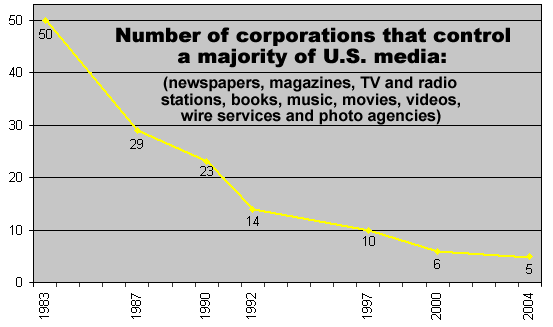
Likening media consolidation to that of the banking industry, Rather claimed that “roughly 80 percent” of the media is controlled by no more than six, and possibly as few as four, corporations.
This is documented by the following must-see charts prepared by:
And check out this list of interlocking directorates of big media companies from Fairness and Accuracy in Media, and this resource from the Columbia Journalism Review to research a particular company.
This image gives a sense of the decline in diversity in media ownership over the last couple of decades:
3. Drumming Up Support for War
In addition, the owners of American media companies have long actively played a part in drumming up support for war.
It is painfully obvious that the large news outlets studiously avoided any real criticism of the government's claims in the run up to the Iraq war. It is painfully obvious that the large American media companies acted as lapdogs and stenographers for the government's war agenda.
Veteran reporter Bill Moyers criticized the corporate media for parroting the obviously false link between 9/11 and Iraq (and the false claims that Iraq possessed WMDs) which the administration made in the run up to the Iraq war, and concluded that the false information was not challenged because:
"the [mainstream] media had been cheerleaders for the White House from the beginning and were simply continuing to rally the public behind the President — no questions asked."
And as NBC News' David Gregory (later promoted to host Meet the Press) said:
"I think there are a lot of critics who think that . . . . if we did not stand up [in the run-up to the war] and say 'this is bogus, and you're a liar, and why are you doing this,' that we didn't do our job. I respectfully disagree. It's not our role"
But this is nothing new. In fact, the large media companies have drummed up support for all previous wars.
For example, Hearst helped drum up support for the Spanish-American War.
And an official summary of America's overthrow of the democratically-elected president of Iran in the 1950's states, "In cooperation with the Department of State, CIA had several articles planted in major American newspapers and magazines which, when reproduced in Iran, had the desired psychological effect in Iran and contributed to the war of nerves against Mossadeq." (page x)
The mainstream media also may have played footsie with the U.S. government right before Pearl Harbor. Specifically, a highly-praised historian (Bob Stineet) argues that the Army’s Chief of Staff informed the Washington bureau chiefs of the major newspapers and magazines of the impending Pearl Harbor attack BEFORE IT OCCURRED, and swore them to an oath of secrecy, which the media honored (page 361) .
And the military-media alliance has continued without a break (as a highly-respected journalist says, "viewers may be taken aback to see the grotesque extent to which US presidents and American news media have jointly shouldered key propaganda chores for war launches during the last five decades.")
As the mainstream British paper, the Independent, writes:
There is a concerted strategy to manipulate global perception. And the mass media are operating as its compliant assistants, failing both to resist it and to expose it. The sheer ease with which this machinery has been able to do its work reflects a creeping structural weakness which now afflicts the production of our news.
The article in the Independent discusses the use of "black propaganda" by the U.S. government, which is then parroted by the media without analysis; for example, the government forged a letter from al Zarqawi to the "inner circle" of al-Qa'ida's leadership, urging them to accept that the best way to beat US forces in Iraq was effectively to start a civil war, which was then publicized without question by the media..
So why has the American press has consistenly served the elites in disseminating their false justifications for war?
One of of the reasons is because the large media companies are owned by those who support the militarist agenda or even directly profit from war and terror (for example, NBC - which is being sold to Comcast - was owned by General Electric, one of the largest defense contractors in the world -- which directly profits from war, terrorism and chaos).
Another seems to be an unspoken rule that the media will not criticize the government's imperial war agenda.
And the media support isn't just for war: it is also for various other shenanigans by the powerful. For example, a BBC documentary proves:
There was "a planned coup in the USA in 1933 by a group of right-wing American businessmen . . . . The coup was aimed at toppling President Franklin D Roosevelt with the help of half-a-million war veterans. The plotters, who were alleged to involve some of the most famous families in America, (owners of Heinz, Birds Eye, Goodtea, Maxwell Hse & George Bush’s Grandfather, Prescott) believed that their country should adopt the policies of Hitler and Mussolini to beat the great depression."
See also this book.
Have you ever heard of this scheme before? It was certainly a very large one. And if the conspirators controlled the newspapers then, how much worse is it today with media consolidation?
4. Access
Politico reveals:
For $25,000 to $250,000, The Washington Post has offered lobbyists and association executives off-the-record, nonconfrontational access to "those powerful few": Obama administration officials, members of Congress, and — at first — even the paper’s own reporters and editors...That may be one reason that the mainstream news commentators hate bloggers so much. The more people who get their news from blogs instead of mainstream news sources, the smaller their audience, and the less the MSM can charge for the kind of "nonconfrontational access" which leads to puff pieces for the big boys.
The offer — which essentially turns a news organization into a facilitator for private lobbyist-official encounters — was a new sign of the lengths to which news organizations will go to find revenue at a time when most newspapers are struggling for survival.
5. Censorship by the Government
Finally, as if the media's own interest in promoting war is not strong enough, the government has exerted tremendous pressure on the media to report things a certain way. Indeed, at times the government has thrown media owners and reporters in jail if they've been too critical. The media companies have felt great pressure from the government to kill any real questioning of the endless wars.
For example, Dan Rather said, regarding American media, "What you have is a miniature version of what you have in totalitarian states".
Tom Brokaw said "all wars are based on propaganda.
And the head of CNN said:
There was 'almost a patriotism police' after 9/11 and when the network showed [things critical of the administration's policies] it would get phone calls from advertisers and the administration and "big people in corporations were calling up and saying, 'You're being anti-American here.'
Indeed, former military analyst and famed Pentagon Papers whistleblower Daniel Ellsberg said that the government has ordered the media not to cover 9/11:
Ellsberg seemed hardly surprised that today's American mainstream broadcast media has so far failed to take [former FBI translator and 9/11 whistleblower Sibel] Edmonds up on her offer, despite the blockbuster nature of her allegations [which Ellsberg calls "far more explosive than the Pentagon Papers"].Of course, if the stick approach doesn't work, the government can always just pay off reporters to spread disinformation.As Edmonds has also alluded, Ellsberg pointed to the New York Times, who "sat on the NSA spying story for over a year" when they "could have put it out before the 2004 election, which might have changed the outcome."
"There will be phone calls going out to the media saying 'don't even think of touching it, you will be prosecuted for violating national security,'" he told us.
* * *
"I am confident that there is conversation inside the Government as to 'How do we deal with Sibel?'" contends Ellsberg. "The first line of defense is to ensure that she doesn't get into the media. I think any outlet that thought of using her materials would go to to the government and they would be told 'don't touch this . . . .'"
Famed Watergate reporter Carl Bernstein says the CIA has already bought and paid for many successful journalists. See also this New York Times piece, this essay by the Independent, this speech by one of the premier writers on journalism, and this and this roundup.
Indeed, in the final analysis, the main reason today that the media giants will not cover the real stories or question the government's actions or policies in any meaningful way is that the American government and mainstream media been somewhat blended together.
Can We Win the Battle Against Censorship?We cannot just leave governance to our "leaders", as "The price of freedom is eternal vigilance" (Jefferson). Similarly, we cannot leave news to the corporate media. We need to "be the media" ourselves.
"To stand in silence when they should be protesting makes cowards out of men."
- Abraham Lincoln
"Our lives begin to end the day we become silent about things that matter."
- Dr. Martin Luther King Jr.
"Powerlessness and silence go together. We...should use our privileged positions not as a shelter from the world's reality, but as a platform from which to speak. A voice is a gift. It should be cherished and used."
– Margaret Atwood
"There is no act too small, no act too bold. The history of social change is the history of millions of actions, small and large, coming together at points in history and creating a power that governments cannot suppress."
- Howard Zinn (historian)
"All tyranny needs to gain a foothold is for people of good conscience to remain silent"
- Thomas Jefferson
A Cheaper and More Effective Military Strategy for Afghanistan
Supporters of an escalation of the Afghanistan war often ask that we give military options a chance. They also respond to criticism of the surge by asking "okay smart guy, what would YOU do to fight Al Qaeda in Afghanistan?"
Well, initially, the U.S. admits there are only a small handful of Al Qaeda in Afghanistan. As ABC notes:
U.S. intelligence officials have concluded there are only about 100 al Qaeda fighters in the entire country.There are probably more than 100 homicidal maniacs in any large American city. But we wouldn't send soldiers into the city to get those bad guys.
With 100,000 troops in Afghanistan at an estimated yearly cost of $30 billion, it means that for every one al Qaeda fighter, the U.S. will commit 1,000 troops and $300 million a year.
Indeed, a leading advisor to the U.S. military - the very hawkish Rand Corporation - released a study in 2008 called "How Terrorist Groups End: Lessons for Countering al Qa'ida". The report confirms what experts have been saying for years: the war on terror is actually weakening national security.
As a press release about the study states:
Terrorists should be perceived and described as criminals, not holy warriors, and our analysis suggests that there is no battlefield solution to terrorism.There are additional reasons why prolonging the Afghan war may reduce our national security, such as weakening our economy.
But if you want a military solution anyway, Andrew J. Bacevich has an answer.
Bacevich is no dove. Graduating from West Point in 1969, he served in the United States Army during the Vietnam War. He then held posts in Germany, including the 11th Armored Cavalry Regiment, the United States, and the Persian Gulf up to his retirement from the service with the rank of Colonel in the early 1990s. Bacevich holds a Ph.D. in American Diplomatic History from Princeton University, and taught at West Point and Johns Hopkins University prior to joining the faculty at Boston University in 1998. Bacevich's is a military family. On May 13, 2007, Bacevich's son, was killed in action while serving in Iraq.
Last year, Bacevich wrote in an article in Newsweek:
Meanwhile, the chief effect of allied military operations there so far has been not to defeat the radical Islamists but to push them across the Pakistani border. As a result, efforts to stabilize Afghanistan are contributing to the destabilization of Pakistan, with potentially devastating implications. September's bombing of the Marriott hotel in Islamabad suggests that the extremists are growing emboldened. Today and for the foreseeable future, no country poses a greater potential threat to U.S. national security than does Pakistan. To risk the stability of that nuclear-armed state in the vain hope of salvaging Afghanistan would be a terrible mistake.In other words, America's war strategy is increasing instability in Pakistan. Pakistan has nuclear weapons. So the surge could very well decrease not only American national security but the security of the entire world.
All this means that the proper U.S. priority for Afghanistan should be not to try harder but to change course. The war in Afghanistan (like the Iraq War) won't be won militarily. It can be settled—however imperfectly—only through politics.
The new U.S. president needs to realize that America's real political objective in Afghanistan is actually quite modest: to ensure that terrorist groups like Al Qaeda can't use it as a safe haven for launching attacks against the West. Accomplishing that won't require creating a modern, cohesive nation-state. U.S. officials tend to assume that power in Afghanistan ought to be exercised from Kabul. Yet the real influence in Afghanistan has traditionally rested with tribal leaders and warlords. Rather than challenge that tradition, Washington should work with it. Offered the right incentives, warlords can accomplish U.S. objectives more effectively and more cheaply than Western combat battalions. The basis of U.S. strategy in Afghanistan should therefore become decentralization and outsourcing, offering cash and other emoluments to local leaders who will collaborate with the United States in excluding terrorists from their territory.
This doesn't mean Washington should blindly trust that warlords will become America's loyal partners. U.S. intelligence agencies should continue to watch Afghanistan closely, and the Pentagon should crush any jihadist activities that local powers fail to stop themselves. As with the Israelis in Gaza, periodic airstrikes may well be required to pre-empt brewing plots before they mature.
Were U.S. resources unlimited and U.S. interests in Afghanistan more important, upping the ante with additional combat forces might make sense. But U.S. power — especially military power — is quite limited these days, and U.S. priorities lie elsewhere.
Rather than committing more troops, therefore, the new president should withdraw them while devising a more realistic — and more affordable — strategy for Afghanistan
I think that diplomatic rather than military means should be used to kill or contain the 100 bad guys in Afghanistan. But if we are going to remain engaged militarily, Bacevich's approach is a lot smarter than a surge of boots on the ground.
World's Leading Scientist Fighting Against Global Warming is Opposed to Cap And Trade
James Hansen is the world's leading climate scientist fighting against global warming.
Yesterday, Dr. Hansen told the Guardian:
He is vehemently opposed to the carbon market schemes – in which permits to pollute are bought and sold – which are seen by the EU and other governments as the most efficient way to cut emissions and move to a new clean energy economy.Therefore, Hansen says:
It would be better for the planet and for future generations if next week's Copenhagen climate change summit ended in collapse.Hansen has previously said that cap and trade "will not work", and he has previously called cap and trade "a Ponzi-like ... scheme".I have repeatedly pointed out that cap and trade won't work. Indeed:
- The economists who invented cap-and-trade say that it won't work for global warming
- Many environmentalists say that carbon trading won't effectively reduce carbon emissions
- European criminal investigators have determined that there is a tremendous amount of fraud occurring in the carbon trading market.
- Former U.S. Undersecretary of Commerce for Economic Affairs Robert Shapiro says that the proposed cap and trade law "has no provisions to prevent insider trading by utilities and energy companies or a financial meltdown from speculators trading frantically in the permits and their derivatives."
- Our bailout buddies over at Goldman Sachs, JP Morgan, Morgan Stanley, Citigroup and the other Wall Street behemoths are buying heavily into carbon trading (see this, this, this, this, this and this). As University of Maryland professor economics professor and former Chief Economist at the U.S. International Trade Commission Peter Morici writes:
Obama must ensure that the banks use the trillions of dollars in federal bailout assistance to renegotiate mortgages and make new loans to worthy homebuyers and businesses. Obama must make certain that banks do not continue to squander federal largess by padding executive bonuses, acquiring other banks and pursuing new high-return, high-risk lines of businesses in merger activity, carbon trading and complex derivatives. Industry leaders like Citigroup have announced plans to move in those directions. Many of these bankers enjoyed influence in and contributed generously to the Obama campaign. Now it remains to be seen if a President Obama can stand up to these same bankers and persuade or compel them to act responsibly.
In other words, the same companies that made billions off of derivatives and other scams and are now getting bailed out on your dime are going to make billions from carbon trading.
Thursday, December 3, 2009
Bernanke Nomination on Hold
I just received the following message from a Congressional source:
Bunning, Sanders, and DeMint have holds on Bernanke, and Bernanke made some interesting comments on fiscal policy. DeMint tweeted that he will hold the nomination until there’s a vote to audit the Fed.
In non-hearing news, Chairman Frank says that he doesn’t think the Fed audit provision will change on the floor, which means it is likely to pass the full House next week.
DeMint tweets: “I will oppose Bernanke and hold his nomination until we get a vote to audit the Fed.”
http://twitter.com/JimDeMint/statuses/6315878082
One Job Creation Proposal that Might Actually Work
I have previously documented how grim the unemployment situation really is. See this.
At President Obama's job summit, many different ideas for job creation are being touted.
Some of these are good, and some are bad. For example, any proposal which stresses restarting securitization markets is barking up the wrong tree. Shahien Nasiripour rounds up some of the various proposals, pointing out that some propose:
Using other TARP money to provide cheap financing for investors to buy securitized small business loans...
[Mark Zandi, chief economist with Moody's Economy.com] said federal money instead should be used to bolster the securitization market for small business loans, partly because it's not clear that the banks would want the TARP money if there are too many strings attached.
Given that the Fed, the Bank of International Settlements and many leading economists have all said that securitization is part of the problem, Zandi's proposal should be a non-starter.
On the other hand, the National Federation of Independent Business will propose a one-year payroll tax cut. As Bruce Krastig argues, a one-year payroll tax cut could be implemented in a revenue-neutral fashion so as to create new jobs:
It is my estimate that 2010 calendar year payroll taxes will be $680 billion. This is a massive amount of money. If the tax were suspended for a year a portion of this pile of money would go directly into the pockets of America’s 90 million+ workers. It would equally go into their employer’s coffers. The primary beneficiaries would be small businesses. In other words, this would go right to where it is most needed.
At roughly $700 mmm this would be a size equal to the entire two-year stimulus program of February 2009. But its impact would be multiples of that in terms of increased demand in the economy.
I do not have a big computer, but a program like this would result in a jump in GDP of 3-4% just by itself. A guess on job creation would be around 3mm. If you want a big jolt in the arm this is it.
Eliminating payroll taxes for one year would ... would put hundreds of billions back in people's pockets just before next year’s elections...
There is one significant flaw to this approach. It would devastate the Social Security Trust Fund. That is something that Congress will not allow to happen. Even with the benefits that may go with it, that would be a 'no sale'.
There is a way to do this Revenue Neutral to the Trust Fund. It is relatively easy. You just have to cut current and future benefits that the Fund pays out. That would be extremely unpopular...
There is one approach that could work. A “means” tax on benefits for a stated period of time. A simple rule: If one has taxable income over $150,000 they do not get benefits for the following year. If this were in place for approximately five years the Fund would have offset the shortfall incurred in the first year where no taxes are collected.
The number of individuals who are both 65 and earn $150,000 is not large. They may yell and scream at this, but they are small in number. Those same individuals have significant irons in the fire. They would benefit from the robust economy that would follow. To make it fair, the amount that had been withheld could be deducted from future death taxes that will come due. My point is, this deal is sellable. The bulk of the "Panthers" would love it.
These are the pieces for the largest stimulus effort in history. And it is budget neutral. Keynes would be proud. The results would be dramatic. The impacts would be lasting. This by itself would not right our economy. But it would give us three to four years in order to dig ourselves out of a hole...
Note: The Trust Fund owns $2.5 Trillion of Government IOU’s. For them (through Treasury) to repo $650b into the 1-3 year credit market over the course of a year would not represent a significant issue for the bond market. One consequence would be that this would drain available liquidity; precisely what the Fed has told us it intends to do. This would be achieved with less impact on supply and demand than other options available to the Fed. A drain of about $700b is approximately the right size.
Goldman Predicts Gold Will Rise Above $1,400 An Ounce
Goldman Sachs is predicting that gold will shoot past $1,400/ounce by 2011, largely on the basis of central banks becoming net buyers of gold, gold ETFs continuing to buy substantial volumes, and real estate prices being depressed.
I agree.
In fact, I have previously argued that gold is a reasonable investment based on: 1) the dollar; 2) central banks; 3) declining production; 4) inflation; 5) deflation; 6) global short-term interest rates; 7) uncertainty and distrust in government; and 8) flight to safety.
Below is an updated version of my argument.
As everyone knows, gold is linked to the dollar.
As MarketWatch notes:
As I have recently argued, the dollar will likely strengthen during the next big decline in the stock market. But the long-term trend is strongly downward, favoring gold.Gold's performance in the euro, British pound and other currencies has been lackluster compared to its rise in U.S. dollars, a trend suggesting investors are more interested in bullion as a hedge against the greenback than global inflation.
That sensitivity also means the gold rally could quickly reverse if the U.S. dollar gains ground, one analyst warned.
"The lion's share of the gold-price increase is due to the weak dollar," said Carsten Fritsch, a commodities analyst for Commerzbank in Frankfurt. "Once things make a turn there, you could see a quite rapid correction in gold prices"...
In British pounds, gold has sunk about 6% from February highs and is up just 6% for the year, based on pricing of the most active contracts at the time.
In Australian dollars, the metal has tumbled about 25% from its February highs and has actually lost ground for the year.
The disparity reveals just how crucial a role the falling U.S. dollar has played in driving up gold and other commodities prices.
Gold is usually seen as the ultimate currency - a liquid investment that holds fast when paper currencies depreciate, potentially because inflation is rising. But in recent months, investors seem to be treating the metal specifically as a hedge against the dollar's drop than a deterioration in currencies in general.
China, India, Russia and Other Gold Buyers
According to Nouriel Roubini, central banks are drastically curtailing their sales of gold, which should support gold prices.
In fact, many central banks are buying large quantities of the shiny yellow metal.
China is said to be looking to buy large quantities.
Commentators such as Ambrose Evans-Pritchard and Byron King argue that China's hunger for gold will put a floor on gold prices. Specifically, they argue that China will "buy the dips" in gold prices, effectively putting a minimum on how low gold prices can go.
Indeed, former chief Merrill Lynch economist David Rosenberg argues that because China will buy a lot of gold, gold will shoot to $2,600/ounce.
India's central bank has also bought large amounts of gold, and Russia is said to be looking to buy gold as well.
Even small countries such as Sri Lanka and Mauritius are buying large quantities of gold.
Declining Production
The world's biggest gold producer - Barrick - says that the relatively easy-to-reach gold supplies are gone, and so supplies are getting more and more expensive to locate and extract:
Mining-Technology.com stated in March 2008:Aaron Regent, president of the Canadian gold giant [Barrick], said that global output has been falling by roughly 1m ounces a year since the start of the decade. Total mine supply has dropped by 10pc as ore quality erodes, implying that the roaring bull market of the last eight years may have further to run.
"There is a strong case to be made that we are already at 'peak gold'," he told The Daily Telegraph at the RBC's annual gold conference in London.
"Production peaked around 2000 and it has been in decline ever since, and we forecast that decline to continue. It is increasingly difficult to find ore," he said.
Global gold production has been in steady decline since 2002. Production in 2007 was around 2,444t, down 1% on the previous year.
Analysts note that virtually all of the low-lying fruit has now been picked with respect to gold, meaning that companies will have to take on more challenging and more expensive projects to meet supply. The extent to which the current high price of gold can translate into profits remains to be seen...
According to Bhavesh Morar, national leader of the mining, energy and infrastructure group with Deloitte Australia, frenzied exploration activity over the last few years has seen virtually all of the easy harvest been picked with respect to gold...
The high price of gold is however encouraging more adventurous projects, be they more challenging financially, geologically, geopolitically or all three. New projects for gold and other resources are mushrooming throughout Africa, China, the Middle East and the former Soviet Union; all areas where sovereign risk is potentially very high.
Zeal Speculation and Investment wrote in July of this year:
Miners have the same geological landscape to work with today as those miners thousands of years ago. The only difference is the low-hanging fruit has already been picked. Gold producers must now search for and mine their gold in locations that may not be very amenable to mining. Many of today’s gold mines are located in parts of the world that would not have even been considered in the past based on geography, geology, and/or geopolitics.
And these factors among many are attributable to an alarming trend we are seeing in global mined production volume. According to data provided by the US Geological Survey, global gold production is at a 12-year low. And provocatively this downward trend has accelerated during a period where the price of gold is skyrocketing.
You would think that with the price of gold rising at such a torrid pace gold miners would ramp up production in order to profit from this trend. But as you can see in this chart this has not been the case, at all. Not only has gold production not responded, but it has dropped at an unsightly pace that has sent shockwaves throughout the gold trade.
As the red line illustrates gold’s secular bull began in 2001, finally changing direction after a long and brutal bear market drove down prices to ridiculous lows in the $200s. To match this bull the blue-shaded area provides a picture of the corresponding global production trend. And you’ll notice that in the first 3 years of gold’s bull production was steady. This is not a surprise as you figure it would take the producers a few years to ramp up supply. But instead of supply increasing in response to growing demand and rising prices, it took a turn to the downside. And what’s even more amazing is the persistence of this downtrend. Since 2001 gold production is down a staggering 9.3%! In 2008 there were 7.7m fewer ounces of gold produced than in 2001.

Also in July, Whiskey and Gunpowder posted a chart on historical gold production, and argued for decreasing production:
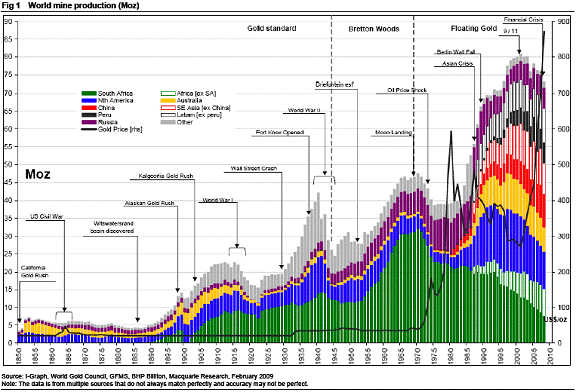
Take a look at the chart below from Macquarie Research, depicting world gold production 1850-2008...
[Click here for full chart]
For example, look at the very steep rise in gold output during the 1930s. That was during the depths of the worldwide Great Depression.
In both the US/Canada (blue area), and the rest of the world (gray area), people were digging more and more gold. The Soviets (purple area) increased their gold output too, courtesy of Joseph Stalin and his Gulag. Desperate times call for desperate measures, I suppose. Will that sort of history repeat this time around?
Or look at that massive run-up in gold output from South Africa (green area) in the 1950s and 1960s. That was during a time when South Africa was instituting its post-World War II system of apartheid. Labor was cheap (sorrowfully cheap), and quite a lot of international investment poured into South Africa without moral qualm. The South Africans dug deep and just plain tore into those gold-bearing reef structures of the Witwatersrand Basin.
But notice how quickly the South African gold output declined in the 1970s, as the mines got REALLY deep and the rest of the world began to institute sanctions against South Africa over its apartheid system.
And then look at the Gold Price run-up that followed in the late 1970s. It was a time of inflation, mainly coming from the US Dollar. Yet world gold mine output was dropping as well. Falling output, plus monetary inflation? The Gold Price skyrocketed. Another bit of useful history, right?
Now let's focus on more recent history, since about 1990. There were large increases in gold output from the US/Canada (blue), Australia (gold) and Asia (China orange, non-China open bar). By 2000 or so – the world production peak – Gold Prices were down toward $300 per ounce and below.
But as the chart shows, in the past 10 years, gold output has shown a marked DECLINE in the major historic Gold Mining regions. The prolific gold output from the US/Canada, Australia and South Africa has followed downward trends. Sure, these regions still lift a lot of ore and pour a lot of melt. But the production trend is DOWN.
The US/Canada, Australia and South Africa all have well-established and (more or less) workable mining laws – despite the best efforts of many current politicians and regulators to screw it all up. These historically producing areas are politically stable. Overall, there's good mining infrastructure, with road and rail networks, power systems, refining plants, a vendor base, mining personnel and access to capital.
But that's not the case in many areas of the developing parts of the world. Political stability? Security? Infrastructure? Transport? Power? Refining? Vendors? Personnel? Capital? Everywhere is different, of course. But overall, the entire process is much more problematic. So there's a lot more risk. When you move away from the traditional mining jurisdictions, the whole process of exploration, development and mining is more expensive.
Thus, the new gold discoveries of the future are going to lack some (if not most, or perhaps all) of the advantages of the developed mining world. That means that the ore deposits of the future will have to offer much higher profit margins, based on size and ore grade, to compensate for the increased risks. Too bad Mother Nature (or Saint Barbara, who looks after miners) doesn't work that way.
It also means the timeline to develop the mines of the future will likely be stretched over many years while political, legal, bureaucratic, logistical and social issues are ironed out.
The key driver for the future of worldwide gold supply will be DECLINING output overall over time.

Of course, if the price of gold warrant ramping up then production will increase. Just as with discussions about peak oil, the issue is not that the resource is totally running out, it is that it will be more and more expensive to extract.
Inflation
It is conventional wisdom that gold is a hedge against inflation.
For example, noted inflationist John Williams advises buying gold.
Axel Merk argues that gold is a better buy than TIPS as an inflation bet.
And Taleb advised buying gold in May, since currencies including the dollar and euro face pressures.
As of this writing, gold has had a good run, and might face a correction. But as hedge fund luminary John Paulson argues, its something you buy-and-hold for at least the medium term:
Paulson is convinced that gold will be a very good way to protect himself from the eventuality of currency debasement (i.e., inflation). He observed that if one thinks about gold in a three- or five-year time horizon (instead of hour to hour, day to day or week to week), the probability increases of gold being higher over time...
Deflation
If gold does well during times of inflation, it makes sense that it would perform poorly during deflationary periods.
But Examiner.com points out that such an assumption is probably untrue.
Specifically, as Examiner.com writes:
Eric Sprott - who manages $4.5 billion in assets, and correctly predicted in March of 2008 a "systemic financial meltdown” - says:“I believe no matter what environment you’re in - deflation or inflation - people will run to gold,” Sprott said. “Gold is proving exactly what we all would have expected, that in almost any environment, it’s a go-to asset.”
And investment analyst and financial writer Yves Smith argues that gold does well during both periods of deflation and high inflation. She argues:
Historically, gold does well [in] hyperinflation and deflationary [periods]. Gold does poorly under more normal conditions, and gets hammered in disinflationary conditions, a falling but positive rate of inflation.
Analyst Adrian Ash argues that gold's value actually increases during periods of deflation even if its price drops:
Does the price of gold rise or fall in a deflation?In other words, Ash argues that you can't take inflation or deflation in a vacuum. During deflationary periods - like we have now - governments always increase the money supply with a flood of new dollars, which is bullish for gold.Hint: It’s a trick question, already tripping up plenty of would-be advisors...
Absent the money-supply limits which the gold standard imposed on the world, people rightly guess that double-digit inflation would prove rocket-fuel for the bull market in gold. Yet the purchasing power of gold nearly doubled during the Great Depression, and it’s risen four-fold during this decade’s low consumer-price inflation as well.Why? Because both those periods of low price-inflation saw the money-issuing authorities devalue the currency, first with explicit reference to gold but now without daring to name it. Roosevelt in the mid-30s slashed the dollar’s gold content by 40%; the Greenspan/Bernanke Fed devalued the Dollar again to sidestep a DotCom Depression, keeping real interest rates at less than zero, between 2002-2005.
The maestro’s apprentice applied the same trick in the back-half of 2008, but so far to no avail. And now even the European Central Bank is pumping out money – a near half-trillion euros today alone – in a bid to revive bank lending, swamp the currency markets, and pull Germany out of its first flirt with deflation since the 1930s.
Just such a devaluation – and again, absent any stated reference to gold – was attempted by the Bank of Japan a little less than a decade ago.
Indeed, Japan is the only developed nation since the end of the gold standard to have suffered an extended deflation in prices. So far, at least. Germany and Switzerland look set to try for a re-wind, and unless the dollar can outpace the euro’s descent, we might yet see truly sub-zero inflation in the United States, too.
But whatever that should mean for gold prices, all other things being equal, just doesn’t matter. Because the gold price will not get a chance. All other things are not equal, and the policy solution – rank devaluation – can only make gold more appealing to investors and savers, whether the “monetarist experiment” of TARP, quantitative easing or a half-trillion euros proves successful or not.
Japan’s slump into deflation coincided with the Bank of Japan’s “zero interest rate policy” (ZIRP) at the start of this decade. It also saw the gold price worldwide hit rock-bottom and turn higher, a move that analysts (including us) have typically linked to US monetary moves and investment cash looking for safety as the Dotcom Bubble exploded.
But zero-rate money from the world’s second-largest economy shouldn’t be ignored. And today, zero-rate money is all the developed world has to offer – a trick that might not beat deflation, but might just spur a whole new rush into gold.
And PhD economist Marc Faber wrote in October 2007 that gold will do well even in a deflation:
How would gold perform in a deflationary global recession? Initially gold could come under some pressure as well but once the realization sinks in how messy deflation would be for over-indebted countries and households, its price would likely soar.
Therefore, under both scenarios - stagflation or deflationary recession - gold, gold equities and other precious metals should continue to perform better than financial assets.
Looking At the Charts
Is Faber right?
Well, take a look at the following charts showing gold's performance as compared to the yen during Japan's "lost decade" of deflation:

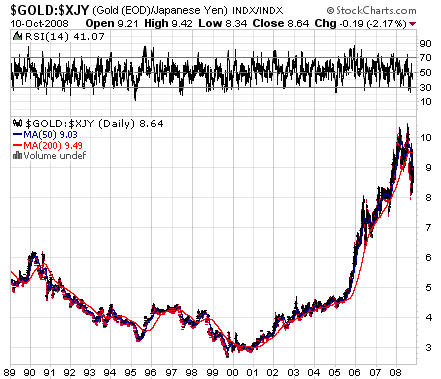
This provides some evidence that gold may tend to hold or increase its value at least in the later part of the deflationary period as compared with the relevant national currency.
Moreover - approximately half the time - gold has risen during recessions in the United States:

(The grey vertical bars show periods of recession; the chart gives gold prices in monthly averages; click here for larger image).
If you study the above chart, you will see that gold seems to often fall during the beginning stages of a recession, then rise in the later stages of the recession (before 1971, the dollar was still backed by gold at a fixed price, and so gold did not fluctuate).
But what about Ash's theory?
The American Enterprises Institute notes:
After five years in a deflationary economic wilderness, the Bank of Japan switched during the spring of 2001 to a policy of quantitative easing--targeting the growth of the money supply instead of nominal interest rates--in order to engineer a rebound in demand growth.
Look again at the first gold chart for Japan, above. Gold appears to start increasing against the Yen in 2001.
This may provide some evidence for Ash's thesis that it is an expansion of the money supply which pushes the price of gold up in the later stages of deflationary periods.
Uncertainty
Finally, Chris Martenson argues that - in prolonged periods of deflation - we usually see failures of large and significant banks, institutions, and perhaps even states and countries. Because gold traditionally does well during periods of uncertainty, Martenson likes gold during periods of deflation.
Examiner.com notes in a subsequent article:
Merrill Lynch agrees.Specifically, PhD economist Nouriel Roubini paraphrases a report from Merill Lynch (not available online) as follows:
Short-term rates of 0% are bullish for gold, which serves as a store of value but is a useful hedge against deflation as well, since deflation is inherently destabilizing for financial assets. In the 2001-03 deflationary period, gold rose more than 30%, not to mention the prospect of a return to a dollar bear market. "Gold is inversely correlated to global short-term interest rates and there is a race right now towards 0%. Production is down 4.0% y/y while fiat currencies globally are being created at a double digit rate by the world's central banks....As for all the talk of a 'gold bubble,' it would take a nearly 625% surge in gold to over US$6,000/oz and a flat stock market to actually get the ratio of the two asset classes back to where it was three decades ago when bullion was in an unsustainable bubble phase."
Gold tends to be less sensitive to global economic slowdown than industrial metals or energy and works better as a hedge against crisis than inflation.
See also Fred Sheehan's summary of Roy Jastram's study of the performance of gold during deflationary periods throughout history.
Global Short Term Interest Rates Are Low
The above-quoted Merrill article states:
Gold is inversely correlated to global short-term interest rates and there is a race right now towards 0%.
This argues for gold.
Distrust in Government
Time Magazine writes:
Traditionally, gold has been a store of value when citizens do not trust their government politically or economically.
Given the enormous levels of distrust in the government politically and/or economically (and the fact that some have warned of recession-induced violence), gold might do well.
Also, as mentioned above, gold tends to do well during periods of uncertainty. Given that the fundamental problems with the economy have not been fixed, things will likely become less certain.
Greenspan and Exeter
Professor Emeritus of Mathematics Antal Fekete has argued for years that gold is the ultimate - and only - safe haven when things really hit the fan.
For example, in 2007 Fekete wrote:
The grand old man of the New York Federal Reserve bank’s gold department, the last Mohican, John Exter explained the devolution of money (not his term) using the model of an inverted pyramid, delicately balanced on its apex at the bottom consisting of pure gold. The pyramid has many other layers of asset classes graded according to safety, from the safest and least prolific at bottom to the least safe and most prolific asset layer, electronic dollar credits on top. (When Exter developed his model, electronic dollars had not yet existed; he talked about FR deposits.) In between you find, in decreasing order of safety, as you pass from the lower to the higher layer: silver, FR notes, T-bills, T-bonds, agency paper, other loans and liabilities denominated in dollars. In times of financial crisis people scramble downwards in the pyramid trying to get to the next and nearest safer and less prolific layer underneath. But down there the pyramid gets narrower. There is not enough of the safer and less prolific kind of assets to accommodate all who want to "devolve”. Devolution is also called "flight to
safety”.
Darryl Schoon makes the same argument.
Here's a visual depiction Exeter's inverted pyramid, courtesy of Wikimedia:

(Click here for full image; I can't vouch for the accuracy of the rankings for all of the levels . . . for example, muni bonds versus corporate bonds)
Alan Greenspan has just lent some support to the theory. Specifically:
Gold prices that jumped above $1,000 an ounce this week are signaling that investors are buying metals to hedge against declines in currencies, former Federal Reserve Chairman Alan Greenspan said.
The gains are “strictly a monetary phenomenon,” Greenspan said today at an investment conference in New York. Rising prices of precious metals and other commodities are “an indication of a very early stage of an endeavor to move away from paper currencies,” he said...
“What is fascinating is the extent to which gold still holds reign over the financial system as the ultimate source of payment,” Greenspan said.
In other words, Greenspan is saying that investors are moving out of the second-to-lowest step on the pyramid (currencies and government bonds) and into the lowest step (gold).
Greenspan is also verifying what goldbugs like Exeter, Fekete and Schoon have been claiming: that "the barbarous relic" still holds an important place in the modern investor's psyche.
Are Exeter, Fekete and Schoon right? I don't know. And Greenspan might be wrong, or trying to excuse weakness in the dollar (as opposed to all paper currencies).
Note 1: Of course, when everyone is on one side of a trade, it means that the market is about to crash. Some of the best recent arguments I've heard against investing in gold are written by Vitaliy Katsenelson. Read this, this, this and this.
Note 2: While Schoon alleges the manipulation of gold prices, he argues that gold manipulation will end because the world's central banks (and their primary dealers) will no longer be able to afford it. Specifically, he argues that they will simply run out of money to keep playing the game. If he is right, then manipulation of gold prices - even if real - would end up being moot at some point.
Note 3: I am not an investment advisor and this should not be taken as investment advice.
Has America Suffered a PERMANENT Loss of Jobs?
Some of the top economists say that America has suffered a permanent loss of jobs:
- JPMorgan Chase’s Chief Economist Bruce Kasman told Bloomberg:
[We've had a] permanent destruction of hundreds of thousands of jobs in industries from housing to finance.
- The chief economists for Wells Fargo Securities, John Silvia, says:
Companies “really have diminished their willingness to hire labor for any production level,” Silvia said. “It’s really a strategic change,” where companies will be keeping fewer employees for any particular level of sales, in good times and bad, he said.
- Former Merrill Lynch chief economist David Rosenberg writes:
The number of people not on temporary layoff surged 220,000 in August and the level continues to reach new highs, now at 8.1 million. This accounts for 53.9% of the unemployed — again a record high — and this is a proxy for permanent job loss, in other words, these jobs are not coming back. Against that backdrop, the number of people who have been looking for a job for at least six months with no success rose a further half-percent in August, to stand at 5 million — the long-term unemployed now represent a record 33% of the total pool of joblessness.
- Nobel Prize winner Edmund Phelps and Pacific Investment Management Co. Chief Executive Officer Mohamed El-Erian say the fallout from the deepest recession in more than five decades is driving the so-called natural rate higher, perhaps to 7 percent.
- And Former Labor Secretary Robert Reich wrote yesterday:
And see this.The basic assumption that jobs will eventually return when the economy recovers is probably wrong. Some jobs will come back, of course. But the reality that no one wants to talk about is a structural change in the economy that's been going on for years but which the Great Recession has dramatically accelerated.
Under the pressure of this awful recession, many companies have found ways to cut their payrolls for good. They've discovered that new software and computer technologies have made workers in Asia and Latin America just about as productive as Americans, and that the Internet allows far more work to be efficiently outsourced abroad.
This means many Americans won't be rehired unless they're willing to settle for much lower wages and benefits. Today's official unemployment numbers hide the extent to which Americans are already on this path. Among those with jobs, a large and growing number have had to accept lower pay as a condition for keeping them. Or they've lost higher-paying jobs and are now in a new ones that pays less.
Yet reducing unemployment by cutting wages merely exchanges one problem for another. We'll get jobs back but have more people working for pay they consider inadequate, more working families at or near poverty, and widening inequality. The nation will also have a harder time restarting the economy because so many more Americans lack the money they need to buy all the goods and services the economy can produce.
Heck of a job, Larry, Tim and Ben.
Prolonging the War is a "Threat to Our National Security"
Congressman Kucinich said today:
America is in the fight of its life and that fight is not in Afghanistan -- it's here ... We are deeply in debt. Our GDP is down. Our manufacturing is down. Our savings are down. The value of the dollar is down. Our trade deficit is up. Business failures are up. Bankruptcies are up.Is he right?The war is a threat to our national security. We’ll spend over $100 billion next year to bomb a nation of poor people while we reenergize the Taliban, destabilize Pakistan, deplete our army and put more of our soldiers’ lives on the line. Meanwhile, back here in the USA, 15 million people are out of work. People are losing their jobs, their health care, their savings, their investments, and their retirement security. $13 trillion in bailouts for Wall Street, trillions for war; when are we going to start taking care of things here at home?
Well, the director of U.S. national intelligence, retired Admiral Dennis Blair, said in February that the economic crisis was the biggest national security threat to the United States. See this and this.
And - contrary to common beliefs - economists say that prolonged wars increase unemployment, shrink the economy, and cause rather than solve recessions. See this, this and this. And to those who say that deficits don't matter, please read this.
As ABC notes:
U.S. intelligence officials have concluded there are only about 100 al Qaeda fighters in the entire country...
With 100,000 troops in Afghanistan at an estimated yearly cost of $30 billion, it means that for every one al Qaeda fighter, the U.S. will commit 1,000 troops and $300 million a year.
And TalkingPointsMemo reported yesterday that - in addition to the troops - the US now has more than 104,000 defense contractors in the country. So that drives up the cost per al Qaeda fighter even higher.
Moreover, a leading advisor to the U.S. military - the very hawkish Rand Corporation - released a study in 2008 called "How Terrorist Groups End: Lessons for Countering al Qa'ida". The report confirms what experts have been saying for years: the war on terror is actually weakening national security.
As a press release about the study states:
"Terrorists should be perceived and described as criminals, not holy warriors, and our analysis suggests that there is no battlefield solution to terrorism."As one blogger commented in response to a previous essay:
If we continue to react as we did after 9-11 then al Qaeda will win. This primarily being a financial site, everyone here should understand ROI [return on investment]. They invested less than a million and made us spend 1 trillion+. They could pass the collection plate around at the average mosque in Pakistan and bankrupt us with 1 more operation. Even if you are not convinced that we are creating more extremists than we are killing, we simply cannot afford to "win the war on terrorism". Fighting fire with fire just makes things burn faster...Kucinich is right.
Keep in mind as well that most empires that have been defeated were not annihilated on the battlefield, but rather in the bank account.
Wednesday, December 2, 2009
Robert Reich Confirms Permanent Destruction of Jobs in America
Former Labor Secretary Robert Reich writes today:
The basic assumption that jobs will eventually return when the economy recovers is probably wrong. Some jobs will come back, of course. But the reality that no one wants to talk about is a structural change in the economy that's been going on for years but which the Great Recession has dramatically accelerated.
Under the pressure of this awful recession, many companies have found ways to cut their payrolls for good. They've discovered that new software and computer technologies have made workers in Asia and Latin America just about as productive as Americans, and that the Internet allows far more work to be efficiently outsourced abroad.
This means many Americans won't be rehired unless they're willing to settle for much lower wages and benefits. Today's official unemployment numbers hide the extent to which Americans are already on this path. Among those with jobs, a large and growing number have had to accept lower pay as a condition for keeping them. Or they've lost higher-paying jobs and are now in a new ones that pays less.
Yet reducing unemployment by cutting wages merely exchanges one problem for another. We'll get jobs back but have more people working for pay they consider inadequate, more working families at or near poverty, and widening inequality. The nation will also have a harder time restarting the economy because so many more Americans lack the money they need to buy all the goods and services the economy can produce.
Reich is only confirming what many others have said:
- JPMorgan Chase’s Chief Economist Bruce Kasman told Bloomberg:
[We've had a] permanent destruction of hundreds of thousands of jobs in industries from housing to finance.
- The chief economists for Wells Fargo Securities, John Silvia, says:
Companies “really have diminished their willingness to hire labor for any production level,” Silvia said. “It’s really a strategic change,” where companies will be keeping fewer employees for any particular level of sales, in good times and bad, he said.
- And former Merrill Lynch chief economist David Rosenberg writes:
And see this.The number of people not on temporary layoff surged 220,000 in August and the level continues to reach new highs, now at 8.1 million. This accounts for 53.9% of the unemployed — again a record high — and this is a proxy for permanent job loss, in other words, these jobs are not coming back. Against that backdrop, the number of people who have been looking for a job for at least six months with no success rose a further half-percent in August, to stand at 5 million — the long-term unemployed now represent a record 33% of the total pool of joblessness.
Heck of a job, Larry, Tim and Ben.
What Empires Have Said Throughout History: "One More Surge"
A leading advisor to the U.S. military, the Rand Corporation, released a study in 2008 called "How Terrorist Groups End: Lessons for Countering al Qa'ida". The report confirms what experts have been saying for years: the war on terror is actually weakening national security.
As a press release about the study states:
"Terrorists should be perceived and described as criminals, not holy warriors, and our analysis suggests that there is no battlefield solution to terrorism."In fact, starting right after 9/11 -- at the latest -- the goal has always been to create "regime change" and instability in Iraq, Iran, Syria, Libya, Sudan, Somalia, Lebanon and other countries.
As American historian, investigative journalist and policy analyst Gareth Porter writes in the Asia Times:
Three weeks after the September 11, 2001, terror attacks, former US defense secretary Donald Rumsfeld established an official military objective of not only removing the Saddam Hussein regime by force but overturning the regime in Iran, as well as in Syria and four other countries in the Middle East, according to a document quoted extensively in then-under secretary of defense for policy Douglas Feith's recently published account of the Iraq war decisions. Feith's account further indicates that this aggressive aim of remaking the map of the Middle East by military force and the threat of force was supported explicitly by the country's top military leaders.
Feith's book, War and Decision, released last month, provides excerpts of the paper Rumsfeld sent to President George W Bush on September 30, 2001, calling for the administration to focus not on taking down Osama bin Laden's al-Qaeda network but on the aim of establishing "new regimes" in a series of states...
***
General Wesley Clark, who commanded the North Atlantic Treaty Organization bombing campaign in the Kosovo war, recalls in his 2003 book Winning Modern Wars being told by a friend in the Pentagon in November 2001 that the list of states that Rumsfeld and deputy secretary of defense Paul Wolfowitz wanted to take down included Iraq, Iran, Syria, Libya, Sudan and Somalia [and Lebanon].
***
When this writer asked Feith . . . which of the six regimes on the Clark list were included in the Rumsfeld paper, he replied, "All of them."
***
The Defense Department guidance document made it clear that US military aims in regard to those states would go well beyond any ties to terrorism. The document said the Defense Department would also seek to isolate and weaken those states and to "disrupt, damage or destroy" their military capacities - not necessarily limited to weapons of mass destruction (WMD).
The goal was never focused on destroying Al Qaeda. As just one example, the U.S. let Bin Laden escape in 2001 and again in 2007.
Indeed, the goal seems to have more to do with being a superpower (i.e. an empire) than stopping terrorism.
As Porter writes:
After the bombing of two US embassies in East Africa [in 1988] by al-Qaeda operatives, State Department counter-terrorism official Michael Sheehan proposed supporting the anti-Taliban Northern Alliance in Afghanistan against bin Laden's sponsor, the Taliban regime. However, senior US military leaders "refused to consider it", according to a 2004 account by Richard H Shultz, Junior, a military specialist at Tufts University.A senior officer on the Joint Staff told State Department counter-terrorism director Sheehan he had heard terrorist strikes characterized more than once by colleagues as a "small price to pay for being a superpower".
One More Surge in Afghanistan
Empire after empire has broken its back trying to control Afghanistan.
Why?
It is the crossroads between East, West, South Asia and Central Asia. And now it is the proposed site for a Trans-Afghanistan gas pipeline.
If you believe President Obama's statement that America will be out of Afghanistan in 18 months, I have some barren, rocky hills to sell you. Indeed:
[Presidential] aides said that by announcing a date for beginning a withdrawal, the president was not setting an end date for the war.And as CNN notes, the 2011 date for the beginning of withdrawal is not fixed in stone.
And it is important to note that - contrary to conventional wisdom - extended wars cause rather than end recessions. See this, this and this.
Michael Rivero summarizes Obama's Afghanistan war surge in the context of the 2,000-plus-year history of empires trying to conquer that country:
"Just one more surge!" -- The Indus
"Just one more surge!" -- The Kushan
"Just one more surge!" -- The Scythians
"Just one more surge!" -- The Parthians
"Just one more surge!" -- The Saffarid
"Just one more surge!" -- The Ghaznavid
"Just one more surge!" -- The Ghorid
"Just one more surge!" -- The Timurid
"Just one more surge!" -- The Hotaki
"Just one more surge!" -- The Durrani
"Just one more surge!" -- The Aryan
"Just one more surge!" -- The Persians
"Just one more surge!" -- The Sassanids
"Just one more surge!" -- The Hephthalites
"Just one more surge!" -- The Huns
"Just one more surge!" -- The Mughals
"Just one more surge!" -- The Arabs
"Just one more surge!" -- The Turkic
"Just one more surge!" -- The Hazaras
"Just one more surge!" -- The Khwarezmids
"Just one more surge!" -- The Mongols
"Just one more surge!" -- The British
"Just one more surge!" -- The British (again)
"Just one more surge!" -- The British (Yet again)
"Just one more surge!" -- The USSR
"Just one more surge!" -- The United States
Former Managing Director of Goldman Sachs: Accounting Fraud of the Too Big to Fails May Be Worse Than Enron
Nomi Prins - former managing director of Goldman Sachs and head of the international analytics group at Bear Stearns in London - is saying the same thing that financial bloggers have been saying: The giant banks are manipulating their books to make themselves look profitable.
In fact, Prins says that this might be worse than the fraud which occurred at Enron:
Surely someone with Prins' financial background can sort out the accounting of the TBTFs?Enron was the financial scandal that kicked off the decade: a giant energy trading company that appeared to be doing brilliantly—until we finally noticed that it wasn’t. It’s largely been forgotten given the wreckage that followed, and that’s too bad: we may be repeating those mistakes, on a far larger scale.
Specifically, as the largest Wall Street banks return to profitability—in some cases, breaking records—they say everything is rosy. They’re lining up to pay back their TARP money and asking Washington to back off. But why are they doing so well? Remember that Enron got away with their illegalities so long because their financials were so complicated that not even the analysts paid to monitor the Houston-based trading giant could cogently explain how they were making so much money.
In fact, no:
The giant banks have played so many games of massaging numbers (see this), hiding losses off the books (see this) and - as Prins documents - failing to report core data and shuffling things around so that it is impossible to tell what they are doing.After two weeks sifting through over one thousand pages of SEC filings for the largest banks, I have the same concerns. While Washington ponders what to do, or not do, about reforming Wall Street, the nation’s biggest banks, plumped up on government capital and risk-infused trading profits, have been moving stuff around their balance sheets like a multi-billion dollar musical chairs game.
I was trying to answer the simple question that you'd think regulators should want to know: how much of each bank’s revenue is derived from trading (taking risk) vs. other businesses? And how can you compare it across the industry—so you can contain all that systemic risk?
Indeed, financial writers (like Reggie Middleton, Mike Shedlock, Tyler Durden, Karl Denninger and others) who have dug deep and analyzed the underlying data say that the giant banks are totally insolvent. This wouldn't be the first time that the biggest banks went bust and then covered it up over a period of many years.
Prins offers a solution:
Yes, and break up the too big to fails.The long-term solution is bringing back Glass-Steagall. Being big doesn’t just risk bringing down a financial system—it means you can also more easily hide things. Remember the lesson from the Enron saga: when things look too good to be true, they usually are.
In addition, Congresswoman Marcy Kaptur, Tarp overseer Elizabeth Warren, prominent economists such as James Galbraith, Simon Johnson, Max Wolff and William Black, and financial experts such as Janet Tavakoli have all said that fraud was a primary cause of the financial crisis.
Galbraith and others say that unless past fraud is prosecuted so that Americans trust that the system is fair, the economy will not stabilize.
By allowing the giant banks' shenanigans to continue, the government is guaranteeing that the economy cannot truly recover.


 Posts
Posts