
Wednesday, December 16, 2009
Officials and Experts Warn of Crash-Induced Unrest
Numerous high-level officials and experts warn that the economic crisis could lead to unrest world-wide - even in developed countries:
- Today, Moody's warned that future tax rises and spending cuts could trigger social unrest in a range of countries from the developing to the developed world, that in the coming years, evidence of social unrest and public tension may become just as important signs of whether a country will be able to adapt as traditional economic metrics, that a fiscal crisis remains a possibility for a leading economy, and that 2010 would be a “tumultuous year for sovereign debt issuers”.
- The U.S. Army War College warned in 2008 November warned in a monograph [click on Policypointers’ pdf link to see the report] titled “Known Unknowns: Unconventional ‘Strategic Shocks’ in Defense Strategy Development” of crash-induced unrest:
The military must be prepared, the document warned, for a “violent, strategic dislocation inside the United States,” which could be provoked by “unforeseen economic collapse,” “purposeful domestic resistance,” “pervasive public health emergencies” or “loss of functioning political and legal order.” The “widespread civil violence,” the document said, “would force the defense establishment to reorient priorities in extremis to defend basic domestic order and human security.” “An American government and defense establishment lulled into complacency by a long-secure domestic order would be forced to rapidly divest some or most external security commitments in order to address rapidly expanding human insecurity at home,” it went on. “Under the most extreme circumstances, this might include use of military force against hostile groups inside the United States. Further, DoD [the Department of Defense] would be, by necessity, an essential enabling hub for the continuity of political authority in a multi-state or nationwide civil conflict or disturbance,” the document read.
- Director of National Intelligence Dennis C. Blair said:
"The global economic crisis ... already looms as the most serious one in decades, if not in centuries ... Economic crises increase the risk of regime-threatening instability if they are prolonged for a one- or two-year period," said Blair. "And instability can loosen the fragile hold that many developing countries have on law and order, which can spill out in dangerous ways into the international community."***
"Statistical modeling shows that economic crises increase the risk of regime-threatening instability if they persist over a one-to-two-year period."***
“The crisis has been ongoing for over a year, and economists are divided over whether and when we could hit bottom. Some even fear that the recession could further deepen and reach the level of the Great Depression. Of course, all of us recall the dramatic political consequences wrought by the economic turmoil of the 1920s and 1930s in Europe, the instability, and high levels of violent extremism.”
Blair made it clear that - while unrest was currently only happening in Europe - he was worried this could happen within the United States.
[See also this].
- Former national security director Zbigniew Brzezinski warned "there’s going to be growing conflict between the classes and if people are unemployed and really hurting, hell, there could be even riots."
- The chairman of the Joint Chiefs of Staff warned the the financial crisis is the highest national security concern for the U.S., and warned that the fallout from the crisis could lead to of "greater instability".
- The head of the World Trade Organization
- The head of the International Monetary Fund (and see this)
- The head of the World Bank
- Senator Christopher Dodd
- Congressman Ron Paul (radio interview on March 6, 2009)
- Britian's MI5 security agency
- Leading economic historian Niall Ferguson
- Leading economist Marc Faber and billionaire investor Jim Rogers
- Leading economist Nouriel Roubini
- Leading economist John Williams
- Top trend researcher Gerald Calente
- European think tank Leap2020


Copenhagen Police Use Force on Unarmed Protestors
Police at the climate summit in Copenhagen are using force on unarmed protestors:
Copenhagen has turned into Chokenhagen ...
For background, see this, this, and this.
Senator Merkley: No On Bernanke
I received this by email.
WASHINGTON, DC – Oregon’s Senator Jeff Merkley, a member of the Senate Committee on Banking, Housing and Urban Development, issued the following statement on his intention to vote against Ben Bernanke’s nomination to a second term as Chairman of the Board of Governors of the Federal Reserve System:
“Tomorrow, I will vote against confirming Ben Bernanke as Chairman of the Federal Reserve. The reason, in short, is that as Chairman, Dr. Bernanke failed to recognize or remedy the factors that paved the road to this dark and difficult recession. Following our economic collapse, it is also apparent that he has not changed his overall approach to prioritizing Wall Street over American families.
“My decision is based on my fundamental belief that our economy cannot recover if we do not put Main Street first.
“Our nation is just beginning to emerge from the greatest financial crisis since the Great Depression, and there is no guarantee we will continue on the road to recovery over the long or short terms. Unemployment remains far too high, credit is unavailable to too many businesses, and families are plagued by falling home prices and high foreclosure rates. Even as we move forward with our efforts to get our economy back on track, it is critical we carefully examine what led us to this point.
“For too many years, federal regulators turned a blind eye to signs of an impending financial crisis. Tricks and traps proliferated in the credit card and consumer lending industries. Predatory mortgage loans exploded, fueling an unsustainable housing bubble. Regulators lifted rules requiring banks to keep adequate capital, and a laissez-faire approach to securitization, derivatives, and proprietary trading encouraged excessive risk-taking on Wall Street. As a member of the Board of Governors, Chair of the Council of Economic Advisers, and then ultimately as Chairman of the Board of Governors, Dr. Bernanke supported each of these decisions, failing to take the necessary precautionary steps that could have averted or mitigated financial collapse.
“These failures are very relevant to the future. We need economic leaders who understand that the ultimate goal of economic policies and the key to meaningful economic recovery should be financially successful families, not oversized Wall Street profits.
“Indeed, it should be recognized that although Wall Street prospered in the short-term from reduced leverage requirements, securitization of faulty mortgages, and the explosion of derivatives, Americans did not. The expansion that occurred from 2002 to 2007 became the first economic expansion in which working families were worse off at the end than at the beginning. This is not a path that we can afford to travel again.”
Global WARming
As I have previously pointed out:
I now have some figures to back this up.Continuing the wars in Afghanistan and Iraq will more than wipe out any reduction in carbon from the government's proposed climate measures ...
The continuance of the Afghanistan and Iraq wars completely and thoroughly undermines the government's claims that there is a global warming emergency and that reducing carbon output through cap and trade is needed to save the planet.
I can't take anything the government says about carbon footprints seriously until the government ends the unnecessary wars in Afghanistan and Iraq.
Professor Michael Klare noted in 2007:
Sixteen gallons of oil. That's how much the average American soldier in Iraq and Afghanistan consumes on a daily basis -- either directly, through the use of Humvees, tanks, trucks, and helicopters, or indirectly, by calling in air strikes. Multiply this figure by 162,000 soldiers in Iraq, 24,000 in Afghanistan, and 30,000 in the surrounding region (including sailors aboard U.S. warships in the Persian Gulf) and you arrive at approximately 3.5 million gallons of oil: the daily petroleum tab for U.S. combat operations in the Middle East war zone.And in 2008, Oil Change International released a report showing that:
- The war is responsible for at least 141 million metric tons of carbon dioxide equivalent (MMTCO2e) since March 2003. To put this in perspective, CO2 released by the war to date equals the emissions from putting 25 million more cars on the road in the US this year.
- Between March 2003 and October 2007 the US military in Iraq purchased more than 4 billion gallons of fuel from the Defense Energy Support Center, the agency responsible for procuring and supplying petroleum products to the Department of Defense. Burning these fuels has directly produced nearly 39 million metric tons of CO2 Just transporting 4 billion gallons of fuel to the military in Iraq consumed at least as much fuel as was delivered nearly doubling overall fuel-related emissions.
- Emissions from the Iraq War to date are nearly two and a half times greater than what would be avoided between 2009 and 2016 were California to implement the auto emission regulations it has proposed (but that the Bush Administration struck down).
- If the war were ranked as a country in terms of annual emissions, it would emit more CO2 each year than 139 of the world’s nations do, more than 60% of all countries on the planet.
The report also notes:
The emissions associated with the war in Iraq are literally unreported. Military emissions abroad are not captured in the national greenhouse gas inventories that all industrialized nations, including the United States, report under the United Nations Framework Convention on Climate Change. It’s a loophole big enough to drive a tank through.Of course, the escalation of the war in Afghanistan will lead to a huge surge in greenhouse gas emissions as well. As the Washington Post noted on December 15th:
The military is planning for thousands of additional tanker truck deliveries a month, big new storage facilities and dozens of contractors to navigate the landlocked country's terrain ...
The military's fuel needs are prodigious. According to the Government Accountability Office, about 300,000 gallons of jet fuel are delivered to Afghanistan each day, in addition to diesel, motor and aircraft gasoline. A typical Marine corps combat brigade requires almost 500,000 gallons of fuel per day, according to a recent study by Deloitte Analysis, a research group. Each of the more than 100 forward operating bases in Afghanistan requires a daily minimum of 300 gallons of diesel fuel, the study said.
The GAO report said that in June 2008 alone, 6.2 million gallons of fuel went for air and ground operations, while 917,000 gallons went for base support activities including lighting, running computers, and heating or cooling ...Another measure of the fuel needs -- and the long-term planning associated with them -- can be seen in the number of solicitations for storage facilities being put forward in the past months.
The largest would construct a new bulk fuel storage system for Bagram. It would require tanks to hold 1.1 million gallons of fuel, along with pumps, controls and supporting facilities. The overall facility, including electric, water, sewer, curbs and security measures, is to cost up to $25 million.
Although Obama has said that U.S. forces would begin returning home in 18 months, the fuel storage facility at Bagram would take almost 15 months to build, once the contract is awarded early next year. The contract requires storage for 6 million gallons of U.S.-standard jet fuel, 3 million gallons of Russian standard jet fuel and 1 million gallons of diesel fuel. The facility must be capable of receiving fuel from up to 100 tank trucks a day, 24 hours a day, seven days a week.
Facilities that can store 3 million gallons will be built in Ghazni and at Sharana.
Tuesday, December 15, 2009
Any Climate Treaty Which Does Not Dramatically Reduce Soot Is Not Worth the Paper It's Written On
Preface: I studied global warming at a top university in the early 1980's. I was taught - as Al Gore was taught in college - that temperatures are directly correlated with CO2 levels.
This essay will not address the question of whether global temperatures are rising, and if so, how much. Others have written extensively on that issue. This essay also will not look at questions of the percentage of climate change attributable to natural factors, such as variations in solar output, volcanic activity or El Niño (also called the "southern oscillation"). These are important issues, but this essay will not address them.
Whether or not you believe the planet is warming or that it is warming because of CO2 is irrelevant for the purpose of this essay. Either way, you will benefit from reading this.
Finally, I am against big oil and big coal. As I have repeatedly argued, power should be taken away from the oil giants and decentralized. I have repeatedly argued for microgeneration and for alternative energy. These things are beneficial for a number of reasons - including better health, less corruption of our political systems through decentralization of power, and a boost to our economy - in addition to whatever climate benefits they may have.
Do you remember the stories a couple of years ago about all of the dust coming from China?
There were headlines such as:
Unfortunately, it's not just dirt. It's also soot, or "black carbon".As the Wall Street Journal wrote in 2007:
"There are times when it covers the entire Pacific Ocean basin like a ribbon bent back and forth," said atmospheric physicist V. Ramanathan at the Scripps Institution of Oceanography in La Jolla, Calif.
On some days, almost a third of the air over Los Angeles and San Francisco can be traced directly to Asia. With it comes up to three-quarters of the black carbon particulate pollution that reaches the West Coast, Dr. Ramanathan and his colleagues recently reported in the Journal of Geophysical Research."
And the New York Times wrote in 2007:
Soot and Climate ChangeOne of China's lesser-known exports is a dangerous brew of soot, toxic chemicals and climate-changing gases from the smokestacks of coal-burning power plants.
In early April, a dense cloud of pollutants over Northern China sailed to nearby Seoul, sweeping along dust and desert sand before wafting across the Pacific. An American satellite spotted the cloud as it crossed the West Coast.
Researchers in California, Oregon and Washington noticed specks of sulfur compounds, carbon and other byproducts of coal combustion coating the silvery surfaces of their mountaintop detectors. These microscopic particles can work their way deep into the lungs, contributing to respiratory damage, heart disease and cancer.
Filters near Lake Tahoe in the mountains of eastern California "are the darkest that we've seen" outside smoggy urban areas, said Steven S. Cliff, an atmospheric scientist at the University of California at Davis.
Time Magazine wrote last month:
Black carbon [another name for "soot"] in the air actually absorbs sunlight as it comes from space, directly heating up the atmosphere. "The soot particles are like the parts of a blanket, and it's getting thicker," says Ramanathan. "The smoke absorbs sunlight and heats the blanket directly."The world's leading crusader against global warming - Dr. James Hansen - said in 2003:
Soot in snow and ice, by itself in an 1880-2000 simulation, accounted for 25 percent of observed global warming.
NASA wrote in 2005, based on Hansen's work:
Far in the frigid north, glaciers rule and temperatures are harsh. It is not the sort of place one would expect pollution to be a problem, but new NASA research reveals that soot is traveling farther north than previously believed. Soot, or black carbon, could have a huge impact on the delicate Arctic environment by speeding up the melting of Arctic ice, altering temperatures and cloud formation, and changing weather patterns.
Black carbon is released into the atmosphere when fossil fuels are not completely burned, either in vehicles, home heating appliances, or when trees and other plants are burned. When large quantities of soot enter the atmosphere, they create a haze that absorbs energy from the Sun, so the temperature of the atmosphere increases. This atmospheric heating can affect weather patterns and cloud formation.
Dorothy Koch and James Hansen, climate scientists at NASA’s Goddard Institute for Space Studies (GISS), modeled the transport of black carbon particles around the world using the GISS general circulation model. The above images show some of their results. The top image shows where black carbon is concentrated in the atmosphere, and thus where surface temperatures and weather patterns might be affected, and the lower image shows where carbon is predicted to settle on the ground.
In the top image, the regions with the most haze—higher optical thickness—are white, while the least-affected areas are blue. As the image shows, Koch and Hansen found that soot in the atmosphere is most concentrated over southern and eastern China, where industry pumps black carbon into the atmosphere, and over central Africa, where fires are widely used for agriculture. Other regions with high concentrations of black carbon include the United States, Central Europe, and India. The model also reveals that instead of being clear of soot, the Arctic is blanketed with black carbon haze. About one-third of the haze, Koch and Hansen say, comes from Asia, one-third comes from fire around the world, and the remaining third comes from the United States, Russia, and Europe.
Soot does not stay in the atmosphere; it falls out in rain or with dust. Koch and Hansen’s research reveals that soot might have a longer range than previously believed, with higher concentrations reaching far into the Arctic. As dark soot falls on the snow and ice of the Arctic, it turns the white, reflective surface into a dark surface that absorbs the Sun’s energy. This extra energy makes the snow melt more quickly.

Studies by other mainstream scientists also demonstrate that much of the melting of Himalyan glaciers is due to soot:
Soot emitted when fuels like diesel, wood and coal are burned, may have a bigger impact on climate in some areas than greenhouse gases. New research presented here at the American Geophysical Union meeting shows that the 20 percent decrease in the extent of Himalayan glaciers since the 1960s may be partly due to an influx of black carbon [i.e. soot] from Asian cities.
As NASA writes:
A new modeling study from NASA confirms that when tiny air pollution particles we commonly call soot – also known as black carbon – travel along wind currents from densely populated south Asian cities and accumulate over a climate hotspot called the Tibetan Plateau, the result may be anything but inconsequential.
In fact, the new research, by NASA’s William Lau and collaborators, reinforces with detailed numerical analysis what earlier studies suggest: that soot and dust contribute as much (or more) to atmospheric warming in the Himalayas as greenhouse gases.
Indeed, some scientists think that the role of soot is much bigger. As an article from 2002 pointed out:
The research, published in this week's Science, suggests that soot — produced by diesel engines, cooking fires and other sources — could have nearly as much impact on climate change as carbon dioxide, which has long been considered the primary culprit in global warming.And an article published in the journal Nature Geosciences (subscription required) concludes “increasing concentrations of black carbon have substantially contributed to rapid Arctic warming during the past three decades”, and that aerosols are responsible for “half or more” of Arctic warming.
A group of US and Chinese researchers used a global climate model to simulate how black carbon affects weather patterns. They found that soot can influence regional climate by absorbing sunlight, heating the air and affecting rainfall.
Emissions of soot are particularly large in China because cooking and heating are done with wood, cow dung and coal at low temperatures that do not allow for complete combustion.
Indeed, Dr. Hansen himself now admits:
Black soot is probably responsible for as much as half of the glacial melt.A paper published by the National Academy of Science in July 2009 notes:
Our ability to predict how global temperatures will change in the future is currently limited by the large uncertainties associated with aerosols. Soot aerosols represent a major research focus as they influence climate by absorbing incoming solar radiation resulting in a highly uncertain warming effect. The uncertainty stems from the fact that the actual amount soot warms our atmosphere strongly depends on the manner and degree in which it is mixed with other species, a property referred to as mixing state. In global models and inferences from atmospheric heating measurements, soot radiative forcing estimates currently differ by a factor of 6, ranging between 0.2–1.2 W/m2, making soot second only to CO2 in terms of global warming potential. This article reports coupled in situ measurements of the size-resolved mixing state, optical properties, and aging timescales for soot particles. Fresh fractal soot particles dominate the measured absorption during peak traffic periods (6–9 AM local time). Immediately after sunrise, soot particles begin to age by developing a coating of secondary species including sulfate, ammonium, organics, nitrate, and water. Based on these direct measurements, the core-shell arrangement results in a maximum absorption enhancement of 1.6× over fresh soot. These atmospheric observations help explain the larger values for soot forcing measured by others and will be used to obtain closure in optical property measurements to reduce one of the largest remaining uncertainties in climate change.This is a new discovery. As Time notes:
The science is evolving — it's so new that black carbon wasn't even listed as a warming agent in the most recent report from the Intergovernmental Panel on Climate Change — but it cannot be ignored.Soot Has a More Immediate Effect than CO2
The key is that there is a much shorter lag time between soot and temperature that between CO2 and temperature. As Time writes:
Unlike CO2, which can hang around in the atmosphere for centuries — CO2 that was emitted by the first coal-powered train is probably still in the air, warming the planet — black carbon has a relatively brief life span. It remains just a few weeks in the air before it falls to earth. That's key, because if the world could reduce black carbon emissions soon, it could help blunt warming almost instantly. "You can wait a week or a month and the totals in the atmosphere can be significantly different," says Eric Wilcox, an atmospheric scientist with NASA. Meanwhile, if we were to vastly reduce new CO2 emissions immediately, the billions of tons that already exist in the atmosphere would keep warming the planet for decades.
Because black carbon only remains in the atmosphere for several days to weeks, reducing it can bring about almost immediate mitigation of warming, whereas decreases in temperature lag reductions in CO2 by 1,000 years or more.Good News
Time points out that it is relatively easy to reduce soot:
The good news is that while taking CO2 out of our energy cycle has proven very difficult — especially in poorer developing nations — black-carbon emissions should be easier to curb. Reducing deforestation will help — the burning of tropical rain forests is a big contributor to the black-carbon load. Next, diesel filters in cars can be upgraded, and biomass-burning stoves can be exchanged for technology that uses solar power or natural gas. These changes will cost money, but they should be cheaper than decarbonization. And cutting back on black carbon will also pay immediate health dividends, with less air pollution and fewer deaths from respiratory diseases. We might even be able to see the sky in New Delhi again.
The New York Times also notes the cost-effectiveness of reducing soot:A neglected fast-action strategy presented in the paper is reducing black carbon soot, an aerosol produced largely from the incomplete combustion of diesel fuels and biofuels, and from biomass burning. It is now considered to be the second or third largest contributor to climate change.
“If we reduce black carbon emissions worldwide by 50% by fully deploying all available emissions-control technologies, we could delay the warming effects of CO2 by one to two decades and at the same time greatly improve the health of those living in heavily polluted regions,” said Dr. Ramanathan.
Decreasing black carbon emissions would be a relatively cheap way to significantly rein in global warming — especially in the short term, climate experts say ...For these reasons, any international treaty or domestic law which does not focus on significantly reducing soot is not worth the paper it's written on.
Note 1: As I have previously noted, Dr. Hansen, the economists who invented cap and trade, and the head of California's cap and trade offsets program for the EPA are all opposed to cap and trade. I have also noted that the person who invented credit default swap derivatives is one of the key people pushing cap and trade.
Therefore, any treaty which pushes cap and trade at the exclusion of soot reduction is doubly worthless.
Note 2: As one example of an inexpensive soot reduction measure, solar cookers or plans for building them could be given to millions of people in the developing world, thus slashing soot from the burning of wood and dung.
Monday, December 14, 2009
Tony Blair: Whether Or Not the Stated Reasons Are True, We Must Do It Anyway
Former British Prime Minister Tony Blair told the Iraq War investigation that - whether or not Iraq had weapons of mass destruction - he would have backed the Iraq war. As the Guardian notes:
He explained it was "the notion of him as a threat to the region" because Saddam Hussein had used chemical weapons against his own people.
"This was obviously the thing that was uppermost in my mind. The threat to the region. Also the fact of how that region was going to change and how in the end it was going to evolve as a region and whilst he was there, I thought and actually still think, it would have been very difficult to have changed it in the right way."
Given this admission, are those pushing to impose a framework for global warming sure it's smart to have Blair as a keynote speaker at Copenhagen?
Indeed, as the Telegraph notes:
The world must take action on climate change at Copenhagen even if the science is not correct, Tony Blair, the former Prime Minister has suggested ...
Following the 'climategate scandal', Mr Blair said the science may not be “as certain as its proponents allege”.
But he said the world should act as a precaution against floods, droughts and mass extinction caused by climate change, in fact it would be “grossly irresponsible” not to.
Whatever one believes about climate science, it is too easy to discredit Blair as a messenger. Whether you think global warming is an imminent threat or not, having Blair justify the cause with language eerily reminiscent of his defense for the Iraq war is not very effective. It is too easy to argue that - in both cases - Blair is saying that whether or not the stated reason is true, we must do it anyway.
The Copenhagen framework would not significantly reduce carbon emissions (see this and this). Just as the Iraq war did not increase the national security of the United States. See this, this and this.
Supreme Court Ruling Means Torture May Return
The Supreme Court has just ruled that four Guantanamo prisoners cannot sue the government for torture. The Center for Constitutional Rights notes:
It is an awful day for the rule of law and common decency when the Supreme Court lets stand such an inhuman decision. The final word on whether these men had a right not to be tortured or a right to practice their religion free from abuse is that they did not. Future prospective torturers can now draw comfort from this decision. The lower court found that torture is all in a days’ work for the Secretary of Defense and senior generals. That violates the President’s stated policy, our treaty obligations and universal legal norms. Yet the Obama administration, in its rush to protect executive power, lost its moral compass and persuaded the Supreme Court to avoid a central moral challenge. Today our standing in the world has suffered a further great loss.As Raw Story notes, this means that torture could return.
In fact, torture is a violation of both international and American law. Specifically, the Geneva Convention makes it illegal to inflict mental or physical torture or inhuman treatment.
Torture Is Still - In Fact - Illegal
As I pointed out in 2005:
The War Crimes Act of 1996, a federal statute set forth at 18 U.S.C. § 2441, makes it a federal crime for any U.S. national, whether military or civilian, to violate the Geneva Convention by engaging in murder, torture, or inhuman treatment.The Military Commissions Act of 2006 limited the applicability of the War Crimes Act, but still made the following unlawful: torture, cruel or inhumane treatment, murder, mutilation or maiming, intentionally causing serious bodily harm, rape, sexual assault or abuse.
The statute applies not only to those who carry out the acts, but also to those who ORDER IT, know about it, or fail to take steps to stop it. The statute applies to everyone, no matter how high and mighty.
***
Indeed, even the lawyers and other people who aided in the effort may be war criminals; see also this article , this one, and this press release.
Is Torture a Necessary Evil?
Let's not let a little bit of law get in the way. Many would say that torture is a necessary evil to defend our national security.
But as I have previously demonstrated:
- Torture actually reduces our national security
- Most of those tortured were innocent
- Torture has also been used throughout history as a form of intimidation, to terrorize people into obedience, not for gathering information
Moreover, the type of torture used by the U.S. in the last 10 years is of a special type. Senator Levin revealed that the U.S. used torture techniques aimed at extracting false confessions.
McClatchy fills in some of the details:
Former senior U.S. intelligence official familiar with the interrogation issue said that Cheney and former Defense Secretary Donald H. Rumsfeld demanded that the interrogators find evidence of al Qaida-Iraq collaboration...
For most of 2002 and into 2003, Cheney and Rumsfeld, especially, were also demanding proof of the links between al Qaida and Iraq that (former Iraqi exile leader Ahmed) Chalabi and others had told them were there."It was during this period that CIA interrogators waterboarded two alleged top al Qaida detainees repeatedly — Abu Zubaydah at least 83 times in August 2002 and Khalid Sheik Muhammed 183 times in March 2003 — according to a newly released Justice Department document...
When people kept coming up empty, they were told by Cheney's and Rumsfeld's people to push harder," he continued."Cheney's and Rumsfeld's people were told repeatedly, by CIA . . . and by others, that there wasn't any reliable intelligence that pointed to operational ties between bin Laden and Saddam . . .
A former U.S. Army psychiatrist, Maj. Charles Burney, told Army investigators in 2006 that interrogators at the Guantanamo Bay, Cuba, detention facility were under "pressure" to produce evidence of ties between al Qaida and Iraq.
"While we were there a large part of the time we were focused on trying to establish a link between al Qaida and Iraq and we were not successful in establishing a link between al Qaida and Iraq," Burney told staff of the Army Inspector General. "The more frustrated people got in not being able to establish that link . . . there was more and more pressure to resort to measures that might produce more immediate results."
"I think it's obvious that the administration was scrambling then to try to find a connection, a link (between al Qaida and Iraq)," [Senator] Levin said in a conference call with reporters. "They made out links where they didn't exist."
Levin recalled Cheney's assertions that a senior Iraqi intelligence officer had met Mohammad Atta, the leader of the 9/11 hijackers, in the Czech Republic capital of Prague just months before the attacks on the World Trade Center and the Pentagon.
The FBI and CIA found that no such meeting occurred.
In other words, top Bush administration officials not only knowingly lied about a non-existent connection between Al Qaida and Iraq, but they pushed and insisted that interrogators use special torture methods aimed at extracting false confessions to attempt to create such a false linkage. See also this and this.
Paul Krugman summarized eloquently summarized the truth about the type of torture used:
Illegal ... check. Unnecessary ... check.Let’s say this slowly: the Bush administration wanted to use 9/11 as a pretext to invade Iraq, even though Iraq had nothing to do with 9/11. So it tortured people to make them confess to the nonexistent link.
There’s a word for this: it’s evil.
Why hasn't America banned torture?
Larry Summers Is Like a Guy Who Yells That the Sun Really DOES Revolve Around the Earth and that the Current Orbit is Just a Temporary Aberration
Two leading White House economic advisors - Larry Summers and Christina Romer - are giving very different views on the economy.
As Fox news summarizes:
"Everybody agrees that the recession is over," said Larry Summers, director of the National Economic Council.
"Of course not," countered Council of Economic Advisers Chairwoman Christina Romer in a separate interview when asked if the recession is a thing of the past ...
Romer appeared to be more politically sensitive to [the high unemployment rate], reflecting Obama's recent statement that he won't rest until all Americans who are looking for work can find jobs again.
Based on the "official definition," the economy has, "at least in terms of GDP, reached that point" where the recession has ended, she said. But given high unemployment which could go even higher, Romer offered a different response when asked if the recession was over "in your mind."...
Summers appeared to cite such forecasts in explaining the stages of economic recovery. He referenced the fact that unemployment dropped from 10.2 percent to 10 percent last month and predicted more solid trends toward recovery next year.
"Today, everybody agrees that the recession is over, and the question is what the pace of the expansion is going to be," he said on ABC's "This Week." "These things happen in stages. First, GDP goes up. That has happened. Then, hours that are worked by workers who already have jobs go up. That's starting to happen. Then employment goes up. We got very close to that this year, this month, with only 11,000 jobs lost. And then unemployment starts to come down. So these problems weren't made in a month or a year, and they are going to take a substantial time to solve.
At first glance, Summers' argument sounds convincing ... GDP has been growing, and jobs lag the general economy.
However, as Paul Volcker explained to Spiegel this weekend, the growth in GDP is an illusion. Specifically, the economy is actually shrinking, and the only growth is from what the Fed has poured into the economy:
SPIEGEL: The US has not yet instituted any kind of reform policy. What we see is the government and the Federal Reserve pouring money into the economy. If one looks beyond that money, one sees that the economy is in fact still shrinking.
Volcker: What should I say? That's right. We have not yet achieved self-reinforcing recovery. We are heavily dependent upon government support so far. We are on a government support system, both in the financial markets and in the economy.
Moreover, Romer is right that unemployment might increase. Indeed, Summers has created a rising tide of unemployment in America which threatens to stall any lasting economic recovery for a while.
Indeed, many leading economists believe that America has permanently lost jobs under Summers' watch.
Summers is out of touch with reality. He lost billions at Harvard due to his blindness about the riskiness of derivatives.
As I wrote in February:
Summers is the guy responsible for:
- Allowing the banks to carry extraordinary levels of debt, thirty-to-one fractional reserve banking margins
- Ensuring that derivatives were not regulated, and that AIG could operate as a giant hedge fund
- Repealing New Deal era legislation which separated investment banks from commercial banks, insurers and stock brokers, and which kept companies from becoming "too big to fail"
As a 1999 New York Times article entitled "Congress Passes Wide-Ranging Bill Easing Bank Laws" quotes Summers as saying:
''Today Congress voted to update the rules that have governed financial services since the Great Depression and replace them with a system for the 21st century,'' Treasury Secretary Lawrence H. Summers said. ''This historic legislation will better enable American companies to compete in the new economy.''
As I pointed out in April:
On Friday, Summers basically said we should continue to do the exact same things which got us into this mess because:
All crises must end. The “self-equilibrating” nature of the economy will ultimately prevail, although that may take massive one-off government actions. Such a crisis happens only ”three or four times” per century, so taking on huge amounts of government debt is fine; implicitly, we will grow out of that debt burden.Um . . . sorry to break it to you there Larry, but a group of economics professors has recently demolished the "self-equilibrating economy" theory:If one browses through the academic macroeconomics and finance literature, “systemic crisis” appears like an otherworldly event that is absent from economic models. Most models, by design, offer no immediate handle on how to think about or deal with this recurring phenomenon. In our hour of greatest need, societies around the world are left to grope in the dark without a theory. ...And when economist James Galbraith spoke at a recent panel on the causes of the financial crisis, the first thing he listed as the main cause of the crisis was "The idea that capitalism ... is inherently self-stabilizing" ...The implicit view behind standard models is that markets and economies are inherently stable and that they only temporarily get off track. The majority of economists thus failed to warn policy makers about the threatening system crisis and ignored the work of those who did. ...
The confinement of macroeconomics to models of stable states that are perturbed by limited external shocks and that neglect the intrinsic recurrent boom-and-bust dynamics of our economic system is remarkable. After all, worldwide financial and economic crises are hardly new and they have had a tremendous impact beyond the immediate economic consequences of mass unemployment and hyper inflation. This is even more surprising, given the long academic legacy of earlier economists’ study of crisis phenomena ... This tradition, however, has been neglected ...
Summers [is] like a guy swearing that the Sun really does revolve around the Earth and that the current orbit is just a temporary aberration . . . and that if we just wait a little while, "everything will return to normal".
As I pointed out in September, Summers has totally misunderstood the multiplier effect.
He must be replaced with someone whose allegiance is to America as a whole, and not solely Wall Street.
As Congressman DeFazio put it:
[Obama] is being failed by his ec[onomic team ... We may have to sacrifice just two more jobs [Summers and Geithner] to get millions back for Americans.
Sunday, December 13, 2009
Do Summers, Geithner and Bernanke Have to Share Credit for Saving the Banks with Drug Kingpins?
I have repeatedly criticized Summers, Geithner, Bernanke and the rest of the boys for their approach to "saving" the too big to fail banks. I have argued that they are trying to paper over the banks' real problems instead of fixing them.
I have pointed out that the giant banks may still be insolvent - even after all of the money which the fellas handed them - demonstrating that:
(1) The giant banks have repeatedly gone bankrupt in the past due to speculative bets, and the government hid the insolvency
(2) The too big to fails have used "creative accounting", and may still be in big trouble. I've repeatedly noted that the giant banks have huge liabilities hidden off-balance sheet in "structured investment vehicles" and are using mark-to-moon accounting valuations to pretend that their toxic assets are worth enough to keep them in the green. As one of the engineers of Britain's efforts to rescue its financial statement reminded us last week:
An IMF study showed at the middle of this year that banks had only declared half their losses on their books: we have a long way to go.
But let's be optimistic and assume that the giant banks really have made it through the crisis. We can congratulate Summers, Geithner and Bernanke, right?
Not according Antonio Maria Costa.
Costa is the head of the UN's Office on Drugs and Crime. He says that what saved many banks during the height of the financial crisis was drug money:
"In many instances, the money from drugs was the only liquid investment capital. In the second half of 2008, liquidity was the banking system's main problem and hence liquid capital became an important factor," he said.
Some of the evidence put before his office indicated that gang money was used to save some banks from collapse when lending seized up, he said.
"Inter-bank loans were funded by money that originated from the drugs trade and other illegal activities ... There were signs that some banks were rescued that way."
So even if the banking system really has stabilized, Summers, Geithner and Bernanke cannot really take full credit.
The Fed's "Independence" Argument Is False
The House has passed a bill to audit the Federal Reserve. 79% of the American people support a full audit.
In response, the Fed says that an audit would interfere with its "independence".
However, the Constitution does not empower a central bank. And Congress - which created the Federal Reserve in 1913 and which has the power to create credit and money - certainly has the power to audit, dissolve, or do whatever it likes with the central bank (including stripping it of the power to create credit).
I have previously demonstrated that the Fed has done a terrible job of managing the economy, keeping unemployment low, and regulating banks.
And I have previously pointed out that the the independence argument is a red herring.
Indeed, the whole idea of independence means that the Fed should be shielded from political pressure to artificially pump up the economy with easy money right before elections. Congress never intended Fed "independence" to mean independence from Congressional oversight to ensure that the Fed is acting within its mandate and in the best interests of the country. These are two totally different concepts, and the Fed and its boosters are being disingenuous when they argue that an audit will interfere with independence from pressure to pump up the economy right before elections.
SPIEGEL: Lawmakers on Capitol Hill are thinking about tougher controls over the Federal Reserve.
Volcker: I think the loss of independence and authority of the Federal Reserve would be a very serious matter for the United States. Not just in terms of monetary policy but in terms of our place in the world. People look to strong, credible institutions and I think the Federal Reserve has been such an institution. If that's lost or too hamstrung by legislation I think we will regret it.
SPIEGEL: But is the Fed still the same kind of institution as during your tenure as chairman? Or is it now more of a governmental instrument? The Fed is managing the TARP program and is also buying government bonds.
Volcker: In some sense the Federal Reserve is always an instrument of the government. It is a government body but it is independent within government. But you are right in the sense that part of the concern is that they have involved themselves quantitatively in entering markets and in that process, you are supporting some markets and not others. That is an area in which the Federal Reserve has never wanted to get into and one that most central banks don't want to get into. If you are going to maintain your independence you have to avoid that. To intervene in particular sectors of the market is not the proper role for the central bank over time. It could be justified only by extreme emergency.
Intervening and supporting some market players (Goldman, AIG, etc.) and not others (Lehman, etc.) is precisely what Bernanke has been doing. Whatever can be said for the Fed in the past, picking winners and losers is "not the proper role for the central bank", in Volcker's words. Without an audit, we will never know which "winners" were saved and which "losers" were left to die, or why. Nor do we really currently know which bailouts and other actions were truly performed under emergency conditions - to stave off catastrophe - and which were done to help out financial companies for other reasons.
Moreover, Bernanke gave many billions to private foreign banks and foreign central banks (and see this). Has the Fed been picking winners and losers among countries? Among private banks?
As former Federal Reserve economist William Bergman wrote (he sent me this by email; it was previously published in article form, but is not available on the Web):
One of the principal laws governing audits in the Federal Reserve was passed in 1978, the Federal Banking Agency Audit Act. This law established audit authority in the Comptroller General of the United States, who leads today’s General Accountability Office (GAO). The GAO conducts audits and surveys for a wide range of Federal Reserve activities, with over 100 conducted since 1978. Audit authority also resides in the Federal Reserve Board’s Office of Inspector General, who can audit Board programs as well as Reserve Bank operations when carrying out functions delegated by the Board.
The Federal Reserve’s financial statements are audited every year. The Board of Governor’s financial statements are audited by an independent auditor selected by the Board’s Office of Inspector General. The Reserve Banks’ statements are also subjected to outside audits, conducted by firms retained by the Board of Governors. These latter audits must have been an interesting exercise this year, given the massive expansion in Reserve Bank balance sheets in 2008. In turn, more generally, the Board of Governors conducts a wide range of reviews of Reserve Bank operations as part of its mandated oversight authority.
In this brief review of the Fed audit landscape, it’s worth noting that things haven’t always been this way. From the early 1930s to the early 1950s, for example, one of the shoes was on the other foot, as audit teams from the Reserve Banks examined the Board of Governors books. The GAO was actually precluded by law, law passed by Congress, from audit responsibility for the Fed, at least until the 1978 act referred to above. The main lesson here is that the structure of reporting and audit authority has changed in the past, and it can change again in the future.
But today, authority for auditing the Fed is in place. So why do so many people think we need an Audit the Fed Act?
Well, for one thing, the appearance of extensive auditing authority doesn’t mean audits are effective. Good auditing requires the willingness and ability of auditors to do their jobs. Some people view the Inspectors General, generally, and the Federal Reserve Board’s Office of Inspector General, specifically, as less than effective or independent in pursuing their mandates. In turn, some people question whether the Board’s oversight of the Reserve Banks, including the Federal Reserve Bank of New York, might be less than arms-length. More fundamentally, from the point of view of the supporters of the recently introduced legislation, there are a variety of restrictions on the ability of the GAO to audit the Fed. There are significant exceptions for monetary policy and transactions with foreign central banks and international organizations like the Bank for International Settlements and the IMF. The law proscribes GAO inspections of ‘deliberations, decisions, or actions on monetary policy,’ for example, as well as ‘transactions made under the direction of the Federal Open Market Committee.’ The proposed legislation under H.R. 1207 and S. 604 would remove those exceptions.
Why are the exceptions there in the first place? Well, a widespread mantra has it that Federal Reserve independence is crucial in allowing it to effectively pursue the statutory goals of maximum employment and stable prices. If we let politicians start mucking around in that arena too much, Fed leaders and supporters stress, we aren’t going to see very effective monetary policy. At a ‘town hall’ meeting last weekend, while addressing the audit issue, Fed Chairman Bernanke said ‘I don’t think people want Congress making monetary policy.’ But these audit bills don’t call for the Congress to make monetary policy. They call for broader authority for an independent audit of the Fed, from the General Accountability Office. Supporters feel it this authority would allow the Congress to do a better job of overseeing the performance of an entity to which the Congress has delegated the authority to ‘coin money, and regulate the value thereof,’ under Article I of the U.S. Constitution.
How independent is the Fed, right now, to begin with? The Fed is not an apolitical beast. It has had politicians working there in formal leadership positions as well as staffing roles. The Fed’s regulatory performance matters for the conduct of monetary policy, and the Fed’s relationships with the banks it regulates and bails out deserve scrutiny. Recently, we’ve been through a financial calamity, and have endured the biggest spike in the unemployment rate since World War II. Investment returns crumbled in 2007 and 2008, and Federal Reserve monetary and other regulatory policy played a significant role in this calamity. Looking back a little further, how effective has the ‘independent’ Fed been as source of stable prices? Congress passed the law first mandating ‘stable prices’ as a goal for Fed monetary policy in 1977, and the CPI has tripled since then.
The debate over curtailing the current legal restriction on GAO audits for ‘transactions made under the direction of the Federal Open Market Committee’ makes for a good case in point. This provision, on the surface, helps insulate monetary policy from Congressional oversight and/or second-guessing, promoting independent policymaking. But the FOMC conducts monetary policy under authority delegated by the Congress. It seems reasonable to allow for some form of stronger inquiry in this area, especially after the worst financial and economic crisis since the Great Depression. One facet of a possible future investigation could deal with individual monetary policy ‘transactions.’ Under the quantitative easing posture adopted by the Fed in recent years, with a wider range of financial instruments bought to liquify the banking system and promote monetary and credit growth, the question arises – at what price were those instruments bought? Were they ‘market’ prices, or were they another way to apply public resources to overpay for bad assets and help large financial firms that got into trouble?
That may or may not be a valid avenue of inquiry, but it seems like we could benefit greatly from learning about the broader range of issues that could be tackled.
Audit the Fed? Sounds good to me.
Volcker: There's No Growth Other Than What The Fed's Pouring Into The Economy
Here is an interesting excerpt from an interview of Paul Volcker by Spiegel this weekend:
SPIEGEL: The US has not yet instituted any kind of reform policy. What we see is the government and the Federal Reserve pouring money into the economy. If one looks beyond that money, one sees that the economy is in fact still shrinking.
Volcker: What should I say? That's right. We have not yet achieved self-reinforcing recovery. We are heavily dependent upon government support so far. We are on a government support system, both in the financial markets and in the economy.
Friday, December 11, 2009
House Passes Bill to Audit the Fed
I have just received confirmation from a very credible Congressional source that the bill to audit the Federal Reserve is included in the House financial reform legislation which passed today. My source says:
The Fed audit provision which passed the Financial Services Committee a few weeks ago is part of the bill. This is a real milestone, as it means that the full House of Representatives has passed a bill that mandates a complete audit of the Fed.
The effort to audit the Fed - supported by 79% of the American people - is gaining traction.
UPDATE: Congressman Grayson has confirmed that the bill to audit the Fed passed:
The bill includes the Paul-Grayson amendment, which calls for the first independent audit of the Federal Reserve in the 96-year history of the central bank. Congressman Grayson teamed with Rep. Ron Paul to push for the “Audit The Fed” legislation. Congressman Grayson discovered that the Federal Reserve has conducted secret bailouts that range in the hundreds of billions of dollars since 2008. The bill grants authority to the non-partisan General Accountability Office to conduct the audit. “Exposing how the Federal Reserve operates is a crucial component to any meaningful reform. We need to find out what they’ve done and then we can figure out how to respond,” Congressman Grayson said.
My source says that it will take a couple of days for the GAO to assemble all of the amendments into a single text.
In the meantime, you can view the version of the bill provided by Congress' Thomas website here or here.
The New York Times has also posted what it claims is the final version of the bill (see below). If accurate, the relevant provisions appear to be the following.
SEC. 1000A. RESTRICTIONS ON THE FEDERAL RESERVE SYSTEM PENDING AUDIT REPORT.
(a) In General- Notwithstanding any other provision of law, the Comptroller General of the United States shall perform an audit of all actions taken by the Board of Governors of the Federal Reserve System and the Federal reserve banks during the current economic crisis pursuant to the authority granted under section 13(c) of the Federal Reserve Act. Such audit shall be completed as expeditiously as possible after the date of the enactment of the Financial Stability Improvement Act of 2009.
(b) Report-
(1) REQUIRED- Not later than the end of the 90-day period beginning on the date the audit referred to in subsection (a) is completed, the Comptroller General of the United States shall submit a report to the Congress, and make such report available to the public.
(2) CONTENTS- The report under paragraph (1) shall include a detailed description of the findings and conclusion of the Comptroller General with respect to the audit that is the subject of the report, together with such recommendations for legislative or administrative action as the Comptroller General may determine to be appropriate.
***
SEC. 1008. OVERSIGHT BY GAO.
(a) Authority to Audit- The Comptroller General of the United States may audit the activities and financial transactions of--
(1) the Council; and
(2) any person or entity acting on behalf of or under the authority of the Council, to the extent such activities and financial transactions relate to such person's or entity's work for the Council.
(b) Access to Information-
(1) IN GENERAL- Notwithstanding any other provision of law, the Comptroller General of the United States shall have access, upon request and at such reasonable time and in such reasonable form as the Comptroller General may request, to--
***
(B) any records or other information under the control of a person or entity acting on behalf of or under the authority of the Council, to the extent such records or other information is relevant to an audit under subsection (a).
SEC. 1001. FINANCIAL SERVICES OVERSIGHT COUNCIL ESTABLISHED.
(a) Establishment- Immediately upon enactment of this title, there is established a Financial Services Oversight Council.
(b) Membership- The Council shall consist of the following:
(1) VOTING MEMBERS- Voting members, who shall each have one vote on the Council, as follows:
***
(B) The Chairman of the Board of Governors of the Federal Reserve System.
Call your Senator and demand that the Senate approve the bill to audit the Fed (and demand that the language be tightened up to close all loopholes).
Copenhagen Framework Demands Huge Amounts of Spending, But Allows Enron-Style Accounting Tricks So That Carbon Isn't Actually Reduced
The UN and other agencies calling for a war on global warming say the price tag will be trillions.
But - according to top experts on climate and cap and trade - the regulatory framework being rammed through in America and internationally won't actually reduce carbon to any meaningful degree. See this, this, this and this.
Now, the Independent notes that the Copenhagen framework uses Enron-style accounting tricks to give the impression of cutting carbon, without really doing so:
The first week of this summit is being dominated by the representatives of the rich countries trying to lace the deal with Enron-style accounting tricks that will give the impression of cuts, without the reality. It's essential to understand these shenanigans this week, so we can understand the reality of the deal that will be announced with great razzmatazz next week ...
A study by the University of Stanford found that most of the projects that are being funded as "cuts" either don't exist, don't work, or would have happened anyway. Yet this isn't a small side-dish to the deal: it's the main course ...
Trick one: hot air. The nations of the world were allocated permits to release greenhouse gases back in 1990, when the Soviet Union was still a vast industrial power – so it was given a huge allocation. But the following year, it collapsed, and its industrial base went into freefall – along with its carbon emissions. It was never going to release those gases after all. But Russia and the eastern European countries have held on to them in all negotiations as "theirs". Now, they are selling them to rich countries who want to purchase "cuts". Under the current system, the US can buy them from Romania and say they have cut emissions – even though they are nothing but a legal fiction.
We aren't talking about climatic small change. This hot air represents 10 gigatonnes of CO2. By comparison, if the entire developed world cuts its emissions by 40 per cent by 2020, that will only take six gigatonnes out of the atmosphere.
Trick two: double-counting. This is best understood through an example. If Britain pays China to abandon a coal power station and construct a hydro-electric dam instead, Britain pockets the reduction in carbon emissions as part of our overall national cuts. In return, we are allowed to keep a coal power station open at home. But at the same time, China also counts this change as part of its overall cuts. So one tonne of carbon cuts is counted twice. This means the whole system is riddled with exaggeration – and the figure for overall global cuts is a con.
Trick three: the fake forests ... the Canadian, Swedish and Finnish logging companies have successfully pressured their governments into inserting an absurd clause into the rules. The new rules say you can, in the name of "sustainable forest management", cut down almost all the trees – without losing credits. It's Kafkaesque: a felled forest doesn't increase your official emissions... even though it increases your actual emissions.
There are dozens more examples like this, but you and I would lapse into a coma if I listed them. This is deliberate. This system has been made incomprehensible because if we understood, ordinary citizens would be outraged. If these were good faith negotiations, such loopholes would be dismissed in seconds. And the rich countries are flatly refusing to make even these enfeebled, leaky cuts legally binding. You can toss them in the bin the moment you leave the conference centre, and nobody will have any comeback.
Can Nobel Prize Winner Obama At LEAST Stop the Torture?
On Thursday, President Obama said:
We lose ourselves when we compromise the very ideals that we fight to defend.
Presumably, complying with American and international law are some of the ideals that we fight to defend.
Torture is a violation of both international and American law. Specifically, the Geneva Convention makes it illegal to inflict mental or physical torture or inhuman treatment.
As I pointed out in 2005:
The War Crimes Act of 1996, a federal statute set forth at 18 U.S.C. § 2441, makes it a federal crime for any U.S. national, whether military or civilian, to violate the Geneva Convention by engaging in murder, torture, or inhuman treatment.Have Things Changed Under the Obama Administration?
The statute applies not only to those who carry out the acts, but also to those who ORDER IT, know about it, or fail to take steps to stop it. The statute applies to everyone, no matter how high and mighty.
***
Indeed, even the lawyers and other people who aided in the effort may be war criminals; see also this article , this one, and this press release.
You may assume that things have changed after President Obama was sworn in.
However, the Obama Department of Justice is trying to protect torture memo writer John Yoo. As constitutional law expert Jonathan Turley notes:
The president literally has gotten onto a plane this evening to go to Norway to accept the Nobel Prize, while his Justice Department is effectively gutting a major part of Nuremberg.
The Obama administration is arguing not only that they shouldn't be prosecuted, but it's now saying that you shouldn't even be able to sue them civilly .... It's an international disgrace.
Well, it may be a disgrace, but at least torture isn't continuing under the Obama administration, right?
As Spiegel wrote on September 21, 2009, in an article entitled "Prisoner Abuse Continues at Bagram Prison in Afghanistan":
US President Barack Obama has spoken out against CIA prisoner abuse and wants to close Guantanamo. But he tolerates the existence of Bagram military prison in Afghanistan, where more than 600 people are being held without charge. The facility makes Guantanamo look like a "nice hotel," in the words of one military prosecutor...
Bagram is "the forgotten second Guantanamo," says American military law expert Eugene Fidell, a professor at Yale Law School. "But apparently there is a continuing need for this sort of place even under the Obama administration.
"From the beginning, "Bagram was worse than Guantanamo," says New York-based attorney Tina Foster, who has argued several cases on behalf of detainee rights in US courts. "Bagram has always been a torture chamber."
And what does Obama say? Nothing. He never so much as mentions Bagram in any of his speeches. When discussing America's mistreatment of detainees, he only refers to Guantanamo.
Obama still never mentions Bagram.
Spiegel continues:
From the beginning, Bagram was notorious for the brutal forms of torture employed there. Former inmates report incidents of sleep deprivation, beatings and various forms of sexual humiliation [and rape with sticks]...
At least two men died during imprisonment. One of them, a 22-year-old taxi driver named Dilawar, was suspended by his hands from the ceiling for four days, during which US military personnel repeatedly beat his legs. Dilawar died on Dec. 10, 2002. In the autopsy report, a military doctor wrote that the tissue on his legs had basically been "pulpified." As it happens, his interrogators had already known -- and later testified -- that there was no evidence against Dilawar...
However attorney Tina Foster feels that the new initiative is just a cosmetic measure. "There is absolutely no difference between the Bush administration and the Obama administration's position with respect to Bagram detainees' rights," she says during an interview with SPIEGEL in her office in the New York borough of Queens.
And see this.
Moreover, Obama is still apparently allowing "rendition flights" - where prisoners are flown to countries which freely torture - to continue. This itself violates the Geneva Convention and the War Crimes Act of 1996.
Specifically, to the extent that the U.S. is sending prisoners to other countries for the express purpose of being tortured are true, violation of the war crimes act by the highest officials of our country would be probable. For who else but Obama, Gates and other top officials would have the ability to authorize such flights? How could such a program be undertaken without their knowledge? And how could such a program be anything but the intentional "ordering" of torture, or at least "knowing about it" and "failing to take steps to stop it"?
Finally, Jeremy Scahill - the reporter who broke most of the stories on Blackwater - says that some forms of torture at Guantanamo have continued under Obama, and may even have gotten worse. For example, Scahill points out that:
The Center for Constitutional Rights released a report titled "Conditions of Confinement at Guantánamo: Still In Violation of the Law," which found that abuses continued. In fact, one Guantanamo lawyer, Ahmed Ghappour, said that his clients were reporting "a ramping up in abuse" since Obama was elected.But Torture Is a Necessary Evil
Many would say that this is disgusting, but that torture is a necessary evil to defend our national security.
But as I have previously pointed out:
- Torture actually reduces our national security
- Most of those tortured were innocent
- Torture has also been used throughout history as a form of intimidation, to terrorize people into obedience, not for gathering information
Moreover, the type of torture used by the U.S. in the last 10 years is of a special type. Senator Levin revealed that the U.S. used torture techniques aimed at extracting false confessions.
McClatchy subsequently filled in some of the details:
Former senior U.S. intelligence official familiar with the interrogation issue said that Cheney and former Defense Secretary Donald H. Rumsfeld demanded that the interrogators find evidence of al Qaida-Iraq collaboration...
For most of 2002 and into 2003, Cheney and Rumsfeld, especially, were also demanding proof of the links between al Qaida and Iraq that (former Iraqi exile leader Ahmed) Chalabi and others had told them were there."It was during this period that CIA interrogators waterboarded two alleged top al Qaida detainees repeatedly — Abu Zubaydah at least 83 times in August 2002 and Khalid Sheik Muhammed 183 times in March 2003 — according to a newly released Justice Department document...
When people kept coming up empty, they were told by Cheney's and Rumsfeld's people to push harder," he continued."Cheney's and Rumsfeld's people were told repeatedly, by CIA . . . and by others, that there wasn't any reliable intelligence that pointed to operational ties between bin Laden and Saddam . . .
A former U.S. Army psychiatrist, Maj. Charles Burney, told Army investigators in 2006 that interrogators at the Guantanamo Bay, Cuba, detention facility were under "pressure" to produce evidence of ties between al Qaida and Iraq.
"While we were there a large part of the time we were focused on trying to establish a link between al Qaida and Iraq and we were not successful in establishing a link between al Qaida and Iraq," Burney told staff of the Army Inspector General. "The more frustrated people got in not being able to establish that link . . . there was more and more pressure to resort to measures that might produce more immediate results."
"I think it's obvious that the administration was scrambling then to try to find a connection, a link (between al Qaida and Iraq)," [Senator] Levin said in a conference call with reporters. "They made out links where they didn't exist."
Levin recalled Cheney's assertions that a senior Iraqi intelligence officer had met Mohammad Atta, the leader of the 9/11 hijackers, in the Czech Republic capital of Prague just months before the attacks on the World Trade Center and the Pentagon.
The FBI and CIA found that no such meeting occurred.
In other words, top Bush administration officials not only knowingly lied about a non-existent connection between Al Qaida and Iraq, but they pushed and insisted that interrogators use special torture methods aimed at extracting false confessions to attempt to create such a false linkage. See also this and this.
Paul Krugman summarized eloquently summarized the truth about the type of torture used:
Let’s say this slowly: the Bush administration wanted to use 9/11 as a pretext to invade Iraq, even though Iraq had nothing to do with 9/11. So it tortured people to make them confess to the nonexistent link.
There’s a word for this: it’s evil.
Torture Is Antithetical to American Ideals
All torture is unjustifiable, as it produces no good intelligence and weakens national security. I think that - as Congress recognized in passing the War Crimes Act of 1996 - all torture is antithetical to American ideals.
The surge in Afghanistan is not necessary. For example, the U.S. admits there are only a small handful of Al Qaeda in Afghanistan. As ABC notes:
U.S. intelligence officials have concluded there are only about 100 al Qaeda fighters in the entire country.And a leading advisor to the U.S. military - the very hawkish Rand Corporation - released a study in 2008 called "How Terrorist Groups End: Lessons for Countering al Qa'ida". As a press release about the study states:
With 100,000 troops in Afghanistan at an estimated yearly cost of $30 billion, it means that for every one al Qaeda fighter, the U.S. will commit 1,000 troops and $300 million a year.
Terrorists should be perceived and described as criminals, not holy warriors, and our analysis suggests that there is no battlefield solution to terrorism.There are additional reasons why prolonging the Afghan war may reduce our national security, such as arguably weakening our economy.
Many experts also say that a surge in Afghanistan will actually weaken our national security by pushing the few remaining Al Qaeda into Pakistan - a county with nuclear weapons. See this and this.
If Nobel Peace Prize winner Obama is going to escalate the war in Afghanistan anyway, the least he should do is stop all torture.
Thursday, December 10, 2009
Are Food Stamps the Soup Lines of this Great Recession?
Bloomberg notes that, as of 2007:
In Missouri, about 100 percent who were eligible [for food stamps] that year took advantage of the program, the highest rate in the nation, followed by residents of Maine and Michigan, at 91 percent and 89 percent, respectively ...Things have gotten much worse since 2007:
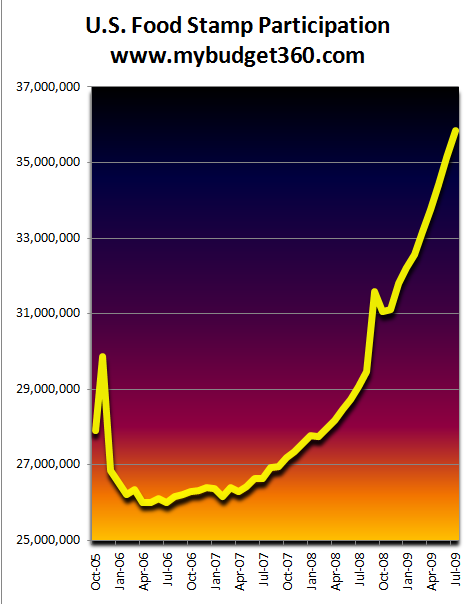
As the New York Times notes, "one in eight Americans and one in four children" receive food stamps.
Many economists and financial experts have said that we are in a depression. See this, this and this.
I hope they are wrong, or that - if we were in a depression - we're out of it now.
But it is indisputable that the unemployment numbers are still grim. Specifically:
- More people will be unemployed than during the Great Depression
- Some of the top economists say that America has suffered a permanent loss of jobs
- By some measures, unemployment is worse than it was during a comparable time-frame in the Great Depression
- Vice President Biden said recently: "It's a depression for millions of Americans"
Given the above, Stacy Herbert's question of today is compelling:
The food stamps story seems to be one that keeps popping up; I guess food stamps are the soup lines of this Great Depression?
Note: At least some economists say that food stamps give more bang for the buck in stimulating the economy than just about anything else. And see this. But economic, political and moral questions surrounding food stamps are beyond the scope of this essay.


 Posts



