
Tuesday, April 6, 2010
No, There Are NOT More Earthquakes Than Normal
It seems like there are more big earthquakes than ever before.
Some people are calling foul play. For example, some point to the fact that former secretary of defense William Cohen told a conference on terrorism on April 28, 1997 that people can:
Alter the climate, set off earthquakes, volcanoes remotely through the use of electromagnetic waves.
Secretary Cohen might be right. Does that mean that hostile governments or terrorists are using electromagnetic weapons to cause earthquakes?
Others claim that climate change or an approaching celestial event having to do with the year 2012 are causing the earthquakes. Are they right?
Well, the United States Geological Survey explains that - contrary to appearances - we really don't have more earthquakes than normal:
Although it may seem that we are having more earthquakes, earthquakes of magnitude 7.0 or greater have remained fairly constant throughout this century and, according to our records, have actually seemed to decrease in recent years.
There are several reasons for the perception that the number of earthquakes, in general, and particularly destructive earthquakes is increasing.
1) A partial explanation may lie in the fact that in the last twenty years, we have definitely had an increase in the number of earthquakes we have been able to locate each year. This is because of the tremendous increase in the number of seismograph stations in the world and the many improvements in global communications.
***
2) The population at risk is increasing. While the number of large earthquakes is fairly constant, population density in earthquake-prone areas is constantly increasing. In some countries, the new construction that comes with population growth has better earthquake resistance; but in many it does not. So we are now seeing increasing casualties from the same sized earthquakes.
3) Better global communication. Just a few decades ago, if several hundred people were killed by an earthquake in Indonesia or eastern China, for example, the media in the rest of the world would not know about it until several days, to weeks, later, long after such an event would be deemed “newsworthy”. So by the time this information was available, it would probably be relegated to the back pages of the newspaper, if at all. And the public Internet didn't even exist. We are now getting this information almost immediately.
4) Earthquake clustering and human psychology. While the average number of large earthquakes per year is fairly constant, earthquakes occur in clusters. This is predicted by various statistical models, and does not imply that earthquakes that are distant in location, but close in time, are causally related. But when such clusters occur, especially when they are widely reported in the media, they are noticed. However, during the equally anomalous periods during which no destructive earthquakes occur, no one deems this as remarkable.
The USGS provides the following charts on large earthquakes:


Note that many people have seen strange lights in the sky prior to or during recent earthquakes.
However, strange lighting phenomenon has been observed in connection with earthquakes throughout history.
For example, "immense columns of flame" were reported by Greek writings prior to the giant earthquake in 373 BC in which destroyed the cities of Helike and Bura.
And the New England Earthquake of 1727 was preceded by strange lighting phenomena:
People that were awake when the earthquake came said that a flash of light preceded it. It was seen as it passed the windows, and a blaze seemed to run along the ground, dogs that saw it giving a sudden bark as if frightened. Before they had time to consider the source or cause of the light a sound like a gentle murmur floated to them on the still evening air, followed by a slight ruffling wind. Then came a rumbling as of distant thunder, which approached nearer and nearer and grew louder and louder till it sounded as if innumerable heavy carriages were being rapidly driven over pavements, or like the roaring of a great furnace, but incomparably fiercer and more terrible, having a hollow sound as if it came from under the earth. Then the shock came suddenly and severely and the houses were felt to totter and reel with the trembling and heaving of the ground.See this and this.
There are numerous theories about the cause of "earthquake lights", including:
- Sparks or gas ionisation due to a piezoelectric effect in quartz-bearing rock
- Frictional heating
- Exoelectron emissions
- Sonoluminescence
- Triboluminescence
- Generation and ignition of flammable gases either from pockets of natural gas or from rocks under enormous stress.
- Gas ionisation or electrical effects due to electrokinetics
- Separation of positive hole charge carriers that turn rocks momentarily into p-type semiconductors


Long-Term Unemployment at Post-WWII High
As Barry Ritholtz pointed out Friday:
Long-term unemployed (jobless for 27 weeks+) increased by 414,000 to 6.5 million.Yesterday, the Pew Charitable Trusts released a report noting that long-term unemployment is the worst it has been since the end of World War II. As summarized by Shahien Nasiripour:
More than three million Americans have been out of work for at least a year, according to a new analysis of unemployment data.
That represents 23 percent of the roughly 14.8 million Americans out of work and looking for a job -- a post-World War II high. For those 3.4 million Americans, the consequences from such a long time out of work -- a cost of the Great Recession -- can be calamitous.
"[T]he likelihood of finding a job declines as the length of unemployment increases," notes the team led by Ingrid Schroeder, director of the Pew Fiscal Analysis Initiative, a program of the Pew Economic Policy Group and the Pew Charitable Trusts. "People who are unemployed for a long time can lose their job skills. A long unemployment spell can mark them as undesirable, making it more difficult to compete against other job candidates. [Federal] data suggests that workers who are jobless for the longest duration incur the largest reductions in weekly earnings upon returning to work."
The situation will not improve until the underlying causes are addressed.
Hindu “Holy Man ... Exposed for Running a Huge Call Girl Racket with Over a 1,000 Girls That Serviced ... Politicians and Influential People"
The Global Post notes:
In recent weeks, in New Delhi a holy man called Swami Bhimanand Ji Maharaj Chitrakootwale was exposed for running a huge call girl racket with over a 1,000 girls that serviced, among others, politicians and influential people.
In Bangalore, Swami Nithyananda -- whose ashram had several branches in the United States and all over the world -- was caught on camera having sex with an actor. Even as his shell-shocked devotees called for action, Nithyananda first said he was being framed by a digitally altered video. When a second tape with yet another actor surfaced, he admitted to the incident and fled the ashram with police hot on his tail.
Other swamis have been charged with cheating, rape and child sexual abuse. The wave of scandals involving holy men had one leading newspaper headlining, "baba black sheep, have you any scruples?"
The Mormon and other churches (and this) have also been hit with sex scandals.
Monday, April 5, 2010
Rental Prices: Up Or Down?
Preface: Rental prices are important not only for renters and apartment owners, homeowners and the building industry, but also because they greatly influence the consumer price index (see this and this). As the Federal Reserve Bank of San Francisco noted today:
Part of the drop in measured core inflation is undoubtedly due to the deceleration in the price of housing. The declines in housing inflation have been more profound than in core inflation. The 12-month percentage change in rents and owners’ equivalent rents has come down from 4.5% in February 2007, at the height of the housing bubble, to 0.3% in February 2010. This decline in the rate of housing price increases reflects reduced upward pressure on rents, which in turn is due to historically high vacancy rates for rental properties. Because house price inflation is now below core inflation, it drags down the overall level of core inflation.
There are many factors which affect rental prices, including: (1) the general health of the economy; (2) demographics; (3) housing strength; (4) population growth; (5) migration patterns; and (6) wealth distribution.
The General Health of the Economy
The relation between housing sales and rentals cannot be examined in a vacuum. The general health of the economy is important as well.
For example, as the Newark Law Review notes:
During the depression years, there was a widespread tendency among tenants to seek reduction of the previously established rental for the premises they occupied, basing their pleas on a general shrinkage of incomes. Many of these requests were complied with, landlords realizing that rentals stipulated in boom days before the crash were far above the price for which other premises were available.This is not just of historical interest, given that many financial experts think this could be worse than the Great Depression. And see this.
In addition, banks still are not lending to most individuals (indeed, the Fed is intentionally tying up excess reserves so they won't be circulated in the economy). So for now, the credit crunch is still playing a role.
The effects of a credit shortage are complicated.
As USA Today noted in 2008:
Another writer listed other potential effects of a credit shortage:Several factors are driving up demand for rentals:
***
•Renters are finding it harder to buy. Many renters can't qualify for an affordable mortgage because of stricter lending rules that call for larger down payments and excellent credit. The days of getting a home with no money down or with other unconventional loan structures are gone.
Lenders have turned more cautious for good reason: Foreclosures are up, and each of them costs lenders an estimated $50,000, on average, in processing fees, liquidation-sale price cuts and other costs, according to the Center for Responsible Lending.
"We've seen demand for rental housing go up," says Mark Obrinsky, chief economist at the National Multi Housing Council. "The ownership side is retrenching, and we're seeing the demand going to the rental side. There's a lot of hesitancy to buy. Others can't get (financing), so they're remaining renters longer."
People who can't sell their home may try to rent it out. (Pushes rental prices down.) [and] People who buy cheap homes for investment purposes may rent them out until the market recovers. (Pushes rental prices down.)On the other hand, if the economy improves more quickly than most imagine, rental prices might be pushed up along with everything else.
Demographics
The American population is rapidly aging.
As I wrote in October:
Seniors have less income from wages, but have had longer to save money and invest. However, a report by the Center for Economic and Policy Research shows that most baby boomers have accumulated little to no wealth.As I have previously noted, Japan's population is rapidly aging, and the U.S. age pyramid - while not as bad - is not nearly as young as that of Brazil or India's:
The chief economist for Standard and Poor's is now confirming the importance of national demographics:Which countries have the best demographics?
Let's start by looking at the "age pyramid" for the United States. The following 2 charts from the National Institutes of Health shows that the population is aging:
This graphic (courtesy of Ed Stephan) shows the U.S. age pyramid from from 1950 through 2050:
male female 
Population of the United States, by Age and Sex,
1950-2050 (millions)
information source: International Data Base, U.S. Census Bureau;
supplied pyramids were modified using Canvas, GraphicConverter and GIFBuilder.[If you can't see the dates at the bottom of the pyramid, click here].
As NIH notes:
The first of the postwar baby boom cohort, born 1946–1964, will turn 55 years in 2001. In just three decades, an extraordinary change in the age structure of the United States is anticipated. By 2030, one in five persons (20% of the U.S. population) will be aged 65 or older, increasing from the present ratio of one in nine persons (12.8%). The number of persons in the 65 and older age group will more than double, increasing from the current 34 million persons to 70 million persons. Moreover, within the older segment of the population, because of longer life expectancy and additional persons reaching older ages, there will be age shifts resulting in the 85 and older population more than doubling in size from 4.3 million persons to approximately 8.9 million persons.An aging U.S. population means less productive workers, less big-spending consumers, and more dependent elders...
Brazil has a much younger age demographic.
And India's is even younger than Brazil's.
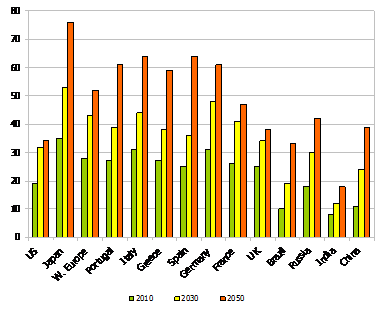
The following chart shows that Japan has the worst demographics of all, with a staggering percentage of elderly who need to be taken care of by the young:
Chart 2: Old Age Dependency Ratios for Selected Countries
Source: http://data.un.org/
In other words, America's age demographics aren't as bad as Japan's, but they aren't helping, either.But I don't think [a lost decade in the U.S. is] as likely over here. For one thing, one of the problems in Japan was the demographics. And we don't have the problem of a declining population to deal with, although the labor force is going to slow down considerably as soon as the baby boomers retire.


No wonder:
David Rosenberg from Gluskins Sheff expects Americans to retrench ferociously as 78m baby boomers face the looming threat of penury in old age.In addition, pensions are getting killed, and because the states are already experiencing massive budget deficits that cannot cover education and other expenses, something has to give. I am not convinced that pensioners are going to get paid 100% of what they were promised. Same with social security benefits.
Does that mean people will receive drastically reduced benefits compared to what they were promised, that taxes will skyrocket, or both? Any way you look at it, the American population is quickly greying, and a high percentage of seniors won't have much to spend on housing.
As the above-quoted Forbes article states:
Pittsburgh has the country's cheapest metropolitan area rental units. Lessees there pay a median monthly rent of $608, less than half of San Jose's.
This is partly because Pittsburgh has struggled to rebuild its economic base after the loss of its steel industry, and residents are aging or leaving the city.
"The bottom line is that Pittsburgh is undergoing a sea shift in its economic base," says Susan Wachter, a real estate professor at the University of Pennsylvania's Wharton School. "Rents are relatively low because it's in a state which is losing population, and it is simply not doing well."
One final factor: long-term care facilities for seniors are growing like gangbusters:
Assisted living facilities are a relatively new housing phenomenon. Although they were extremely rare even ten or fifteen years ago, they've become the fastest-growing and most popular elderly residential product type. Although actual numbers are sketchy, an estimated one million seniors currently reside in approximately 40,000 assisted living facilities, as compared with only 600,000 who did so only ten years ago, when there were about one-quarter of these projects nationwide. And looking ahead, experts estimate that by the year 2020, 14 million of us will require this kind of housing, double the number who do so today.Such facilities will soak up some of the housing demand for the elderly, which also argues for lower rental prices.
Housing Troubles
Falling home prices are generally correlated with rising rental prices. As Forbes noted in 2008:
Sinking house prices often send rents soaring ...Moreover, when there are a lot of foreclosures in a given area, a lot of people are evicted from their homes, and must scramble to find rentals. This usually leads to higher rental prices, as surging demand chases a fixed supply.
As the above-quoted USA Today pointed out:
The most brutal real estate slump in decades is reverberating through the rental market. Renters in properties that are being foreclosed on are being evicted. Homeowners forced into foreclosure are becoming tenants again and driving up rents. And renters not yet ready to buy a home — shut out by stricter lending rules or hoping to buy after prices fall still further — are creating a dynamic shift: Even as real estate is sputtering, the rental market is surging.On the other hand, as CNN noted in 2008 that foreclosures may make more rental properties available, thus tending to reduce rental prices:
So how is housing going to do?"The major factors having an impact on housing prices are foreclosures, which make more rental property available," said Owen Johnson, president of Investment Instruments, "and also foreclosures that are not happening."
In the latter case, according to Johnson, many speculators bought properties to "flip," selling them quickly in a rapidly appreciating market. In some Sun-Belt areas, investors bought condos and other properties while they were still in development, to sell when a project finished.
Other investors bought existing single-family homes or other properties, intending to do cosmetic improvements and then sell them at a profit. But before they could do that, the slump hit, and home values dropped. Instead of selling at a loss, investors of all stripes are now renting them out.
Well, as the Washington Post noted last week, things aren't all rosy:
Indeed, the S&P Case Shiller Futures Index forecasts that housing won't bottom until May 2011:The [Case-Shiller] report is "mixed," David M. Blitzer, chairman of the index committee at Standard & Poor's, said in a statement. The "rebound in housing prices seen last fall is fading." And given the data, he said, "we can't say we're out of the woods yet."
Housing analysts are worried that an expected increase in foreclosures hitting the market could put pressure on prices this year. Also, a Federal Reserve program that has kept interest rates low ends Wednesday. If mortgage rates rise later this year as expected, some potential buyers might stay on the sidelines.
Home sales have been weak since a tax credit for first-time home buyers was initially scheduled to expire in November. Existing-home sales have fallen 23 percent since then, for example. Congress extended the tax credit, giving buyers until April 30 to sign a contract for a home, and expanded it to more buyers. But "the second credit, up to now, is having minimal effects," said Patrick Newport, an economist with IHS Global Insight.
Many buyers at the tipping point of making a home purchase probably took advantage of the tax credit the first time, Dye said. "That group now has been used up. I would expect to see a smaller marginal effect from the tax credit going forward," he said.
Even if home prices rise during the spring buying season, they are likely to fall again during the second half of the year, analysts said. IHS Global Insight is expecting prices to fall another 5 percent this year. "There is some turbulence out there that I am concerned about," Dye said.

Specifically, the Case Shiller Futures Index assumes that housing prices will remain strong for the first half of the year - while various Fed programs are still in effect - and then fall sharply until they hit bottom in spring 2011.
And - contrary to what many assume - the foreclosure crisis is far from over.As I wrote in September:
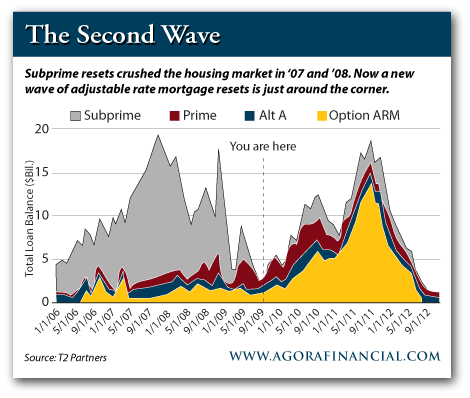
And see this article from Time, this chart from Credit Suisse:The foreclosure problem in American is not just subprime mortgages. True, banks have been holding on to their foreclosed properties for months, but now they're getting ready to release them onto the market, which could depress prices for existing homeowners, further driving them underwater. But that's not what I'm talking about.
There are huge tidal waves of defaults on option arm, alt-a, and other types of loans coming (see this and this).
But even that is arguably not the main problem.
Perhaps the biggest problem is that the crash in real estate and rising unemployment together form a positive feedback loop. As McClatchy and the Associated Press note, foreclosures rise as jobs and income drop.
As former chief IMF economist Simon Johnson points out, there is a vicious cycle also exists between unemployment and property foreclosures:Unemployment is always a lagging indicator, and given the record low number of average hours worked, it will turn around especially slowly this time. Until then, people will continue to lose their jobs and wages will remain flat, and any small rebound in housing prices is unlikely to help more than a few people refinance their way out of unaffordable mortgages. So unless the other part of the equation – monthly payments – changes, the number of foreclosures should just continue to rise.Indeed, the Washington Post notes:
The country's growing unemployment is overtaking subprime mortgages as the main driver of foreclosures, according to bankers and economists, threatening to send even higher the number of borrowers who will lose their homes and making the foreclosure crisis far more complicated to unwind.And see this.
Some economists give 5% as the magic number: when unemployment declines to 5%, then unemployment will no longer be such a huge contributor to foreclosures.
But Moody's forecasts that unemployment will not go back down to 5% until 2014.
Indeed, unemployment could be a problem for many years to come.
Similarly, the the chief economist for the U.S. Chamber of Commerce - Martin Regalia - "thinks that it could be five years before the U.S. economy generates enough jobs to overcome those lost and to employ the new workers entering the labor force", according to McClatchy.

Indeed, as David Rosenberg writes:
There were over 158,000 bankruptcy filings in the personal sector in the U.S. [in March] (that’s 6,900 per day!) which was a 35% surge over February’s result and up 19% from last year’s elevated levels. This also shows the extent to which fewer people are attempting to save their homes. They realized that their mortgage payments are not affordable and their attitudes towards residential real estate as a viable retirement asset have been altered permanently as many now see their house as nothing more than a debt-laden ball and chain.(Rosenberg also points out that while skyrocketing unemployment might be slowing, wage deflation is just beginning).
Finally, Calculated Risk writes today:
On The Other Hand ...From Diana Olick at CNBC: Let the Short Sales Begin
I'm ... starting to hear rumblings among the number crunchers that the wave of foreclosures we keep hearing about is about to hit with a thunderous roar.I don't know about a "thunderous roar", but I do think we will see more distressed sales soon. Most trustee sales seem to be "postponed" each month, and perhaps the lenders were just waiting for the HAFA short sales program to begin. That program started today ...
Servicers are ramping up the mod process and pushing those who don't qualify out the door more quickly than ever.
In really bad times, people who are evicted from their houses will not rent. Instead, they will move in with friends or family for some time.
As the Wall Street Journal explained last October:
Driving the change [i.e. large numbers of rental vacancies and lower rents] is the troubled employment market, which is closely tied to rentals. With unemployment at 9.8% -- a 26-year high -- more would-be renters are doubling up or moving in with family and friends during periods of job loss. Landlords have been particularly battered because unemployment has been higher among workers under 35 years old, who are more likely to rent. Nationally, effective rents have fallen by 2.7% over the past year, to around $972.
As Zack's Investment Research writes:
A smaller percentage of Americans owned their own homes in the 4th quarter of 2009 than at any time since 2000. In the 4th quarter 67.2% of Americans owned their own home, down from 67.6% in the third quarter and two full percentage points below the peak set in the fourth quarter of 2004.
As the first graph below shows (from Calculated Risk) ...:

So where have all these people gone who are no longer homeowners? It does not appear that they are moving into apartments or rental housing. As the second graph shows (also from Calculated Risk), the rental vacancy rate is now at 10.7%. While that is down from the record level of 11.1% in the third quarter, it is up from 10.1% a year ago, and the 7-8% range that was normal for most of the 1990s ...

In other words, the correlation between falling home prices and rising defaults, on the one hand, with increasing rental demand and higher rental prices, on the other hand, doesn't hold in a really tough economy.***
It thus appears that many of the people who used to own their homes, and no longer do, are doubling up with friends and family. This is probably not their first choice of living arrangements, but they are doing so because they have no other choice economically.
American Population Growth is Slowing
The U.S. Census Bureau notes:
The U.S. population growth rate is slowing.
Despite these large increases in the number of persons in the population, the rate of population growth, referred to as the average annual percent change,1 is projected to decrease during the next six decades by about 50 percent, from 1.10 between 1990 and 1995 to 0.54 between 2040 and 2050. The decrease in the rate of growth is predominantly due to the aging of the population and, consequently, a dramatic increase in the number of deaths. From 2030 to 2050, the United States would grow more slowly than ever before in its history.
A lower population growth rate would tend to argue for lower rental prices, since it means less new residents looking for housing.
Indeed there is somewhat of a "reverse migration" occurring. For example, last year there were many stories of immigrants returning to their native countries. Of course, if the American economy substantially strengthens, this trend will stop.
"Dust Bowl in Reverse"
A "dust bowl in reverse" has also occurred, where people are moving out of the West and back to the mid-West.
As California state senator George Runner pointed out last year:
Indeed, a lot of people are moving to places like Oklahoma. As Michael Roston writes:A recent Sacramento Bee article cites a reverse migration to the Mid-west. This marks a stunning reversal of the historical trend of migration into California - especially during the Dust Bowl that sent hundreds of thousands of Midwesterners west toward the Golden State.
During the Dust Bowl, people left states like Texas, Arkansas, and Oklahoma because a drought left the once fertile soil barren and bone-dry. The livelihoods of the farmers shriveled with the crops, and families found themselves in destitution. They sought the greener pastures of California. But where the Dust Bowl of the Great Depression sent a massive migration of Midwesterners to California, the current economic hardship is now driving residents back to the Midwest.
In fact, between 2004 and 2007, California lost 275,000 residents to the former Dust Bowl states that were once responsible for the state’s huge population growth. While California was once seen as the place of hope for a better life, Californians are now looking elsewhere for opportunity...
The Tulsa World noted in December:The state added 43,025 residents from July 2008 to July 2009, the largest annual increase this decade.
The annual increase also reverses the one-year dip when the population failed to increase more than it did the previous year.
Overall, the Census Bureau estimates the Oklahoma population was 3,687,050 in July 2009 compared to 3,644,025 in July 2008. The annual population increase was 39,780 in 2007 and 34,238 in 2008.
Most of the overall population increase was fueled by persons moving to Oklahoma from other states, defined as domestic migration.
Domestic migration accounted for 18,345 new residents to the state with international migrants accounting for 5,340 additional people.
It’s not quite gangbusters, but it shows that the state known more for the Dust Bowl than for economic opportunity has turned itself around in a lot of ways. The Oklahoman’s crack Database Editor Paul Monies put together some visualizations of the differences in population between the Oklahoma of the Great Depression and the the Oklahoma of the Great Recession. His newspaper went on some months later to reflect triumphantly in an editorial:
Time was when Oklahomans fled to California in great numbers, so much so that the Golden State tried to put a stop to it. Now Californians are moving east; some of them are landing in Oklahoma. Cox says that in every year during the 2000s, Oklahoma gained net domestic migrants from California.
The South has also been hit hard. As the Wall Street Journal noted last month:
The recession has halted the dominant migration trend of recent decades, turning once-hot destinations such as Las Vegas and Orlando, Fla., into some of the country's losers.On the other hand, the Journal notes:
***
The reversal of migration in former housing-boom cities could aggravate their real-estate downturns. A separate report released by the National Association of Realtors on Tuesday showed that February real-estate sales and prices were hit harder in the West and South—areas that have seen big reductions in migration.
The shifts represent a radical departure from the migration patterns that had made cities such as Las Vegas and Orlando some of the country's fastest-growing. For decades, people have been leaving colder Northeastern and Midwestern states, either to retire or to chase better weather and jobs in the South and West.
"It's unprecedented to see areas like Las Vegas and Orlando, just blue-chip destinations for anybody who wanted to move, to stop and stay stopped over a couple of years," said William Frey, a demographer with the Brookings Institution, a Washington think tank.
In many cases, cities in the Midwest and Northeast are gaining because residents are locked in place. With depressed home prices and a dearth of out-of-state job offers preventing departures, even a modest number of people moving in can drive gains. The Boston area, for example, swung to an inflow of about 6,800 in 2008-2009 from an outflow of about 46,000 in 2004-2005. The Chicago area's outflow narrowed to about 40,400 from about 77,400.The most-recent official U.S. Census Bureau population growth rates for different states - between July 1, 2008 to July 1, 2009, and for earlier periods - are available here, and here is a summary.
This factor weighs in favor of higher rental prices in the Midwest and Northeast, and lower rental prices in the West and South.
Back to the Country?
For hundreds of years, people have migrated from rural areas to the cities in search of better employment.
Will this change?
Sean Riskowitz argues that it already has:
Data released by the U.S. Census Bureau reveals a reverse urban migration trend in the country.Again, even if Riskowitz's interpretation of the data is correct, such a trend might be reversed if the economy strengthens.
This interactive graph paints the picture.
The recession has played a big role in determining migration trends in the U.S., with most people either staying where they are or returning to where they came from, particularly in big cities. The New York area lost a net 100,000 people in 2009, (down from 220,000 in 2007) while Los Angeles lost a net 80,000 (down from a massive 222,000 in 2007). Chicago lost a net 40,000 residents which is in line with the 52,000 the recession sent packing in 2007. This runs contrary to historical data which shows a net migration of people to big cities, rather than away from them.
Reverse urban migration will decrease the supply of labor and consumers in the cities which could result in lower prices in terms of real estate and consumer goods, not to mention services such as restaurants.
But there may also be longer-term trends arguing for counter-urbanization.
Oxford University's Geography Dictionary defines counter-urbanization, and gives some good arguments for it:
The movement of population and economic activity away from urban areas. The push factors include: high land values, restricted sites for all types of development, high local taxes, congestion, and pollution. The pull factors offered by small towns are just the reverse: cheap, available land, clean, quiet surroundings, and high amenity. Improvements in transport and communications have also lessened the attractiveness of urban centres, and commuters are often willing to trade off increased travel times for improved amenity. Furthermore, with the ageing of populations in the West, many no longer need to travel to work.Some argue that technology will encourage counter-urbanization. However, Bill Gates has famously said:
In advanced economies, there have been swings in the directions of net migration between metropolitan and non-metropolitan areas, although the timing of these shifts varies spatially. The USA, for example, saw counter-urbanization the 1970s, and concentration in the 1980s, followed by further deconcentration in the 1990s (Lewis, Geography 85). The migration balance will also be affected by government policy which suggests that 60% of new housing should be on brownfield sites, and 40% on greenfield (Department of the Environment 1996 Household Growth).
I thought digital technology would eventually reverse urbanization, and so far that hasn't happened. But people always overestimate how much will change in the next three years, and they underestimate how much will change over the next 10 years.If the U.S. economy really tanks to the point that distribution systems are disrupted, then people may either move out in the country (to grow their own food and locate their own water) or into the middle of the big cities (where they can get by without gas, and pool resources with others).
Obviously, if it occurs, counter-urbanization would lead to a decrease in demand for urban rentals. But it is too early to know how these trends will play out.
Wealth Distribution
The polarization of America's wealth distribution is more extreme than it is has been for many decades. In other words, not only have the rich gotten richer and the poor gotten poorer, but much of the middle class has disappeared.
So most people have less to spend on housing. The wealthy are likely going to buy, not rent, so they shouldn't play a part in the analysis.
That may argue for low-income and modest rentals doing well as most people become more frugal.
Obviously, many other factors influence how desirable a given locale is.
Silicon valley rental prices boomed during the dot com era. Washington D.C. is currently booming, due to the increased government involvement in the economy. As the Wall Street Journal writes:
Some cities accustomed to losing people are showing net gains. The government's growing role in the economy has benefited the Washington, D.C., area, which drew 18,200 residents from other states, its first net gain since 2002.
If the "next big thing" is centralized in one or a few areas, then rental prices could skyrocket in those areas.
Forbes points out that areas with a high number of apartment-to-condo conversions have higher rental prices:
And factors such as the amount of crime, how good the schools are and percentage of public housing will always affect rental prices.Signing a lease is also costly in some Florida areas. Miami and Orlando fetched monthly rents of $1,031 and $981 respectively.
The race to build condos is partly to blame, says Sean Snaith, director of the Institute for Economic Competitiveness at the University of Central Florida.
"Miami and Orlando were two pretty hot areas when the housing market was raging for conversion of apartment stock into condominiums," he says of the mid-decade housing boom. "So that reduced supply."
Rental experts note that small changes can affect rents:
Where To From Here?There are unique dynamics to the rental market, according to Johnson. Rents rise and fall independently of home prices. And there's often a push-pull to rental amounts: They're pushed up when foreclosures put homeowners back in the rental market but pulled back because the supply of rentals increases.
And, while national figures tend not to be too volatile, local markets can record large swings, as they did in 2007, when four of the 10 markets covered recorded double digit gains or losses.
Sometimes small events can leverage large changes, according to Johnson. "If MIT opens a new dormitory, for example, it can decrease rents substantially all over the Boston area," he said.
Pulling just a few hundred students out of the rental market in Cambridge (where the Massachusetts Institute of Technology is located) cascades down across many neighborhoods. Suddenly, there are a lot of empty apartments in the area, and renters from other places move in, increasing inventory in their old neighborhoods.
The Wall Street Journal writes:
Calculated Risk comments on the Wall Street Journal story, noting:Apartment rents rose during the first quarter, ending five straight quarters of declines and signaling the worst may be over for the hard-hit sector.
Nationally, the apartment vacancy rate stayed flat at 8%, the highest level since Reis Inc., a New York research firm, began its tally in 1980.
Reis tracks vacancies and rents in the top 79 U.S. markets, and rents rose in 60 of them, led by Miami, Seattle and New York—all cities that have notched big rental declines in the past year.
Rents increased 1.6% in the first quarter in Miami and 0.9% in New York. The gains came during what is usually a seasonally weak period for apartments and suggested that landlords may have some momentum heading into the peak spring and summer leasing season.
"Deterioration seems not to have just been arrested but reversed," said Victor Calanog, director of research for Reis. "Several markets have bottomed and may be on track to recovery," he said.
Nationally, effective rents, which include concessions such as one month of free rent, rose 0.3% during the quarter compared with a 0.7% decline in the fourth quarter of last year and a 1.1% drop in the first quarter of 2009. Vacancies are tied to unemployment, because many would-be renters move in with family members or double up during a downturn.
"We clearly hit an inflection point in all of our markets in January and February," said Jeffrey Friedman, chief executive of Associated Estates Realty Corp., which owns and operates 12,000 units in the eastern U.S.
Renters are also staying put longer: the average renter now stays for 19 months, up from an average of 14 months, said Mr. Friedman, and despite low mortgage rates and greater home affordability, fewer renters are leaving to buy homes.
"This is the first time in many, many years that it feels like even people who could afford to buy are making the investment decision not to," Mr. Friedman said.
Difficulty in obtaining financing for new apartment construction, meanwhile, has limited the supply of new units that will be added in the coming years. Those fundamentals have landlords and investors excited about the potential for rents to pop once the economy gathers steam.
Still, Mr. Calanog said that a "slow recovery" was likely and that landlords shouldn't expect "galloping rental growth" until the job market firms up, particularly because younger workers that are more likely to rent have borne the brunt of job losses.
Others warned that gains were fragile and that landlords could continue to offer concessions to fill units.
"Rent reductions are not over yet," said Hessam Nadji, managing director at real-estate firm Marcus & Millichap. He said he didn't expect to see sustained rental growth until the second half of the year.
Barely half of the 22,000 units in buildings that opened their doors last quarter were filled, and landlords may cut deals because they face deadlines to pay back construction loans. "That's where renters are going to find deals," Mr. Calanog said.
The Reis numbers are for cities. The overall vacancy rate from the Census Bureau was at a near record 10.7% in Q4 2009.
Rents plunged in 2009 by the most in the 30 years Reis has been tracking rents - and with vacancies at record levels, the slight increase in Q1 2010 rents doesn't mean the rent declines are over.But why were there so many vacancies in the first place?
As discussed above, unemployment is causing people to double-up with others. And as the Wall Street Journal explained last October, there was overbuilding in some of the prime markets:
The housing bust has also flooded some of the most overbuilt housing markets with new apartment inventory as developers have converted unsold condominium developments into rentals.
Proof that Regulators Knew of and Allowed Debt-Hiding Accounting Tricks Like Lehman's Repo 105
Regulators like the Fed and SEC have said they didn't know about Lehman's use of Repo 105s to hide its mountain of debt.
But in a must-read New York Times Op-Ed, law school professors Susan P. Koniak, George M. Cohen, David A. Dana, and Thomas Ross point out:
Our bank regulators were not, as they would like us to believe, outside the disco, deaf and blind to the revelry going on within. They were bouncing to the same beat. In 2006, the agencies jointly published something called the “Interagency Statement on Sound Practices Concerning Elevated Risk Complex Structured Finance Activities.” It became official policy the following year.
What are “complex structured finance” transactions? As defined by the regulators, these include deals that “lack economic or business purpose” and are “designed or used primarily for questionable accounting, regulatory or tax objectives, particularly when the transactions are executed at year end or at the end of a reporting period.”
How does one propose “sound practices” for practices that are inherently unsound? Yet that is what our regulatory guardians did. The statement is powerful evidence of the permissive approach bank regulators took toward the debt-dissolving financial products that our banks had been developing, hawking and using themselves for years. And it’s good reason for Americans to be outraged by the “who me, what, where?” reaction of Mr. Bernanke and the S.E.C. to the revelation of Lehman’s Repo 105 scam.
***
The interagency statement on “sound practices” of 2006 ... was greeted with effusive praise from bankers, their lawyers and accountants. Gone was the requirement [proposed by the law professors and others] to ensure that customers understood these instruments and that the banks document that they would not be used to phony-up a company’s books.
The focus on complexity was also gone, as was the concern over transactions “with significant leverage” — that is, deals with little real cash underneath, another unfortunate deletion because attending to excessive leverage would have served us well.
Instead, the only products that the banks were asked to handle with special care were so narrowly defined and so obviously fraudulent that suggesting that they could be sold at all was outrageous. These included “circular transfers of risk ... that lack economic substance” and transactions that “involve oral or undocumented agreements that ... would have a material impact on regulatory, tax or accounting treatment.” [and these weren't banned, but apparently only required special disclosures by the banks]
Just as troubling, at least in retrospect, the new statement specifically exempted C.D.O.’s from the need for any special care ..
Only two years later, these same regulators were explaining that the complexity and opaqueness of instruments like C.D.O.’s had contributed significantly to the economic collapse...
Moreover, the collapse was characterized by institutions supposedly healthy one day and on the verge of collapse the next, due in no small part to their extraordinary debt burdens — debt burdens that complex instruments magically removed from the books.
To this day, that final interagency statement (which was adopted in 2007) has not been repealed or replaced. It can still be found on the S.E.C. Web site, along with the letters from industry representatives praising the 2006 draft.
As the law professors point out, you can have all sorts of laws on the books, but if regulators aren't enforcing them, they are not worth the paper they are written on.
Sunday, April 4, 2010
Is There Any Law Requiring the Average American Citizen to Pay Income Tax?
I finally watched From Freedom to Fascism, made by the producer of movies such as Trading Places, Wise Guys, and The Rose.
The film includes interesting interviews with the former IRS Commissioner and chief IRS counsel, former IRS agents, and a juror on a tax evasion case.
I am interested in whether or not the claims made in the film regarding income tax are true. If you have expertise in income tax issues, please comment below.
I am also interested in whether Ron Paul's view on income tax is right. Paul says that there may not be a legal duty for salaried employees to pay income tax, but since the government has force on its side, we will probably still get in trouble if we don't pay our income tax.
What do you think?
Saturday, April 3, 2010
It's Not Just the Banks ... Defense and Pharmaceutical Giants Also Too Big
Everyone knows that the megabanks are considered too big to fail.
But its not just banks ...
There was AIG and the big auto makers.
And CNN noted yesterday that the government found pharmaceutical giant Pfizer "too big to nail".
And former high-level CIA officer Giraldi notes that the national security apparatus has grown too powerful to rein in:
Forget free market capitalism. Forget checks and balances.Giraldi believes that, as with companies such as AIG and GM becoming “too big to fail,” the size and success of this massive national security espionage scandal has simply become too big to bust...
Giraldi added, “The people in Congress and in the Justice Department who should be investigating this…and also in the media—because the media is tied hand and foot to government—this is all part of one big, you know, conspiracy, if you want to look at it this way. And, essentially, this is a story that they don’t want to get out.”
A handful of dinosaurs are using raw size and power to control everyone else.
Not Just the Catholic Church ... Mormon Church and Other Religious Institutions Have Also Covered Up For Pedophiles
Five minutes of research shows that the Mormon Church - like the Catholic Church - has covered up for its pedophiles.
For example, the Houston Chronicle wrote in 1999:
In 2001, the lawyer for a victim of sexual abuse stated:The church that is known for placing a spiritual premium on family values is under increasing attack for an alleged failure to protect its children from pedophiles.
Therein lies the irony of a barrage of lawsuits and general complaints alleging that - in an effort to protect its wholesome image - the Church of Jesus Christ of Latter-day Saints, commonly called the Mormon Church, has failed to root out child molesters in its midst.
The fast-growing institution, with 10 million members worldwide, is not the only church that has been plagued in recent years by embarrassing cases involving sexual abuse of children. But while Mormon officials maintain that they have eliminated most of the problems that may have once existed, lawsuits and criminal charges linking the church to pedophiles have continued to mount.
The Mormon Church covered up its knowledge of a High Priest's sexual molestation of young boys for more than a decade according to a Portland,Oregon lawsuit that the church paid $3,000,000.00 to settle. The charges were brought by one of the priest's victims, Jeremiah Scott. Today, Scott's mother made a statement describing the Mormon Church as a, "sanctuary for pedophiles...And an Associated Press story from Thursday notes that some Mormon church leaders may have covered up pedophile problems involving Boy Scouts leaders. And see this.
The church claimed throughout the litigation that it had a constitutional right to "wipe the slate clean" of any member who had "repented" for his abuse of children and had been forgiven by the church. "It is a policy that puts out the welcome mat for pedophiles like Franklin Curtis," Mrs. Scott commented...
Jeff Anderson of St. Paul, Minnesota, who is nationally recognized for his work representing victims of abuse by clergy and who joined Scott's legal team this year to prepare for the anticipated trial, described the Mormon Church's conduct as among the worst of any religious organization in the county...
Abuse is common among many other denominations as well. As Associated Baptist Press wrote in 2007:
Inappropriate behavior by clergy cuts across all denominational ties and theological positions, [Christian] ethicist Joe Trull said. But he says a case can be made that “nondenominational churches and Baptist churches who have autonomous church government are more vulnerable and susceptible” to instances of sexual abuse.Abuse is also common in the quasi-independent religious orders.
Note: I strongly believe in freedom of religion. This is in no way meant as an attack on the Mormon faith, only the decision by clergy to cover up for pedophiles.
Head of the CIA’s National Clandestine Service: No Loss of Intelligence Since We Stopped Waterboarding
Two stories this week prove once again that torture is unnecessary and counter-productive for obtaining intelligence.
First, according to the Washington Post, the CIA's top spy - Michael Sulick, head of the CIA’s National Clandestine Service - said :
The spy agency has seen no fall-off in intelligence since waterboarding was banned by the Obama administration. "I don’t think we’ve suffered at all from an intelligence standpoint."Second, after repeatedly torturing a supposed "senior Al Qaeda" leader and key player in 9/11, the government now admits that he had no knowledge or role in 9/11, and wasn't even affiliated with Al Qaeda.
Friday, April 2, 2010
U.S. Recants Claims that Detainee Who Was One of the Main Sources for the 9/11 Report, and Repeatedly Tortured, Was Involved in 9/11 or Even Al Qaeda
Abu Zubaydah was the first "high-value" detainee who was tortured, as the U.S. claimed he was a top Al Qaeda terrorist who knew a lot about 9/11.
He was waterboarded at least 83 times in August 2002 alone.
In fact, Abu Zubaydah was one of the main sources of information for the 9/11 report.
Never mind that he was literally crazy. As the New Yorker noted a year ago:
The F.B.I.’s point man on the Abu Zubaydah interrogation, Daniel Coleman, had read Zubaydah’s diaries and concluded that he “had a schizophrenic personality.”Indeed, the Washington Post noted in 2007:
Retired FBI agent Daniel Coleman, who led an examination of documents after Abu Zubaida's capture in early 2002 and worked on the case, said the CIA's harsh tactics cast doubt on the credibility of Abu Zubaida's information.
"I don't have confidence in anything he says, because once you go down that road, everything you say is tainted," Coleman said, referring to the harsh measures. "He was talking before they did that to him, but they didn't believe him. The problem is they didn't realize he didn't know all that much."
***
Abu Zubaida ... was a "safehouse keeper" with mental problems who claimed to know more about al-Qaeda and its inner workings than he really did.Pulitzer Prize winning journalist Ron Suskind writes that Coleman advised a top FBI official at the time:
***
Looking at other evidence, including a serious head injury that Abu Zubaida had suffered years earlier, Coleman and others at the FBI believed that he had severe mental problems that called his credibility into question. "They all knew he was crazy, and they knew he was always on the damn phone," Coleman said, referring to al-Qaeda operatives. "You think they're going to tell him anything?"
"This guy is insane, certifiable, split personality."
Now, Jason Leopold reports that the government is backing away from all claims that Abu Zubaydah had any role in Al Qaeda or 9/11:
For the first time, the government officially admitted that Zubaydah did not have "any direct role in or advance knowledge of the terrorist attacks of September 11, 2001," and was neither a "member" of al-Qaeda nor "formally" identified with the terrorist organization.
Heck of a job, guys.
Prominent Catholics Say Problem is Homosexuality, Not Pedophelia ... Does that Mean Molesting GIRLS Is Okay?
Some prominent Catholics have said that the problem is not pedophelia so much as homosexuality. Does that mean that molesting underage girls is okay?
And given that some forms of abuse by the clergy did not involve sexuality at all (and thus not homosexuality), does that mean that they are okay?
The Vatican has also said that the storm of criticism regarding sex abuse by priests is akin to anti-semitism. There is of course a big difference. Anti-semitism (which is wholly different from anti-Zionism or criticizing Israel) is a form of hatred based on someone's race - rather than that person's actions. In other words, it is hating someone based on something that the hated person can't do anything about.
In contrast, people are angry at the actions of the Catholic Church. Specifically, the Vatican has known of child abuse by priests and bishops for many decades, and yet has failed to defrock the abusive clergy and has covered it up.
Note 1: While the agent of consent in Vatican City is 12 years old, when there is a relationship of dependence (like teacher/student/ etc.) the age of consent is 15 years.
Note 2: I strongly believe in freedom of religion, and this is in no way meant as an attack on the Catholic faith, only on criminal activity and cover-ups. Indeed, tomorrow I will focus on other denominations.
What Do the New Unemployment Numbers Mean?
What do the new BLS numbers - 162,000 nonfarm payroll jobs added in March - mean?
Barry Ritholtz provides a very useful summary:
Let’s break down the highlights into the good and bad:
Negatives
• Average Hourly Earnings of all employees NFP fell by 2 cents, or 0.1%.
• Unemployment rate is unchanged at 9.7% (no improvement this month)
• U6 Unemployment, the broadest measure, rose to 16.9% –that’s off of the December 2009 peak of 17.3, but higher than January (16.5%) and February (16.8%) of 2010.
• Long-term unemployed (jobless for 27 weeks+) increased by 414,000 to 6.5 million. (bad)
• 44.1 percent of unemployed persons were jobless for 27 weeks +. (Also very bad)
• Involuntary part-time workers increased to 9.1 million in March. (This remains a stubborn problem area)Positives
• +162k is the best report since March, 2007.
• Average workweek was up by 0.1 hour to 34.0 hours in March.
• Temp help services added 40,000 jobs in March. That’s a cumulative add of 313k since September 2009.
• Census added “only” 48,000 workers — far below the 100-150k consensus. This pushes their hiring out into the rest of the year.
• Civilian Labor Force Participation Rate at 64.9% edged up in March
• Manufacturing continued to trend up (+17,000); Mfr added 45,000 jobs in Q1.
• Revisions: January 2010 data was revised upwards 40k (from-26k to +14k); February was revised up 22k (from -36k to -14k).
Stone-McCarthy points out that - if we subtract the temporary hiring of census workers, better weather and birth-death model adjustments - we're left with a net loss of 67,000 jobs.
Indeed, Goldman Sachs attributes the job gain as "due mainly if not entirely to census hiring and weather rebound", finds "little underlying improvement", and says that "productivity gains have diminished sharply".
Gallup puts underemployment at 20.3%:
Behind the rosy headlines, data from the Bureau of Labor Statistics also give a grim side of the employment picture.
***The underemployment rate -- which includes the part-timers and people who want work but have given up looking - - increased to 16.9% from 16.8%, based on government data, seasonally adjusted.
However, the latest Gallup Daily tracking finds that 20.3% of the U.S. workforce was underemployed in March-- a slight uptick from the relatively flat January and February numbers. Gallup employment data are not seasonally adjusted. (See chart)
Gallop concludes its findings as follows:As unemployed Americans find part-time, temporary, and seasonal work, the official unemployment rate could decline. However, this does not necessarily mean more Americans are working at their desired capacity. It will continue to be important to track underemployment -- to shed light on the true state of the U.S. workforce."

Mish gives a detailed analysis on the jobs report, concluding:
The official unemployment rate is 9.7%. However, if you start counting all the people that want a job but gave up, all the people with part-time jobs that want a full-time job, all the people who dropped off the unemployment rolls because their unemployment benefits ran out, etc., you get a closer picture of what the unemployment rate is. That number is in the last row labeled U-6.For background, see this.
It reflects how unemployment feels to the average Joe on the street. U-6 is 16.9%.
Looking ahead, there is no driver for jobs. Moreover, states are in forced cutback mode on account of shrinking revenues and unfunded pension obligations. Shrinking government jobs and benefits at the state and local level is a much needed adjustment. Those cutbacks will weigh on employment and consumer spending for quite some time.
Expect to see structurally high unemployment for years to come.
***
All things considered, this report looks OK on the surface, and horrendous underneath.
Hoening: The Claim that America Needs Megabanks to Compete Globally is Nothing But "A Fantasy"
Thomas Hoening - the longest-serving Federal Reserve policy maker, a voting member of the Fed's main policy-making body (the Federal Open Market Committee), and President of the Federal Reserve Bank of Kansas City - told Shahien Nasiripour that the claim that the U.S. needs megabanks to compete globally (as made by Jamie Dimon and others) is nothing but fantasy:
That is a fantasy -- I don't know how else to describe it. Our strengths will be from having a strong industrial economy. We will have financial institutions that are large enough to give us influence in the markets but not so large that they're too big to fail.
The outcome of that is that strong banks [and] strong economies bring capital to themselves, and they are by themselves competitive.
The United States became a financial center not because we had large institutions but because we had a strong industrial economy with a good working financial system across the United States -- not just highly-concentrated in one market area [i.e. Wall Street].
For background, see this and this.
Thursday, April 1, 2010
“We Are in a Cabal... Five or Six Players ... Own the Regulatory Apparatus. Everybody Is Afraid to Regulate Them"
Harold Bradley - who oversees almost $2 billion in assets as chief investment officer at the Kauffman Foundation - told the Reuters Global Exchanges and Trading Summit in New York that a cabal is preventing swap derivatives from being forced onto clearing exchanges:
There is no incentive from the moneyed interests in either Washington or New York to change it... I believe we are in a cabal. There are five or six players only who are engaged and dominant in this marketplace and apparently they own the regulatory apparatus. Everybody is afraid to regulate them. Indeed, as I wrote last May:
And see this.
In at least one area - one of the most important causes of the financial crisis - reform has already been defeated.
By way of background, the derivatives industry has volunteered (once again) to regulate itself.
As Newsweek noted April 10th, the big boys were using bailout money to aggressively lobby against the regulation of credit default swaps:
Major Wall Street players are digging in against fundamental changes. And while it clearly wants to install serious supervision, the Obama administration—along with other key authorities like the New York Fed—appears willing to stand back while Wall Street resurrects much of the ultracomplex global trading system that helped lead to the worst financial collapse since the Depression.At issue is whether trading in credit default swaps and other derivatives—and the giant, too-big-to-fail firms that traded them—will be allowed to dominate the financial landscape again once the crisis passes. As things look now, that is likely to happen. And the firms may soon be recapitalized and have a lot more sway in Washington—all of it courtesy of their supporters in the Obama administration...
The financial industry isn't leaving anything to chance, however. One sign of a newly assertive Wall Street emerged recently when a bevy of bailed-out firms, including Citigroup, JPMorgan and Goldman Sachs, formed a new lobby calling itself the Coalition for Business Finance Reform. Its goal: to stand against heavy regulation of "over-the-counter" derivatives, in other words customized contracts that are traded off an exchange...
Geithner's new rules would allow the over-the-counter market to boom again, orchestrated by global giants that will continue to be "too big to fail" (they may have to be rescued again someday, in other words). And most of it will still occur largely out of sight of regulated exchanges...
The old culture is reasserting itself with a vengeance. All of which runs up against the advice now being dispensed by many of the experts who were most prescient about the crash and its causes—the outsiders, in other words, as opposed to the insiders who are still running the show.
And today, Treasury gave the financial giants exactly what they wanted. As Bloomberg writes in an article entitled "Wall Street Derivatives Proposals Adopted in Treasury Overhaul ":
Wall Street’s largest banks are getting what they want in the U.S. Treasury’s plan to regulate over-the-counter derivatives by making all market participants adhere to the same capital requirements...
“The banks appear to wish to maintain the intra-dealer market and raise barriers to new entrants to keep the OTC business as compartmentalized as possible and to protect their profitable market conditions,” said Brad Hintz, an analyst at Sanford C. Bernstein & Co. in New York. “The Street’s lobbyists appear to be asking for a ‘club’ structure in OTC trading.”...
The bank-written plan, titled “Outline of Potential OTC Derivatives Legislative Proposal” and dated Feb. 13, said the systemic regulator “shall promulgate rules” requiring “capital adequacy,” “regulatory and market transparency” and “counterparty collateral requirements.”
Hintz said Wall Street revenue from trading fixed-income, commodities and currency swaps in the over-the-counter market may be reduced by 15 percent under the Treasury’s changes. “Limiting potential competition” in the market “may not be an unreasonable position to take” by the banks due to the potential loss of income, he said...
Investment banks fought regulation of OTC derivatives for more than a decade because the contracts provide a significant portion of bank earnings.
Do you get it?
Instead of "blowing up or burning" over-the-counter CDS - as nobel economist Myron Scholes urged - or making any other real changes which would help the economy and the consumer, the rule changes are mainly a p.r. effort by the derivatives industry itself (like the stress tests were a p.r stunt by the banking industry.) The "changes" will do virtually everything the derivatives industry asked for, including guaranteeing the big banks' profits in selling CDS by keeping out smaller competitors.
Regulation of over the counter CDS has already failed.
Given that JP Morgan Chase, Bank of America, Goldman Sachs, Citigroup, and Morgan Stanley together held 80% of the country's derivatives risk and 96% of the exposure to credit derivatives as of July 2009, those are probably the players to which Bradley is referring.
Geithner: Pickpocketing Trillions from the People to Give to the Oligarchy Was "Deeply Unfair", But We ... Um ... Had To
Tim Geithner told the Today Show that:
It's "deeply unfair" that some financial institutions that got taxpayer-paid bailouts are emerging in better shape from the recession than millions of ordinary Americans.
Geithner also argued that President Barack Obama had no choice when confronted with a financial crisis.
"As the president has said, we had to do some very unpopular things," Geithner said. "People looked at what had happened.""It's not fair. It's deeply unfair," he said. "He (Obama) had to decide whether he was going to act to fix it or stand back ... and that would have been calamitous for the American economy."
There are only a couple of minor inaccuracies in Geithner's statements:
- The government hasn't done anything to fix the economy
- Geithner's entire approach is wrong, because the economy can't recover until many of the "financial institutions that got taxpayer-paid bailouts [and] are emerging in better shape" are broken up
- The government has been anemic in addressing unemployment
Moreover, it is not like their approach fell on them and they couldn't do anything about it. Geithner, Summers, Bernanke and the boys made a conscious decision to side with the oligarchy at the expense of the people.
As Simon Johnson and James Kwak write:
[There was a] point at which the government had to decide if it would defend the financial oligarchy from populist outrage, or whether it would reform the financial system that brought us the financial crisis and severe recession. We do not think it was an easy choice. But ultimately Obama and his advisers chose to bet on the bankers they knew. The result has been even larger banks and an even more concentrated financial sector.Geithner also told the Today Show that he hopes skeptical voters will note legislation moving through Congress to bring reforms to the financial system.
He's banking, of course, on the fact that many voters won't realize that the legislation is a placebo containing no real medicine.
Geithner ended the interview with this pearl of wisdom:
"What happened in our country should never happen again," he said. "People were paid for taking enormous risks. It was a crazy way to run a financial system." Geithner said, "It's the government's job ... to do a better job of restraining that kind of risk-taking."Indeed ... too bad that Geithner and the boys are still encouraging that kind of risk-taking.
Geithner was, of course, largely responsible for much of the failure of the government to restrain risk-taking in the first place.
As William Black points out:
Mr. Geithner, as President of the Federal Reserve Bank of New York since October 2003, was one of those senior regulators who failed to take any effective regulatory action to prevent the crisis, but instead covered up its depth.Geithner was also complicit in Lehman's accounting fraud .
And pushed to pay AIG's CDS counterparties at full value, and then to keep the deal secret.
And as Robert Reich notes today, Geithner was "very much in the center of the action" regarding the secret bail out of Bear Stearns without Congressional approval.
Indeed, the list of Geithner's hinky actions grows longer by the day as new facts emerge.
Blogs Are Useful to the Extent They Provide Information, Hope and Suggestions for Concrete Action
Yesterday, I asked whether blogs are useful or a waste of time.
Perhaps blogs are useful to the extent that they:
(1) Convey information not available from the mainstream media;
(2) Give hope that things can improve;
and
(3) Suggest concrete ways to improve things.
Conveying Information Not Available from the MSM
This one is easy, since the MSM censors virtually all information critical of the powers-that-be.
Of course, a website is only as good as:
(1) It's information is scrupulously attempts fact-checked to maintain accuracy, and speculation is labeled as such;
and
(2) It conveys or aggregates hard-hitting or useful information in a timely manner.
Because the MSM does a horrible job of "connecting the dots", blogs provide a valuable service if they tie together seemingly disconnected facts to show a pattern or put events in a historical context. Obviously, the pattern and historical context have to be accurate; if they are just Glenn Beck style free-association, they are worse than worthless.
Give Hope
While false hope - the kind peddled by Obama - is interfering with our ability to turn things around, real hope is a necessity.
People who are wholly cynical and don't think anything can change won't lift a finger to change things ... thus ensuring that nothing will change.
So blogs have to point out the bleak facts, but then remind people that - if enough of us get angry and demand change - things can change. See this and this.
Suggesting Concrete Actions
Disclosing truth and giving people some hope won't go very far if people aren't given concrete suggestions about actions to take which might actually change things. Nothing will change if people are informed and hopeful, but then don't actually do anything to change things.
A blog is most useful if it suggests specific actions. Whether it's moving our money from giant banks, promoting protests, sit-ins or strikes, refusing to pay debts incurred for unlawful purposes, or some other concrete action which can actually change things for the better if enough people do it, a blog should be more than just a passive scribe documenting facts.
There might be much more effective actions than the ones listed above. There are hopefully much smarter strategists than me concerning how to affect social change.
Of course, blogs which call for unlawful acts which will be unsuccessful or just discredit all those who question the actions of the powers-that-be are counterproductive.
As usual, I am just trying to start the conversation ... not provide the definitive answer. Hopefully, someone has a better framework or a better idea, and this will get the ball rolling.Obviously, some blogs will stress one of the three useful attributes more than others. For example, a blog written by a whistleblower is useful if it provides otherwise unknown information, and a site focused on organizing protests is useful for helping to inspre people to take action. Most people read several blogs or websites, and can get the 3 attributes from the various websites they read. But the 3-attribute framework provides a useful model.
And websites which convey practical knowledge about investing in periods of financial chaos or producing our own energy and food could be very valuable in the future ... if we can't turn things around, we may need to learn how to provide for ourselves without the benefit of our current institutions or organizations.


 Posts



