
Tuesday, August 24, 2010
Good News for a Change, Or More Faulty Science? Newly-Discovered Species of Bacteria Claimed to be Breaking Down Oil in Deepwater Plumes in the Gulf
A team of scientists published a paper today in the journal Science which provides some hopeful news.
Specifically, a team of scientists have discovered a new species of oil-eating microbes which thrive in the deepwater of the Gulf of Mexico:
The biological effects and expected fate of the vast amount of oil in the Gulf of Mexico from the Deepwater Horizon blowout are unknown due to the depth and magnitude of this event. Here, we report that the dispersed hydrocarbon plume stimulated deep-sea indigenous-proteobacteria that are closely related to known petroleum-degraders. Hydrocarbon-degrading genes coincided with the concentration of various oil contaminants. Changes in hydrocarbon composition with distance from the source and incubation experiments with environmental isolates demonstrate faster-than-expected hydrocarbon biodegradation rates at 5°C.
Even better, the scientists believe that this new species (pronounced "gamma-proteo-bacteria") may not suck up as much oxygen as previously-discovered species:
Based on these results, the potential exists for intrinsic bioremediation of the oil plume in the deep-water column without substantial oxygen drawdown.
This discovery is especially important given that a leading expert on oil-eating microbes - Dr. David Valentine - failed to find any of the leading known oil-eating bacteria in the deepwater plumes.
Many well-known bacteria - such as Salmonella, Yersinia (plague), Vibrio (cholera), Pseudomonas aeruginosa (lung infections in hospitalised or cystic fibrosis patients) and E. coli (food poisoning), as well as a number of geothermic ocean vent dwellers which eat methane or hydrogen sulfide - are members of the Gammaproteobacteria class of microbes. The scientists found a BP oil-eating species within that broader class of bacteria.As Lawrence Berkeley Labs - a U.S Department of Energy lab - notes, the new species is closely related to Oceanospirillales, an order within the Gammaproteobacteria class of microbes:
Results in the Science paper are based on the analysis of more than 200 samples collected from 17 deepwater sites between May 25 and June 2, 2010.However, as Science News points out, not all experts agree with the new report:
***
The dominant microbe in the oil plume is a new species, closely related to members of Oceanospirillales family, particularly Oleispirea antarctica and Oceaniserpentilla haliotis.
***
Frequent episodic oil leaks from natural seeps in the Gulf seabed may have led to adaptations over long periods of time by the deep-sea microbial community that speed up hydrocarbon degradation rates.One of the concerns raised about microbial degradation of the oil in a deepwater plume is that the microbes would also be consuming large portions of oxygen in the plume, creating so-called “dead-zones” in the water column where life cannot be sustained. In their study, the Berkeley Lab researchers found that oxygen saturation outside the plume was 67-percent while within the plume it was 59-percent.
The team reports data from late May to early June showing that those deep-sea plumes enticed a hitherto unknown cold-water–adapted bacterium to rapidly chow down on the oil.Similarly, as Reuters notes:Indeed, [lead author Dr. Terry Hazen, co-director of the Earth Sciences Division of the Lawrence Berkeley National Laboratories] says, those bugs have been so voracious that for one plume of oil his team had been following, “within the last three weeks we no longer detect a deep plume. At all.” It went away approximately two weeks after the well was capped on July 15, he observes. Its oil “is completely undetectable.”
Also, the unusual population of oil-digesting bacteria that had inhabited that plume — and that would ordinarily be expected to stay with it as it moved — remained behind in a vestigial microbial cloud. “Doesn’t that suggest biodegradation?” he asks.
Speaking of deep-sea plumes, “I’ve heard rumors they might have gone missing,” notes David Valentine, a microbial geochemist at the University of California, Santa Barbara — but currents might simply have moved them into hiding. It would be nice to think the oil has been removed, he says. “But if it sounds too good to be true,” he cautions, “it probably is.” And yes, “This sounds too good to be true.”
***
Hazen’s interpretation has its skeptics. “Most of the science associated with this spill has been oversimplified,” says John Kessler, a chemical oceanographer at Texas A&M University in College Station. In a good-faith effort to make sense of what’s going on, many researchers look to offer interpretations based on too few data, he charges.
For instance, he says, “what Hazen was measuring was a component of the entire hydrocarbon matrix,” which is a complex mix of literally thousands of different molecules. Although the few molecules described in the new paper in Science may well have degraded within weeks, Kessler says, “there are others that have much longer half-lives — on the order of years, sometimes even decades.”
Moreover, he points out, many of the tools traditionally used to gauge biodegradation don’t work well in the field. A few teams have lately begun transitioning to use of more sensitive probes, he says.
And data from those more sensitive tools are fueling his skepticism of Hazen’s report that microbes have been erasing deep-sea plumes. As recently as August 22, Kessler says, “I spoke to some of those researchers out there [in the Gulf], and they told me they were still seeing plumes.”
University of South Florida microbial ecologist John Paul, part of a recent study that found oil in Florida fish spawning beds and contradicted federal claims of the oil’s disappearance, wasn’t convinced by the new results. The differences in bacterial abundance, diversity and hydrocarbon degrading potential are “slight” between plume samples and regular Gulf seawater, said Paul. He also said that the gene-tagging technologies used by Hazen’s team are used by few researchers “because they are often problematic in execution and interpretation of results.” According to University of Maryland aquatic toxicologist Carys Mitchelmore, Hazen’s team only measured the breakdown of select compounds in the oil. “There’s lots of other chemicals in the oil,” she said. She also stressed that it’s essential to identify what happens when oil is degraded. That catch-all term implies that it just vanishes, but “sometimes things can be degraded into more toxic components,” said Mitchelmore. The latest study did not make those measurements, nor did it test how microbes interacted with chemical oil dispersants used during the disaster. “The big take-home is that we don’t know much about many things related to this spill, the oil fate and its effects” said Mitchelmore. “There are huge data gaps and uncertainties, conflicting data from many aspects, and this will continue to happen based on the huge complexity of studying this.” “Above all,” said Mitchelmore of the latest study, “note this is all based on 17 sample sites from the field.According to WHOI oceanographer Richard Camilli, the plume could already be hundreds of miles from its previous location, and Hazen’s team could simply have missed it. “The plume is not a stationary object,” he told the Wall Street Journal.
As Lawrence Berkeley Labs notes, the research was funded by BP:
***
Hazen ... conducted this research under an existing grant he holds with the Energy Biosciences Institute (EBI) to study microbial enhanced hydrocarbon recovery. EBI is a partnership led by the University of California (UC) Berkeley and including Berkeley Lab and the University of Illinois that is funded by a $500 million, 10-year grant from BP.
Reuters also picks up on the potential conflict of interest:
Funding for the study was provided by the Energy Biosciences Insitute, a joint project of the University of California, Berkeley, the Lawrence Berkeley National Laboratory, the University of Chicago at Illinois-Champaign and BP, who gave the EBI a $500 million, 10-year grant. Terry Hazen sits on the EBI’s Executive Committee, as does BP executive Tom Campbell. Conflicts of interest are rarely as black-and-white or simple as they seem, but this ought to be mentioned.And Democracy Now notes:
The Lawrence Berkeley National Laboratory has extensive ties to both BP and the US government. In 2007, the lab received the bulk of a controversial $500 million science grant from BP. The Lawrence Berkeley Lab’s director at the time, Steven Chu, now heads the Department of Energy, which also partially funds the lab.


Monday, August 23, 2010
Dispersants Cause Gulf Fish to Absorb More Toxins and then Make It Harder for the Fish to Get Rid of the Pollutants Once Exposed
Louisiana State University fish toxicologist Kevin Kleinow has found that the dispersants used in the Gulf increase the amount of toxins the fish absorb and then, once exposed, makes it harder for the fish to get rid of the toxins through normal biological processes.
As LSU reported last week:
Kevin Kleinow, DVM, PhD, is a toxicologist who specializes in environmental health issues, especially those related to fish. This means he studies how contaminants in the environment affect fish and how those interactions may affect other organisms, including humans. With the oil spill in the Gulf, Dr. Kleinow has redirected ongoing work on domestic and industrial surfactant input into aquatic environments to dispersant use with the oil spill. Surfactants, major components of dispersants, are being examined as to how they may affect the uptake and fate of petrochemicals in the fish.So not only do the dispersants used in the Gulf directly pose health risks to people and sealife (see this, this, this, this and this) and cause the oil to sink so that oil-eating bacteria will break it down much more slowly, but they increase harm to the fish from the oil as well.
***
Dr. Kleinow postulated that surfactants discharged in the environment—even at low concentrations—would alter the uptake, excretion, retention, and potential toxicity of other chemicals in the environmental food chain.
Subsequent work in his laboratory ... showed that indeed this was true.
***
That’s what happens with the surfactant; it progressively increases the permeability so more and more compound gets into the animal from the higher contaminant concentration in the diet in the intestine, increasing bioavailability. In a similar fashion, but with opposite results, surfactants prevent the transporter-mediated concentration of contaminants into the bile necessary for excretion. Leakage back from the bile lowers the amount of contaminant available for excretion. For both venues the net result is increased compound equivalents in the fish. Surfactants themselves, having low relative toxicity as a group and hence widespread use in shampoos, detergents and the like, could facilitate the toxicity of other chemicals potentially much more hazardous to the fish.
***
By adding dispersants to the water to break up the oil, surfactants in the dispersants not only increase access of the non-remediated oil to the fish, but also could cause select toxic compounds in the oil to be absorbed more rapidly and make it harder for the fish to excrete those compounds.
And dispersants are apparently still being sprayed.
Hat tip Alexander Higgins.
Sunday, August 22, 2010
Portions of the Gulf are So Toxic that Dolphins, Fish, Crabs, Stingrays and Other Animals are "Trying to Crawl Out of the Water"
On Friday, Inter Press Service reported:
This has been a common occurrence since BP started spilling oil into the Gulf.Danny Ross, a commercial fisherman from Biloxi… said he has watched horseshoe crabs trying to crawl out of the water, and other marine life like stingrays and flounder trying to escape the water as well. He believes this is because the water is hypoxic. …
David Wallis, another fisherman from Biloxi… [said] “I’ve seen crabs crawling out of the water in the middle of the day. This is going to be affecting us far into the future.”
The Post Chronicle noted on August 12th:
Some local fishermen say they are seeing strange behavior by marine life -- mullets, crabs and other creatures which normally stay well under water have been sighted congregating on the surface -- and they relate this to the spill.The Advocate-Messenger pointed out on July 31st:
***
"It looks like all of the sea life is trying to get out of the water," said Alabama fisherman Stan Fournier. "In the 40 years I have been on these waters I've never seen anything like this before."
And AP wrote in June:Besides potentially maintaining higher levels of toxicity, the oil trapped in the water column is also suffocating the ocean, causing radical drops in oxygen levels never before seen, [Monty Graham, a biological oceanographer specializing in plankton at the Dauphin Island Sea Lab on the coast of Alabama] said.
Following the oil and methane spill, Graham’s measurements of oxygen levels in the waters where he studies plankton dropped to two to three times lower than normal, to a level so low most animals cannot tolerate it.
That suffocating effect is why all kinds of sea animals have been showing up in greater and greater numbers, closer and closer to shore — they can’t breathe in their normal habitats anymore.
Dolphins and sharks are showing up in surprisingly shallow water just off the Florida coast. Mullets, crabs, rays and small fish congregate by the thousands off an Alabama pier. Birds covered in oil are crawling deep into marshes, never to be seen again.Marine scientists studying the effects of the BP disaster are seeing some strange — and troubling — phenomena.
Fish and other wildlife are fleeing the oil out in the Gulf and clustering in cleaner waters along the coast. But that is not the hopeful sign it might appear to be, researchers say.
The animals' presence close to shore means their usual habitat is badly polluted, and the crowding could result in mass die-offs as fish run out of oxygen. Also, the animals could easily get devoured by predators.
"A parallel would be: Why are the wildlife running to the edge of a forest on fire? There will be a lot of fish, sharks, turtles trying to get out of this water they detect is not suitable," said Larry Crowder, a Duke University marine biologist.
Tragically, when sea animals crowd into shallow water in an attempt to escape pollution, they can quickly use up all available oxygen.
As the New Jersey Department of Environmental Protection writes:
The warmer water is the less dissolved oxygen it is able to hold. If the fish schooled very tightly in shallows very close to shore for any reason, they may have simply used up all the oxygen that was available to them and died.”Update: Bloomberg reports on August 23rd that scientists confirm that this is related to the oil spill:
BP Plc’s oil spill in the Gulf of Mexico may be exacerbating a natural phenomenon that causes fish, crabs, eels and shrimp to swarm the shoreline to escape oxygen-depleted sea waters.
Called "jubilees" by locals because of the opportunity to scoop up seafood in buckets, they typically appear during the summer along the Gulf Coast. This year, scientists say jubilees have occurred in open water for the first time, raising concern that low-oxygen areas are expanding because of the more than 4 million barrels of oil BP’s Macondo well leaked into the Gulf.
Low oxygen in the water because of oil and methane from the BP spill contributed to a “jubilee-like effect” in late June off the coast of Fort Morgan, Alabama, at the mouth of Mobile Bay Monty Graham, a senior marine scientist at the Dauphin Island Sea Lab in Alabama, said in a telephone interview. Catfish, shrimp, crab and flounder piled up along an offshore sandbar, until the sharks moved in, Graham, 45, said.
“Most of us believe it had something to do with the oil,” said Robert Shipp, 67, chairman of the Marine Sciences Department at the University of South Alabama. There was a “consensus” among faculty at the University of South Alabama and the Dauphin Island Sea Lab that oil played a part in the event, which was “quite different” from the naturally occurring jubilees in the Gulf’s Mobile Bay, Shipp said.
***
“Oil residues on the bottom and in the water columns could exacerbate and make worse this phenomenon,” Kent Mountford, an environmental historian who has studied estuarine ecology for 46 years, said in a telephone interview. Mountford, 73, works for Cove Corp., an environmental consultancy, in Lusby, Maryland.
Saturday, August 21, 2010
Gulf Oil May Not Degrade for DECADES
As you might have heard, scientists are finding gigantic under oil plumes from the BP spill, including one that is more than 22 miles long, more than a mile wide and 650 feet deep.
On Thursday, Dr. Ian MacDonald and and Dr. Lisa Suatoni testified to a Congressional subcommittee that the oil will stay toxic, and will not degrade much further, for decades. MacDonald is an expert in deep-ocean extreme communities including natural hydrocarbon seeps, gas hydrates, and mud volcano systems, a former long-time NOAA scientist, and a professor of Biological Oceanography at Florida State University. Suatoni has a PhD in Ecology and Evolutionary Biology from Yale, and is Senior Scientist at the Natural Resources Defense Council's Oceans Program.
Dr. MacDonald told Congress that the oil has already degraded, emulsified and evaporated about as much as its going to, and it is going to very resistant for further biodegradation. The oil will be in the environment for a long-time, he said, and the imprint of the BP discharge will be detectable "for the rest of my life" (he's 58, and the average lifespan for American men is about 76; so that's some 18 years).
Dr. Suatoni told Congress that oil which goes into low-oxygen zones will remain in a full toxic form for decades.
Why isn't the oil degrading faster?
As National Georgraphic noted Thursday:Indeed, one of the world's leading experts on oil-eating bacteria told me yesterday that the main oil-eaters aren't even present in the underwater plumes he sampled.The oil plume's stability is "a little unexpected," study leader Richard Camilli, of WHOI's Applied Ocean Physics and Engineering Department, said at a Thursday press briefing in Washington, D.C.
"We don't have any clear indication as to why it set up at that depth."
It's unclear why the Gulf's microbes aren't eating the oil plume, but the organisms are infamous for being unpredictable, said study co-author Christopher Reddy, a marine chemist at WHOI.
***
Further studies are needed to figure out why the plume isn't degrading, Reddy said during the press briefing ....
Update: The News Observer reports:
Oil floating underwater, beyond the reach of cleanup efforts and not exposed to sun, wind and wave action, could be an ongoing plague. Regarding a realistic time frame for a true cleanup, oceanographer Hans Graber of the University of Miami [who is also Chairman of the Rosenstiel School’s Division of Applied Marine Physics] says that even after all the surface "skimmers" are gone, "It's probably a fair guess to say we're looking at years, if not tens of years, for all of this stuff to eventually come to the surface."
FDA Not Testing Gulf Seafood for Mercury, Arsenic or Other Heavy Metals Because "We Do Not Expect to See an Increase Based on this Spill"
Congressman Markey's subcomittee held a hearing Thursday on seafood and the oil spill.
Markey got the Food and Drug Administration to admit that fish are not being tested from oiled areas:
The FDA also admitted that it is not testing for mercury, arsenic or other toxic heavy metals, because - wait for it - the FDA doesn't expect to see an increase of these toxins from the oil spill:
But in the real world:
And as the Wall Street Journal noted yesterday:Crude oil contains such powerful cancer-causing chemicals as benzene, toluene, heavy metals and arsenic.
***
As Bloomberg notes:
“Oil is a complex mixture containing substances like benzene, heavy metals, arsenic, and polynuclear aromatic hydrocarbons -- all known to cause human health problems such as cancer, birth defects or miscarriages,” said Kenneth Olden, founding dean of New York’s CUNY School of Public Health at Hunter College, who is monitoring a panel on possible delayed effects.
***
Benzene, toluene, arsenic, heavy metals and many other components of crude oil ... bioaccumulate.
Researchers said they found high concentrations of benzene, toluene, xylene and other so-called BTEX petroleum compounds that could be traced to the leaking well. They calculated that the plume contained between 5% and 6% of the signature BTEX petroleum hydrocarbons released during the spill.The FDA's statement is similar to NOAA Administrator Jane Lubchenco's recent assertion that oil doesn't bioaccumulate in fish, and that fish naturally "degrade and process" the oil.
As a former long-time NOAA scientist points out, NOAA hasn't exactly been neutral and objective with regards to Gulf oil spill science:
Unfortunately, this is how government today operates ... its main activity is simply to try to cover up crises.Ian R. MacDonald, an oceanographer at Florida State University ... sees this latest incident as part of an ongoing problem.
Lubchenco had previously been a key figure in the patently low-ball estimates for the oil flow, and fervently resisted acknowledging the existence of underwater oil plumes, he said.
"I've worked with NOAA essentially all my career and I have many good friends there, and people I respect in the agency, scientists who are really solid," MacDonald said.
"Throughout this process, it's been troubling to me to see the efforts of people like that passed through a filter where the objective seems to be much more political and public relations than making comments to inform the public.
"The consistent theme," MacDonald said, "seems to be to minimize the impact of the oil -- and to act as a bottleneck for information."
The FDA also admitted that it is not testing for the most toxic bioaccumulating metabolites of polycyclic aromatic hydrocarbons.
Hat tip Florida Oil Spill Law.
Friday, August 20, 2010
Use of Dispersants in the Gulf Proves to Have Little Benefit
Dr. David Valentine - one of the world's leading experts on oil-eating bacteria - told me today:
We have found no Alcanivorax borkumensis in the deepwater plumes.
That may not seem like a very interesting or controversial sentence.
But it is actually a jaw-dropping statement, showing that the use of Corexit in the Gulf has failed by any measure.
To understand why, let's quickly run through the science of the oil spill.
Why Was Corexit Used in the Gulf?
While many - including me - have accused BP of dumping millions of barrels of Corexit in the Gulf in order to hide the oil, some scientists argued that Corexit would make it easier for oil-eating microbes to break down the oil.
As Scientific American pointed out in May:
The last (and only) defense against the ongoing Deepwater Horizon oil spill in the Gulf of Mexico is tiny—billions of hydrocarbon-chewing microbes, such as Alcanivorax borkumensis. In fact, the primary motive for using ... chemical dispersants on the oil slick both above and below the surface of the sea is to break the oil into smaller droplets that bacteria can more easily consume.
In fact, there is no clear science showing that dispersants help microbes break down oil. As Chemical and Engineering News noted in June:
Behind those teams’ assumption lie murky data. The authors of the 2005 [National Research Council] dispersant report described the results of three decades of research into dispersants’ effects on biodegradation as “mixed” with studies showing evidence for “enhancement, inhibition, and no effect.”
Nevertheless, tremendous quantities of Corexit have been sprayed some 5,000 feet underwater at the wellhead.
Does Corexit Interfere with the Microbes?
Dr. Valentine - a biogeochemist at the University of California, Santa Barbara - received funding from the National Science Foundation to characterize the microbial response to the Gulf oil spill. The National Science Foundation has funded Dr. Valentine's research into how the oil-eating microbes are dealing with the spill, and whether or not Corexit is interfering with the microbes' ability to break down the oil.
As I wrote last month:
Corexit might be killing the oil-eating bacteria which would otherwise break down the oil. University of Georgia scientist Samantha Joye notes that scientists have no idea how the large quanties of dispersant will effect the Gulf's microbial communities (for more information, watch part 1, part 2, part 3, part 4 and part 5 of Dr. Joye's July 13th press conference).
Moreover, as MSNBC notes, oil-eating bacteria are less active in deepwater, where much of the oil sinks after treatment with dispersants:
Some note that little is known about the deepwater ecosystem — or how the oil and dispersants will react under extremely high water pressure, very low temperatures, limited oxygen and virtually no light.
***
The conditions at the bottom of the Gulf also could affect the bacteria that help break down the oil near the surface, as they are less active in cold temperatures than in the warm surface waters, and they may be less abundant in the deep.
“We know that the surface material has been degrading,” says Ralph J. Portier, professor of environmental studies at LSU. “But what about the microbial population at depth?”
As Scientific American points out:
[But] colder, deeper waters inhibit microbial growth. "Metabolism slows by about a factor of two or three for every 10 degree[s] Celsius you drop in temperature," notes biogeochemist David Valentine of the University of California, Santa Barbara, who just received funding from the National Science Foundation to characterize the microbial response to the ongoing oil spill. "The deeper stuff, that's going to happen very slowly because the temperature is so low."Mother Jones provides additional details:
***
At the same time, the addition of ... dispersants deep beneath the surface is having uncertain effects; it may even end up killing the microbes it is meant to help thanks to the fact that Corexit 9527A contains the solvent 2-butoxyethanol, which is a known human carcinogen and toxic to animals and other life.
David Valentine ... warns the stuff may be riskier than just its toxicity. Corexit may undermine the microbes that naturally eat oil.
Some of the most potent oil-eaters—Alcanivorax borkumensis —are relatively rare organisms that have evolved to eat hydrocarbons from naturally occurring oil seeps. Valentine tells Eli Kintisch at Science Insider that after spills, Alcanivorax tend to be the dominant microbes found near the oil and that they secrete their own surfactant molecules to break up the oil before consuming the hydrocarbons. Other microbes don't make surfactants but devour oil already broken into small enough globs—including those broken down by Alcanivorax.
What we don't know is how the surfactants in Corexit and its ilk might affect the ability of Alcanivorax and other surfactant-makers to eat oil. Could Corexit exclude Alcanivorax from binding to the oil? Could it affect the way microbes makes their own surfactants? Could Corexit render natural surfactants less effective?
The National Science Foundation has awarded Valentine a grant to study the problem.
Alcanivorax borkumensis is the main microbe breaking down oil in the Gulf. For the real science nerds, here are two illustrations of how breaks down oil (click either image for full graphic):


When I spoke with Dr. Valentine today, I asked him whether he has reached any conclusion as to whether Corexit interferes with the ability of Alcanivorax borkumensis to break down the crude.
He replied that he doesn't yet have any findings on that issue.
However, he said, "We have found no Alcanivorax borkumensis in the deepwater plumes".
I asked him whether that was because of the cold temperatures deep under the surface of the ocean, and he replied "we don't know".
I had been worried that the microbes would break down the crude in the underwater oil plumes more slowly than normal ... but Valentine said there are no microbes at all down in the plumes.
The mongoose was introduced to Hawaii in order to control rats (the rats were eating the sugar cane used to make rum, and so were a real nuisance).
It didn't work out very well - mongeese are daylight-loving creatures while rats are nocturnal . So the mongeese didn't control the rats, and instead ran amok and trashed many native Hawaiian species.
The scientists who assumed that Corexit would help the microbes break down the oil from the Gulf spill haven't fared much better.
Remember, the US Minerals Management Service and a consortium of oil companies - including BP - found that as little as 2% of the oil which spills from deepwater wells ever makes it to the surface of the ocean. As Alexander Higgins noted in June:
As the University of California Santa Barbara notes, microbes like the lighter portions of the oil:[A] study called Project “Deep Spill” ... analyzed a wide range of controlled releases at different depths below the sea surface of different types of oil found all over world to help better understand the flow of hydrocarbons released from a deepwater blowout.
One of the studies, called DeepBlow, released 10,000 barrels of oil per day at a depth of 800 meters which is less than half of the depth of the Deepwater Horizon blowout.
The basic findings of that study has been recreated by scientists from the University of North Carolina.
In their research the scientists simulated of the formation of the underwater oil plumes that are created during deepwater blowouts.
Watch The University of North Caroline Simulation Shows How Oil Released Underwater Forms Plumes
While the University of North Carolina simulation gives you a basic understanding of how deepwater blowouts create oil plumes it does not fully account for all the findings of Project “Deep Spill”.
In particular the final report of Project “Deep Spill” found:
1. Only 2% of the oil released in a deepwater blowout may actually make it to the surface. That’s as little as 2% naturally without the use of dispersants. Add dispersants into the equation and it could be less then one percent of oil that makes it to the surface.
***
3. The buoyant parts of the oil released in a deepwater blowout split from the main plume within the first 200 meters of release. Those buoyant parts, which represent only a small portion of the total amount of oil, turn into small droplets that float to the surface.
Here is a graph from the study showing this process.
Deepwater oil release – Buoyancy particle separation graphHere is an image that captures the separation process
Deepwater oil release – Buoyancy particle separation simulation4. Within the first 100 to 200 meters from the source of the release the the majority of the oil loses its buoyancy and stops rising. This majority of the oil remains submerged in an underwater plume that is then carried away by subsurface currents.
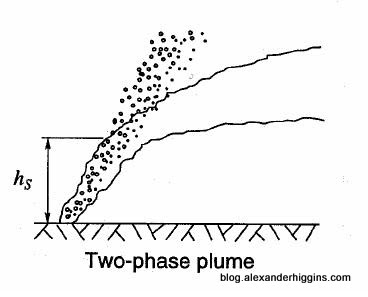
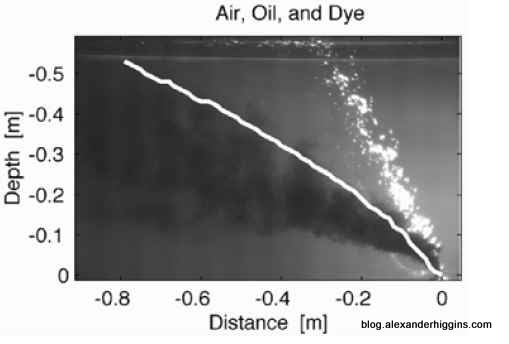
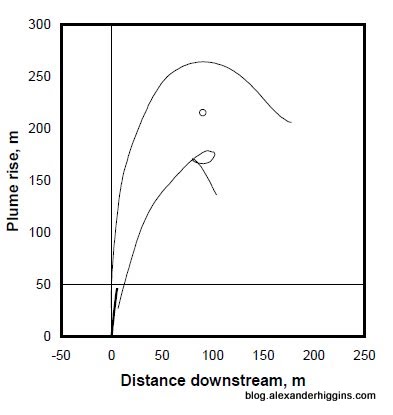
The microbes prefer the lighter compounds of oil, the gasoline part of the black goo ...."There always seems to be a residue," Valentine said. "They (bacteria) hit a wall. There seems to be stages in which they eat. There's the easy stuff ––the steak. And then they work their way to the vegetables, and then garnish, and then they stop eating after awhile. Just depends on how hungry they are and what's fed to them."
Corexit: A Failed Science Experiment
So let's recap.
The overwhelming majority of oil from deepwater spills stays beneath the surface in plumes. See this and this.
Oil-eating microbes like the lighter portions of oil.Writing in the journal Science, the scientists confirmed that oil from the well had been caught below the surface of the Gulf in pools of microscopic oil drops and petroleum-based trace chemicals, which were degrading more slowly than many had expected. The plume resembled a mist of trace chemicals largely invisible to the eye, rather than a river of oil.
In normal circumstances, crude oil floats to the surface, where it can be skimmed, burned off or evaporated. Floating on the waves, it can be churned into smaller drops readily digested by bacteria.
But oil from the ruptured well, broken down by sprays of chemical dispersants and held at depth by water pressure, has formed microscopic droplets not buoyant enough to break through the transition layer that separates warm surface currents from the cold bottom water, several experts said.
Dr. Valentine found none of the main oil-eating microbes in the deepwater plumes he tested. Whether that is because the Corexit killed them, its too cold in the deep ocean, they don't like the heavier portions of the oil that don't float to the surface, or for some other reason, the result is a failure.
Scientists have already said that Corexit is dangerous to sealife and humans (see this and this), and called the application of Corexit the largest science experiment ever conducted. For example, Rob Kendall, director of Texas Tech’s Institute of Environmental & Human Health, says:
This is a catastrophe of enormous proportions. To me, this is the biggest environmental toxicology experiment we’ve ever conducted.
And Kim Withers, a coastal ecologist at Texas A&M University in Corpus Christi notes:
It's like the biggest science experiment ever. Unfortunately, it's a completely uncontrolled experiment.
They were talking about the toxic effects of Corexit on sealife.
But Dr. Valentine's findings lead me to conclude that the experiment on the potential of Corexit to help the microbes break down the oil has failed as well.


Thursday, August 19, 2010
Top Expert: Geology is "Fractured", Relief Wells May Fail ... BP is Using a "Cloak of Silence", Refusing to Share Even Basic Data with the Government
Few people in the world know more about oil drilling disasters than Dr. Robert Bea.
Bea teaches engineering at the University of California Berkeley, and has 55 years of experience in engineering and management of design, construction, maintenance, operation, and decommissioning of engineered systems including offshore platforms, pipelines and floating facilities. Bea has worked for many years in governmental and quasi-governmental roles, and has been a high-level governmental adviser concerning disasters. He worked for 16 years as a top mechanical engineer and manager for Shell Oil, and has worked with Bechtel and the Army Corps of Engineers. One of the world's top experts in offshore drilling problems, Bea is a member of the Deepwater Horizon Study Group, and has been interviewed by news media around the world concerning the BP oil disaster.
Washington's Blog spoke with Dr. Bea yesterday.WB: Is BP sharing information with the government?
Bea: No. BP is using a "cloak of silence". BP is not voluntarily sharing information or documents with the government.
In May, for example, Senator Boxer subpoenaed information from BP regarding footage of the seafloor taken before the blowout by BP's remotely operated vehicles (ROVs). We still have not received a response 12 weeks later.
[Bea subsequently clarified that he's not sure whether BP has failed to release the information, or Senator Boxer's committee has sat on the information. My bet is on BP. Indeed, BP has refused to answer some very basic written questions from Congressman Markey, chair of the Select Committee on Energy Independence and Global Warming. See this and this. Indeed, it is unclear whether BP is sharing vital details even with Thad Allen, Secretary of energy Chu, or the Unified Command].
WB: Might there be problems with the relief wells? I know that it took a couple of relief wells to finally stop the Ixtoc leak, and it has taken as many as 5 relief wells to stop some blowouts.
Bea: Yes, it could take repeated attempts.
WB: Are there any conditions at BP's well which might make killing the leak with relief wells more difficult than with the average deepwater oil spill?
Bea: That's an interesting question. You have to ask why did this location blow out when nearby wells drilled in even deeper water didn't blow out.
You have to look at the geology of the Macondo well. It is in a subsalt location, in a Sigsbee salt formation. [For background, see this and this]
The geology is fractured.
Usually, the deeper you drill, the more pressure it takes to fracture rock. This is called the "fracture gradient".
But when BP was drilling this well, the fracture gradient reversed. Indeed, BP lost all pressure as it drilled into the formation.
WB: Is it possible that this fractured, subsea salt geology will make it difficult to permanently kill the oil leak using relief wells?
Bea: Yes, it could. The Santa Barbara channel seeps are still leaking, decades after the oil well was supposedly capped. This well could keep leaking for years.
Scripps mapped out seafloor seeps in the area of the well prior to the blowout. Some of the natural seeps penetrate 10,000 to 15,000 feet beneath the seafloor. The oil will follow lines of weakness in the geology. The leak can travel several horizontal miles from the location of the leak.
[In other words, the geology beneath the seafloor is so fractured, with soft and unstable salt formations, that we may never be able to fully kill the well even with relief wells. Instead, the loss of containment of the oil reservoir caused by the drilling accident could cause oil to leak out through seeps for years to come. See this and this for further background].
WB: I know that you've previously said that you're concerned that there might be damage to the well bore, which could make it more difficult for the relief wells to succeed.
Bea: Yes, that's still a concern.
WB: I have heard that BP is underestimating the size of the oil reservoir (and see this). Is it possible that the reservoir is bigger than BP is estimating, and so - if not completely killed - the leak could therefore go on for longer than most assume?
Bea: That's plausible.
WB: The chief electronics technician on the Deepwater Horizon said that the Macondo well was originally drilled in another location, but that "going faster caused the bottom of the well to split open, swallowing tools", and that BP abandoned that well. You've spoken to that technician and looked into the incident, and concluded that “they damn near blew up the rig.” [See this and this].
Do you know where that abandoned well location is, and do you know if that well is still leaking?
Bea: The abandoned well is very close to the current well location. BP had to file reports showing the location of the abandoned well and the new well [with the Minerals Management Service], so the location of the abandoned well is known.
We don't know if the abandoned well is leaking.
WB: Matthew Simmons talked about a second leaking well. There are rumors on the Internet that the original well is still leaking. Do you have any information that can either disprove or confirm that allegation?
Bea: There are two uncorroborated reports. One is that there is a leak 400 feet West of the present well's surface location. There is another report that there is a leak several miles to the West.
[Bea does not know whether either report is true at this time, because BP is not sharing information with the government, let alone the public.]
WB: There are rumors on the Internet of huge pockets of methane gas under the well which could explode. I've looked into this rumor, and have come to the conclusion that - while the leak is releasing tremendous amounts of methane - there are no "pockets" of methane gas which could cause explosions. Do you have any information on this?
Bea: I have looked into this and discussed methane with people who know a tremendous amount about it. There is a lot of liquid and solid methane at the Macondo site, but no pockets of methane gas.
WB: That's good news, indeed.
Bea: But there was one deepwater leak I worked with where tremendous amounts of hydrogen sulfite were released. We had to evacuate two towns because of the risk. [I didn't ask Dr. Bea if there were any dangerous compounds which could be formed from the interaction of the crude oil and methane with chemicals in the ocean water or dispersants].
And with the Bay Charman oil leak, more than 50% of the oil stayed below the surface of the ocean. [As I've previously pointed out, the US Minerals Management Service and a consortium of oil companies, including BP, found that as little as 2% of the oil which spill from deepwater wells ever makes it to the surface of the ocean. And the use of dispersant might decrease that number still further].
WB: I have previously argued that nuking the well would be a bad idea. What do you think?
Bea: [Bea agreed that nuking the well would be counter-productive. He told me a story about a leaking deepwater well that he was involved in killing. A nuclear package was on its way to the well site but - fortunately - the well stopped by itself before a nuke was deployed. I'm not sure whether this is classified information, so I won't disclose the name of the well. Bea also discussed alternatives in the form of high-pressure, high-temperature conventional explosives, echoing what Bill Clinton said recently].
WB: Thank you for your generous time and for sharing your expertise with us, Dr. Bea.
Bea: You're welcome.
BP and the Government Are Underplaying the Difficulty of Stopping the Oil Leak
While BP and the government say that permanently capping the oil well is no problem, they act like they have little idea of what they're doing.
Indeed, Admiral Thad Allen is now saying "We’re concerned about the vital signs of this well":
He's also saying that completion of relief well will be delayed until mid-September, at the earliest, and that the government is looking for problematic “material” in the well:
What's really going on?
Well, initially, if the well had structural integrity, there wouldn't be concern about the "vital signs" of the well, there wouldn't have been delay after delay in completing the relief wells, there wouldn't be never-ending rounds of new tests, there wouldn't have been an attempt to seal it (or perhaps more accurately, patch it) from the top using cement, there wouldn't be an attempt to remove "material" from the well.
Indeed, what does "removing material" even mean? Does that mean removing crumpled casing or drill pipe, or does it mean clearing out caved-in portions of the well and trying to rebuild those portions from scratch?
Moreover, one of the world's top experts in oil drilling disasters - Dr. Robert Bea - told me yesterday that the geology underneath the seafloor at the leak site is fractured, and includes very loose salt formations. This geology may make it very hard to kill the well, even using relief wells, and he says that we may never be able to kill it. He also said that there are uncorroborated reports of additional leaks other than the main well, but that BP isn't sharing enough information to be able to assess whether or not that there are additional leaks. (Dr. Bea told me that BP is using a "cloak of silence", and is refusing to even show the government videos of what the seafloor looked like before the April explosion).
So instead of simply trying to cap an existing well, it may be more accurate to think of this as trying to build a new well - or at least trying to duck tape the old one - so that it has enough integrity to be permanently stopped.
Update: Admiral Thad Allen just confirmed in a press briefing some of what I wrote above, saying that a collapse of the formation surrounding the wellbore (rather than concrete) might be what is blocking the bottom portion of the cement:
Wednesday, August 18, 2010
The Sun Affects the Earth More Than You Might Realize
What happens in Vegas stays in Vegas.
But what happens on the sun doesn't stay on the sun.
As I pointed out last year:
It is known that intense solar activity can destroy ozone in the Earth's atmosphere, thus affecting climactic temperatures. See this, this, this, this and this. Indeed, the effects of solar energy on ozone may be one of the main ways in which the sun influences Earth's climate.
The sun itself also affects the Earth more than previously understood. For example, according to the European Space Agency:
Scientists ... have proven that sounds generated deep inside the Sun cause the Earth to shake and vibrate in sympathy. They have found that Earth’s magnetic field, atmosphere and terrestrial systems, all take part in this cosmic sing-along.
And NASA has just discovered that "space weather" causes "spacequakes" on Earth:
Researchers using NASA's fleet of five THEMIS spacecraft have discovered a form of space weather that packs the punch of an earthquake and plays a key role in sparking bright Northern Lights. They call it "the spacequake."A spacequake is a temblor in Earth's magnetic field. It is felt most strongly in Earth orbit, but is not exclusive to space. The effects can reach all the way down to the surface of Earth itself.
"Magnetic reverberations have been detected at ground stations all around the globe, much like seismic detectors measure a large earthquake," says THEMIS principal investigator Vassilis Angelopoulos of UCLA.
It's an apt analogy because "the total energy in a spacequake can rival that of a magnitude 5 or 6 earthquake," according to Evgeny Panov of the Space Research Institute in Austria.
***
"Now we know," says THEMIS project scientist David Sibeck of the Goddard Space Flight Center. "Plasma jets trigger spacequakes."
According to THEMIS, the jets crash into the geomagnetic field some 30,000 km above Earth's equator. The impact sets off a rebounding process, in which the incoming plasma actually bounces up and down on the reverberating magnetic field. Researchers call it "repetitive flow rebuffing." It's akin to a tennis ball bouncing up and down on a carpeted floor. The first bounce is a big one, followed by bounces of decreasing amplitude as energy is dissipated in the carpet.
***"When plasma jets hit the inner magnetosphere, vortices with opposite sense of rotation appear and reappear on either side of the plasma jet," explains Rumi Nakamura of the Space Research Institute in Austria, a co-author of the study. "We believe the vortices can generate substantial electrical currents in the near-Earth environment."
Acting together, vortices and spacequakes could have a noticeable effect on Earth. The tails of vortices may funnel particles into Earth's atmosphere, sparking auroras and making waves of ionization that disturb radio communications and GPS. By tugging on surface magnetic fields, spacequakes generate currents in the very ground we walk on. Ground current surges can have profound consequences, in extreme cases bringing down power grids over a wide area.
What does this mean?
Some allege that spacequakes cause actual, physical earthquakes on Earth. I have no idea whether or not that is true.
The above-quoted NASA article concludes with a poem which implies such a connection:
Vortices swirl
plasma a'twirl
Richter predicts
a magnitude six
However, the poem may use artistic license rather than scientific rigor.
What is certain is that the science of the affect of space events on Earth is in its infancy, and that there are many fascinating discoveries in our future.
The True Meaning of the Ground Zero Mosque Controversy
The Founding Fathers believed in freedom of religion, and tolerance of all religions. The Constitution enshrines freedom of religion.
As such, anyone who tries to ban Islam as evil is anti-American.
As Greg Palast argues, if we ban mosques because some Muslims are murderers, we should also ban churches because Timothy McVeigh was a Christian.
Indeed, we should also ban synagogues because some Jews commit terrorism (see second bulleted paragraph).
Of course, anyone who sees their religion as the "good guys" and the other guy's religion as "evil" is living in a cartoon.
As Christian writer and psychiatrist M. Scott Peck explained, there are different stages of spiritual maturity. Fundamentalism - whether it be Muslim, Christian, Jewish or Hindu fundamentalism - is an immature stage of development. Indeed, a a Christian fundamentalist who kills others in the name of religion is much more similar to a Muslim fundamentalist who kills other in the name of his religion than to a Christian who peacefully fights for justice and truth, helps the poor, or serves to bring hope to the downtrodden.
But there is another meaning to the Ground Zero controversy.
Nice Gesture ... Now Can We End the Crusades?
The war on terror is largely a religious war.
As I pointed out in January:
ABC News is reporting that U.S. military weapons are inscribed with secret 'Jesus' Bible codes [the military subsequently endorsed this practice]
Conservative Christians were the biggest backers of the Iraq war ...
One of the top Pentagon officials involved in the Iraq war - General William Boykin - literally:
Sees the "war on terror" as a religious war between Judeo-Christian civilization and Satan, with Islam of course cast in the latter role.Jeremy Scahill describes Boykin as:
A Deputy Undersecretary of Defense for Intelligence under Bush. Boykin was part of Donald Rumsfeld's inner circle at the Pentagon where he was placed in charge of hunting "high-value targets." Boykin was one of the key U.S. officials in establishing what critics alleged was death-squad-type activity in Iraq.Boykin's crusade is also important because one of his assigned jobs was:
Speeding up the flow of intelligence on terrorist leaders to combat teams in the field so that they can attack top-ranking terrorist leaders. It can easily be speculated that it is this urgency to obtain intelligence, and an uncompromising religious outlook backed by a [crusader] mentality, that has led to the lower echelons in the US military to adopt Saddam Hussein-like brutalities.Moreover, the U.S. military has just been busted trying to convert Afghanis to Christianity (the same thing happened in Iraq).
As Scahill notes:What's more, the center of this evangelical operation is at the huge US base at Bagram, one of the main sites used by the US military to torture and indefinitely detain prisoners.The bottom line is that - while torture was ordered by the highest level Bush administration officials in order to create a false link between 9/11 and Iraq - it seems like many of those who enthusiastically rallied around torture looked at it, literally, as a religious crusade.
As I wrote on May 25th:
According to French President Chirac, Bush told him that the Iraq war was needed to bring on the apocalypse:
In Genesis and Ezekiel Gog and Magog are forces of the Apocalypse who are prophesied to come out of the north and destroy Israel unless stopped. The Book of Revelation took up the Old Testament prophesy:
"And when the thousand years are expired, Satan shall be loosed out of his prison, And shall go out to deceive the nations which are in the four quarters of the earth, Gog and Magog, to gather them together to battle and fire came down from God out of heaven, and devoured them."
Bush believed the time had now come for that battle, telling Chirac:
"This confrontation is willed by God, who wants to use this conflict to erase his people's enemies before a New Age begins"...
There can be little doubt now that President Bush's reason for launching the war in Iraq was, for him, fundamentally religious. He was driven by his belief that the attack on Saddam's Iraq was the fulfilment of a Biblical prophesy in which he had been chosen to serve as the instrument of the Lord.And British Prime Minister Tony Blair long-time mentor, advisor and confidante said:
Given that the Iraq war really was a crusade, the fact that the Pentagon is now saying that it may have to leave troops in Iraq for another decade shows that the crusade is still ongoing under Obama."Tony's Christian faith is part of him, down to his cotton socks. He believed strongly at the time, that intervention in Kosovo, Sierra Leone – Iraq too – was all part of the Christian battle; good should triumph over evil, making lives better."
Mr Burton, who was often described as Mr Blair's mentor, says that his religion gave him a "total belief in what's right and what's wrong", leading him to see the so-called War on Terror as "a moral cause"...
Anti-war campaigners criticised remarks Mr Blair made in 2006, suggesting that the decision to go to war in Iraq would ultimately be judged by God.
Indeed, churchgoers are more likely to back torture of suspected terrorists than atheists (and see this), and torture is apparently still continuing under the Obama administration.
So if Obama wants to create better relations with the Islamic world, he might want to start by ending the Crusades.
Pulling combat troops out of Iraq was a good first step. And high-level intelligence and military leaders have suggested some constructive ideas for Afghanistan. See this and this.
And if Americans want to practice a little Christian charity, how about providing medical care to the heroes who pulled survivors out of the rubble on 9/11, and are now dying due to our neglect?
Tuesday, August 17, 2010
The Government Lies to the American People About the Safety of Gulf Seafood
The Centers of Disease Control (CDC) just announced:
For the seafood to pose a health risk, the food would have to be heavily contaminated with oil, and would therefore have a strong odor and taste of oil.
That is patently untrue.
As I pointed out in June:
Crude oil contains such powerful cancer-causing chemicals as benzene, toluene, heavy metals and arsenic.
***
As Bloomberg notes:
“Oil is a complex mixture containing substances like benzene, heavy metals, arsenic, and polynuclear aromatic hydrocarbons -- all known to cause human health problems such as cancer, birth defects or miscarriages,” said Kenneth Olden, founding dean of New York’s CUNY School of Public Health at Hunter College, who is monitoring a panel on possible delayed effects.
Corexit breaks oil down into its constituent chemicals. So there could easily be toxic levels in the compounds that don't smell anything like oil.
For example, arsenic is odorless. So fish contaminated with arsenic will not smell or taste like oil.
And crude oil contains mercury. Mercury is odorless, so fish contaminated with mercury will not smell or taste like oil.
As McClatchy notes today:
The Gulf of Mexico oil spill still poses threats to human health and seafood safety, according to a study published Monday by the peer-reviewed Journal of the American Medical Association.
***In the short term, study co-author Gina Solomon voiced greatest concern for shrimp, oysters, crabs and other invertebrates she says are have difficulty clearing their systems of dangerous polycyclic aromatic hydrocarbons (PAHs) similar to those found in cigarette smoke and soot. Solomon is an MD and public health expert in the department of medicine at the University of California at San Francisco.
In the longer term, she expressed worries about big fin fish such as tuna, swordfish and mackerel, saying levels of mercury from the oil might slowly increase over time by being consumed by fish lower in the food chain and becoming concentrating in the larger fish.
As time goes on, she said, doctors may be warning pregnant women and children to strictly limit the amount of such fish they eat. Some of the fish had relatively high levels of mercury even before the oil spill, she said.
Moreover, Corexit is itself toxic. Many of the ingredients of Corexit are either odorless and tasteless or have very different smells and tastes from oil. For example, Corexit contains propylene glycol, which is nearly odorless, with a faintly sweet taste. And some versions of Corexit contain 2-butoxyethanol which has a fruity rather than petroleum-like smell.
Finally, Corexit interacts with crude oil to form new compounds. No one has thoroughly studied the range of new compounds which might be formed by the interaction of Corexit with crude oil, let alone what they taste or smell like.
And see this.
In addition, NOAA Administrator Jane Lubchenco says that oil doesn't bioaccumulate in fish, and that fish naturally "degrade and process" the oil:
However, as the above-quoted article by the Journal of the American Medical Association states:
Shrimp, oysters, crabs and other invertebrates ... have difficulty clearing their systems of dangerous polycyclic aromatic hydrocarbons (PAHs) ....Moreover:
Accumulation of PAHs occurs in all marine organisms.Benzene, toluene, arsenic, heavy metals and many other components of crude oil also bioaccumulate. Indeed, researcher Bob Kibler recently found benzene levels 1,000 times higher than allowed in the mud of Louisiana's Four Bayou Pass, which will bioaccumulate in the oysters, shrimp and other marine organisms (starting around 2:30 into video):
Visit msnbc.com for breaking news, world news, and news about the economy
In addition, NOAA admitted in Congressional testimony that dispersants may bioaccumulate.
Finally, Lubchenco says that we can be assured that Gulf seafood is safe because only fishing areas which are free of oil are being reopened.
That is also false.
Bacteria and Phytoplankton Affect the Weather
It turns out that critters so small that they can't be seen with the naked eye might affect the weather, and perhaps even climate.
As I pointed out last year, spacefaring bacteria might affect rainfall:
Now, NOAA scientists say that phytoplankton affects hurricanes. As New Scientist writes:In 2002, several scientists claimed that bacteria high in Earth's atmosphere came from space.
Last year, scientists said that bacteria in the upper atmosphere may actually make rain. Specifically, they said that bacteria can freeze at fairly warm temperatures, so that the "biological ice nuclei" form condensation nuclei which triggers rain.
Indeed, some scientists have speculated that bacteria cause rain as a means of transportation, so that they will "rain out" from the upper atmosphere to the surface of a planet.
Now, scientists have discovered a "hibernating" bacteria in a salt mine in Utah which they believe has been in suspended animation for 250 million years. There is evidence that this ability to hibernate for long periods of time is also useful for travel through space by the bacteria:
Indeed, there is a more down-to-earth analogy to the idea of spacefaring bacteria: the humble coconut. Coconuts can float across long distances of water in the ocean, and when they land on a hospitable island, start growing.Bacteria have the ability to go into a kind of semi-permanent hibernation, but survival for this long was unheard of. After lying dormant in the salt crystal for 250 million years, the scientists added fresh nutrients and a new salt solution, and the ancient bacteria "re-animated."
Dr. Russell Vreeland, one of the biologists who found the bacteria, pointed out that bacteria can survive the forces [of] acceleration via rubble thrown into space via a meteor impact. If it is possible for a bacteria to survive being [thrown] off the planet and to stay alive within a salt chunk for 250 million years, then in a sort of "reverse-exogenesis" it may be possible that earth's own microbes are already out there.
Using a computer weather simulator, [NOAA's Anand Gnanadesikan] compared the formation of tropical storms in the Pacific under today's phytoplankton concentrations to conditions without any phytoplankton at all. What he found was an overall decrease in tropical storms in a phytoplankton-free digital Pacific.
The mechanism for this shift lies in phytoplankton's ability to absorb sunlight, which heats up the water around it. Without phytoplankton, the sun's rays penetrate deep into the ocean, leaving the surface water cold. Cool water has less energy than warm water, produces less of the moist air needed to build up tropical storms, and allows for stronger winds that can dissipate thunderstorms before they turn into typhoons (what hurricanes are called in the Pacific Ocean). All of this adds up to a Pacific Ocean that is less exciting and deadly than the one we currently have.
Because phytoplankton levels have dropped 40 percent since the 1950s, that may mean that hurricane frequency and/or intensity may decline.
Rain can provide transportation to bacteria, which provides an obvious evolutionary advantage: it gives them a free ride out of space down to a planet's surface.
But could there also be an advantage to phytoplankton from hurricanes? Believe it or not, there is.
As NASA wrote in 2004:
Whenever a hurricane races across the Atlantic Ocean, chances are phytoplankton will bloom behind it. According to a new study using NASA satellite data, these phytoplankton blooms may also affect the Earth's climate and carbon cycle.
***
The satellite images showed tiny microscopic ocean plants, called phytoplankton, bloomed following the storms.
"Some parts of the ocean are like deserts, because there isn't enough food for many plants to grow. A hurricane's high winds stir up the ocean waters and help bring nutrients and phytoplankton to the surface, where they get more sunlight, allowing the plants to bloom," Babin said.***
Bigger storms appear to cause larger phytoplankton blooms. Larger phytoplankton should have more chlorophyll, which satellite sensors can see.
Hurricane-induced upwelling, the rising of cooler nutrient-rich water to the ocean surface, is also critical in phytoplankton growth. For two to three weeks following almost every storm, the satellite data showed phytoplankton growth. Babin and his colleagues believe it was stimulated by the addition of nutrients brought up to the surface.***
By stimulating these phytoplankton blooms, hurricanes can affect the ecology of the upper ocean. Phytoplankton is at the bottom of the food chain. The factors that influence their growth also directly affect the animals and organisms that feed on them.


 Posts



