Monday, April 12, 2010

A Banana Republic With No Bananas


Experts on third world banana republics from the IMF and the Federal Reserve have said the U.S. has become a third world banana republic (and see this and this).

Are they right?

Well, let's look at Wikipedia's description of the four factors which make a country a banana republic.

Profits Privatized and Debts Socialized

The first feature of a banana republic as "A collusion between the overweening state and certain favored monopolistic concerns, whereby the profits can be privatized and the debts socialized."

✓ Check.

As I pointed out in November:

Nouriel Roubini writes in a recent essay:

This is a crisis of solvency, not just liquidity, but true deleveraging has not begun yet because the losses of financial institutions have been socialised and put on government balance sheets. This limits the ability of banks to lend, households to spend and companies to invest...

The releveraging of the public sector through its build-up of large fiscal deficits risks crowding out a recovery in private sector spending.

Roubini has previously written:

We're essentially continuing a system where profits are privatized and...losses socialized.

Nassim Nicholas Taleb says the same thing:

After finishing The Black Swan, I realized there was a cancer. The cancer was a huge buildup of risk-taking based on the lack of understanding of reality. The second problem is the hidden risk with new financial products. And the third is the interdependence among financial institutions.

[Interviewer]: But aren't those the very problems we're supposed to be fixing?

NT: They're all still here. Today we still have the same amount of debt, but it belongs to governments. Normally debt would get destroyed and turn to air. Debt is a mistake between lender and borrower, and both should suffer. But the government is socializing all these losses by transforming them into liabilities for your children and grandchildren and great-grandchildren. What is the effect? The doctor has shown up and relieved the patient's symptoms – and transformed the tumour into a metastatic tumour. We still have the same disease. We still have too much debt, too many big banks, too much state sponsorship of risk-taking. And now we have six million more Americans who are unemployed – a lot more than that if you count hidden unemployment.

[Interviewer]: Are you saying the U.S. shouldn't have done all those bailouts? What was the alternative?

NT: Blood, sweat and tears. A lot of the growth of the past few years was fake growth from debt. So swallow the losses, be dignified and move on. Suck it up. I gather you're not too impressed with the folks in Washington who are handling this crisis.

Ben Bernanke saved nothing! He shouldn't be allowed in Washington. He's like a doctor who misses the metastatic tumour and says the patient is doing very well.
Nobel prize winning economist Joseph Stiglitz calls it "socialism for the rich". So do many others.

Devalued Paper Currency

The second characteristic of a banana republic is "Devalued paper currency in the international community."

✓ Check. Here's a chart of the trade weighted US Dollar from 1973-2009.

US_dollar

And here's a bonus chart showing the decline in the dollar's purchasing power from 1913 to 2005:

US_dollar

Politicians Use Time in Office to Maximize Their Own Gains


The third characteristic of a banana republic is:

Kleptocracy -- those in positions of influence use their time in office to maximize their own gains, always ensuring that any shortfall is made up by those unfortunates whose daily life involves earning money rather than making it.

✓ Check. As I wrote last month:

Summers, Geithner, Bernanke and Congress like things just the way they are.

Of course they do ... they're bought and paid for:

  • Lobbyists from the financial industry have paid hundreds of millions to Congress and the Obama administration. They have bought virtually all of the key congress members and senators on committees overseeing finances and banking. The Congress people who receive the most money from lobbyists are the most opposed to regulation. See this, this, this, this, this, this, and this.
  • Obama received more donations from Goldman Sachs and the rest of the financial industry than almost anyone else
  • Summers and the rest of Obama's economic team have made many millions - even in the first few months of being appointed, or right beforehand - from the financial industry
The chairman of the Department of Economics at George Mason University (Donald J. Boudreaux) says that it is inaccurate to call politicians prostitutes. Specifically, he says that they are more correct to call them "pimps", since they are pimping out the American people to the financial giants ...

Corruption Remains Unchecked, Politicians Are Only for Show

And the fourth characteristic of a banana republic is:

There must be no principle of accountability within the government so that the political corruption by which the banana republic operates is left unchecked. The members of the national legislature will be (a) largely for sale and (b) consulted only for ceremonial and rubber-stamp purposes some time after all the truly important decisions have already been made elsewhere.

✓ Check. There's no accountability.

For example, former Vice President of Dallas Federal Reserve, who said that the failure of the government to provide more information about the bailout signals corruption. As ABC writes:

Gerald O'Driscoll, a former vice president at the Federal Reserve Bank of Dallas and a senior fellow at the Cato Institute, a libertarian think tank, said he worried that the failure of the government to provide more information about its rescue spending could signal corruption.

"Nontransparency in government programs is always associated with corruption in other countries, so I don't see why it wouldn't be here," he said.

As I noted in October:

William K. Black - professor of economics and law, and the senior regulator during the S & L crisis - says that that the government's entire strategy now - as during the S&L crisis - is to cover up how bad things are ("the entire strategy is to keep people from getting the facts").

Indeed, as I have previously documented, 7 out of the 8 giant, money center banks went bankrupt in the 1980's during the "Latin American Crisis", and the government's response was to cover up their insolvency.

Black also says:

There has been no honest examination of the crisis because it would embarrass C.E.O.s and politicians . . .

Instead, the Treasury and the Fed are urging us not to examine the crisis and to believe that all will soon be well.

PhD economist Dean Baker made a similar point, lambasting the Federal Reserve for blowing the bubble, and pointing out that those who caused the disaster are trying to shift the focus as fast as they can:

The current craze in DC policy circles is to create a "systematic risk regulator" to make sure that the country never experiences another economic crisis like the current one. This push is part of a cover-up of what really went wrong and does absolutely nothing to address the underlying problem that led to this financial and economic collapse.
Baker also says:
"Instead of striving to uncover the truth, [Congress] may seek to conceal it" and tell banksters they're free to steal again.

Politicians are for sale.

And Congress made a big show of passing derivatives reform legislation, but actually weakened existing regulations. In fact, the legislation was "probably written by JP Morgan and Goldman Sachs" (two of the biggest derivatives players). In other words, Congress just rubber-stamped decisions which were already made elsewhere.

The same is true with every other piece of financial "reform" legislation which has been passed. See this and this.

It's all for show, folks. Dodd, Frank, Obama and all the other politicians of both parties (with the exception of a handful trying to do the right thing) are "consulted only for ceremonial and rubber-stamp purposes some time after all the truly important decisions [about economic legislation] have already been made elsewhere"

Without the Bananas

Wikipedia gives some additional background on the term "banana republic":
Banana republic is a pejorative term originally used to refer to a country that is politically unstable, dependent on limited agriculture (e.g. bananas), and ruled by a small, self-elected, wealthy, and corrupt clique.

Well, America isn't dependent on limited agriculture like bananas. But just about the only areas of growth are in the military and in giant companies lavished with buckets of cash and special "favors" by Uncle Sugar.

As one commentator succinctly put it, America has become:

A banana republic with no bananas.

Sunday, April 11, 2010

Is the World's Second Biggest Economy On the Ropes?


Iceland has approximately the 101st biggest economy in the world.

Dubai is also tiny.

Greece is somewhat bigger, with the 27th biggest economy.

When Iceland, Dubai and Greece tanked, that was horrible ... but not catastrophic.

Portugal - the 37th biggest economy - may be next. It would be horrible if Portugal tanks.

But Spain is also in real trouble. As the 9th biggest economy, a default by Spain could be major.

But none of these are in the same ballpark as Japan - the world's 2nd biggest economy. Only the U.S. is bigger.

So it is newsworthy that S & P cut Japan's sovereign credit rating in January.

And that, as Bloomberg wrote April 2nd:

Japanese National Strategy Minister Yoshito Sengoku said the country should have a greater sense of urgency about the nation’s fiscal situation, comparing it to the plight of Greece. “So far some have been crying wolf, but Greece’s situation isn’t entirely unrelated to Japan’s,” Sengoku said at a news conference in Tokyo today. “At the end of the day, Japan’s situation right now is not that good. There hasn’t been a sense of crisis about this, including from ourselves.”

***

Sengoku is not the only policy maker to compare Japan with Greece, whose fiscal woes weakened the euro and forced the government to adopt austerity measures as its borrowing costs surged. Bank of Japan board member Seiji Nakamura said in February that Greece’s example shouldn’t be regarded as “a burning house on the other side of the river.”
And AFP reports today:

Greece's debt problems may currently be in the spotlight but Japan is walking its own financial tightrope, analysts say, with a public debt mountain bigger than that of any other industrialised nation.

Public debt is expected to hit 200 percent of GDP in the next year as the government tries to spend its way out of the economic doldrums despite plummeting tax revenues and soaring welfare costs for its ageing population.

Based on fiscal 2010's nominal GDP of 475 trillion yen, Japan's debt is estimated to reach around 950 trillion yen -- or roughly 7.5 million yen per person.

Japan "can't finance" its record trillion-dollar budget passed in March for the coming year as it tries to stimulate its fragile economy, said Hideo Kumano, chief economist at Dai-ichi Life Research Institute.

"Japan's revenue is roughly 37 trillion yen and debt is 44 trillion yen in fiscal 2010, " he said. "Its debt to budget ratio is more than 50 percent."

Without issuing more government bonds, Japan "would go bankrupt by 2011", he added.

***

The system of Japanese government bonds being bought by institutions such as the huge Japan Post Bank has been key in enabling Japan to remain buoyant since its stock market crash of 1990.

"Japan's risk of default is low because it has a huge current account surplus, with the backing of private sector savings," to continue purchasing bonds, said Katsutoshi Inadome, bond strategist at Mitsubishi UFJ Securities.

But while Japan's risk of a Greek-style debt crisis is seen as much less likely, the event of risk becoming reality would be devastating, say analysts who question how long the government can continue its dependence on issuing public debt.

"There is no problem as long as there are flows of money in the bond market," said Kumano.

"It's hard to predict when the bond market might collapse, but it would happen when the market judges that Japan's ability to finance its debt is not sustainable anymore."

In addition, Japan's population is declining rapidly, due to a combination of delay in age of childbirth, declining fertility and a society unfavorable to immigration. As Business Week wrote last August:

Japan’s Internal Affairs Ministry published the latest numbers on the country’s declining population on Aug. 11. The data doesn’t make for pleasant reading. In the year through the end of March 2009, the number of births in Japan fell for the first time since 2006 to 1.08 million, while there were 1.13 million deaths. Put together, that adds up to a record decline in the population of 45,914. That bests (if that’s the right word) the previous biggest decline of 29,119 in 2007. Just as worrying, the number of Japanese 65 or older increased to a record 28.21 million out of total population of 127 million. Meanwhile, the current recession—Japan’s GDP may shrink 6% this year—will likely make things worse as couples decide to delay or have fewer children.

Japan Times adds some details:

The population dynamics estimate of the Health, Labor and Welfare Ministry indicates that Japan's population decline is accelerating. The report, based on birth and death registers submitted from January 2009 to October 2009, estimates the number of births in Japan in that year at 1,069,000, or 22,000 less than in 2008, and the number of deaths in 2009 at 1,144,000, or 2,000 more than in 2008. The death figure is the highest since 1947 and represents the ninth straight yearly increase.

As a result, Japan's population is estimated to have shrunk by 75,000 last year, 1.46 times the decrease marked in 2008.

Japan's population will continue to decrease at an accelerating rate, the ministry noted. The number of women able to bear children is on the decline, and the number of deaths among the nation's graying population will continue to rise.

The National Institute of Population and Social Security Research estimates that Japan's population will dip below 100 million in 2046, below 90 million in 2055 and down to 44.59 million in 2105. If this trend continues, the labor force and consumer markets will shrink, having a strong impact on the economy.
Here's a visual representation of forecast Japanese population decline courtesy of Alex Dalmady:

Morever, Japan also has very unfavorable age demographics. As I wrote last October:

The following chart shows that Japan has the worst demographics of all, with a staggering percentage of elderly who need to be taken care of by the young:

Chart 2: Old Age Dependency Ratios for Selected Countries

clip_image002[5]

Source: http://data.un.org/

And see this chart from the Statistical Handbook of Japan:


On the other hand, as AFP notes, Japan has some good things going for it, including a large current account surplus, and the fact that Japanese are largely financing their debt themselves:

The system of Japanese government bonds being bought by institutions such as the huge Japan Post Bank has been key in enabling Japan to remain buoyant since its stock market crash of 1990.

"Japan's risk of default is low because it has a huge current account surplus, with the backing of private sector savings," to continue purchasing bonds, said Katsutoshi Inadome, bond strategist at Mitsubishi UFJ Securities

And, as AFP points out, Greece is part of a currency union with strict exchange rates, while Japan has a fiat currency with flexible exchange rates:

The likes of single-currency Greece and non-eurozone countries are also different in that the latter group have flexible currency exchange rates which are more closely calibrated to their fiscal conditions, [Nomura Securities economist Takehide Kiuchi] said.

The Bank of Japan is also taking radical measures to keep interest rates low, but I don't think that's a very helpful approach for the long-term.

Of course, no country can be analyzed in a vacuum. It is - to some extent - a beauty contest, and bondtraders could change horses when they decide that the horse they've been backing is a nag.

As Bruce Krasting comments:
Japan sure looks like it is trouble. But some comparisons to the US are more troubling.

From the CIA fact book:

Japan External Debt = $2.13 Trillion

Japan Reserves = ~$1 Trillion

US External Debt = 13.45T

US Reserves = 75b

From this you get the Japanese External Debt/Reserves as 2:1. For every dollar of debt they owe outside the country they have 50 cents in a piggy bank in real reserves.

The US External Debt/Reserves is 180:1. Our reserve coverage ratio is 1/2 cent for every dollar of external debt.

GW makes the case that Japan is broke because they owe 200% debt to GDP. He is right. They are broke. But the real question of solvency come down to "Who do you that debt to?"

Japan's GDP to external debt is 2:1.

The same ratio for the US is 1:1.

So by this calculation Japan has a much more managable debt load than the US. They owe it largely to themselves. We owe it to non US persons.

Please don't tell me that the US has the ability to print reserves. That argument is not going to fly in 2010. We have a much bigger problem that does Japan.

And if Exeter is right, then the holders of all nations' bonds might get nervous and flee into cash or gold. This would drive many debt-heavy countries into default.

Radical Concentration of Wealth is Destroying Both Capitalism and Democracy


Note: If you wish, feel free to substitute the word "republic" for "democracy".

As I wrote in 2008:

The economy is like a poker game ... it is human nature to want to get all of the chips, but noted that - if one person does get all of the chips - the game ends.

In other words, the game of capitalism only continues as long as everyone has some money to play with. If the government and corporations take everyone's money, the game ends.

The fed and Treasury are not giving more chips to those who need them: the American consumer. Instead, they are giving chips to the 800-pound gorillas at the poker table, such as Wall Street investment banks. Indeed, a good chunk of the money used by surviving mammoth players to buy the failing behemoths actually comes from the Fed.

No wonder billionaire George Soros says that the way US Treasury Secretary Henry Paulson was handling the situation was "very reminiscent of the way the central bankers talked in the 1930s", the time of the Great Depression.

And no wonder Nobel-prize winning economist Joseph Stiglitz stresses putting poker chips back in the hands of the little guy ...

This is not a question of big government versus small government, or republican versus democrat. It is not even a question of Keynes versus Friedman (two influential, competing economic thinkers).

It is a question of focusing any government funding which is made to the majority of poker players - instead of the titans of finance - so that the game can continue. If the hundreds of billions or trillions spent on bailouts had instead been given to ease the burden of consumers, we would have already recovered from the financial crisis.

As FDR’s Fed chairman Marriner S. Eccles explained:

As in a poker game where the chips were concentrated in fewer and fewer hands, the other fellows could stay in the game only by borrowing. When their credit ran out, the game stopped.

As I pointed out last August, and again last month, fewer people have more of the chips than at any time since before the Great Depression. And see this.

When most people lose their poker chips - and the game is set up so that only those with the most chips get more - free market capitalism is destroyed, as the "too big to fails" crowd out everyone else.

And the economy as a whole is destroyed. Remember, consumer spending accounts for the lion's share of economic activity. If most consumers are out of chips, the economy slumps.

And our very democracy is destroyed.

Everyone knows that politicians are bought and paid for by the financial service giants. And the 800 pound gorillas just keep getting bigger and bigger.

Two leading IMF officials, the former Vice President of the Dallas Federal Reserve, and the the head of the Federal Reserve Bank of Kansas City have all said that the United States is controlled by an oligarchy. And Moody's economist Mark Zandi has said "the oligopoly has tightened."

As Supreme Court Justice Louis Brandeis said:

We may have democracy, or we may have wealth concentrated in the hands of a few, but we can't have both.

Dennis Kucinich said in January:

There's nothing liberal about the bailouts. There's nothing liberal about standing by and watching banks use public money to get their executive bonuses. There's nothing liberal about giving insurance companies carte blanche to charge anything they want for health care... Since when did that become liberal?

***
Every area of the economy is still about taking wealth from the great mass of people and putting it into the hands of a few. If you don’t have an economic democracy, you don’t have a political democracy.

Indeed, when wealth and power become too concentrated, capitalism becomes virtually indistinguishable from socialism or fascism.

Of course, antitrust laws were enacted to protect the economy and democracy, but - like the Depression-era laws separating depository banking from investment banking - are not being enforced.

And the government could use existing laws to force ill-gotten gains to be disgorged (see this and this), fraudulent transfers to be voided and - perhaps - even bonuses gained at the expense of taxpayers clawed back. Such actions would make the 800 pound gorillas a little smaller, helping to reduce concentration of wealth somewhat. But that would assume that America is still a nation governed by the rule of law.

Currently, it's not. Only courageous prosecutors and brave judges can restore the rule of law to America.

Saturday, April 10, 2010

The Fed “Owns Credit-Default Swaps ... On Debt Owed by California and Nevada. So the Fed Would Profit If One of Those States Defaulted on its Debt.”


In the you-can't-make-this-stuff-up department, NPR points out:

As part of the bailouts of AIG and Bear Stearns, the Federal Reserve Bank of New York spent more than $70 billion to buy toxic assets the companies owned. Last week, prompted by a lawsuit filed by Bloomberg News, the Fed finally told the world exactly what it bought.

The Fed now owns loans to Hilton hotels in Hawaii, Puerto Rico, Malaysia and Trinidad. It owns loans to the Miami airport, and the Civil Opera House in Chicago.

It also owned a loan to Crossroads Mall in Oklahoma City. Then, when the owners of the mall couldn't make the payments, the Fed foreclosed. So now it owns the mall, which includes a Chick-fil-A and an AMC theater.

The mall's for sale — cheap! "This lender owned distressed asset ... can be purchased at far below replacement cost," this listing says.

The Fed also owns credit-default swaps — basically, insurance policies that pay off if a borrower defaults on a loan. It holds swaps on the debt of Florida schools, and on debt owed by California and Nevada. So the Fed would profit if one of those states defaulted on its debt.

Granted, the Fed holds a very small percentage of outstanding CDS.

But it is a fitting symbol of the fact that the states - and American people's interests - are not necessarily aligned with the Fed's interests.

The Guy Who Brought Down AIG - and Maybe the World Economy - Gets Off Scott-Free, and Gets to Keep $315 Million in Loot


Jospeh Cassano, the guy who brought down AIG - and maybe the world economy - with trillions in risky derivatives deals which AIG couldn't back up, is getting prosecuted ... and the government will claw back all the money he made, right?

Uh, no.

In reality, Cassano is walking away scott-free with $315 million.

As Cent Uygur points out:

Prosecutors will likely not charge him with fraud. They are not going to try for clawbacks to get some of the money back. In the end, he gets away scott-free. But it's better than free, he gets to keep all the money he never really made in the first place ...

I told you about his $35 million thank you note [his exit bonus] for robbing the place clean. But how about the original robbery? How much did he make for himself from 2000 to 2008 by gambling with the company's money? Only $280 million.

In the end, he walked away with over $315 million for destroying the company and maybe the whole economy. So, why wouldn't he do it again? Well, next time it won't be him. We're on to him, so he's going to have spend his retirement on his yacht. It'll be someone else. It'll be another Cassano. And we'll fall for it then as well.

Friday, April 9, 2010

Fraud Finally Being Discussed in Polite Company ... Now Where Are the Prosecutions?


As I have repeatedly pointed out, the economy cannot stabilize unless the fraud which led to the crisis (see this, this, this and this) is openly discussed.

As Shahien Nasiripour notes today today, Alan Greenspan didn't think regulators should even pay any attention to fraud:

He didn't believe that fraud was something that needed to be enforced or was something that regulators should worry about, and he assumed she [Brooksley Born] probably did. And of course she did. I've never met a financial regulator who didn't feel that fraud was part of their mission, but that was her introduction to Alan Greenspan."

Indeed, as Born pointed out last year, Greenspan told her:

I don’t think there is any need for a law against fraud.

But, this week, Greenspan admitted in testimony to the Financial Crisis Inquiry Commissioner that regulators do need to crack down on fraud:

This week, in response to a question from Financial Crisis Inquiry Commissioner Heather Murren, who asked Greenspan whether subprime lenders should now be supervised by the Federal Reserve, Greenspan said:

"Well, first of all, remember you have to distinguish between supervision and enforcement. A lot of the problems which we had in the independent issuers of subprime and other such mortgages, the basic problem there is that, if you don't have enforcement, and a lot of that stuff was just plain fraud, you're not coming to grips with the issue."

In a paper on the financial crisis he presented last month at the Brookings Institution in Washington, Greenspan did not mention the word "fraud", in any of its forms, even once in the 66-page presentation.

His prepared remarks this week, though, mentioned it three times.

"[I]t is one thing to promulgate rules, and quite another to successfully implement them. Rules to prevent fraud and embezzlement have failed as often as not. Parenthetically, in the years ahead, we will need far greater levels of enforcement against misrepresentation and fraud than has been the practice for decades," he told the investigatory panel.

Greenspan also called for "enhanced" enforcement against "misrepresentation and fraud" going forward as one desired part of the government's arsenal in trying to avoid future crises in which taxpayers are forced to bail out private companies.

And the Wall Street Journal is running an important story showing that all of the big bank primary dealers - not just Lehman - have engaged in fraudulent accounting for years:

Major banks have masked their risk levels in the past five quarters by temporarily lowering their debt just before reporting it to the public, according to data from the Federal Reserve Bank of New York.

A group of 18 banks—which includes Goldman Sachs Group Inc., Morgan Stanley, J.P. Morgan Chase & Co., Bank of America Corp. and Citigroup Inc.—understated the debt levels used to fund securities trades by lowering them an average of 42% at the end of each of the past five quarterly periods, the data show. The banks, which publicly release debt data each quarter, then boosted the debt levels in the middle of successive quarters.

The fact that the existence of widespread fraud is finally being addressed in polite company is a good first step.

But where are the prosecutions?

Neither happy talk nor propaganda will fix the economy. The governments of the world have spent trillions trying to wallpaper over the fraud, and have become insolvent doing so.

But it's not working. Indeed, polls show that people no longer trust our economic "leaders". See this and this.

Only honest talk - and holding the people who committed fraud accountable - will stabilize the economy.


Bank of International Settlements' Tough Assessments Don't Bode Well for World Economy


In a new report, the Bank for International Settlements (BIS) - often called the "central banks' central bank" - points out that bond investors are not as smart as they think, that Western debt is much higher than officially reported (since contingent liabilities and pension debts are excluded from official numbers), and that the recovery of the world economy may be crushed by fiscal problems.

The report states:

According to the OECD, total industrialised country public sector debt is now expected to exceed 100% of GDP in 2011 – something that has never happened before in peacetime. As bad as these fiscal problems may appear, relying solely on these official figures is almost certainly very misleading. Rapidly ageing populations present a number of countries with the prospect of enormous future costs that are not wholly recognised in current budget projections. The size of these future obligations is anybody’s guess. As far as we know, there is no definite and comprehensive account of the unfunded, contingent liabilities that governments currently have accumulated.
For background on the effect of aging populations on the economy, see this.

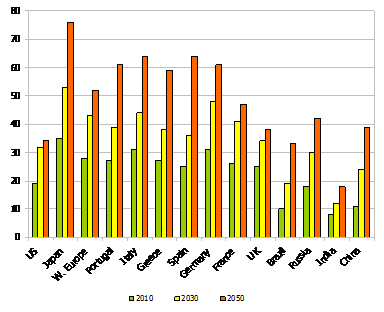
The report includes the following chart on age-related expenditures by country (click for clearer image):

Ambrose Evans-Pritchard succinctly summarizes BIS' findings:
Official debt figures in the West are "very misleading" since they fail to take in account the contingent liabilities and pension debts that have mushroomed over recent years.
BIS writes:
More worryingly, the current expansionary fiscal policy has coincided with rising, and largely unfunded, age-related spending (pension and health care costs). Driven by the countries’ demographic profiles, the ratio of old-age population to working-age population is projected to rise sharply. Interestingly, this rise is concentrated in countries such as Japan, Spain, Italy and Greece, which are already laden with relatively high debts (Graph 2, left-hand panel). Added to the effects of population ageing is the problem posed by rising per capita health care costs.
In other words, BIS is slamming the Western nations for failing to budget for their rapidly aging populations and to set aside adequate funds during the boom. As Evans-Pritchard puts it:
BIS lamented the lack of any systematic data on the scale of unfunded IOUs that care-free politicians have handed out like confetti.
(And, of course, America has been spending money on both guns and butter).

Indeed, here are some recent stories about America's pension crisis:
  • Barron's ran a story on March 15th called "The $2 Trillion Hole: Promised pensions benefits for public-sector employees represent a massive overhang that threatens the financial future of many cities and states."
  • Huffington Post ran a story April 5th entitled "'Something's Got To Give': Massive Pension Fund Shortfalls Threaten To Bankrupt States"
  • World Net Daily ran a story the same day called "America's future? U.S. cities going bust: Public employee pensions burdening states, localities "
  • The Los Angeles Times ran an op-ed on April 6th - written by the special advisor to Califonria Governor Arnold Schwarzenegger for jobs and economic growth - entitled "California's $500-billion pension time bomb: The staggering amount of unfunded debt stands to crowd out funding for many popular programs. Reform will take something sadly lacking in the Legislature: political courage."
The BIS report further points out that bond traders overestimate their timing and forecasting skills:

So far, at least, investors have continued to view government bonds as relatively safe. But bond traders are notoriously short-sighted, assuming they can get out before the storm hits: their time horizons are days or weeks, not years or decades. We take a longer and less benign view of current developments, arguing that the aftermath of the financial crisis is poised to bring a simmering fiscal problem in industrial economies to boiling point. In the face of rapidly ageing populations, for many countries the path of pre-crisis future revenues was insufficient to finance promised expenditure.

Further, BIS notes:

The risk that persistently high levels of public debt will drive down capital accumulation, productivity growth and long-term potential growth. Although we do not provide direct evidence of this, a recent study suggests that there may be non-linear effects of public debt on growth, with adverse output effects tending to rise as the debt/GDP ratio approaches the 100% limit (Reinhart and Rogoff (2009b)).

Actually, as Reinhart and Rogoff showed last December, 90 percent is the threshold:

The relationship between government debt and real GDP growth is weak for debt/GDP ratios below a threshold of 90 percent of GDP. Above 90 percent, median growth rates fall by one percent, and average growth falls considerably more. We find that the threshold for public debt is similar in advanced and emerging economies...
And, as Forbes noted about America:
Add the unfunded portion of entitlement programs and we're at 840% of GDP.

And see this and this.

BIS concludes with this bearish scenario:

If countries do not retrench quickly, they will create a market fear of "monetization" that becomes self-fulfilling. "Monetary policy may ultimately become impotent to control inflation, regardless of the fighting credentials of the central bank" it said.

Some states may be tempted to carry out a creeping default by stoking inflation. "The payoff to do this rises the bigger the debt, the longer its average maturity, the bigger the fraction held by foreigners." The BIS said the danger that any government would consciously take this path is "not insignificant" in the longer run.

Of course, a brutal fiscal purge in every major country at once itself poses a danger. The result would be to crush recovery and tip the world economy back into crisis, making deficits worse again.

See further analysis here, here and here.

Ultimately, though, the primary cause of this acute stage of the global debt crisis is very simple.

As BIS warned in 2008, nations worldwide were bailing out their private banks by transferring toxic risk from the banks onto the sovereigns' own books. The giant banks are, of course, still drowning in debt and - using real world accounting - insolvent, due to all of their gambling schemes gone wrong and toxic assets. The "too big to fails" all over the world have acted like a drowning man who grabs onto someone else and - thrashing around wildly - ends up drowning both.

Debt Repudiation: Good Idea or Bad Idea?


As I noted in November:

Debtors are revolting against exorbitant interest rates and fees and other aggressive tactics by the too big to fail banks. See this, this, and this.

Congresswoman Kaptur advises her constituents facing foreclosure to demand that the original mortgage papers be produced. She says that - if the bank can't produce the mortgage papers - then the homeowner can stay in the house.

Portfolio manager and investment advisor Marshall Auerback argues that a debtor's revolt would be a good thing.

And even popular personal finance advisor Suze Orman is highlighting the debtors revolt phenomenon on her national tv show.

Walking away from home mortgages has actually become mainstream, being trumpeted by:

  • Many others

In addition, as I pointed out in February:

There is an established legal principle that people should not have to repay their government's debt to the extent that it is incurred to launch aggressive wars or to oppress the people.

Matt Taibbi wrote Monday:

As powerful as these Wall Street banks may seem, they are also exquisitely vulnerable. Right now virtually all of them are dependent upon the government keeping accounting standards lax enough for all of them to claim to be functional businesses. It is generally accepted that if the major banks on Wall Street were forced to mark all of their assets to market tomorrow, they would all be either insolvent or close to it.

Thus their “healthy” financial status is already illusory. So imagine what would happen if large numbers of those dubious loans on their balance sheets that they have marked down as “performing” were suddenly pushed ahead of time into the default column. What if Greece, and the Pennsylvania school system, and Jefferson County, Alabama, and the countless other municipalities and states that are wrapped up in these corrupt deals just decided to declare their debts illegitimate and back out?

I think it’s an interesting question and would like to hear what knowledgeable people in the field have to say about it. But the big picture, to me, is that these companies are almost totally dependent not only upon the continued good faith of aggrieved debtors, but upon the government recognizing the (sometimes fraudulent) loans made to those debtors as fully performing.
Similarly, Gregor MacDonald argued in February 2009:
The private sector debt in the United States exerts the same power over the banking system as the public debt of the United States exerts over our international creditors. Collectively, the debtors are in control. Not the creditors. This is why the the Creditors, not the Debtors, will be making most of the concessions in the years ahead. Whether the US public debt is inflated away, rescheduled, or repudiated–or some combination of all three–it doesn’t matter much. The process is already underway.
Former Managing Director and board member of Wall Street investment bank Dillon Read, president of Hamilton Securities Group, Inc., an investment bank, and former government servant Catherin Austin Fitts wrote Tuesday:

Look up “fraudulent inducement.” My position as the former Assistant Secretary of Housing-Federal Housing Commissioner and then as lead financial advisor to the U.S. Department of Housing and Urban Development is that the majority of the mortgages originated in the United States after 1996 were fraudulently induced.

The way to deal with criminals is to treat our contracts with them in a manner reciprocal to how they have treated their contracts with us.

Will a growing movement to abrogate contracts with institutions who have broken the law be disruptive? Yes. Will that require painful adjustments? Yes. That is the price we pay to deal with the challenges we face. This includes the fact that the banks have sold criminally originated debts to our pension funds and retirement accounts as well as to allies and institutions around the world.

It is much less painful, however, than the price we will pay if we continue to operate by a double standard whereby large institutions and a small group of people are permitted to live and operate above the law. So let’s address the lawlessness in the financial sector, face the national security issues involved in using our financial markets for economic warfare and begin the transformation.

Austrian economist Murray Rothbard wrote in 1992:

I propose ... out-right debt repudiation. Consider this question: why should the poor, battered citizens of Russia or Poland or the other ex-Communist countries be bound by the debts contracted by their former Communist masters? In the Communist situation, the injustice is clear: that citizens struggling for freedom and for a free-market economy should be taxed to pay for debts contracted by the monstrous former ruling class. But this injustice only differs by degree from "normal" public debt. For, conversely, why should the Communist government of the Soviet Union have been bound by debts contracted by the Czarist government they hated and overthrew? And why should we, struggling American citizens of today, be bound by debts created by a ... ruling elite who contracted these debts at our expense?

***

Although largely forgotten by historians and by the public, repudiation of public debt is a solid part of the American tradition. The first wave of repudiation of state debt came during the 1840's, after the panics of 1837 and 1839. Those panics were the consequence of a massive inflationary boom fueled by the Whig-run Second Bank of the United States. Riding the wave of inflationary credit, numerous state governments, largely those run by the Whigs, floated an enormous amount of debt, most of which went into wasteful public works (euphemistically called "internal improvements"), and into the creation of inflationary banks. Outstanding public debt by state governments rose from $26 million to $170 million during the decade of the 1830's. Most of these securities were financed by British and Dutch investors.

During the deflationary 1840's succeeding the panics, state governments faced repayment of their debt in dollars that were now more valuable than the ones they had borrowed. Many states, now largely in Democratic hands, met the crisis by repudiating these debts, either totally or partially by scaling down the amount in "readjustments." Specifically, of the 28 American states in the 1840's, nine were in the glorious position of having no public debt, and one (Missouri's) was negligible; of the 18 remaining, nine paid the interest on their public debt without interruption, while another nine (Maryland, Pennsylvania, Indiana, Illinois, Michigan, Arkansas, Louisiana, Mississippi, and Florida) repudiated part or all of their liabilities. Of these states, four defaulted for several years in their interest payments, whereas the other five (Michigan, Mississippi, Arkansas, Louisiana, and Florida) totally and permanently repudiated their entire outstanding public debt. As in every debt repudiation, the result was to lift a great burden from the backs of the taxpayers in the defaulting and repudiating states.

***

The next great wave of state debt repudiation came in the South after the blight of Northern occupation and Reconstruction had been lifted from them. Eight Southern states (Alabama, Arkansas, Florida, Louisiana, North Carolina, South Carolina, Tennessee, and Virginia) proceeded, during the late 1870's and early 1880's under Democratic regimes, to repudiate the debt foisted upon their taxpayers by the corrupt and wasteful carpetbag Radical Republican governments under Reconstruction.

Ambrose Evans-Pritchard wrote in 2009:
In the end, the only way out of all this global debt may prove to be a Biblical debt Jubilee.
Economist Steve Keen is also calling for a debt jubilee, stating:
We should write the debt off, bankrupt the banks, nationalize the financial system, and start all over again.

We need a twenty-first century jubilee.

[We’re going into] a never-ending depression unless we repudiate the debt, which never should have been extended in the first place.

If we keep the parasitic banking sector alive, the economy dies. We have to kill the parasites and give a chance to the real economy to thrive once more and stop the financial [crooks] doing what they did this time around ever again.


And economist Michael Hudson - who also calls for a debt jubiliee - wrote yesterday:
The only way to resolve the [European debt crisis] is to negotiate a debt write-off...
The most cynical (but not necessarily inaccurate) view of debt I've seen is that banks loan out imaginary money they don't really have, which money is "collateralized" by capital they do not really have, which is, in turn, based upon central bank printing presses which create money out of thin air which the central banks don't really have. But then when debtors have trouble repaying onerous loans, the bankers seize real assets. See this and this.

Indeed:

In First National Bank v. Daly (often referred to as the "Credit River" case) the court found that the bank created money "out of thin air":

[The president of the First National Bank of Montgomery] admitted that all of the money or credit which was used as a consideration [for the mortgage loan given to the defendant] was created upon their books, that this was standard banking practice exercised by their bank in combination with the Federal Reserve Bank of Minneaopolis, another private bank, further that he knew of no United States statute or law that gave the Plaintiff [bank] the authority to do this.
The court also held:
The money and credit first came into existence when they [the bank] created it.
(Here's the case file).

Justice courts are just local courts, and not as powerful or prestigious as state supreme courts, for example. And it was not a judge, but a justice of the peace who made the decision.

But what is important is that the president of the First National Bank of Montgomery apparently admitted that his bank created money by simply making an entry in its book ...
The judge voided the mortgage, since he found that the bank hadn't given any real consideration, but simply created money out of thin air.

In other words, according to the most cynical view, the entire debt-money system is a scam ... and should be repudiated.

Thursday, April 8, 2010

1.2 Million Households Disappear, Putting Downward Pressure on Home Prices and Rents


As I wrote Monday:

In really bad times, people who are evicted from their houses will not rent. Instead, they will move in with friends or family for some time.

As the Wall Street Journal explained last October:

Driving the change [i.e. large numbers of rental vacancies and lower rents] is the troubled employment market, which is closely tied to rentals. With unemployment at 9.8% -- a 26-year high -- more would-be renters are doubling up or moving in with family and friends during periods of job loss. Landlords have been particularly battered because unemployment has been higher among workers under 35 years old, who are more likely to rent. Nationally, effective rents have fallen by 2.7% over the past year, to around $972.

As Zack's Investment Research writes:

A smaller percentage of Americans owned their own homes in the 4th quarter of 2009 than at any time since 2000. In the 4th quarter 67.2% of Americans owned their own home, down from 67.6% in the third quarter and two full percentage points below the peak set in the fourth quarter of 2004.

As the first graph below shows (from Calculated Risk) ...:

So where have all these people gone who are no longer homeowners? It does not appear that they are moving into apartments or rental housing. As the second graph shows (also from Calculated Risk), the rental vacancy rate is now at 10.7%. While that is down from the record level of 11.1% in the third quarter, it is up from 10.1% a year ago, and the 7-8% range that was normal for most of the 1990s ...

***

It thus appears that many of the people who used to own their homes, and no longer do, are doubling up with friends and family. This is probably not their first choice of living arrangements, but they are doing so because they have no other choice economically.
In other words, the correlation between falling home prices and rising defaults, on the one hand, with increasing rental demand and higher rental prices, on the other hand, doesn't hold in a really tough economy.
Today, MSNBC adds some important details:
More than 1.2 million households [have been] lost to the recession, according to a report issued this week by the Mortgage Bankers Association that looked at data between 2005 and 2008. That number doesn’t include information from 2009, when job losses and foreclosures continued to rise.

So it's likely that the full impact of the 8.4 million jobs lost and nearly three million homes foreclosed on since the recession began has taken an even bigger toll on the number of American households.

“Given the depth of the downturn in 2009, and the ongoing weakness in the job market through the beginning of this year, this study gives no reason to expect that household formation has picked up at all," said Gary Painter, a professor at the University of Southern California who conducted the study.

The study also shed some light on what happens to the people in those "lost" households. It’s widely assumed that many who lose a home to foreclosure become renters. But since the recession began, there has been a five-fold increase in “overcrowding” of remaining households — defined as more than one person per room, according to the study.

That doubling-up is happening as families who lose their homes move in with friends or family. In other cases, younger people have delayed moving out on their own, instead staying with their parents until the economy improves. Others who fail to find work after graduating from college move back home.

The decline in households is weighing on both the home buying and rental markets. Since the number of home foreclosures began surging in 2007, the national homeownership rate has been steadily falling. But renters also have been forced to double up or move in with friends or family. That’s a major reason that the vacancy rate for U.S. apartments stood at 8 percent in the first quarter, the highest level since 1986, according to a report this week from Reis, a real estate research firm.

***

Homeownership levels, meanwhile, continue to decline. New foreclosures filings are running about 300,000 a month, according to RealtyTrac. There are currently some 5 million homeowners that are 90 days or more past due on their mortgages, according to Fannie Mae chief economist Doug Duncan.

***

In some cases, the loss of a house to foreclosure is leaving families homeless, though there is little national data available on how many are affected. A recent study by the Department of Housing and Urban Development found family homelessness on the rise since the recession began, with the biggest increases in suburban and rural areas.

Other groups, like the National Alliance to End Homelessness, report that a rising number of older adults are without a permanent place to live.

“The limited existing research tells a story of increasing homelessness among adults ages 50 and older,” the group said in a recent report.

The formation of new households isn’t expected to pick up again until at least 2012, according to the MBA study, even as the population continues to increase. Between 2005 and 2008, those 1.2 million households were lost even as the population grew by 3.4 million.


The Guy Who Stole All Our Money Now Wants to Steal Our Paycheck, Too


Ben Bernanke has funneled trillions of dollars worth of bailouts, guarantees and sweetheart deals to U.S. (and foreign - and see this) banks.

This money was pickpocketed from you and me, directly (through government spending) and indirectly (increasing debt costs, future inflation, etc).

Bernanke is now calling for tax increases and raising the possibility of reductions in entitlements such as Medicare and Social Security.

Tax increases means we keep less from each paycheck. Reduction in services means that money we've already paid to the government (through social security, etc.) will now instead be paid to the bankers to service the U.S. debt.

Isn't that like a guy who stole our money now trying to steal our paycheck, too?

As JR writes:

We now have the unbelievable spectacle of the banker as the taxman—Volcker, the banker calling for a VAT tax; Bernanke calling for a tax hike and the possibility of reductions in Medicare and Social Security.

At last, the pretense is gone. First these bankers, posing as national leaders with a mission to rein in inflation, steal the money from the treasury, debase the currency, game the debt, and, now, take the lead in asking for more.


Bernanke: We Must Raise Taxes and Cut Services • Sane People: No, We Need to Stop Endless Bail Outs, Imperial Adventures and Fraudulent Schemes


This week, both Bernanke and Volcker called for tax increases. Bernanke has also raised the possibility of reductions in entitlements such as Medicare and Social Security.

As I pointed out last June:

When the International Monetary Fund or World Bank offer to lend money to a struggling third-world country (or "emerging market"), they demand "austerity measures".

As Wikipedia describes it:

In economics, austerity is when a national government reduces its spending in order to pay back creditors. Austerity is usually required when a government's fiscal deficit spending is felt to be unsustainable.

Development projects, welfare programs and other social spending are common areas of spending for cuts. In many countries, austerity measures have been associated with short-term standard of living declines until economic conditions improved once fiscal balance was achieved (such as in the United Kingdom under Margaret Thatcher, Canada under Jean Chrétien, and Spain under González).

Private banks, or institutions like the International Monetary Fund (IMF), may require that a country pursues an 'austerity policy' if it wants to re-finance loans that are about to come due. The government may be asked to stop issuing subsidies or to otherwise reduce public spending. When the IMF requires such a policy, the terms are known as 'IMF conditionalities'.

Wikipedia goes on to point out:

Austerity programs are frequently controversial, as they impact the poorest segments of the population and often lead to a wider separation between the rich and poor. In many situations, austerity programs are imposed on countries that were previously under dictatorial regimes, leading to criticism that populations are forced to repay the debts of their oppressors.
***

The IMF has already performed a complete audit of the whole US financial system, something which they have only previously done to broke third world nations.

Al Martin - former contributor to the Presidential Council of Economic Advisors and retired naval intelligence officer - observed in an April 2005 newsletter that the ratio of total U.S. debt to gross domestic product (GDP) rose from 78 percent in 2000 to 308 percent in April 2005. The International Monetary Fund considers a nation-state with a total debt-to-GDP ratio of 200 percent or more to be a "de-constructed Third World nation-state."

Martin explained:
What "de-constructed" actually means is that a political regime in that country, or series of political regimes, have, through a long period of fraud, abuse, graft, corruption and mismanagement, effectively collapsed the economy of that country.
***

Given that experts on third world banana republics from the IMF and the Federal Reserve have said the U.S. has become a third world banana republic (and see this and this), maybe the process of turning first world into the third world is already complete.
But raising taxes and paring social services are necessary to dig us out of the debt hole, right? And we needed to spend that money to stabilize the economy, right?

Well, while the economy has admittedly stabilized for billionaires, it hasn't for anyone else. And see this, this and this.

And as I wrote last month:

House majority leader Steny Hoyer - a close ally to President Obama - says the U.S. needs to raise taxes and cut spending .

As Agence France-Presse reports:

The United States must embrace a blend of tax increases and spending cuts to rein in its deficit or face a potentially crippling debt crisis like the one in Greece, a top US lawmaker warned Monday.

"It is enough to look across the Atlantic at Greece's extreme economic crisis and understand: It can happen here. If we don't change course, it will happen here," said Democratic House Majority Leader Steny Hoyer...

"It seems to me that the only solution that can win the support of both parties is a balanced approach: one that cuts some spending and raises some revenue while avoiding extremes in either direction," he said.

Of course, many others have warned of the massive debt overhang in the U.S. as well.

But why aren't our government "leaders" talking about slashing the military-industrial complex, which is ruining our economy with unnecessary imperial adventures?

And why aren't any of our leaders talking about stopping the permanent bailouts for the financial giants who got us into this mess? And see this.

And why aren't they taking away the power to create credit from the private banking giants - which is costing our economy trillions of dollars (and is leading to a decrease in loans to the little guy) - and give it back to the states?

If we did these things, we wouldn't have to raise taxes or cut core services to the American people.
And if there's any shortfall, all we have to do is claw back the ill-gotten gains from the fraudsters working for the too big to fails whose unlawful actions got us into this mess in the first place. See this, this, this, this and this.

Wednesday, April 7, 2010

Banking Industry Insiders Call for Breaking Up Giant Banks


Virtually all independent financial experts are demanding that the too big to fail banks be broken up, including:

  • Chairman of the Council of Economic Advisers under President George W. Bush, and Dean and professor of finance and economics at Columbia Business School, R. Glenn Hubbard
  • The leading monetary economist and co-author with Milton Friedman of the leading treatise on the Great Depression, Anna Schwartz
  • Economics professor and senior regulator during the S & L crisis, William K. Black
  • Professor of entrepreneurship and finance at the Chicago Booth School of Business, Luigi Zingales

In addition, many bank regulators say that we need to break up the too big to fails, including:

(And 5 former Secretaries of the Treasury agree with Volcker.)

Even the Bank of International Settlements - the "Central Banks' Central Bank" - has slammed too big to fail. As summarized by the Financial Times:

The report was particularly scathing in its assessment of governments’ attempts to clean up their banks. “The reluctance of officials to quickly clean up the banks, many of which are now owned in large part by governments, may well delay recovery,” it said, adding that government interventions had ingrained the belief that some banks were too big or too interconnected to fail.

This was dangerous because it reinforced the risks of moral hazard which might lead to an even bigger financial crisis in future.

And many bankers are for breaking up the giants as well.

For example, the President of the Independent Community Bankers of America, a Washington-based trade group with about 5,000 members, is calling for the break up of the TBTFs.

As is former investment banker, Philip Augar.

But as a great new blog shows, even bankers within the mega-banks are themselves calling for them to be broken up.

On April 2nd, The Fourteenth Banker - a blog run by bankers within the big banks for bankers within the big banks - called for a campaign by bankers to demand that the mega-banks be broken up:

If you work for a big bank, ... what would happen if the bank is broken up? Well, that would be very complicated financially, but the result is probably not that hard to predict. Most obviously, deposits would need to stay in the core bank. What would this mean for the way the core bank works to succeed, the non core products it distributes, and the way its deposits fund investments compared to the way things are now? I suspect less net deposits taken out of the community and more loans made in the community.

The different businesses would be spun off to shareholders or sold. Watch the ball here. The Investment Bank is going to want and need a disproportionate share of the capital if they want to maintain their lifestyles. Absent the cloak of respectability the bank provides, they are going to want to be the next Goldman. Watch the ball. Capital is critical. In fact, as a sort of mind game, I wonder how much capital regulators or the SEC or Moody’s would require? What would that leave for the bank?

***

What would the core banks funding cost be if it did not have to worry about the high leverage, senior unsecured bonds and the CDS spreads needed to support those? Maybe the core bank could both make more money and provide better deposit rates to savers. I don’t know. Where is the Congress on this? Why not look at the upside instead of just the fear of systemic risk, important as that is?

Studies consistently cite that the efficiencies (economies) of scale end and $100B or so. If that is the case, does that not make the multi million dollar men at the top of the pyramid the actual problem? Money is diverted from the branch to the Executive ranks, Private Wealth, and the Investment Bank. It is reverse Robin Hood.

So what do the majority of bankers have to fear from a break up? Nothing. It would bring management closer to the customer and the employee, create a better customer experience, more equitable pay, better teamwork, and a return to values oriented banking.

Given this common sense, all branch based folks at the thousand and thousands of branches should write their congressmen and women and Senators and ask for the passage of strong TBTF legislation that would restore dignity to their profession. Let Private Wealth and the I-Bank float on their own. If you are a shareholder in your 401K or otherwise, you will still get a piece of that action. The value of the parts is generally greater than the value of the whole anyway. It is a win-win-win except in the Executive wing and on Wall Street, which is out of touch with Main Street anyway.

Maybe we should organize a million banker March in DC for financial reform. Too bold?

No, not too bold ... much needed.

Tuesday, April 6, 2010

Volcker: Raise Taxes to Curb the Deficit


Paul Volcker says that the U.S. will probably need to raise taxes to curb the deficit.

Specifically, at a speech to the New York Historical Society, Volcker said that America should consider imposing a "value added tax" - a type of national sales tax used in Europe - and also carbon or other energy-related taxes.

Of course, Herbert Hoover raised taxes in 1932, with disastrous results for the economy.

More importantly, instead of raising taxes or cutting services, why don't we just stop unnecessary wars, unnecessary bailouts and unnecessary interest costs - and claw back the ill-gotten gains from the too big to fails?